Introduction
Meetings rarely involve a single speaker. Team discussions, client calls, brainstorming sessions, interviews, sales meetings, and executive reviews often include multiple participants speaking throughout the conversation. For AI meeting assistants to accurately transcribe, summarize, and analyze these discussions, they must first determine who is speaking and when.
This capability is powered by Multi-Speaker Detection Technology.
Multi-speaker detection enables AI meeting assistants to identify, separate, and track multiple voices within a conversation. It serves as a foundational technology behind speaker attribution, meeting transcripts, action item assignment, meeting analytics, and AI-generated insights.
Without accurate multi-speaker detection, meeting transcripts become confusing, summaries lose context, and action items may be assigned to the wrong person.
This guide explores how multi-speaker detection works and why it is critical for modern AI meeting assistants.
What Is Multi-Speaker Detection?
Multi-speaker detection is the process of identifying the presence of multiple speakers within an audio stream and determining when each participant begins and stops speaking.
The technology helps AI systems answer questions such as:
- How many people are speaking?
- Who is currently speaking?
- When does a speaker change occur?
- Are multiple people speaking simultaneously?
- Which statements belong to which participant?
The result is a structured conversation rather than a continuous stream of unidentified speech.
Why Multi-Speaker Detection Matters
Meetings generate large amounts of conversational data.
Without speaker separation, transcripts become difficult to interpret.
Consider this example:
Without Multi-Speaker Detection
“We should launch next week.”
“Can marketing support that?”
“Yes, we’ll prepare the campaign.”
The transcript contains the conversation but provides no indication of who said what.
With Multi-Speaker Detection
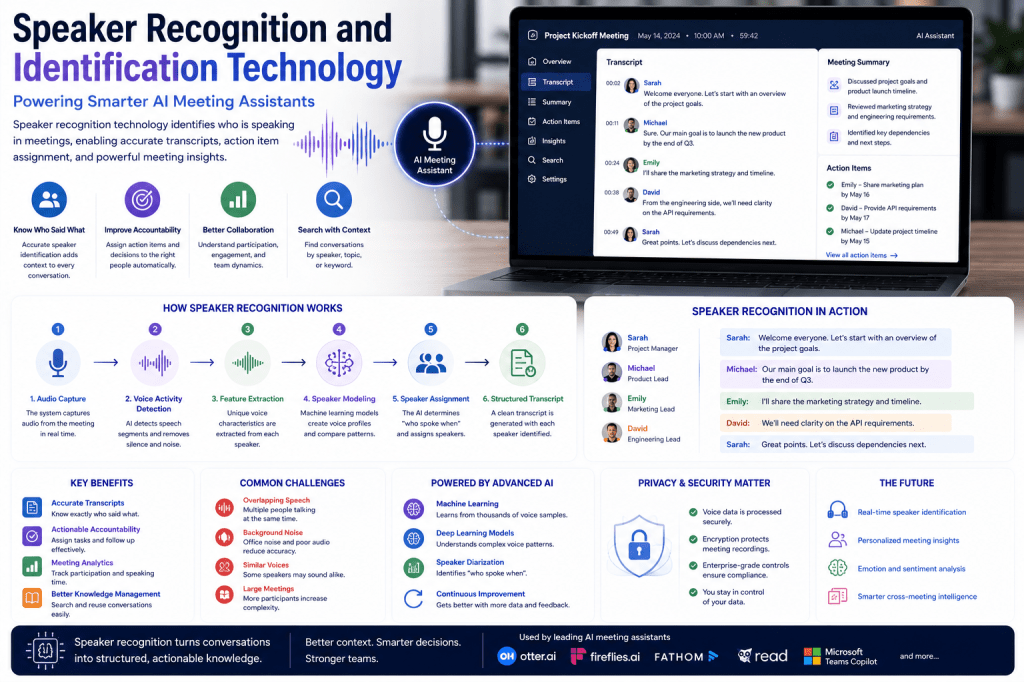
Sarah: We should launch next week.
Michael: Can marketing support that?
Jessica: Yes, we’ll prepare the campaign.
The conversation becomes much more valuable and actionable.
The Role of Multi-Speaker Detection in AI Meeting Assistants
Multi-speaker detection supports many AI meeting assistant features.
Speaker Attribution
Assigns statements to the correct participants.
Meeting Summaries
Provides context around who contributed specific ideas.
Action Item Assignment
Links tasks to responsible individuals.
Meeting Analytics
Tracks participation and engagement.
Searchable Knowledge Bases
Allows users to search conversations by speaker.
Compliance and Documentation
Creates accurate records of discussions and decisions.
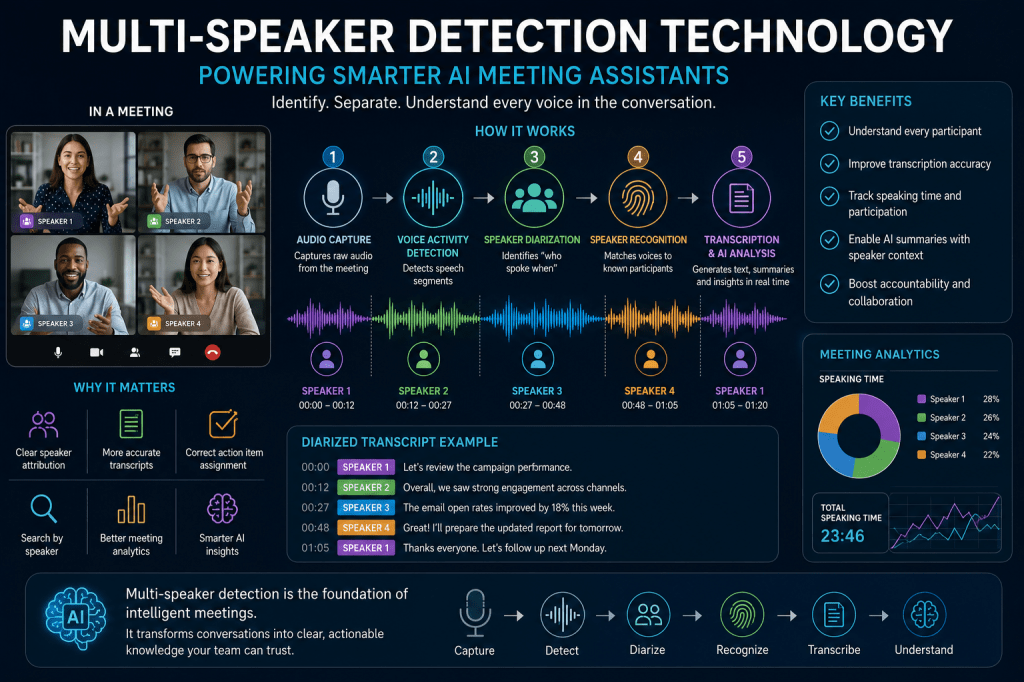
How Multi-Speaker Detection Works
Modern AI meeting assistants use several technologies working together.
Step 1: Audio Capture
The system records audio from:
- Video meetings
- Conference rooms
- Microphones
- Headsets
- Uploaded recordings
The audio contains overlapping voices, pauses, and environmental sounds.
Step 2: Audio Segmentation
The AI divides the audio into smaller segments.
Each segment represents a potential speech event.
The goal is to identify:
- Speech regions
- Silent periods
- Speaker transitions
This prepares the audio for deeper analysis.
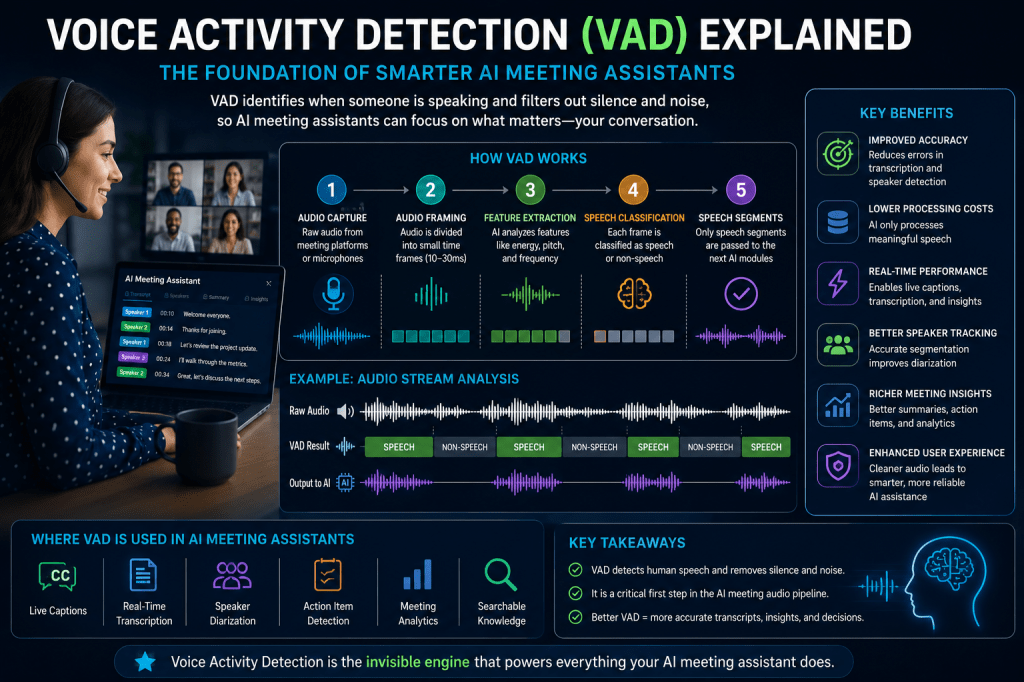
Step 3: Voice Activity Detection
Voice Activity Detection (VAD) identifies when speech is present.
The system distinguishes:
- Human speech
- Silence
- Background noise
Only speech segments move to the next processing stage.
This reduces computational requirements and improves accuracy.
Step 4: Feature Extraction
AI models analyze unique voice characteristics.
Common features include:
Pitch
The perceived frequency of speech.
Timbre
The distinctive quality of a voice.
Spectral Features
Frequency patterns unique to individuals.
Speaking Style
Pacing, pronunciation, and rhythm.
Together these characteristics create a voice profile.
Step 5: Speaker Change Detection
The system identifies moments when one speaker stops and another begins.
For example:
Speaker A speaks for 20 seconds.
A transition occurs.
Speaker B begins speaking.
The AI marks these boundaries automatically.
Accurate speaker change detection is critical for transcript readability.
Speaker Diarization
One of the most important technologies in multi-speaker detection is speaker diarization.
Speaker diarization answers the question:
“Who spoke when?”
The process involves:
- Detecting speech segments
- Grouping speech by speaker
- Labeling each speaker
- Tracking speaker transitions
Most modern AI meeting assistants rely heavily on diarization technology.
A diarized transcript might appear as:
Speaker 1: Welcome everyone.
Speaker 2: Thanks for joining.
Speaker 1: Let’s begin the review.
Even without names, the conversation becomes significantly more useful.
Speaker Recognition vs Multi-Speaker Detection
Although related, these technologies serve different purposes.
Multi-Speaker Detection
Determines:
- Number of speakers
- Speaker transitions
- Speech segments
Speaker Recognition
Determines:
- Speaker identity
- Known participants
- Voice matching
Detection answers:
“How many speakers are there?”
Recognition answers:
“Who are they?”
Many AI meeting assistants combine both technologies.
Handling Overlapping Speech
One of the biggest challenges in meeting analysis is overlapping conversation.
Examples include:
- Interruptions
- Simultaneous responses
- Group discussions
- Fast-paced debates
Traditional transcription systems often struggle with overlapping speech.
Modern AI systems use:
Source Separation
Separates multiple voices into individual audio streams.
Deep Learning Models
Identify individual speakers despite simultaneous speech.
Neural Audio Processing
Improves separation accuracy in complex environments.
These advances have dramatically improved meeting transcription quality.
Machine Learning in Multi-Speaker Detection
Modern systems use machine learning to identify patterns in speech.
Training datasets contain:
- Thousands of speakers
- Multiple languages
- Various accents
- Different recording environments
Machine learning models learn:
- Voice distinctions
- Speaker transitions
- Speech behaviors
- Conversational dynamics
The more diverse the training data, the more accurate the detection system becomes.
Deep Learning Approaches
Many AI meeting assistants rely on deep learning architectures.
Convolutional Neural Networks (CNNs)
Identify patterns in audio signals.
Recurrent Neural Networks (RNNs)
Analyze speech sequences over time.
Transformer Models
Capture long-range relationships in conversations.
Speaker Embedding Models
Create mathematical representations of individual voices.
These technologies allow systems to distinguish speakers with impressive accuracy.
Challenges in Multi-Speaker Detection
Despite major advances, several challenges remain.
Similar Voices
Participants with similar voice characteristics can confuse models.
Poor Audio Quality
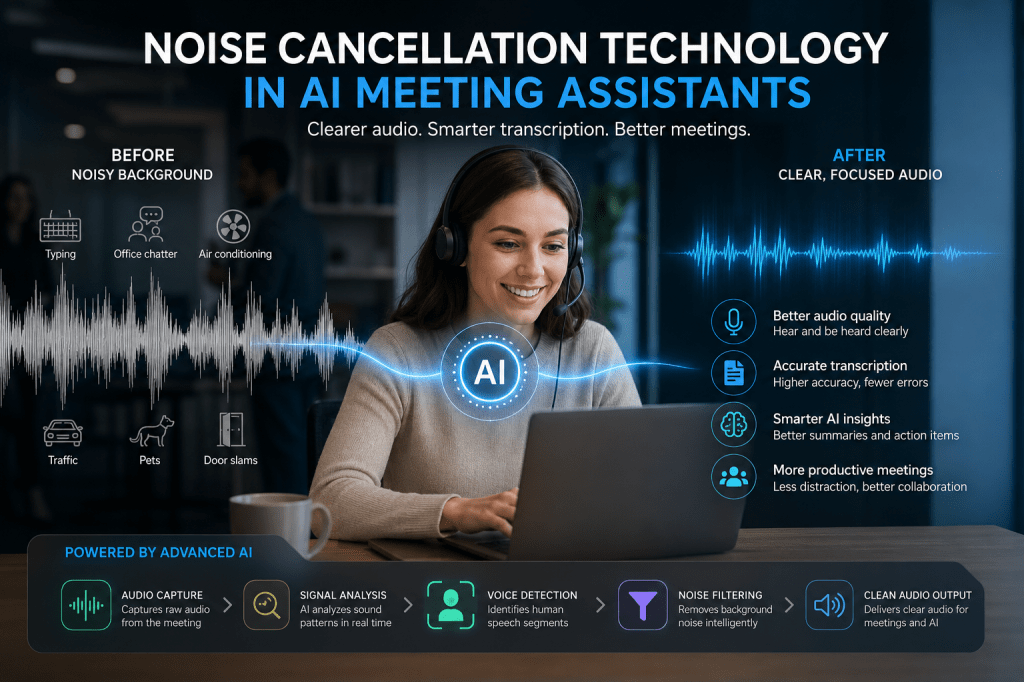
Low-quality microphones reduce accuracy.
Background Noise
Noise can interfere with speaker separation.
Multiple Languages
Language switching creates additional complexity.
Hybrid Meetings
Combining in-room and remote participants introduces acoustic challenges.
AI vendors continuously refine models to address these issues.
Benefits for AI Meeting Assistants
Accurate multi-speaker detection improves nearly every meeting assistant feature.
Better Transcripts
Conversations become easier to read and understand.
Improved Summaries
AI understands who contributed ideas.
Accurate Action Items
Tasks are assigned correctly.
Enhanced Analytics
Organizations gain participation insights.
Stronger Knowledge Management
Meeting records become more searchable and useful.
Improved Collaboration
Participants gain greater visibility into discussions and decisions.
Multi-Speaker Detection and Meeting Analytics
Many AI meeting assistants provide participation analytics.
Metrics may include:
- Speaking time by participant
- Participation rates
- Conversation balance
- Engagement trends
- Team communication patterns
These insights depend entirely on accurate speaker detection.
Without speaker separation, participation analytics would be impossible.
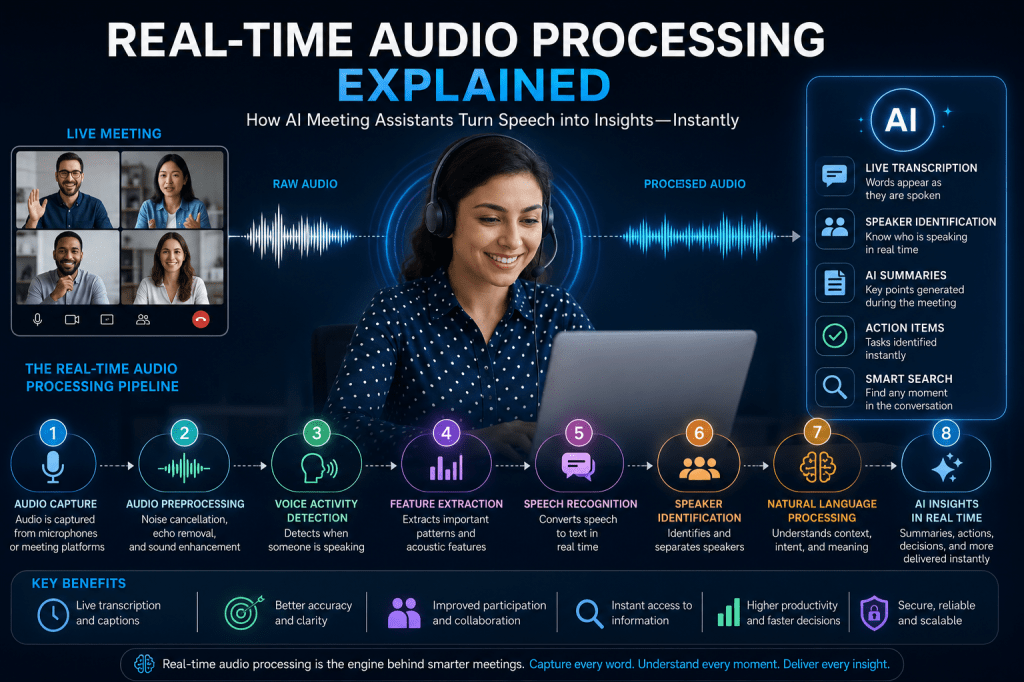
Real-Time Multi-Speaker Detection
Modern meeting assistants increasingly perform speaker detection during live meetings.
Benefits include:
- Real-time captions
- Live speaker labels
- Instant meeting summaries
- Immediate action item tracking
Real-time processing creates more interactive and valuable meeting experiences.
Future of Multi-Speaker Detection
Several innovations are expected to improve speaker analysis further.
Personalized Voice Profiles
AI learns individual team members over time.
Better Overlap Handling
Improved separation of simultaneous speech.
Multilingual Speaker Tracking
Enhanced support for global teams.
Video and Audio Fusion
Combining facial recognition with voice analysis.
Emotion and Intent Recognition
Understanding not only who spoke, but how they communicated.
These developments will make AI meeting assistants even more intelligent and context-aware.
Conclusion
Multi-speaker detection technology is one of the most important foundations of modern AI meeting assistants. By identifying speaker changes, separating voices, and tracking participants throughout conversations, these systems create structured, searchable, and highly valuable meeting records.
Combined with speaker diarization, machine learning, speech recognition, and natural language processing, multi-speaker detection enables accurate transcripts, better meeting summaries, stronger analytics, and more reliable action item tracking.
As AI meeting assistants continue to evolve, multi-speaker detection will remain a critical capability that transforms raw conversations into actionable organizational knowledge.

 Meeting Notes AI