Introduction
The quality of a meeting depends heavily on the quality of its audio. Even the most advanced AI meeting assistant cannot generate accurate transcripts, summaries, action items, and meeting insights if participants are difficult to hear.
In modern workplaces, meetings often take place across home offices, conference rooms, coworking spaces, airports, and remote locations. Background noise, poor microphones, echoes, and unstable connections can all negatively affect audio quality.
To solve these challenges, AI meeting assistants rely on Audio Enhancement Technology.
Audio enhancement technology uses artificial intelligence, machine learning, and advanced signal processing techniques to improve speech clarity before audio is transcribed and analyzed. It helps ensure that conversations are easier for both humans and AI systems to understand.
This guide explains how audio enhancement works and why it has become a critical component of modern AI meeting assistants.
What Is Audio Enhancement Technology?
Audio enhancement technology refers to a collection of techniques that improve the quality, clarity, and intelligibility of audio recordings and live conversations.
The goal is simple:
Make speech easier to hear and easier for AI systems to process.
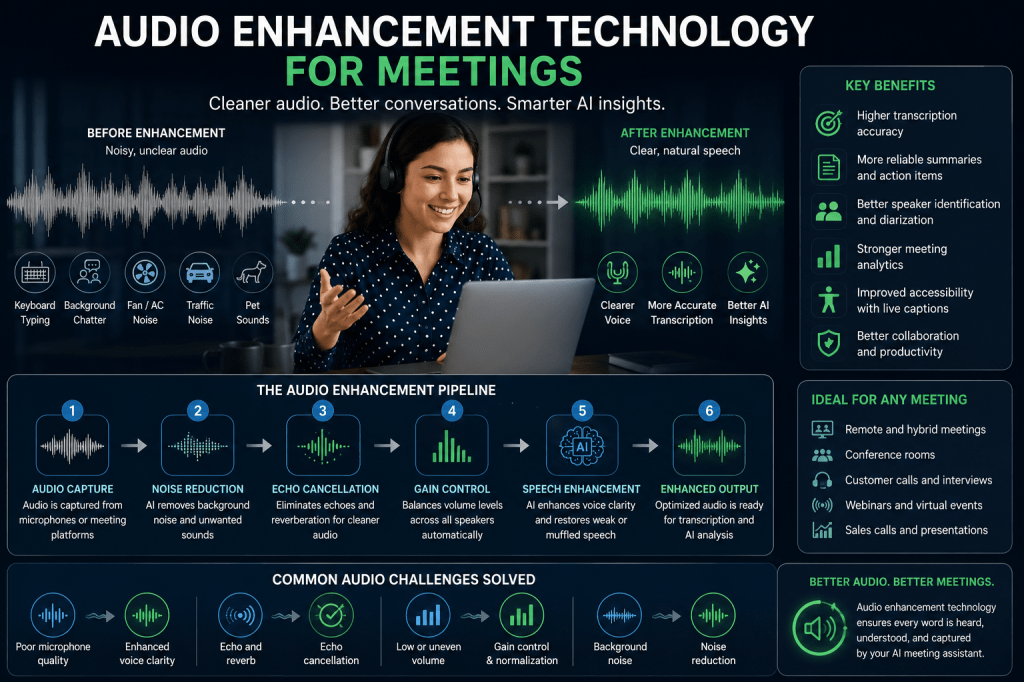
Audio enhancement systems work by:
- Removing unwanted sounds
- Improving voice clarity
- Reducing distortion
- Balancing audio levels
- Enhancing speech signals
- Optimizing recordings for transcription
The result is cleaner, more understandable audio.
Why Audio Quality Matters in AI Meeting Assistants
AI meeting assistants depend on audio as their primary source of information.
Poor audio quality can create:
Transcription Errors
Speech recognition systems struggle when speech is unclear.
Inaccurate Summaries
Misheard words affect AI-generated summaries.
Missed Action Items
Tasks may be incorrectly identified or omitted.
Poor Speaker Identification
Voice separation becomes more difficult.
Reduced User Trust
Users lose confidence when transcripts contain frequent errors.
Audio enhancement directly improves the performance of every downstream AI capability.
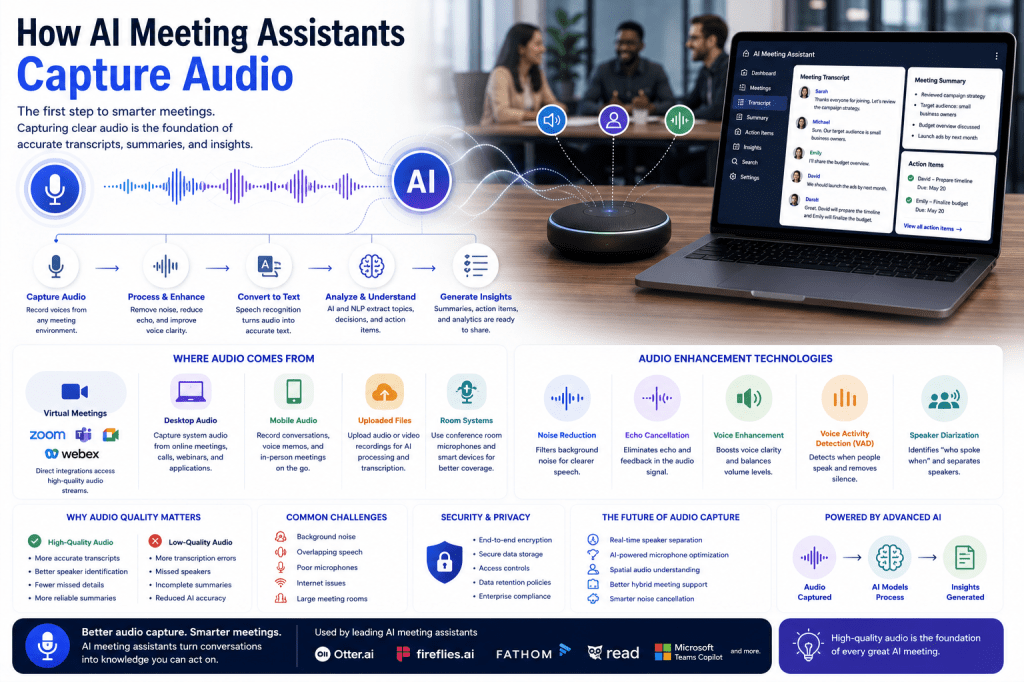
The Audio Enhancement Pipeline
Most AI meeting assistants use a multi-stage audio enhancement process.
Step 1: Audio Capture
The system captures audio from:
- Meeting platforms
- Headsets
- Microphones
- Conference room systems
- Uploaded recordings
The raw audio often contains noise and distortions.
Step 2: Signal Analysis
The audio stream is analyzed to identify:
- Speech
- Background noise
- Echoes
- Audio artifacts
- Speaker characteristics
AI models evaluate audio quality in real time.
Step 3: Enhancement Processing
Multiple enhancement techniques are applied simultaneously.
Step 4: Optimized Output
The enhanced audio is sent to:
- Speech recognition systems
- Speaker identification engines
- AI meeting intelligence platforms
This creates a much stronger foundation for accurate meeting analysis.
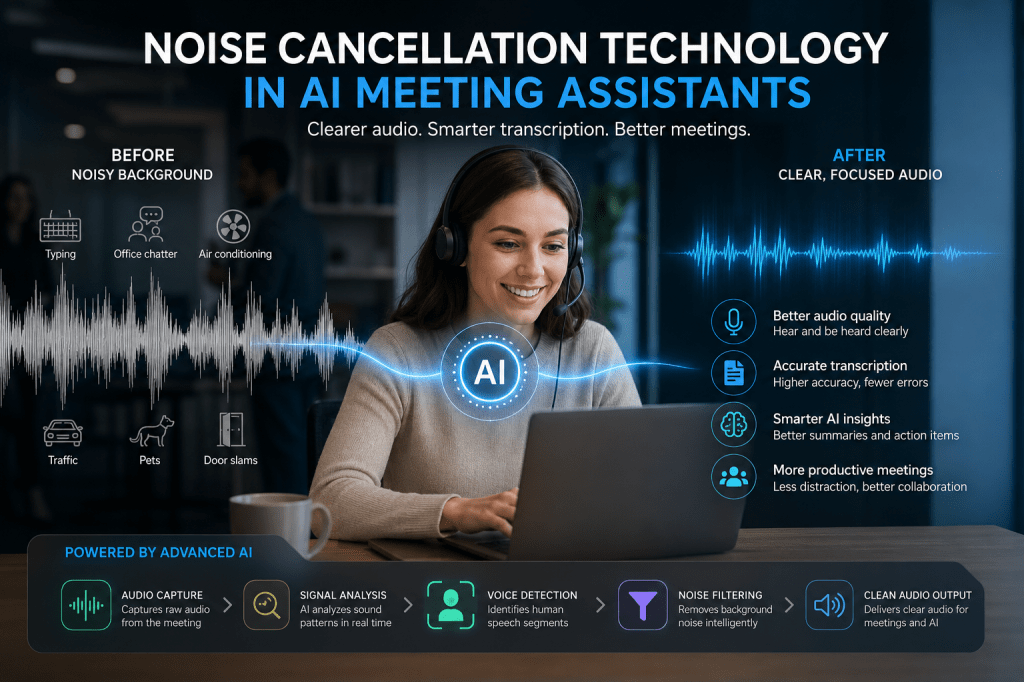
Noise Reduction Technology
One of the most important audio enhancement techniques is noise reduction.
Noise reduction removes sounds that interfere with speech.
Examples include:
- Keyboard typing
- Mouse clicks
- Air conditioning
- Office chatter
- Traffic sounds
- Construction noise
- Pet noises
Modern AI systems use machine learning models trained to distinguish speech from environmental sounds.
The result is significantly cleaner audio.
Noise Cancellation vs Audio Enhancement
Although related, these technologies are not identical.
Noise Cancellation
Focuses on removing unwanted sounds.
Audio Enhancement
Focuses on improving overall speech quality.
Audio enhancement may include:
- Noise reduction
- Voice boosting
- Echo cancellation
- Volume normalization
- Speech reconstruction
Noise cancellation is often one component of a larger enhancement system.
Speech Enhancement Technology
Speech enhancement specifically focuses on improving human voices.
The AI system attempts to:
- Increase speech clarity
- Improve intelligibility
- Reduce muffled audio
- Restore weak signals
Speech enhancement is particularly useful when:
- Participants use low-quality microphones
- Speakers are far from microphones
- Recordings are captured in noisy environments
Many modern AI meeting assistants apply speech enhancement automatically.
Echo Cancellation
Echoes are common in:
- Conference rooms
- Speakerphone calls
- Large meeting spaces
Echo cancellation removes reflected audio signals that can confuse both participants and AI systems.
Benefits include:
- Improved conversation flow
- Better transcription accuracy
- Reduced listener fatigue
Echo cancellation has become a standard feature in enterprise meeting platforms.
Automatic Gain Control
Not all participants speak at the same volume.
Some speakers are naturally quiet.
Others speak loudly.
Automatic Gain Control (AGC) balances audio levels across participants.
Benefits include:
- More consistent recordings
- Improved speech recognition
- Better meeting experiences
AGC helps ensure that every participant can be heard clearly.
Voice Activity Detection and Enhancement
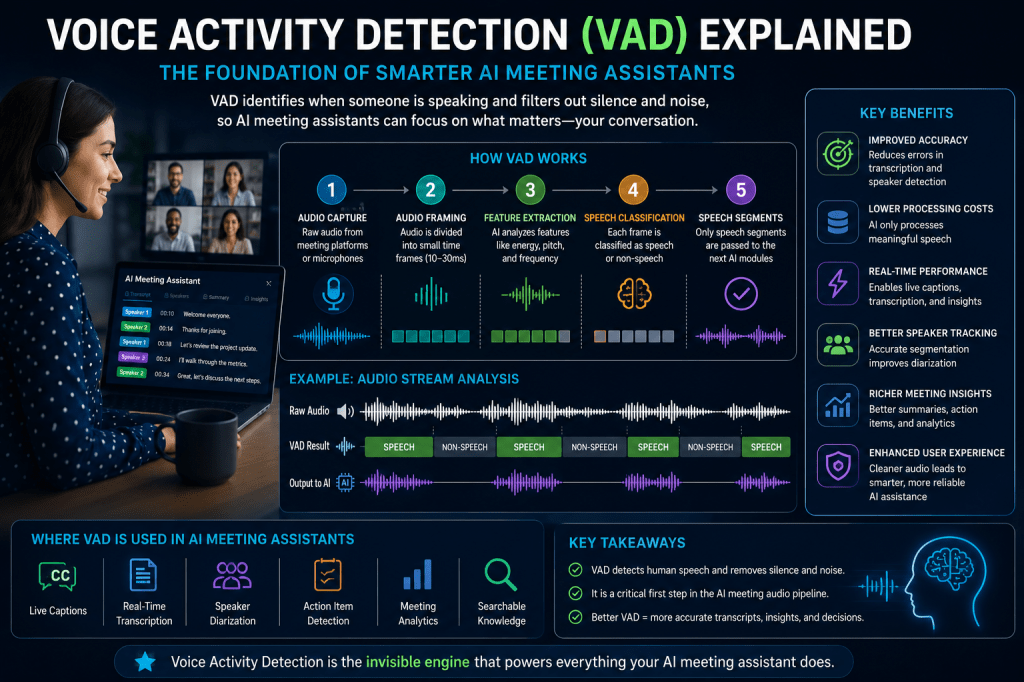
Voice Activity Detection (VAD) works closely with audio enhancement systems.
VAD identifies:
- Speech segments
- Silence
- Non-speech audio
The enhancement engine can then focus processing power on actual speech rather than background sounds.
This improves both efficiency and accuracy.
Machine Learning in Audio Enhancement
Traditional audio processing relied on static filters.
Modern AI meeting assistants use machine learning.
These systems learn from:
- Millions of speech samples
- Different accents
- Various environments
- Diverse microphones
- Multiple languages
Machine learning allows enhancement systems to adapt dynamically to changing meeting conditions.
Deep Learning Audio Models
Advanced meeting assistants often use deep neural networks.
Common approaches include:
Convolutional Neural Networks (CNNs)
Identify patterns within audio signals.
Recurrent Neural Networks (RNNs)
Analyze speech sequences over time.
Transformer Models
Understand long-range audio relationships.
Speech Separation Networks
Separate speech from noise and overlapping voices.
These models deliver far better results than traditional audio filters.
Real-Time Audio Enhancement
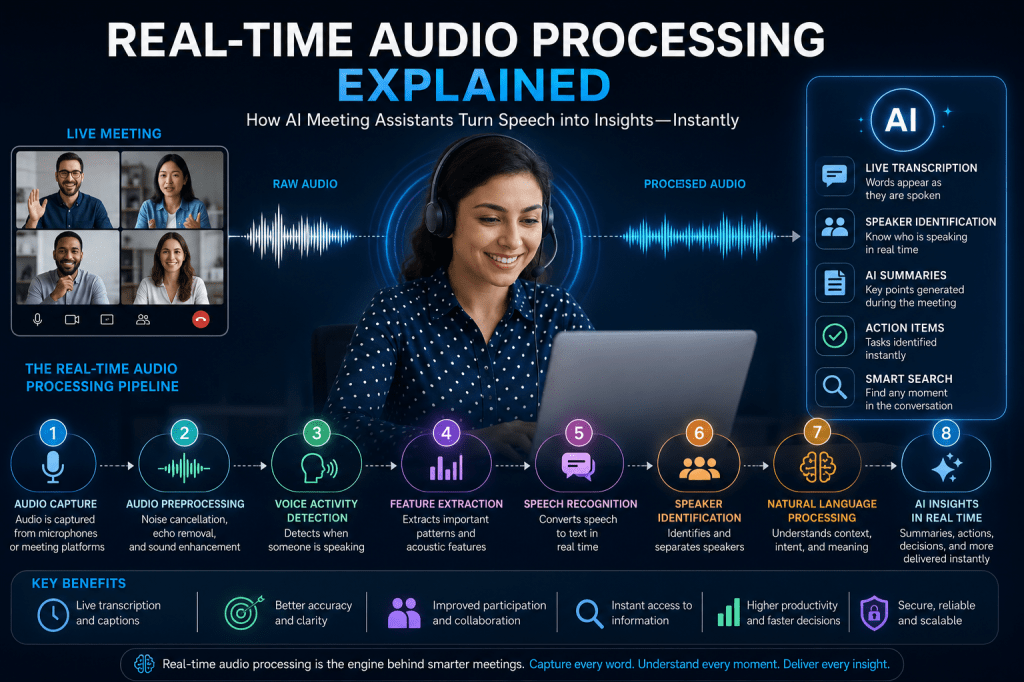
Most AI meeting assistants perform enhancement while meetings are taking place.
Benefits include:
Better Live Captions
Speech becomes easier to recognize instantly.
Improved Participant Experience
Participants hear cleaner audio.
More Accurate Real-Time Transcripts
AI receives higher-quality speech input.
Enhanced Accessibility
Live captions become more reliable.
Real-time enhancement is essential for modern meeting experiences.
Audio Enhancement and Speaker Identification
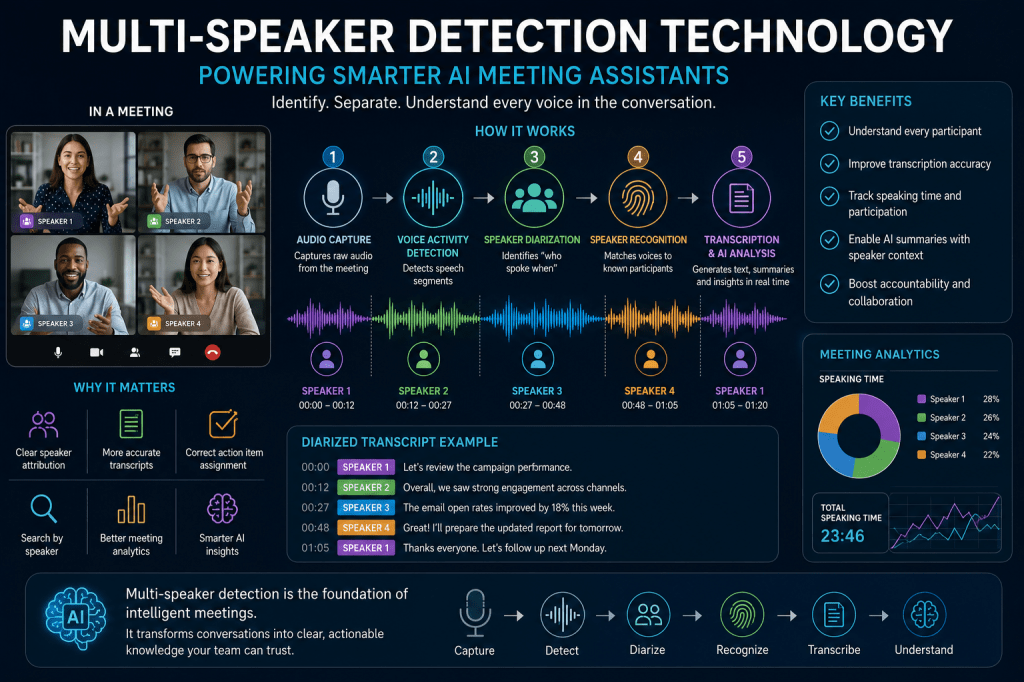
Speaker identification systems rely on voice characteristics.
Poor audio quality makes it harder to distinguish participants.
Audio enhancement improves:
- Voice clarity
- Speaker separation
- Speaker diarization accuracy
- Speaker attribution
This leads to better meeting records and analytics.
Audio Enhancement and AI Summaries
Meeting summaries depend on transcript quality.
The relationship is straightforward:
Enhanced Audio → Better Transcripts → Better Summaries
Improved audio quality helps AI systems:
- Understand context
- Detect decisions
- Identify action items
- Generate accurate insights
The quality of the final summary often begins with audio enhancement.
Hybrid Meetings and Audio Challenges
Hybrid meetings present unique audio difficulties.
Common issues include:
- Multiple microphones
- Room acoustics
- Remote participants
- Variable audio quality
Audio enhancement systems help create consistency across all participants regardless of location.
This improves collaboration and meeting outcomes.
Common Audio Problems Solved by Enhancement Technology
| Problem | Enhancement Solution |
|---|---|
| Background Noise | Noise Reduction |
| Echoes | Echo Cancellation |
| Quiet Speakers | Gain Control |
| Muffled Speech | Speech Enhancement |
| Uneven Volume | Audio Normalization |
| Overlapping Voices | Source Separation |
| Poor Recording Quality | AI Speech Reconstruction |
These technologies work together to improve meeting quality.
Benefits of Audio Enhancement in AI Meeting Assistants
Organizations gain several advantages.
Higher Transcription Accuracy
Cleaner audio improves speech recognition.
Better Meeting Intelligence
AI receives more reliable information.
Improved Collaboration
Participants hear each other more clearly.
Reduced Meeting Fatigue
Less effort is required to follow conversations.
Better Accessibility
Captions and transcripts become more accurate.
Stronger Knowledge Management
Meeting records become more useful and searchable.
Future of Audio Enhancement Technology
Several innovations are expected to shape future meeting platforms.
Personalized Audio Models
Systems learn individual voices.
Generative Speech Reconstruction
AI rebuilds speech from poor recordings.
Advanced Source Separation
Better handling of overlapping speakers.
Context-Aware Enhancement
Systems adapt based on meeting environments.
Edge-Based Audio Processing
Improved privacy and lower latency.
These advancements will continue improving meeting quality and AI performance.
Conclusion
Audio enhancement technology is one of the most important building blocks of modern AI meeting assistants. By improving speech clarity, reducing noise, eliminating echoes, balancing audio levels, and optimizing recordings for transcription, audio enhancement systems enable more accurate meeting intelligence.
From speech recognition and speaker identification to summaries and action item extraction, nearly every AI meeting assistant feature benefits from cleaner audio. As remote and hybrid work continue to expand, audio enhancement technology will remain a critical driver of better communication, stronger collaboration, and more reliable AI-powered meeting experiences.

 Meeting Notes AI