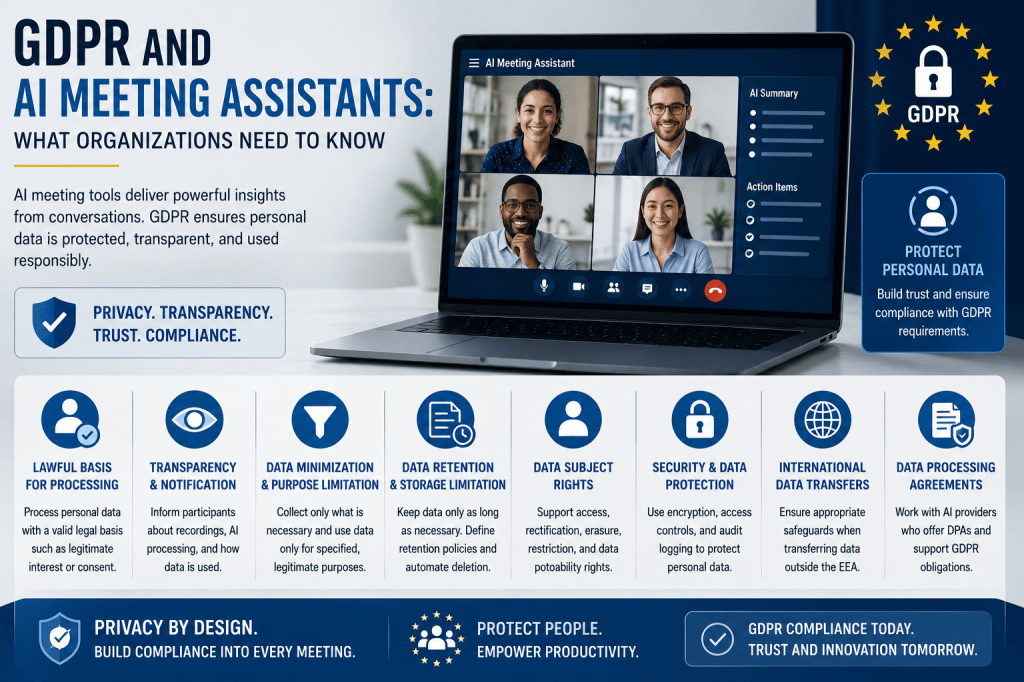
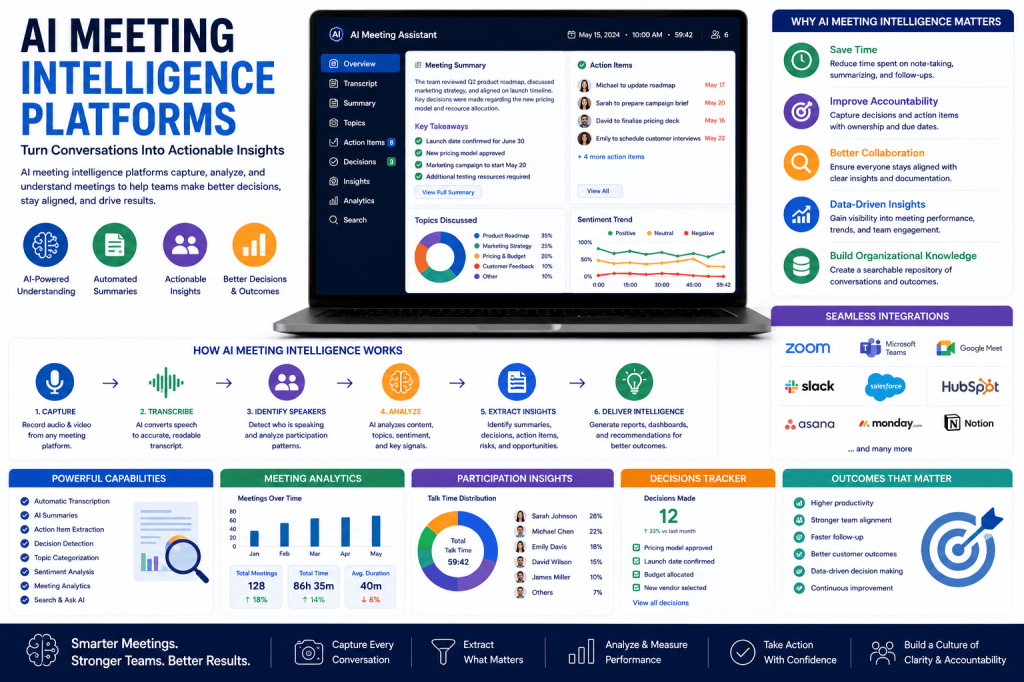
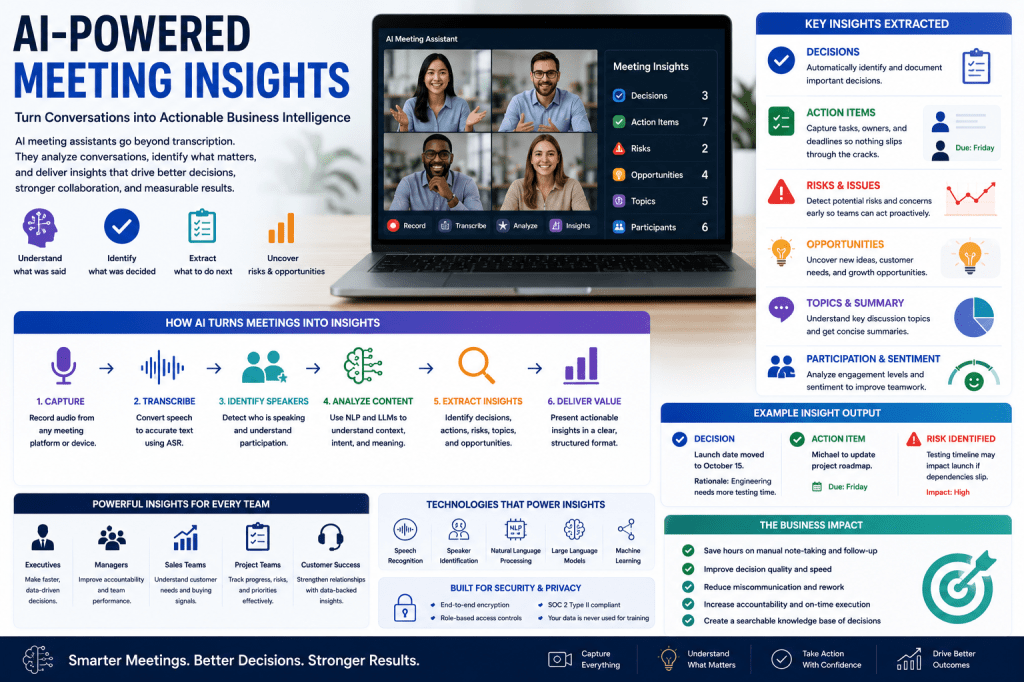
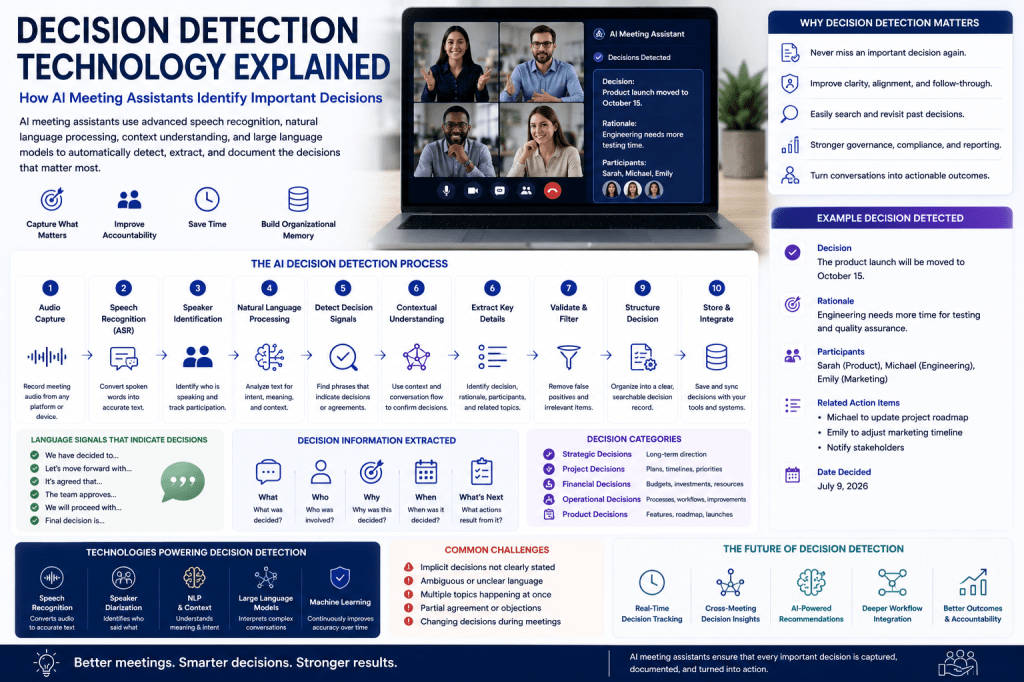
AI Meeting Assistants have rapidly become part of the modern workplace. They record meetings, generate transcripts, create summaries, identify action items, detect decisions, and provide valuable business insights. These capabilities help organizations improve productivity and capture organizational knowledge that might otherwise be lost.
However, AI Meeting Assistants also process significant amounts of personal information. Meeting recordings often contain employee conversations, customer discussions, names, email addresses, opinions, and other identifiable information. For organizations operating within the European Union or handling data belonging to EU residents, this raises important compliance considerations under the General Data Protection Regulation (GDPR).
Understanding how GDPR applies to AI Meeting Assistants is essential for organizations seeking to balance productivity, innovation, and privacy.
What Is GDPR?
The General Data Protection Regulation (GDPR) is one of the world’s most comprehensive privacy regulations.
Implemented by the European Union in 2018, GDPR governs how organizations collect, process, store, and protect personal data.
The regulation applies to:
- Organizations located in the European Union
- Organizations processing personal data of EU residents
- Cloud service providers
- Software vendors
- AI service providers
GDPR gives individuals greater control over their personal information while requiring organizations to implement stronger privacy protections.
Why GDPR Matters for AI Meeting Assistants
AI Meeting Assistants process a large amount of personal information during normal operation.
Examples include:
- Employee names
- Customer names
- Email addresses
- Voice recordings
- Video recordings
- Meeting transcripts
- Discussion content
- Action items
- Opinions and comments
- Behavioral analytics
Under GDPR, much of this information qualifies as personal data.
Because AI Meeting Assistants collect, analyze, and store this information, organizations must ensure that their use of these platforms complies with GDPR requirements.
What Counts as Personal Data?
GDPR defines personal data broadly.
Personal data includes any information that can directly or indirectly identify an individual.
Examples commonly found in meetings include:
- Names
- Job titles
- Phone numbers
- Email addresses
- Voice recordings
- Video recordings
- Employee identifiers
- Customer account information
- Personal opinions
- Performance discussions
Even meeting transcripts may contain extensive personal information.
As a result, most AI Meeting Assistant deployments involve GDPR-regulated data.
Roles Under GDPR
GDPR distinguishes between two important roles.
Data Controller
The organization using the AI Meeting Assistant is typically the Data Controller.
The controller determines:
- Why data is collected
- How data is used
- How long data is retained
Examples include:
- Companies
- Government agencies
- Educational institutions
- Healthcare organizations
Data Processor
The AI Meeting Assistant vendor often acts as the Data Processor.
The processor handles personal data on behalf of the controller.
Examples include:
- Meeting intelligence platforms
- Cloud service providers
- AI transcription services
Understanding these roles is critical because GDPR assigns responsibilities to both parties.
Lawful Basis for Processing Meeting Data
GDPR requires organizations to have a lawful basis for processing personal data.
Common lawful bases for AI Meeting Assistants include:
Legitimate Interest
Organizations may process meeting information when there is a legitimate business need.
Examples include:
- Documentation
- Knowledge management
- Productivity improvement
- Compliance requirements
Consent
In some situations, organizations may seek participant consent before recording meetings.
Consent must be:
- Freely given
- Specific
- Informed
- Revocable
Contractual Necessity
Meeting processing may be necessary to fulfill contractual obligations.
Organizations should consult legal counsel to determine the most appropriate lawful basis for their specific use cases.
Transparency Requirements
GDPR emphasizes transparency.
Individuals must understand:
- That meetings are being recorded
- Why data is being collected
- How information will be used
- How long data will be retained
- Who has access to the data
Organizations should clearly communicate these details through:
- Privacy notices
- Employee policies
- Meeting notifications
- Internal documentation
Transparency helps build trust and supports compliance.
Recording Notifications and Meeting Consent
One common GDPR consideration involves meeting recordings.
Participants should generally be informed when:
- Recording begins
- AI transcription is active
- Meeting analysis is being performed
Many meeting platforms provide automatic recording notifications.
Organizations should ensure participants are aware of:
- Recording status
- AI processing activities
- Data usage practices
In some jurisdictions or specific scenarios, explicit consent may be required.
Data Minimization
One of GDPR’s core principles is data minimization.
Organizations should only collect data that is necessary for a specific purpose.
Examples include:
- Recording only relevant meetings
- Avoiding unnecessary participant tracking
- Limiting stored metadata
- Removing obsolete information
Collecting less data reduces both privacy and security risks.
Purpose Limitation
GDPR requires organizations to use data only for its stated purpose.
For example:
If meeting data is collected to generate transcripts and summaries, it should not later be used for unrelated purposes without appropriate legal justification.
Organizations should clearly define:
- Why meeting data is collected
- How it will be processed
- Who may access it
Purpose limitation helps prevent misuse of personal information.
Data Retention and Storage Limitation
GDPR requires organizations to avoid retaining personal data longer than necessary.
AI Meeting Assistants often store:
- Recordings
- Transcripts
- Summaries
- Analytics
- Metadata
Organizations should establish clear retention policies.
Examples include:
- Delete recordings after 90 days
- Archive transcripts after one year
- Retain summaries for compliance purposes
Retention policies help reduce risk and support GDPR compliance.
Data Subject Rights
GDPR grants individuals several important rights.
Right of Access
Individuals can request access to their personal data.
Right to Rectification
Individuals can request correction of inaccurate information.
Right to Erasure
Also known as the “Right to Be Forgotten.”
Individuals may request deletion of personal data under certain circumstances.
Right to Restrict Processing
Individuals may request limitations on data processing.
Right to Data Portability
Individuals can request copies of their information in usable formats.
Organizations using AI Meeting Assistants should understand how these rights apply to meeting recordings and transcripts.
Security Requirements
GDPR requires organizations to implement appropriate security measures.
Common protections include:
Encryption
Protecting data in transit and at rest.
Access Controls
Limiting access to authorized users.
Multi-Factor Authentication
Strengthening account security.
Audit Logging
Tracking data access and administrative actions.
Data Isolation
Protecting customer environments from unauthorized access.
Security plays a central role in GDPR compliance.
Data Processing Agreements (DPAs)
When using third-party AI Meeting Assistants, organizations often need a Data Processing Agreement.
A DPA defines:
- Responsibilities of each party
- Data handling procedures
- Security requirements
- Compliance obligations
Most enterprise-grade meeting platforms provide DPAs for customers.
Organizations should review these agreements carefully.
International Data Transfers
Many AI Meeting Assistants operate using global cloud infrastructure.
GDPR places restrictions on transferring personal data outside the European Economic Area (EEA).
Organizations should evaluate:
- Data residency options
- Transfer mechanisms
- Vendor compliance measures
- Regional processing capabilities
Many vendors now offer EU-based data storage to support compliance requirements.
AI-Specific GDPR Considerations
AI Meeting Assistants introduce additional privacy considerations.
Organizations should understand:
Automated Processing
How AI systems analyze meeting content.
AI Summaries
How summaries are generated and stored.
Analytics
What behavioral insights are collected.
Model Training
Whether customer data is used to train AI models.
Many organizations prefer vendors that guarantee:
- Customer data isolation
- No training on customer content
- Private AI deployments
- Transparent AI policies
These controls reduce privacy concerns and support GDPR compliance.
Privacy by Design
GDPR encourages Privacy by Design principles.
This means privacy protections should be built into systems from the beginning rather than added later.
Examples include:
- Default encryption
- Access restrictions
- Retention controls
- Data minimization
- Audit capabilities
Many modern AI Meeting Assistants now incorporate Privacy by Design into their architecture.
Best Practices for GDPR Compliance
Organizations using AI Meeting Assistants should consider the following recommendations:
- Inform participants about recording and transcription activities.
- Define a lawful basis for processing.
- Establish retention policies.
- Enable encryption and access controls.
- Use Multi-Factor Authentication.
- Review vendor privacy practices.
- Sign Data Processing Agreements.
- Limit access to meeting information.
- Conduct privacy impact assessments when appropriate.
- Verify how AI-generated data is stored and processed.
These practices help reduce compliance risks while preserving the benefits of meeting intelligence.
The Future of GDPR and AI Meeting Intelligence
As AI capabilities continue to evolve, regulators are paying closer attention to how AI systems process personal information.
Future developments may include:
- Stronger AI transparency requirements
- Additional governance obligations
- Enhanced consent mechanisms
- AI-specific privacy regulations
- Expanded auditing requirements
Organizations adopting AI Meeting Assistants today should build privacy and compliance considerations into their long-term strategies.
Conclusion
GDPR has significant implications for organizations using AI Meeting Assistants. Because these platforms process large amounts of personal information through recordings, transcripts, summaries, analytics, and AI-generated insights, compliance must be considered from the beginning.
By understanding lawful processing requirements, data subject rights, retention policies, security controls, international data transfer obligations, and Privacy by Design principles, organizations can leverage AI-powered meeting intelligence while respecting privacy and maintaining compliance.
The most successful AI Meeting Assistant deployments will be those that combine powerful productivity features with strong privacy protections and responsible data governance.



 Meeting Notes AI