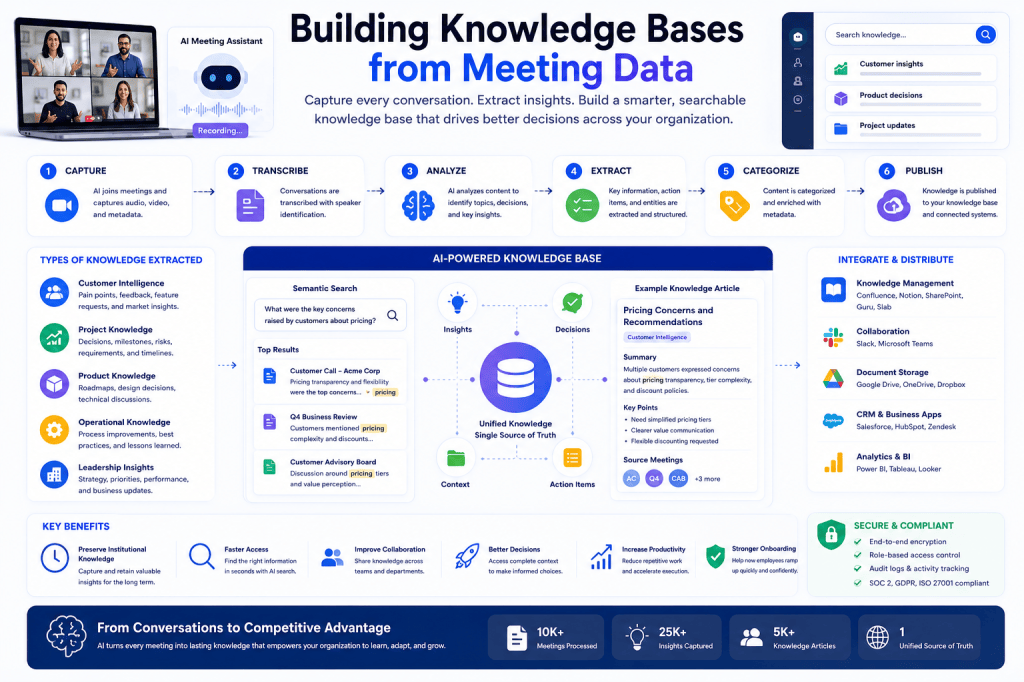
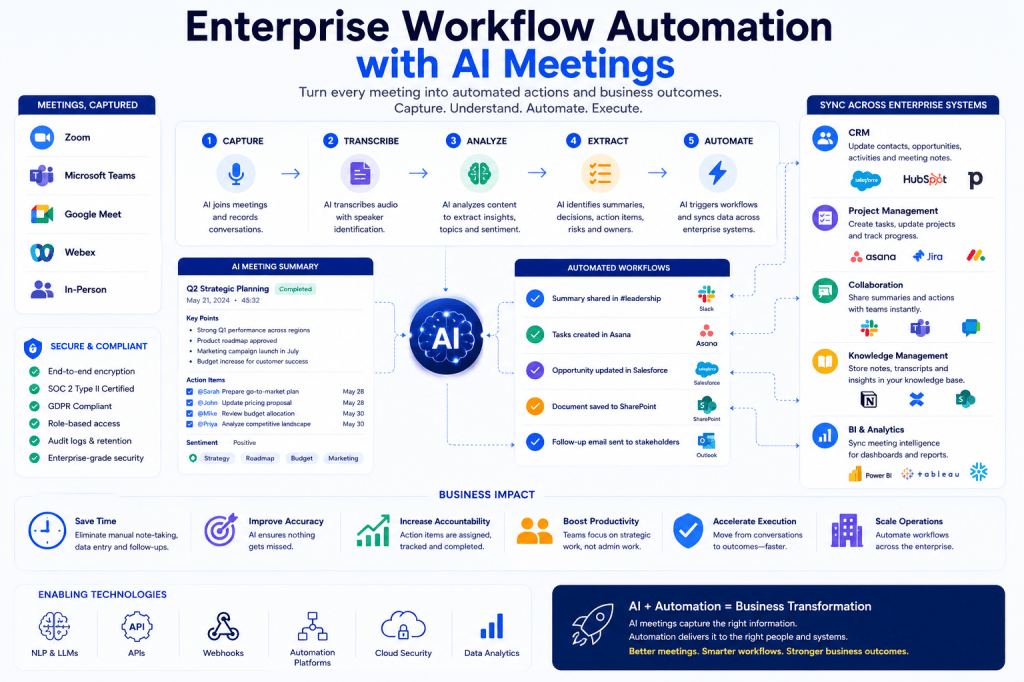
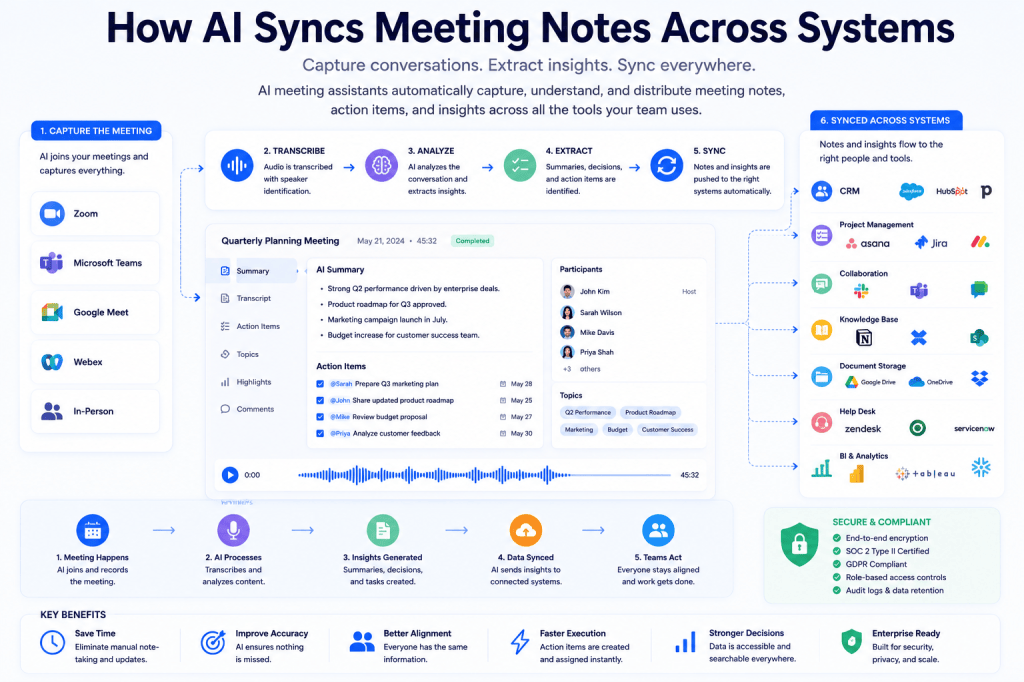
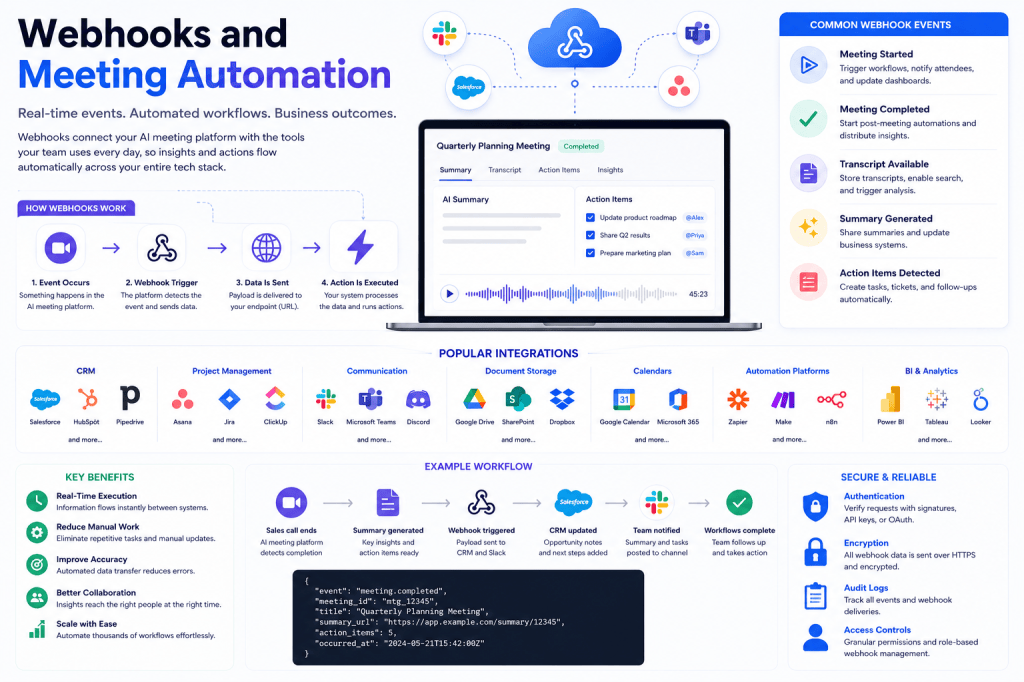
One of the most valuable capabilities of modern AI meeting assistants is their ability to automatically identify action items during and after meetings. Instead of relying on manual note-taking, participants can receive a structured list of tasks, responsibilities, deadlines, and follow-up actions generated directly from meeting conversations.
For many organizations, action item detection delivers even more value than transcription itself. While transcripts document what was said, action items help teams understand what needs to happen next. This transforms meetings from simple discussions into actionable workflows that improve accountability, execution, and productivity.
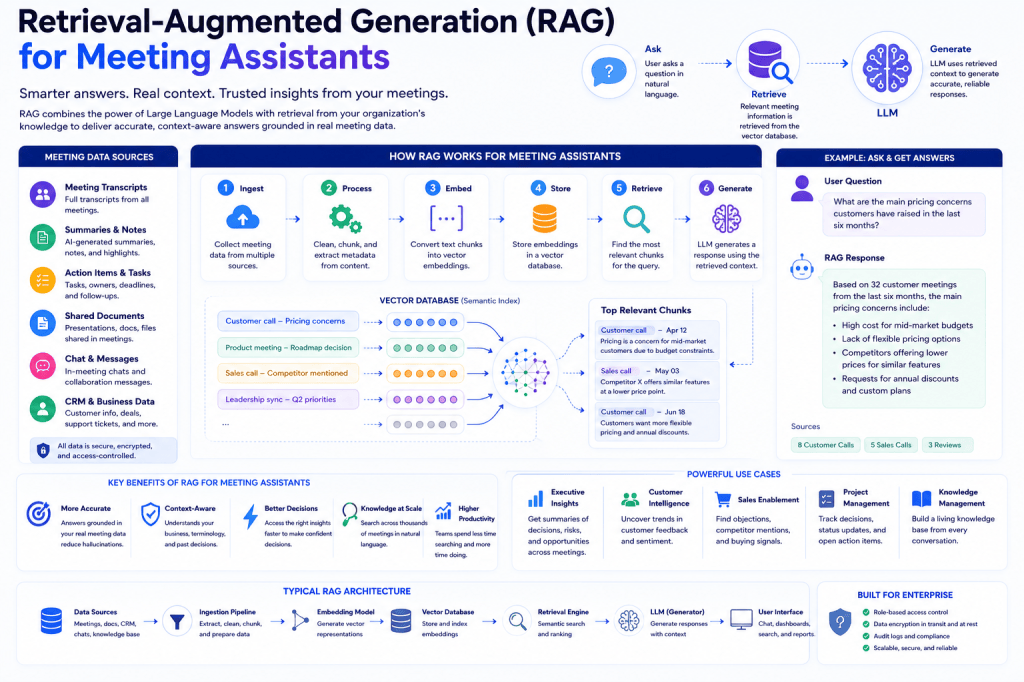
But how does AI actually recognize action items within a conversation? The answer involves a combination of speech recognition, natural language processing, large language models, contextual analysis, and meeting intelligence technologies.
What Are Action Items?
Action items are tasks, commitments, responsibilities, or follow-up activities that emerge during a meeting.
Examples include:
- Completing a report
- Scheduling a follow-up meeting
- Updating project documentation
- Contacting a customer
- Preparing a presentation
- Reviewing a proposal
- Delivering project updates
Action items typically answer three questions:
- What needs to be done?
- Who is responsible?
- When should it be completed?
AI meeting assistants attempt to identify all three components automatically.
Why Action Item Detection Matters
Many meetings produce valuable discussions but fail to generate clear follow-through.
Common problems include:
- Forgotten commitments
- Missed deadlines
- Unclear ownership
- Poor accountability
- Manual note-taking errors
AI-generated action items help solve these challenges by ensuring important tasks are captured and documented.
Benefits include:
- Improved productivity
- Better project execution
- Increased accountability
- Reduced administrative work
- Stronger team alignment
For many organizations, action item extraction is one of the primary reasons for adopting AI meeting assistants.
Step 1: Meeting Audio Capture
The process begins with capturing meeting audio.
Sources may include:
- Zoom meetings
- Microsoft Teams meetings
- Google Meet sessions
- Phone calls
- In-person meetings
- Hybrid meetings
The AI meeting assistant records the conversation and prepares it for analysis.
Step 2: Speech Recognition
The recorded audio is processed using Automatic Speech Recognition (ASR).
ASR converts spoken language into written text.
Example:
Spoken statement:
“Michael, can you update the roadmap by Friday?”
Transcription output:
Michael, can you update the roadmap by Friday?
Accurate transcription is critical because action item extraction depends on understanding the underlying conversation.
Step 3: Speaker Identification
Most action items require ownership.
AI meeting assistants use speaker diarization to determine:
- Who is speaking
- Who is being addressed
- When speakers change
Example:
Sarah: Michael, can you update the roadmap by Friday?
Michael: Yes, I’ll take care of it.
The system now understands both the request and the commitment.
Speaker identification significantly improves action item accuracy.
Step 4: Natural Language Processing (NLP)
Once the transcript is generated, Natural Language Processing analyzes the conversation.
NLP systems examine:
- Grammar
- Sentence structure
- Intent
- Meaning
- Context
The goal is to identify language patterns commonly associated with tasks and commitments.
For example, phrases such as:
- “I’ll handle that.”
- “Can you update the report?”
- “Let’s schedule a follow-up.”
- “We need to review this next week.”
often indicate potential action items.
Step 5: Detecting Task-Oriented Language
AI meeting assistants are trained to recognize specific linguistic patterns.
Common action-item signals include:
Direct Assignments
“Emily will prepare the presentation.”
Requests
“Can you send the proposal tomorrow?”
Commitments
“I’ll update the documentation.”
Group Decisions
“The team will review the findings next week.”
Follow-Up Statements
“Let’s revisit this during the next meeting.”
These signals help the AI identify candidate tasks.
Step 6: Identifying Responsibility
Detecting a task is only part of the challenge.
The AI must also determine who owns the task.
Examples:
Clear Ownership
Michael will update the roadmap.
Owner:
Michael
Assigned Request
Sarah, can you contact the customer?
Owner:
Sarah
Self-Assignment
I’ll create the dashboard.
Owner:
Current speaker
Modern AI meeting assistants use contextual analysis and speaker identification to infer ownership automatically.
Step 7: Detecting Deadlines
Deadlines often appear in natural language.
Examples include:
- By Friday
- Next week
- Before launch
- End of month
- Tomorrow morning
- Before the next meeting
The AI extracts these time references and associates them with tasks.
Example:
Michael will update the roadmap by Friday.
Output:
Task: Update roadmap
Owner: Michael
Due Date: Friday
This structured format improves accountability and follow-through.
Step 8: Contextual Understanding with Large Language Models
Traditional rule-based systems struggled to understand complex conversations.
Large language models have dramatically improved action item detection.
LLMs can interpret statements such as:
It would probably make sense to update the onboarding workflow before launch.
Although this sentence does not explicitly assign a task, modern AI may recognize it as a potential action item.
Large language models help:
- Understand intent
- Infer meaning
- Connect related statements
- Resolve ambiguities
This creates more accurate and useful action-item extraction.
Step 9: Filtering False Positives
Not every statement that sounds task-related should become an action item.
Consider:
We updated the roadmap last week.
This describes completed work rather than future action.
AI meeting assistants must distinguish between:
- Past actions
- Current status updates
- Suggestions
- Actual commitments
Filtering false positives is one of the most challenging aspects of meeting intelligence.
Step 10: Structuring Action Items
After identifying tasks, ownership, and deadlines, the AI organizes information into a structured format.
Example:
Action Item 1
Owner: Michael
Task: Update project roadmap
Due Date: Friday
Action Item 2
Owner: Emily
Task: Coordinate webinar planning
Due Date: Next week
This structured presentation makes action items easy to review and track.
How AI Meeting Assistants Improve Action Item Accuracy
Modern platforms use multiple technologies simultaneously.
Speaker Identification
Improves ownership detection.
Topic Detection
Provides additional context.
Entity Recognition
Identifies people, teams, products, and projects.
Large Language Models
Improve understanding of conversational intent.
Historical Context
Some systems analyze previous meetings to improve interpretation.
The combination of these technologies significantly improves action item quality.
Common Challenges in Action Item Detection
Despite major advances, AI systems still face limitations.
Ambiguous Language
Statements may be unclear.
Someone should look into that.
Who is responsible?
Unspoken Ownership
Tasks are sometimes implied rather than assigned.
Complex Discussions
Responsibilities may emerge gradually across multiple conversations.
Multiple Owners
Some tasks involve teams rather than individuals.
Vague Deadlines
Phrases such as “soon” are difficult to interpret.
These situations continue to challenge even the most advanced AI meeting assistants.
Integration with Productivity Tools
Many meeting assistants automatically synchronize action items with:
- Asana
- Trello
- Monday.com
- Jira
- Microsoft Planner
- ClickUp
- Notion
This eliminates manual task entry and streamlines workflow management.
Future systems will likely automate even more of this process.
The Future of Action Item Detection
Action item detection is evolving rapidly.
Future capabilities may include:
Real-Time Action Item Capture
Tasks identified instantly during meetings.
Predictive Task Suggestions
AI recommending next steps proactively.
Cross-Meeting Tracking
Following action items across multiple meetings.
Workflow Automation
Automatically creating tasks and assigning owners.
Personalized Task Management
Tailoring action items to individual work styles.
As meeting intelligence continues to advance, action item detection will become one of the most important components of workplace AI.
Conclusion
AI meeting assistants identify action items through a sophisticated process involving speech recognition, speaker identification, natural language processing, contextual analysis, and large language models. By analyzing conversations, detecting task-oriented language, identifying ownership, extracting deadlines, and organizing information into structured outputs, these systems help teams improve accountability and execution. Although challenges remain, advances in AI are making action item detection increasingly accurate and valuable. As workplace collaboration continues to evolve, automated action item extraction will play a central role in transforming meetings into productive, actionable outcomes.