For decades, meetings have generated enormous amounts of information, but much of that knowledge was lost once conversations ended. Traditional meeting notes often captured only a fraction of what was discussed, and teams frequently struggled to remember decisions, action items, risks, and opportunities.
AI-powered meeting insights are changing that reality. Modern AI meeting assistants no longer simply record and transcribe conversations. They analyze discussions, identify patterns, extract important information, and transform meetings into valuable sources of business intelligence.
By combining speech recognition, natural language processing, large language models, and meeting intelligence technologies, AI-powered meeting insights help organizations make better decisions, improve collaboration, and unlock the full value of their meeting data.
What Are AI-Powered Meeting Insights?
AI-powered meeting insights are automatically generated observations, recommendations, summaries, and analytics derived from meeting conversations.
Instead of presenting users with a raw transcript, AI meeting assistants extract meaningful information such as:
- Key discussion topics
- Decisions made
- Action items
- Risks and concerns
- Project updates
- Customer feedback
- Team sentiment
- Follow-up opportunities
- Meeting trends
The goal is to help organizations understand not just what was said, but what it means and what actions should be taken.
Why Meeting Insights Matter
Most organizations spend thousands of hours in meetings every year.
Without analysis, valuable information often remains buried within:
- Meeting recordings
- Transcripts
- Notes
- Chat messages
AI-powered insights help organizations:
- Improve decision-making
- Increase accountability
- Accelerate project execution
- Preserve organizational knowledge
- Identify risks earlier
- Improve customer understanding
Meeting insights transform conversations into actionable intelligence.
From Transcription to Intelligence
Meeting transcription is only the first step.
The evolution typically follows this progression:
Stage 1: Recording
Meetings are captured and stored.
Stage 2: Transcription
Speech is converted into text.
Stage 3: Summarization
Important information is condensed.
Stage 4: Insight Generation
AI identifies patterns, decisions, tasks, risks, and opportunities.
This final stage is where true meeting intelligence begins.
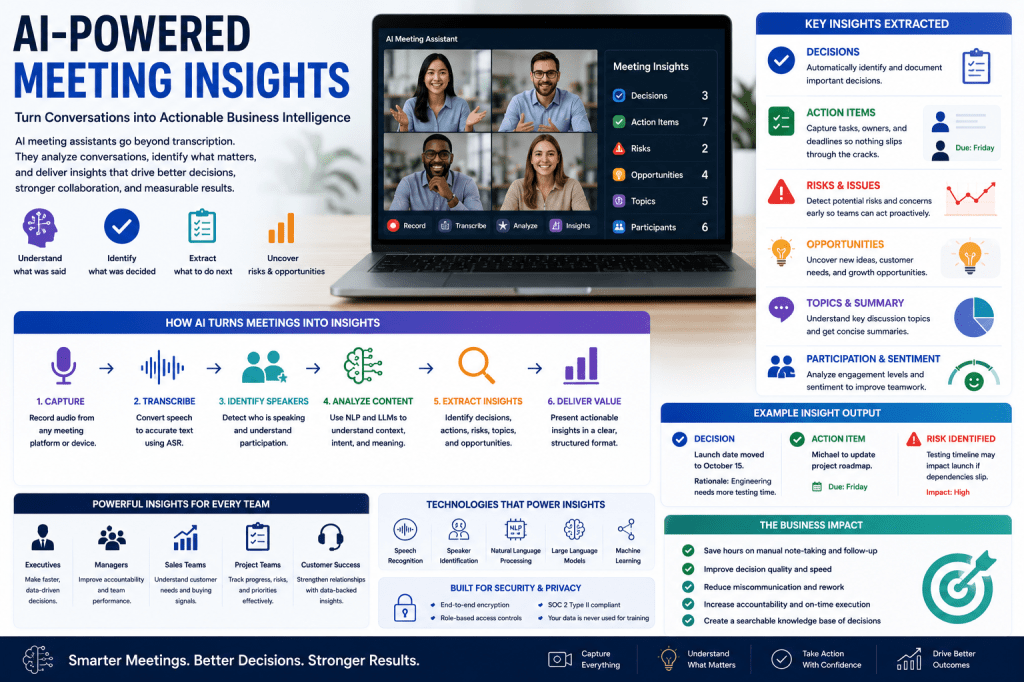
How AI Generates Meeting Insights
Modern AI meeting assistants use several technologies working together.
Audio Capture
The system records meeting conversations.
Speech Recognition
Automatic Speech Recognition converts speech into text.
Speaker Identification
AI determines who is speaking.
Natural Language Processing
NLP analyzes language structure and meaning.
Large Language Models
LLMs interpret context and generate insights.
Meeting Intelligence Engines
Specialized AI models identify business-relevant information.
The combination of these technologies enables advanced meeting analysis.
Key Types of AI-Powered Meeting Insights
1. Discussion Topic Detection
AI automatically identifies the major themes discussed during meetings.
Example:
Topics detected:
- Product launch planning
- Budget allocation
- Marketing strategy
- Customer onboarding
Topic detection helps participants quickly understand meeting focus areas.
2. Decision Insights
One of the most valuable capabilities involves identifying decisions.
Example:
Decision Detected:
The product launch date has been moved to October 15.
Rather than searching through an hour-long transcript, users immediately see important outcomes.
3. Action Item Insights
AI meeting assistants automatically identify tasks and commitments.
Example:
Action Item:
Michael will update the roadmap by Friday.
Insights may include:
- Task owner
- Due date
- Related project
- Priority level
This improves accountability and follow-through.
4. Risk Detection
Meetings often contain early warning signs.
AI systems can identify statements such as:
- Resource shortages
- Schedule concerns
- Technical challenges
- Budget risks
- Customer issues
Example:
Risk Identified:
Engineering team may not complete testing before launch.
Early visibility helps organizations respond proactively.
5. Opportunity Detection
Not all insights focus on problems.
AI may identify:
- Growth opportunities
- New ideas
- Customer requests
- Product improvements
- Strategic initiatives
Example:
Opportunity Identified:
Several customers requested integration with a new platform.
Organizations can use these insights to guide future planning.
6. Customer Intelligence
For sales and customer-facing teams, AI meeting assistants generate valuable customer insights.
Examples include:
Customer Goals
What outcomes are customers trying to achieve?
Pain Points
What problems are they experiencing?
Objections
What concerns are preventing progress?
Buying Signals
What indicates purchase intent?
Customer intelligence helps sales and customer success teams improve performance.
7. Team Alignment Insights
AI can identify whether participants appear aligned or disconnected.
Examples:
- Agreement levels
- Conflicting viewpoints
- Unresolved issues
- Open questions
Managers gain greater visibility into team dynamics and collaboration.
8. Sentiment Analysis
Some AI meeting assistants analyze emotional tone and sentiment.
Examples include:
- Positive sentiment
- Neutral sentiment
- Frustration
- Concern
- Enthusiasm
Sentiment insights help leaders better understand team engagement and customer reactions.
9. Participation Analytics
AI systems can measure meeting participation patterns.
Examples:
- Speaking time by participant
- Participation frequency
- Discussion dominance
- Contributor engagement
These insights help organizations improve meeting effectiveness and inclusivity.
10. Meeting Effectiveness Metrics
Advanced platforms evaluate meeting quality.
Examples include:
- Decision count
- Action item count
- Participant engagement
- Meeting duration
- Follow-up completion
Organizations can use these metrics to optimize meeting culture.
How Large Language Models Improve Meeting Insights
Large language models have dramatically expanded the quality of meeting intelligence.
Traditional systems relied on simple keyword matching.
Modern LLMs can:
- Understand context
- Infer meaning
- Connect ideas
- Recognize relationships
- Generate recommendations
For example:
Conversation:
Engineering needs more testing time.
LLM insight:
Potential Risk: Product launch schedule may be impacted by testing delays.
This contextual reasoning creates significantly more useful insights.
Real-Time Meeting Insights
The next generation of AI meeting assistants is moving toward real-time intelligence.
Future capabilities include:
Live Decision Detection
Decisions identified during meetings.
Real-Time Action Items
Tasks captured instantly.
Live Risk Alerts
Potential issues highlighted immediately.
Meeting Coaching
Suggestions for improving discussions.
Real-time insights could fundamentally change how meetings are conducted.
AI-Powered Insights and Organizational Knowledge
One of the greatest long-term benefits involves knowledge management.
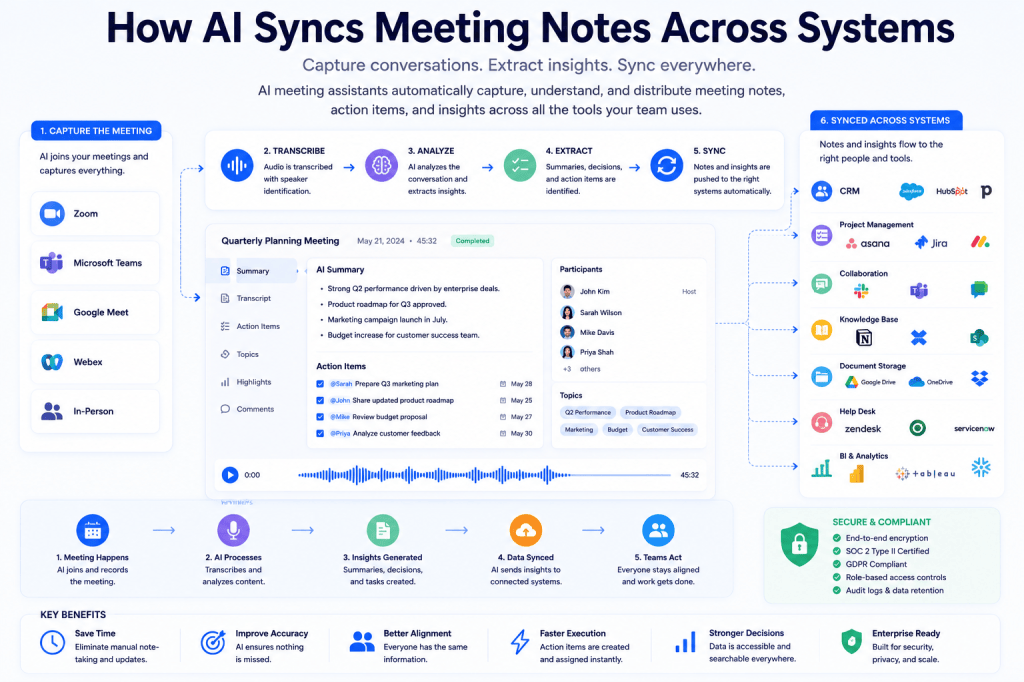
Meeting insights can be connected to:
- Project management platforms
- CRM systems
- Documentation repositories
- Knowledge bases
- Collaboration tools
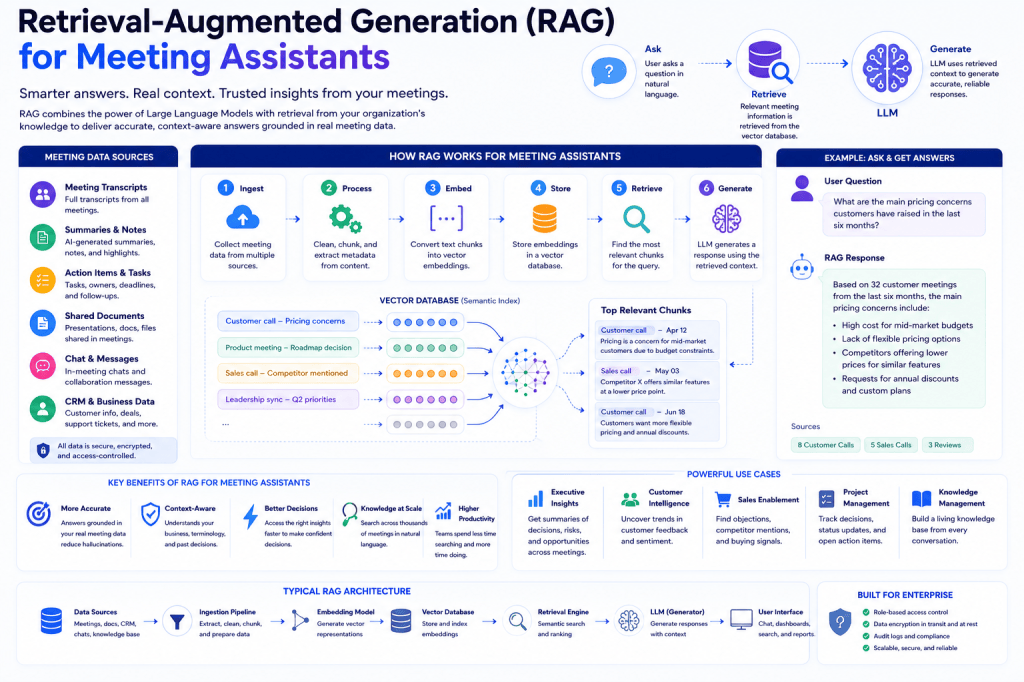
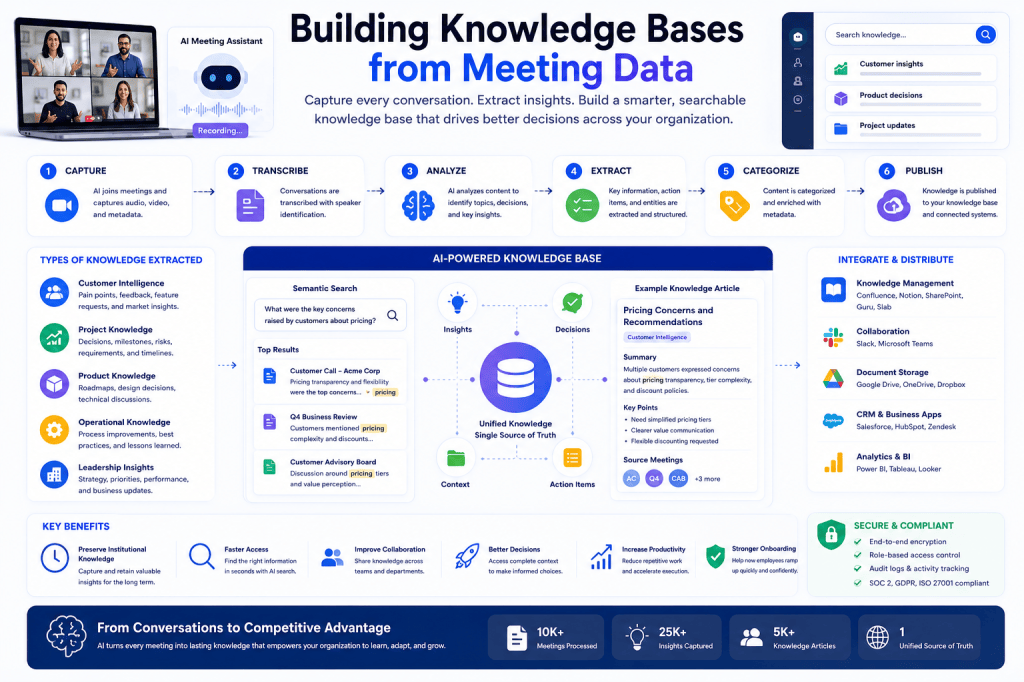
Organizations can build searchable repositories of institutional knowledge generated from meetings.
This helps preserve information even when employees leave or projects change.
Challenges and Limitations
Although AI-powered meeting insights are improving rapidly, challenges remain.
Context Ambiguity
Human conversations are often nuanced.
Incomplete Information
Not all decisions are clearly stated.
Industry Terminology
Specialized language can create interpretation difficulties.
Sentiment Accuracy
Emotional analysis remains imperfect.
Privacy Concerns
Organizations must carefully manage meeting data.
These limitations highlight the importance of human oversight.
The Future of AI-Powered Meeting Insights
The future of meeting intelligence is moving toward deeper understanding and automation.
Emerging capabilities include:
Predictive Insights
Identifying risks before they become problems.
Cross-Meeting Intelligence
Connecting information across multiple meetings.
Organizational Memory
Tracking decisions and commitments over time.
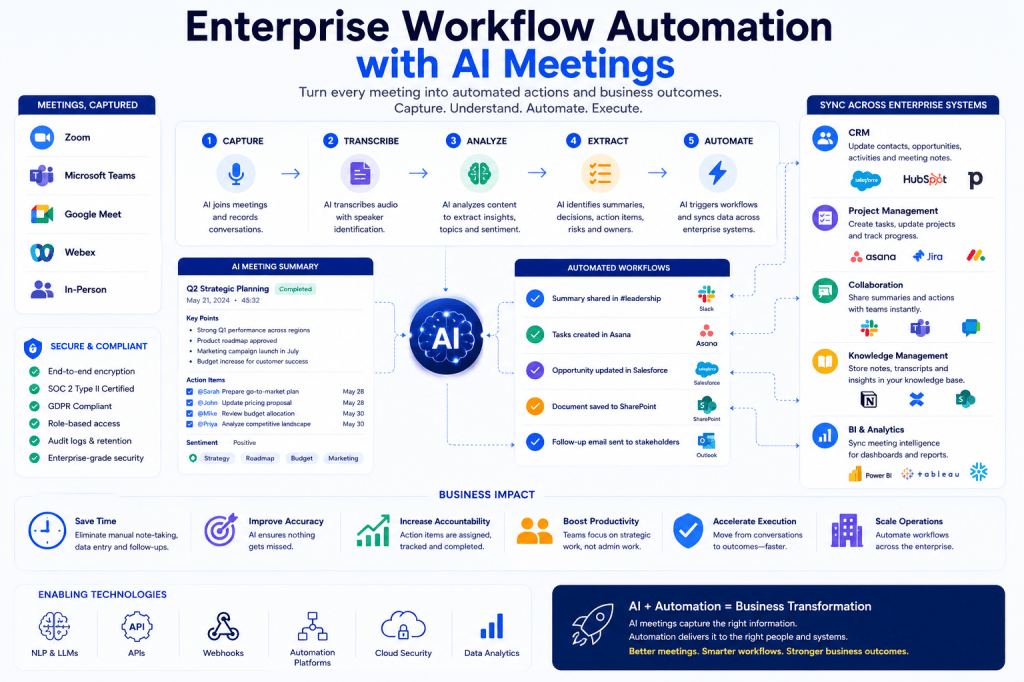
Workflow Automation
Automatically creating tasks and updating systems.
Personalized Insights
Different insights for executives, managers, and contributors.
Meeting assistants are evolving into intelligent business advisors rather than simple transcription tools.
Conclusion
AI-powered meeting insights represent the next evolution of workplace collaboration technology. By combining speech recognition, natural language processing, large language models, and meeting intelligence systems, AI meeting assistants can transform conversations into actionable business intelligence. These insights help organizations identify decisions, track action items, detect risks, uncover opportunities, improve customer understanding, and strengthen team collaboration. As artificial intelligence continues to advance, AI-powered meeting insights will become an increasingly important tool for improving productivity, preserving organizational knowledge, and driving smarter business decisions.