One of the most valuable capabilities of modern AI meeting assistants is their ability to automatically identify and document decisions made during meetings. While meeting transcripts capture everything that was said, decision detection technology focuses on one of the most important outcomes of any discussion: determining what the team actually agreed to do.
For organizations that conduct dozens or even hundreds of meetings each week, decision tracking can significantly improve accountability, reduce misunderstandings, and create a reliable record of important business outcomes. By automatically identifying decisions, AI meeting assistants help teams move from discussion to execution more effectively.
But how does AI know when a decision has been made? The answer lies in a combination of speech recognition, natural language processing, contextual analysis, large language models, and meeting intelligence technologies.
What Is Decision Detection?
Decision detection is the process of automatically identifying, extracting, and documenting decisions that occur during a meeting.
Examples include:
- Approving a project plan
- Selecting a vendor
- Finalizing a launch date
- Allocating resources
- Choosing a strategic direction
- Approving a budget
- Defining project priorities
Decision detection technology helps AI meeting assistants separate important outcomes from general conversation.
Instead of reviewing an hour-long transcript, users can quickly see:
- What was decided
- Who participated
- Why the decision was made
- What actions follow from the decision
Why Decision Detection Matters
Many organizations struggle with decision visibility.
Common challenges include:
- Decisions being forgotten
- Conflicting interpretations
- Lack of documentation
- Repeated discussions
- Poor follow-through
- Knowledge loss when employees leave
Decision detection addresses these problems by creating a structured record of meeting outcomes.
Benefits include:
- Improved accountability
- Faster project execution
- Better organizational memory
- Reduced meeting repetition
- Stronger compliance and governance
For many businesses, decisions are the most important information generated during meetings.
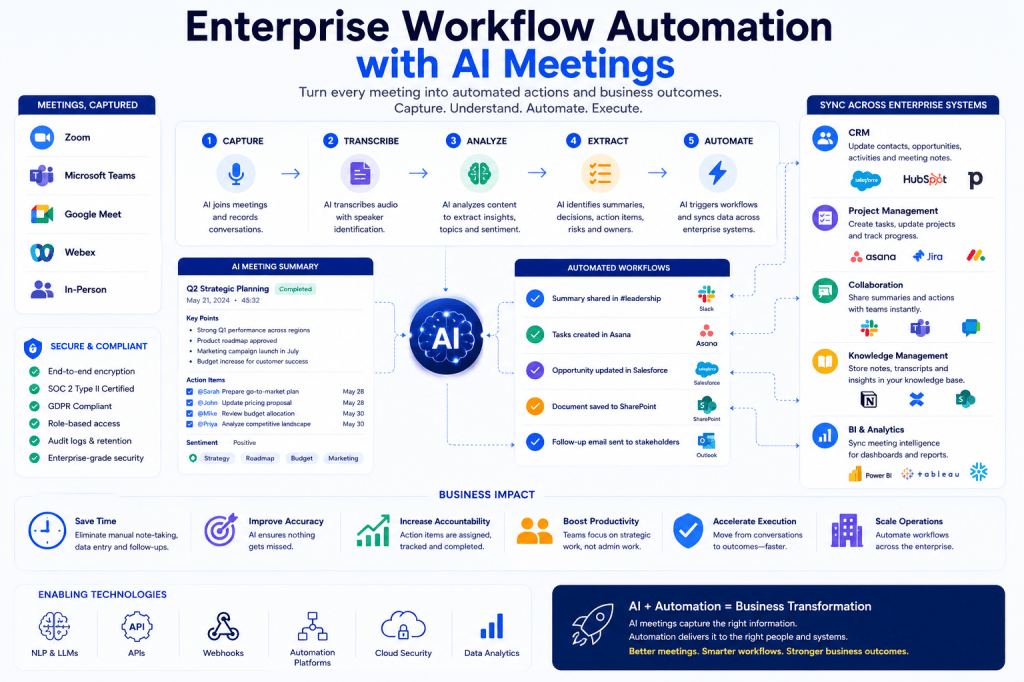
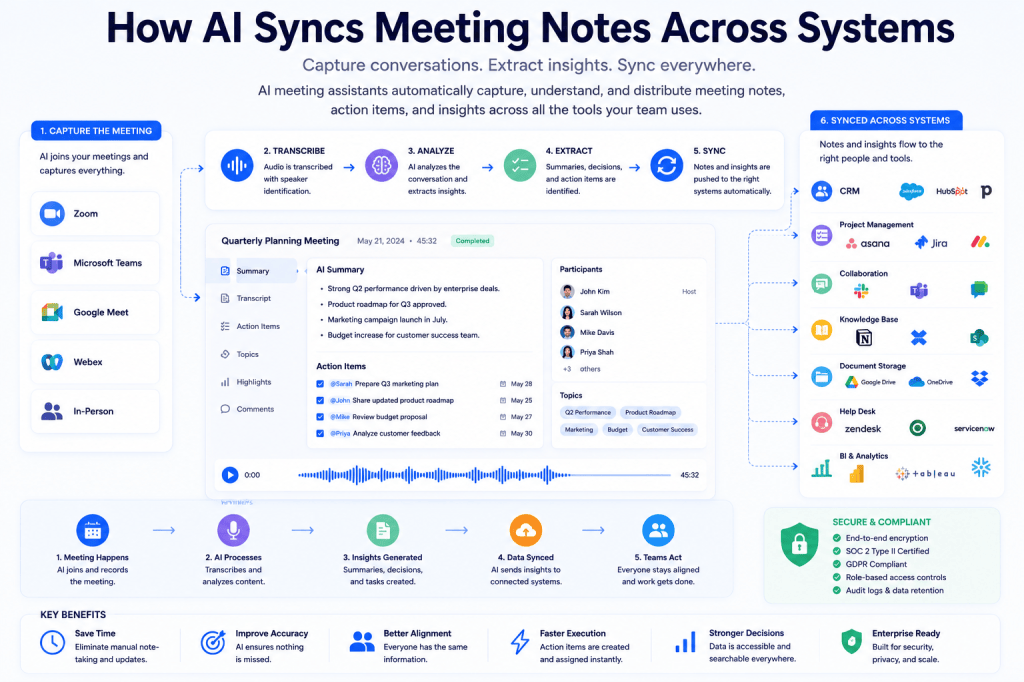
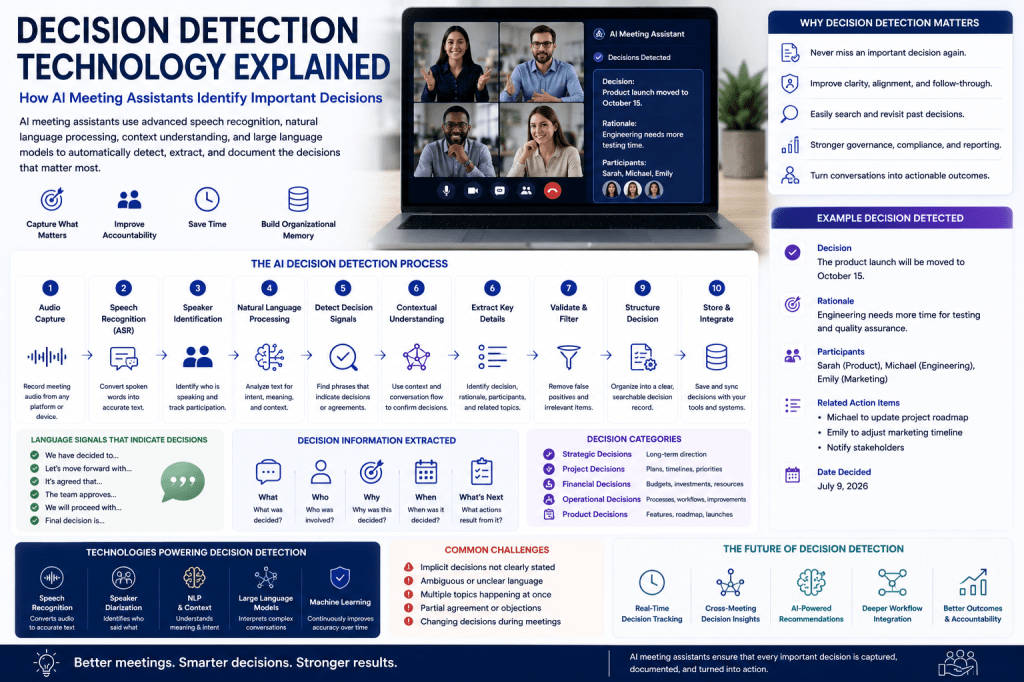
Step 1: Audio Capture
The process begins with meeting audio capture.
AI meeting assistants record conversations from:
- Zoom meetings
- Microsoft Teams meetings
- Google Meet sessions
- Phone calls
- Hybrid meetings
- In-person discussions
The captured audio serves as the foundation for all meeting intelligence features.
Step 2: Speech Recognition
The recorded audio is converted into text using Automatic Speech Recognition (ASR).
Example:
Spoken statement:
We should move the product launch to October.
Transcribed text:
We should move the product launch to October.
Accurate transcription is essential because decision detection relies on understanding the exact language used during discussions.
Step 3: Speaker Identification
Decision-making often involves multiple participants.
AI meeting assistants use speaker diarization to determine:
- Who proposed the idea
- Who approved it
- Who raised objections
- Who accepted responsibility
Example:
Sarah: We should move the launch to October.
Michael: I agree.
Emily: Marketing can support that timeline.
Speaker identification provides important context surrounding decisions.
Step 4: Natural Language Processing
Once the transcript is generated, Natural Language Processing analyzes the content.
NLP helps AI understand:
- Sentence structure
- Intent
- Meaning
- Relationships between statements
The system begins looking for language patterns that frequently indicate decisions.
Step 5: Detecting Decision Signals
AI meeting assistants are trained to recognize phrases commonly associated with decision-making.
Examples include:
Explicit Decisions
We approved the proposal.
The team agreed to move forward.
Let’s proceed with Option B.
Consensus Statements
Everyone is aligned on this approach.
We all agree.
That sounds good to me.
Approval Language
Approved.
Confirmed.
Accepted.
Strategic Choices
We will prioritize the enterprise market.
The launch date will be October 15.
These linguistic signals help the AI identify candidate decisions.
Step 6: Distinguishing Discussion from Decisions
One of the biggest challenges is separating discussion from commitment.
Consider the following statement:
We could launch in October.
This is a possibility, not a decision.
Compare it to:
We will launch in October.
This indicates a clear commitment.
Decision detection systems analyze:
- Certainty
- Commitment level
- Participant agreement
- Conversation context
This distinction is critical for accurate meeting intelligence.
Step 7: Contextual Understanding
Many decisions are not expressed in a single sentence.
Example:
Sarah: Should we move the launch date?
Michael: Engineering needs two more weeks.
Emily: Marketing can support that timeline.
Sarah: Okay, let’s move the launch to October.
The decision emerges across multiple conversational exchanges.
Large language models help connect these statements into a coherent outcome.
Without contextual analysis, the decision might be missed entirely.
Step 8: Large Language Models and Decision Understanding
Modern AI meeting assistants increasingly rely on large language models (LLMs).
LLMs improve decision detection by helping the system:
- Understand intent
- Recognize agreement
- Interpret business context
- Resolve ambiguity
- Connect related discussions
For example, AI can identify decisions even when participants never explicitly say:
We have made a decision.
This contextual reasoning significantly improves accuracy.
Step 9: Extracting Supporting Information
Once a decision is identified, AI meeting assistants gather additional context.
This may include:
Decision Description
What was decided?
Participants
Who contributed?
Reasoning
Why was the decision made?
Risks
Were concerns raised?
Dependencies
What factors influenced the outcome?
Related Action Items
What tasks result from the decision?
This additional information makes decisions more useful and actionable.
Step 10: Structuring Decision Records
Most AI meeting assistants organize decisions into a structured format.
Example:
Decision
Product launch postponed until October 15.
Rationale
Engineering requires additional testing time.
Participants
Sarah, Michael, Emily
Related Actions
- Update project roadmap
- Adjust marketing schedule
- Notify stakeholders
Structured records improve visibility and accountability.
Common Decision Categories
Decision detection systems often classify outcomes into categories.
Strategic Decisions
Long-term organizational direction.
Project Decisions
Planning, timelines, priorities.
Financial Decisions
Budget approvals and resource allocation.
Operational Decisions
Process improvements and workflow changes.
Product Decisions
Features, launches, and roadmap updates.
Categorization improves reporting and searchability.
Challenges in Decision Detection
Despite major advances, decision detection remains complex.
Implicit Decisions
Not all decisions are clearly stated.
Partial Agreement
Participants may agree on some aspects but not others.
Changing Decisions
Decisions may evolve during a meeting.
Ambiguous Language
Statements can be open to interpretation.
Multiple Concurrent Topics
Several decisions may occur simultaneously.
These challenges require sophisticated AI reasoning capabilities.
Decision Detection vs Action Item Detection
Although closely related, decisions and action items are not the same.
Decision
A conclusion or commitment.
Example:
The launch date is October 15.
Action Item
A task resulting from the decision.
Example:
Michael will update the roadmap.
Decision detection answers:
What did we decide?
Action item detection answers:
What happens next?
Together, these technologies form the foundation of meeting intelligence.
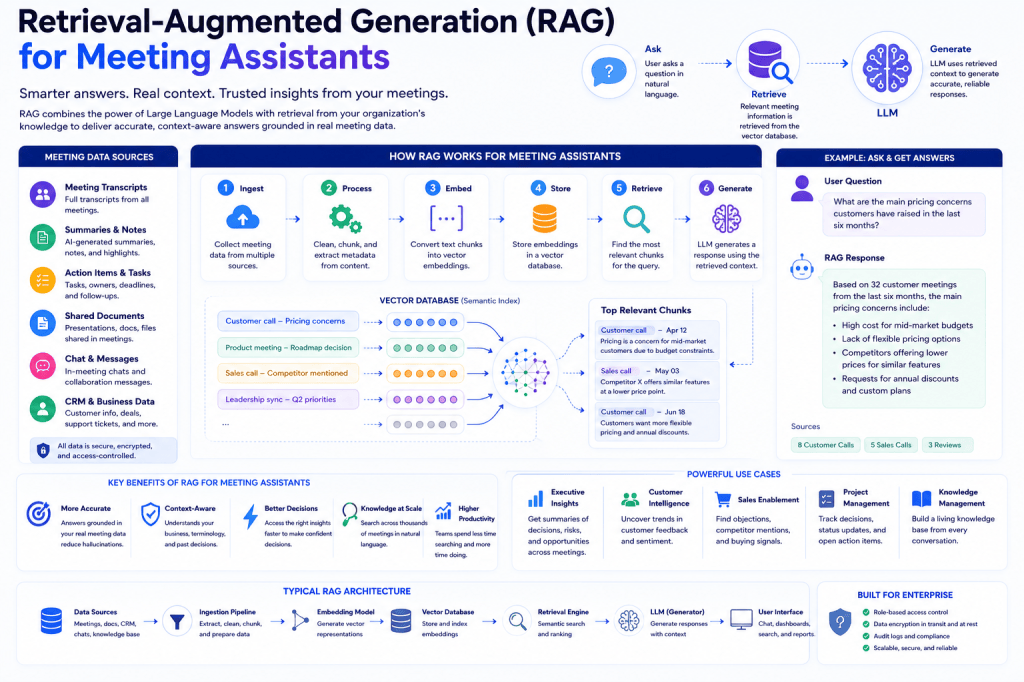
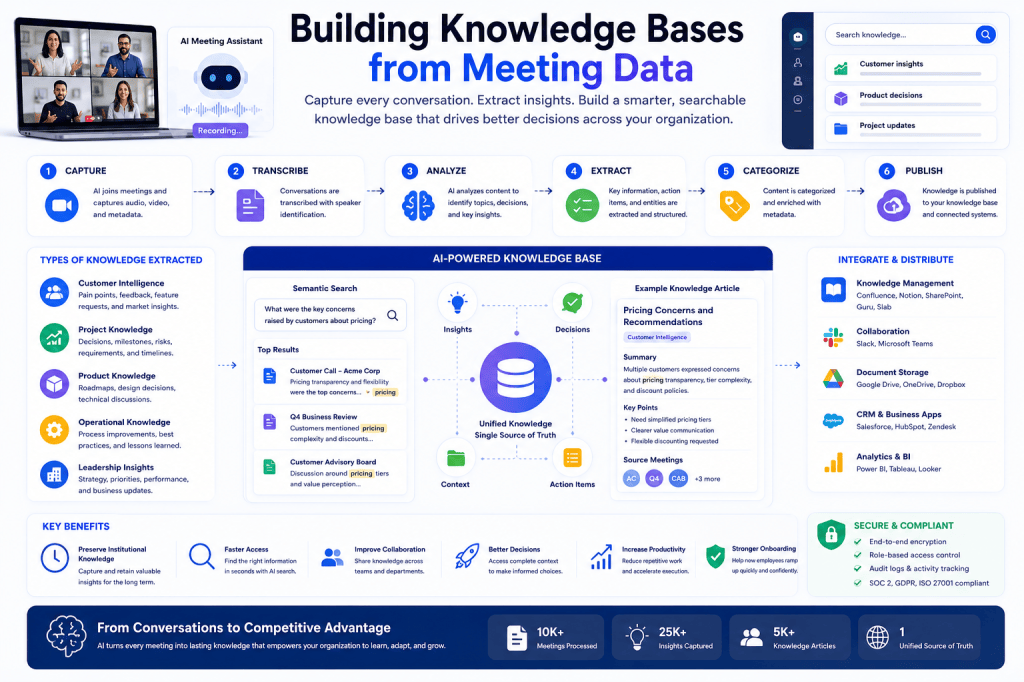
Integration with Organizational Knowledge
Modern AI meeting assistants increasingly connect decision records with:
- Project management tools
- Knowledge bases
- CRM systems
- Collaboration platforms
- Document repositories
This allows organizations to track decisions long after meetings conclude.
Decision history becomes a valuable organizational asset.
The Future of Decision Detection
Decision detection technology is evolving rapidly.
Future capabilities may include:
Real-Time Decision Tracking
Identifying decisions as they happen.
Cross-Meeting Decision Analysis
Tracking decisions across multiple meetings.
Decision Impact Assessment
Evaluating business outcomes resulting from decisions.
AI Decision Recommendations
Suggesting options during discussions.
Organizational Decision Memory
Creating searchable histories of all major decisions.
These developments will further transform AI meeting assistants into intelligent business partners.
Conclusion
Decision detection technology enables AI meeting assistants to automatically identify, extract, and document the most important outcomes of meetings. By combining speech recognition, natural language processing, speaker identification, contextual analysis, and large language models, these systems can distinguish decisions from general discussion and transform conversations into actionable organizational knowledge. As meeting intelligence technology continues to advance, decision detection will become increasingly accurate, helping organizations improve accountability, reduce ambiguity, preserve institutional knowledge, and make better business decisions.