One of the biggest challenges in modern meetings is separating important information from routine conversation. A one-hour meeting may contain thousands of spoken words, yet only a handful of insights truly matter. Important decisions, risks, opportunities, action items, and strategic discussions can easily become buried within lengthy transcripts and recordings.
This is where Key Takeaway Extraction Technology comes into play. Modern AI meeting assistants use advanced artificial intelligence to automatically identify and highlight the most important information discussed during a meeting. Rather than forcing users to review entire recordings or transcripts, AI-generated key takeaways provide concise summaries of the insights that matter most.
As meeting intelligence platforms continue to evolve, key takeaway extraction has become one of the most valuable capabilities for improving productivity, decision-making, and organizational knowledge management.
What Is Key Takeaway Extraction?
Key takeaway extraction is the process of automatically identifying and summarizing the most important points discussed during a meeting.
Examples of key takeaways include:
- Major decisions
- Strategic priorities
- Action items
- Project updates
- Customer feedback
- Risks and concerns
- Opportunities
- Budget approvals
- Timeline changes
The goal is to answer a simple question:
“If someone only reads a few lines about this meeting, what information should they know?”
AI meeting assistants are specifically designed to answer that question automatically.
Why Key Takeaways Matter
Organizations spend enormous amounts of time in meetings.
Without effective summaries, teams often experience:
- Information overload
- Forgotten decisions
- Missed action items
- Poor follow-up
- Repeated discussions
- Knowledge loss
Key takeaways help solve these problems by presenting only the most important outcomes.
Benefits include:
- Faster information consumption
- Better decision visibility
- Improved accountability
- Stronger collaboration
- More effective knowledge sharing
For many users, key takeaways are the first section they read after a meeting concludes.
How Key Takeaway Extraction Works
Modern AI meeting assistants use several technologies working together.
The process typically includes:
- Audio capture
- Speech recognition
- Speaker identification
- Natural language processing
- Topic analysis
- Importance scoring
- Insight extraction
- Summary generation
Each stage contributes to identifying what matters most.
Step 1: Meeting Transcription
Everything begins with transcription.
Automatic Speech Recognition (ASR) converts spoken conversations into text.
Example:
The team approved the October launch date and allocated additional testing resources.
The transcript serves as the foundation for all meeting intelligence features.
Without accurate transcription, key takeaway quality declines significantly.
Step 2: Natural Language Processing
Natural Language Processing (NLP) helps AI understand the meaning behind conversations.
NLP analyzes:
- Words
- Phrases
- Context
- Intent
- Relationships between statements
The AI begins identifying information that appears meaningful and relevant.
Step 3: Topic Detection
AI meeting assistants automatically identify discussion themes.
Example topics:
- Product Launch
- Budget Planning
- Customer Success
- Hiring
- Technical Infrastructure
Topic detection helps the AI understand where important information is concentrated.
Topics receiving substantial discussion often contribute to key takeaways.
Step 4: Identifying Important Signals
Not every statement deserves inclusion as a key takeaway.
AI systems look for signals associated with high-value information.
Examples include:
Decision Signals
We approved the proposal.
The team agreed to proceed.
Action Signals
Michael will update the roadmap.
Risk Signals
Testing delays could affect launch.
Opportunity Signals
Several customers requested this feature.
These signals help the AI determine what deserves attention.
Step 5: Importance Scoring
Modern AI meeting assistants assign importance scores to statements and discussion segments.
Factors may include:
Discussion Frequency
How often was the topic mentioned?
Participant Emphasis
Did multiple people discuss it?
Strategic Relevance
Does it affect important business outcomes?
Decision Impact
Was a decision made?
Actionability
Does it require follow-up?
The highest-scoring information becomes candidate key takeaways.
Step 6: Contextual Understanding with Large Language Models
Traditional summarization systems relied heavily on keywords.
Modern AI meeting assistants use large language models (LLMs) to understand context.
Example:
Conversation:
Engineering needs two more weeks of testing before launch.
The AI may generate:
Key Takeaway:
The product launch timeline may be affected by additional testing requirements.
The system understands meaning rather than simply extracting keywords.
This significantly improves summary quality.
Step 7: Consolidating Related Information
Important information often appears across multiple parts of a meeting.
Example:
Early Discussion:
Testing is behind schedule.
Mid-Meeting Discussion:
Engineering needs additional resources.
Later Discussion:
Launch may move to October.
Rather than generating separate takeaways, AI combines related information into a single coherent insight.
This improves clarity and readability.
Types of Key Takeaways
AI meeting assistants commonly extract several categories of takeaways.
Decisions
Examples:
- Budget approved
- Launch date finalized
- Vendor selected
Action Items
Examples:
- Update roadmap
- Schedule follow-up meeting
- Prepare customer presentation
Risks
Examples:
- Timeline concerns
- Resource shortages
- Technical challenges
Opportunities
Examples:
- Customer requests
- Revenue opportunities
- Product enhancements
Strategic Insights
Examples:
- New priorities
- Market opportunities
- Organizational changes
These categories help users quickly understand meeting outcomes.
Key Takeaways vs Meeting Summaries
Although related, key takeaways and meeting summaries are different.
Meeting Summary
Provides a broader overview of the entire discussion.
Key Takeaways
Focus only on the most important outcomes.
Example:
Meeting Summary:
The team discussed launch plans, marketing readiness, testing progress, customer feedback, and budget requirements.
Key Takeaway:
Launch postponed until October due to testing delays.
Key takeaways provide maximum value in minimum time.
Key Takeaway Extraction and Action Items
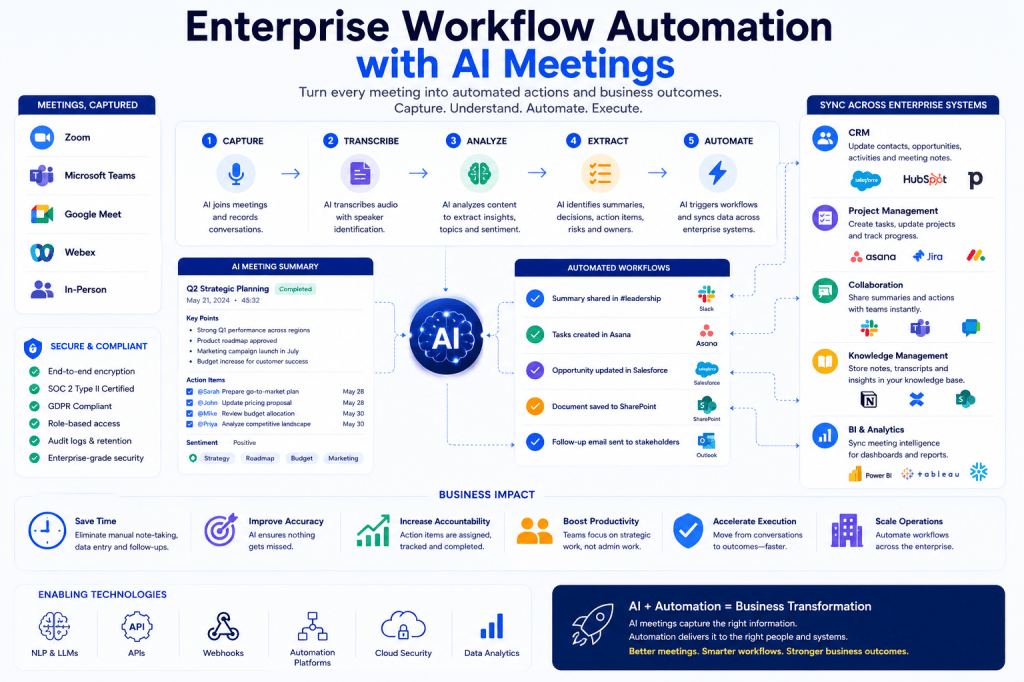
Many AI meeting assistants connect takeaways directly to action items.
Example:
Key Takeaway
Additional testing required before launch.
Related Action Item
Michael to finalize testing plan by Friday.
This linkage improves accountability and execution.
Key Takeaway Extraction and Decision Detection
Decision detection plays a major role in identifying important takeaways.
Example:
Decision:
The product launch date will move to October 15.
Key Takeaway:
Launch timeline adjusted to accommodate additional testing requirements.
Decision detection helps ensure critical outcomes are not overlooked.
Organizational Knowledge Management
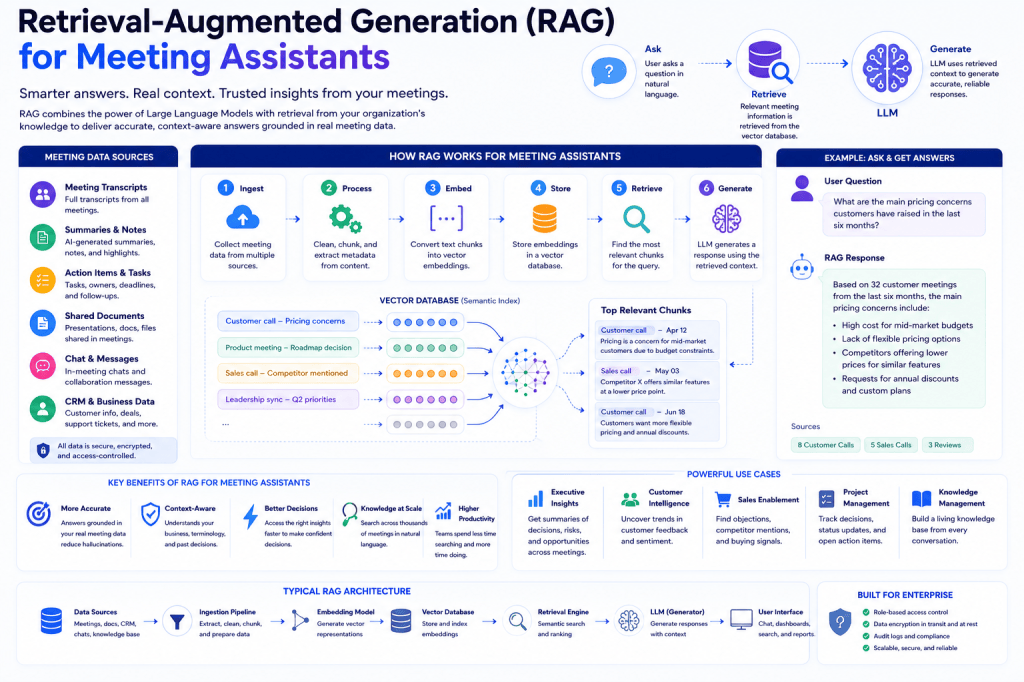
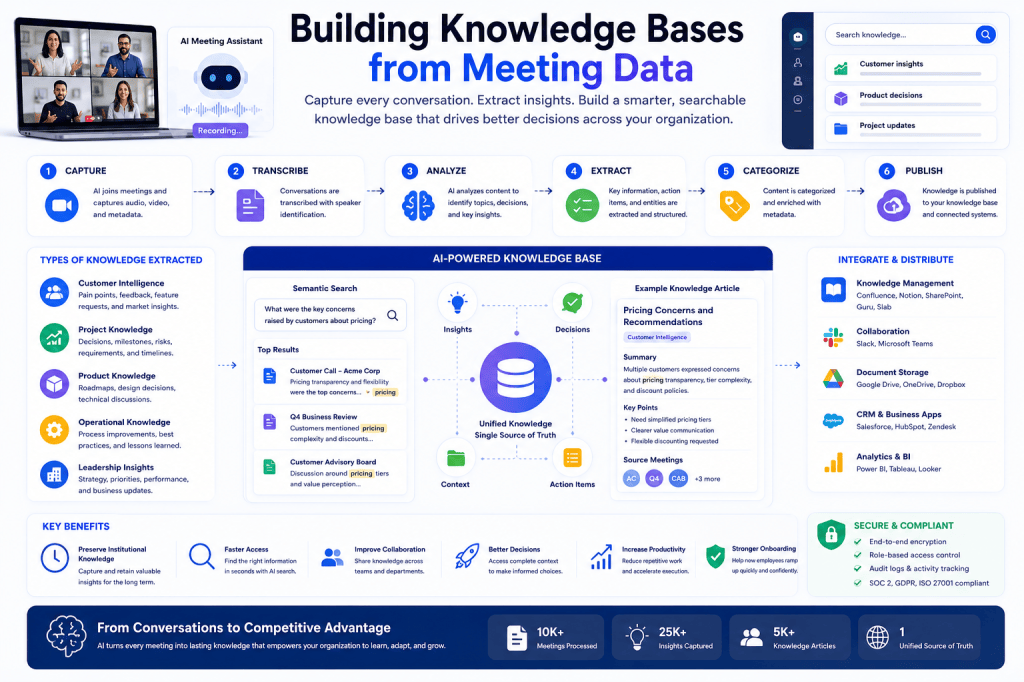
One of the most powerful applications of key takeaway extraction is knowledge management.
Organizations can build searchable repositories containing:
- Meeting outcomes
- Decisions
- Lessons learned
- Risks
- Strategic insights
Employees can quickly review key takeaways instead of reading lengthy transcripts.
This dramatically improves information accessibility.
Challenges and Limitations
Despite significant progress, challenges remain.
Ambiguous Conversations
Not all important information is clearly stated.
Context Dependency
Meaning often depends on previous discussions.
Industry Terminology
Specialized language can complicate interpretation.
Multiple Priorities
Meetings may contain numerous competing topics.
Subjectivity
Different participants may disagree on what is most important.
Large language models continue improving performance in these areas.
Real-Time Key Takeaway Extraction
Future AI meeting assistants are increasingly moving toward real-time intelligence.
Potential capabilities include:
Live Takeaways
Important insights generated during meetings.
Dynamic Summaries
Continuously updated meeting overviews.
Real-Time Alerts
Highlighting critical decisions immediately.
Meeting Guidance
Helping participants stay focused on priorities.
Real-time extraction will further enhance meeting productivity.
The Future of Key Takeaway Extraction
As AI technology advances, key takeaway extraction will become increasingly sophisticated.
Future developments may include:
Personalized Takeaways
Different insights for executives, managers, and contributors.
Cross-Meeting Intelligence
Connecting takeaways across multiple meetings.
Predictive Insights
Identifying future risks and opportunities.
Organizational Memory
Building long-term knowledge repositories automatically.
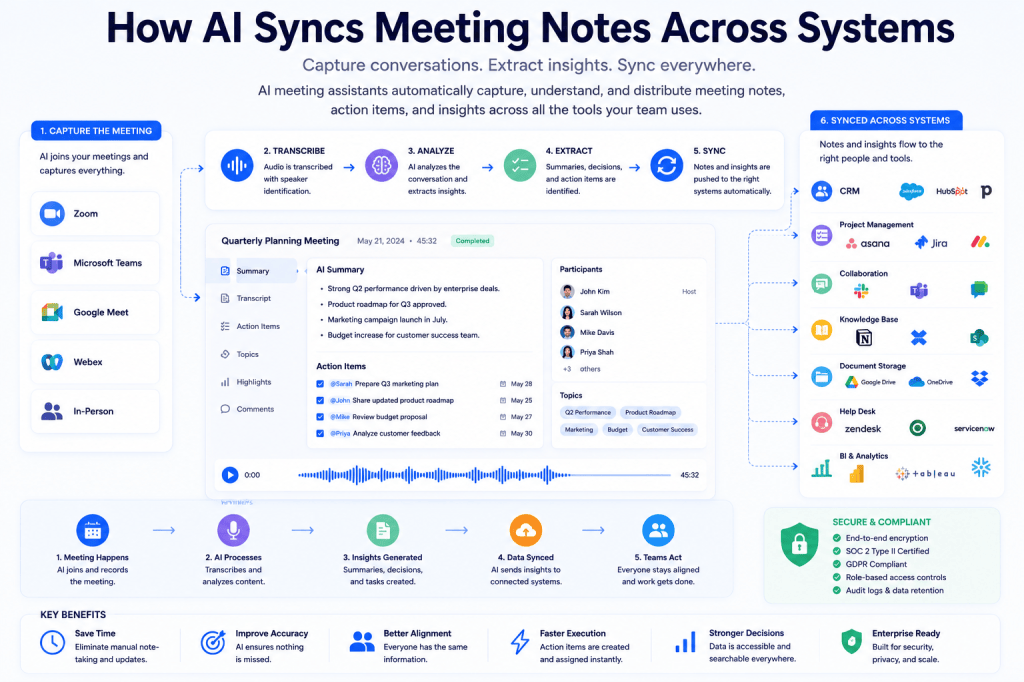
Workflow Integration
Converting takeaways directly into tasks and business processes.
These innovations will transform meetings into strategic intelligence assets.
Conclusion
Key Takeaway Extraction Technology is a core component of modern AI meeting assistants. By combining speech recognition, natural language processing, topic detection, importance scoring, contextual analysis, and large language models, AI systems can automatically identify the most important information discussed during meetings. These insights help teams focus on decisions, action items, risks, opportunities, and strategic outcomes without reviewing lengthy transcripts. As meeting intelligence platforms continue to evolve, key takeaway extraction will play an increasingly important role in improving productivity, collaboration, knowledge management, and organizational decision-making.