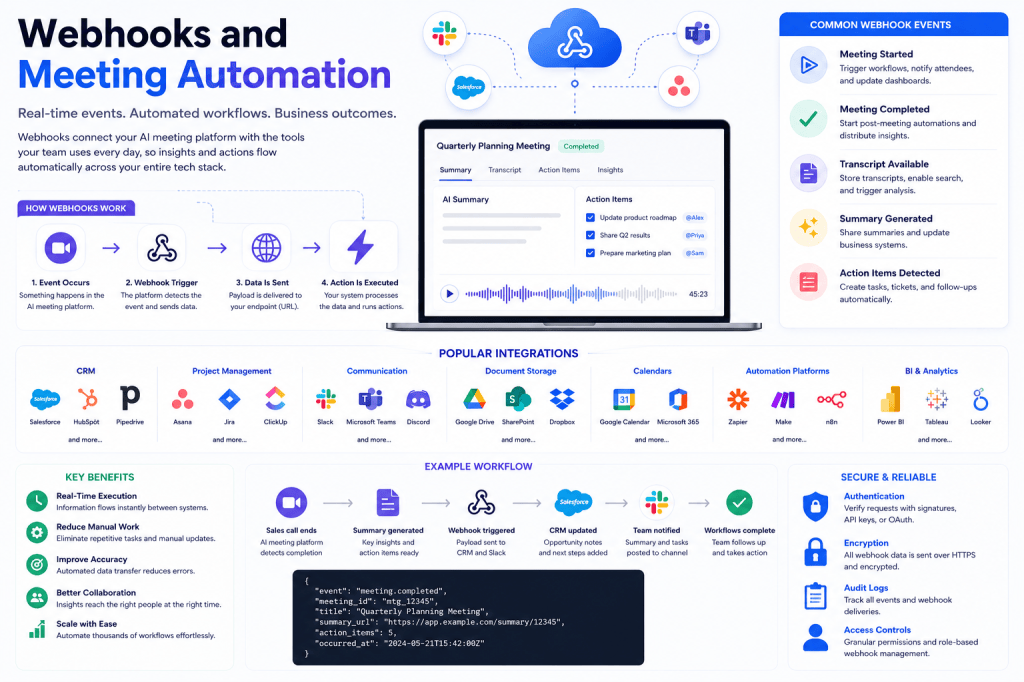
Modern businesses depend on meetings to make decisions, coordinate projects, engage customers, and drive organizational growth. However, the value generated during meetings often remains trapped in recordings, transcripts, or meeting notes unless it is connected to the tools and workflows teams use every day.
This is where webhooks play a transformative role.
Webhooks enable AI meeting platforms to trigger real-time actions based on meeting events, allowing organizations to automate workflows, synchronize systems, and ensure that meeting insights immediately translate into business outcomes.
As AI meeting assistants become more sophisticated, webhooks have emerged as one of the most powerful technologies for creating intelligent, event-driven workplace automation.
What Are Webhooks?
A webhook is an automated HTTP-based notification that is sent from one application to another when a specific event occurs.
Unlike traditional APIs, where applications repeatedly request information, webhooks push information automatically as soon as an event happens.
Think of a webhook as a real-time alert system.
When an event occurs, the source application immediately sends data to a predefined destination, enabling instant automation and response.
For AI meeting platforms, webhooks make it possible to distribute meeting intelligence throughout an organization’s technology stack without manual intervention.
Why Webhooks Matter for Meeting Automation
Meetings generate numerous events that can trigger business processes.
Examples include:
- Meeting started
- Meeting ended
- Recording completed
- Transcript generated
- Summary created
- Action item detected
- Participant joined
- Speaker identified
- Follow-up required
Without automation, employees must manually move information between systems.
Webhooks eliminate this friction by enabling instant communication between applications.
Benefits include:
- Real-time automation
- Faster execution
- Reduced administrative work
- Improved data accuracy
- Better workflow coordination
- Enhanced productivity
Organizations can move from conversation to action within seconds.
How Webhooks Work
The webhook process is relatively straightforward.
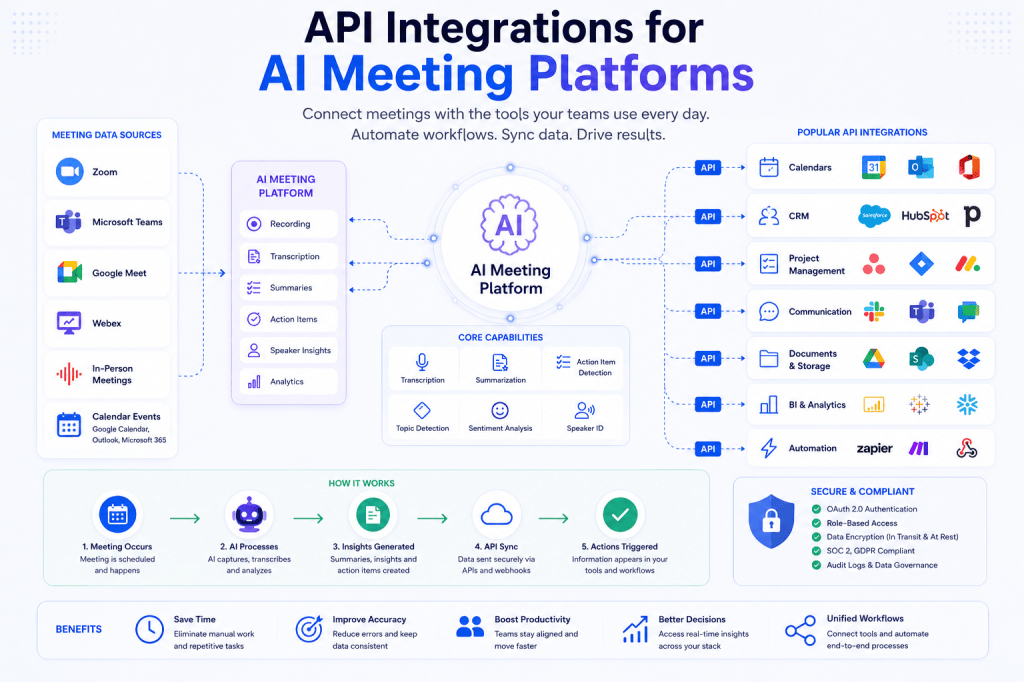
Step 1: Event Occurs
An event takes place inside an AI meeting platform.
Examples include:
- A meeting concludes
- A transcript is completed
- A summary is generated
- New action items are identified
Step 2: Webhook Trigger Activates
The platform recognizes the event and automatically prepares a webhook payload.
The payload may contain:
- Meeting ID
- Meeting title
- Participants
- Summary content
- Transcript links
- Action items
- Timestamps
Step 3: Data Is Sent
The platform sends an HTTP POST request to a configured endpoint.
This destination might be:
- CRM system
- Project management platform
- Collaboration tool
- Internal application
- Workflow automation platform
Step 4: Action Is Executed
The receiving application processes the data and performs predefined actions.
Examples include:
- Creating tasks
- Updating records
- Sending notifications
- Triggering workflows
- Generating reports
The entire process can occur in real time.
Common Webhook Events in AI Meeting Platforms
Meeting Started
Organizations may use this event to:
- Notify attendees
- Start workflows
- Update dashboards
- Activate compliance monitoring
Meeting Completed
One of the most commonly used webhook events.
Actions may include:
- Archiving recordings
- Generating summaries
- Updating CRM records
- Triggering follow-up workflows
Transcript Available
Once transcription is complete, organizations can:
- Store transcripts
- Share meeting records
- Analyze conversation data
- Trigger knowledge management workflows
Summary Generated
Meeting summaries can be distributed automatically to stakeholders through communication platforms or business systems.
Action Items Detected
AI-generated action items can instantly create:
- Tasks
- Tickets
- Work requests
- Project updates
This helps ensure accountability and execution.
Webhooks and CRM Automation
Customer-facing teams often rely heavily on webhook automation.
For example:
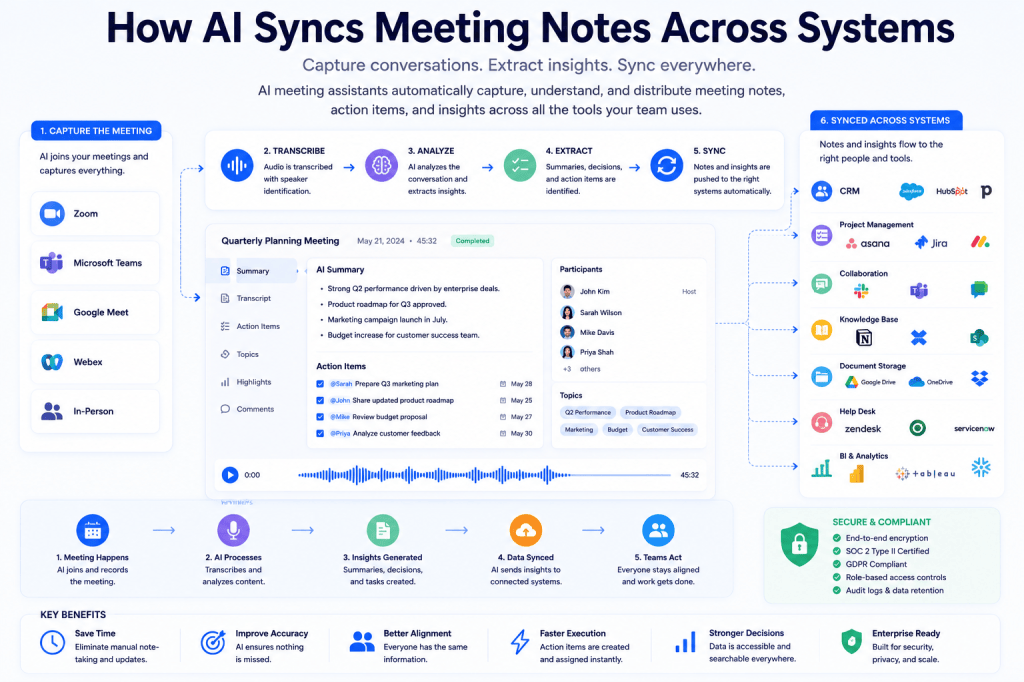
- A sales call ends.
- AI generates a summary.
- A webhook sends data to Salesforce.
- Opportunity records are updated.
- Follow-up tasks are created.
- Managers receive notifications.
This eliminates manual CRM updates and improves pipeline visibility.
Popular CRM integrations include:
- Salesforce
- HubSpot
- Microsoft Dynamics 365
- Pipedrive
- Zoho CRM
Webhooks and Project Management Tools
Project discussions frequently generate tasks and decisions.
Webhook-based automation enables AI meeting platforms to connect with:
- Asana
- Jira
- Monday.com
- ClickUp
- Trello
- Wrike
For example:
- Action items are identified during a meeting.
- A webhook triggers task creation.
- Tasks are assigned automatically.
- Due dates are applied.
- Project boards are updated.
Teams can begin execution immediately.
Webhooks and Communication Platforms
Collaboration tools are among the most common webhook destinations.
AI meeting assistants often connect with:
- Slack
- Microsoft Teams
- Discord
- Workplace communication platforms
Common automation examples include:
- Posting meeting summaries
- Sharing action items
- Sending reminders
- Updating team channels
Meeting intelligence becomes instantly accessible to stakeholders.
Webhooks and Document Management Systems
Organizations frequently need to archive meeting content.
Webhooks can automate storage workflows for:
- Google Drive
- SharePoint
- OneDrive
- Dropbox
- Box
When a transcript or recording becomes available, it can be stored automatically in the appropriate location.
This improves knowledge management and compliance.
Webhooks and Business Intelligence Platforms
Meeting data often contains valuable operational insights.
Webhook integrations can push information into:
- Power BI
- Tableau
- Looker
- Snowflake
- Data warehouses
Organizations can analyze:
- Meeting volume
- Customer sentiment
- Team productivity
- Sales performance
- Project activity
This helps transform conversations into measurable business intelligence.
Benefits of Webhook-Based Meeting Automation
Real-Time Workflow Execution
Information moves instantly between systems without delays.
Reduced Manual Work
Employees spend less time updating records, creating tasks, and distributing information.
Improved Accuracy
Automated data transfer reduces errors and omissions.
Greater Scalability
Organizations can automate thousands of workflows across teams and departments.
Better Collaboration
Meeting outcomes become immediately available to everyone who needs them.
Security Considerations
Because webhooks transfer business-critical information, security is essential.
Organizations should evaluate:
Authentication
Webhook endpoints should verify requests using:
- API keys
- Shared secrets
- Signature validation
- OAuth mechanisms
Encryption
All webhook traffic should use HTTPS encryption.
Access Controls
Organizations should limit who can configure and manage webhook integrations.
Audit Logging
Webhook activity should be tracked for compliance and troubleshooting purposes.
Compliance Requirements
Businesses may need support for:
- GDPR
- SOC 2
- ISO 27001
- HIPAA (where applicable)
Strong governance helps ensure secure automation.
Popular Automation Platforms for Webhooks
Many organizations use automation platforms to manage webhook workflows.
Examples include:
- Zapier
- Make (formerly Integromat)
- Workato
- Tray.io
- Microsoft Power Automate
- n8n
These platforms allow non-technical users to create powerful workflows without extensive coding.
The Future of Webhooks and Meeting Intelligence
As AI meeting platforms continue to evolve, webhooks will support increasingly intelligent automation.
Future capabilities may include:
- Predictive workflow triggers
- Autonomous task management
- AI-driven process orchestration
- Real-time business intelligence updates
- Automated customer engagement workflows
- Intelligent project coordination
Rather than simply sharing data, webhook-enabled systems will increasingly make decisions and initiate actions on behalf of organizations.
Conclusion
Webhooks are a foundational technology for modern meeting automation. By enabling real-time communication between AI meeting platforms and business applications, they help organizations automate workflows, improve collaboration, reduce manual work, and accelerate execution.
As businesses continue to embrace AI-powered productivity tools, webhook-driven automation will play an increasingly important role in ensuring that every meeting generates immediate, measurable value. Organizations that leverage webhooks effectively can transform conversations into actions, insights into outcomes, and meetings into powerful drivers of operational efficiency.

 Meeting Notes AI