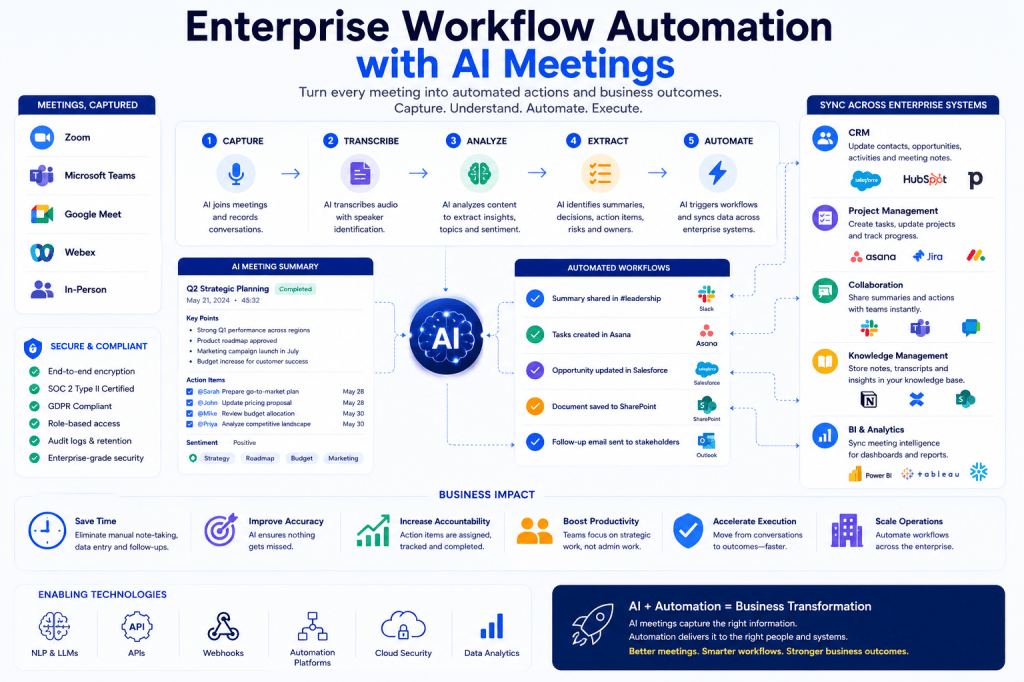
Meetings are the operational heartbeat of modern enterprises. Strategic decisions are made in executive discussions, customer relationships are shaped in sales calls, projects move forward through team collaboration, and operational challenges are addressed in cross-functional meetings. Yet despite their importance, organizations often struggle to convert meeting outcomes into consistent, measurable action.
Employees spend countless hours taking notes, updating systems, assigning tasks, writing summaries, and following up on commitments. These manual processes create inefficiencies, introduce errors, and slow execution across the organization.
Artificial Intelligence is changing this dynamic.
AI meeting platforms are evolving beyond simple transcription tools into intelligent workflow automation engines. By automatically capturing conversations, extracting insights, identifying action items, and triggering workflows across enterprise systems, AI meetings are helping organizations streamline operations, improve productivity, and accelerate decision-making.
As enterprises continue to embrace digital transformation, workflow automation powered by AI meetings is becoming a key driver of operational efficiency and business agility.
What Is Enterprise Workflow Automation?
Enterprise workflow automation is the use of technology to automate repetitive business processes, reduce manual intervention, and improve consistency across organizational operations.
Workflow automation can include:
- Task creation
- Data synchronization
- Approval routing
- Notifications
- Reporting
- System updates
- Process orchestration
The goal is to ensure that business processes execute efficiently, accurately, and at scale.
When combined with AI meeting technology, workflow automation extends beyond structured business applications and begins directly with conversations.
The Evolution of AI Meeting Platforms
Early meeting software focused primarily on communication and collaboration.
Modern AI meeting assistants now offer advanced capabilities such as:
- Automatic recording
- Real-time transcription
- AI-generated summaries
- Action item extraction
- Speaker identification
- Topic analysis
- Sentiment detection
- Meeting intelligence
These capabilities transform meetings into structured data that can power enterprise workflows.
Instead of simply documenting conversations, AI platforms help organizations act on them automatically.
Why Meetings Are Ideal Workflow Triggers
Meetings naturally generate business actions.
Examples include:
- Customer follow-ups
- Project assignments
- Product decisions
- Risk escalations
- Compliance reviews
- Budget approvals
- Hiring decisions
Traditionally, employees manually transfer these outcomes into business systems.
This creates several challenges:
- Delayed execution
- Inconsistent documentation
- Lost action items
- Human error
- Administrative overhead
AI-powered workflow automation eliminates these bottlenecks by connecting meeting intelligence directly to enterprise applications.
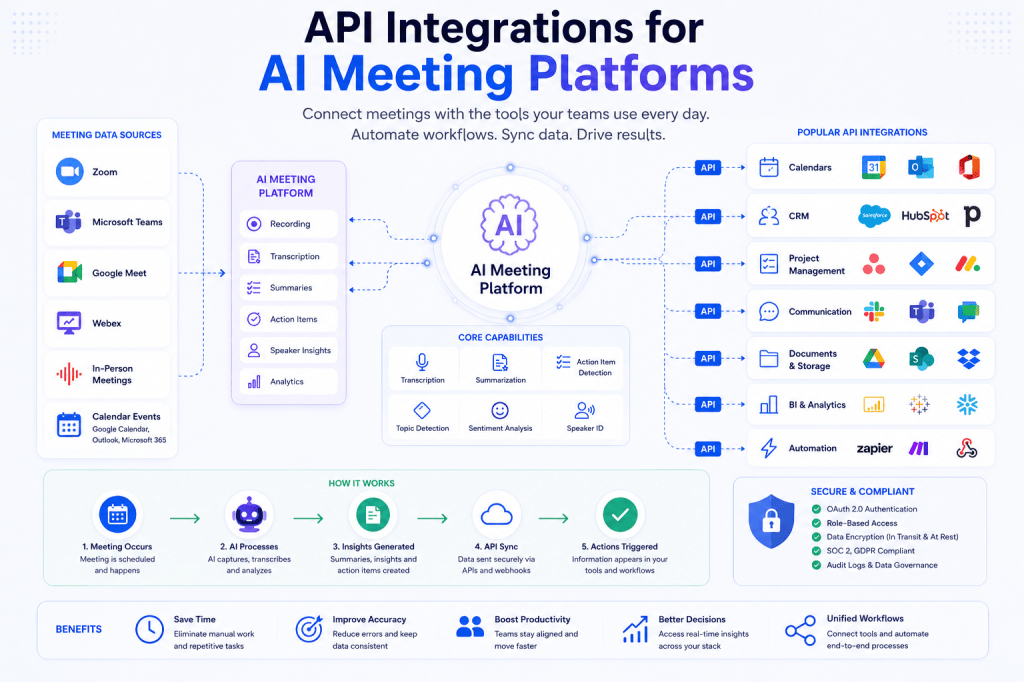
How Enterprise Workflow Automation Works
Step 1: Meeting Capture
The process begins when an AI meeting assistant joins a meeting.
The system records:
- Audio
- Speaker participation
- Meeting metadata
- Shared content
- Discussion topics
This information becomes the foundation for workflow automation.
Step 2: AI Analysis
Advanced Natural Language Processing (NLP) and Large Language Models (LLMs) analyze the conversation.
The AI identifies:
- Key decisions
- Action items
- Risks
- Opportunities
- Deadlines
- Responsibilities
The meeting is transformed into structured business intelligence.
Step 3: Workflow Triggering
Once relevant information is identified, predefined automation rules determine what actions should occur.
Examples include:
- Creating tasks
- Updating CRM records
- Sending notifications
- Triggering approvals
- Scheduling follow-ups
Automation begins immediately after the meeting concludes.
Step 4: Cross-System Synchronization
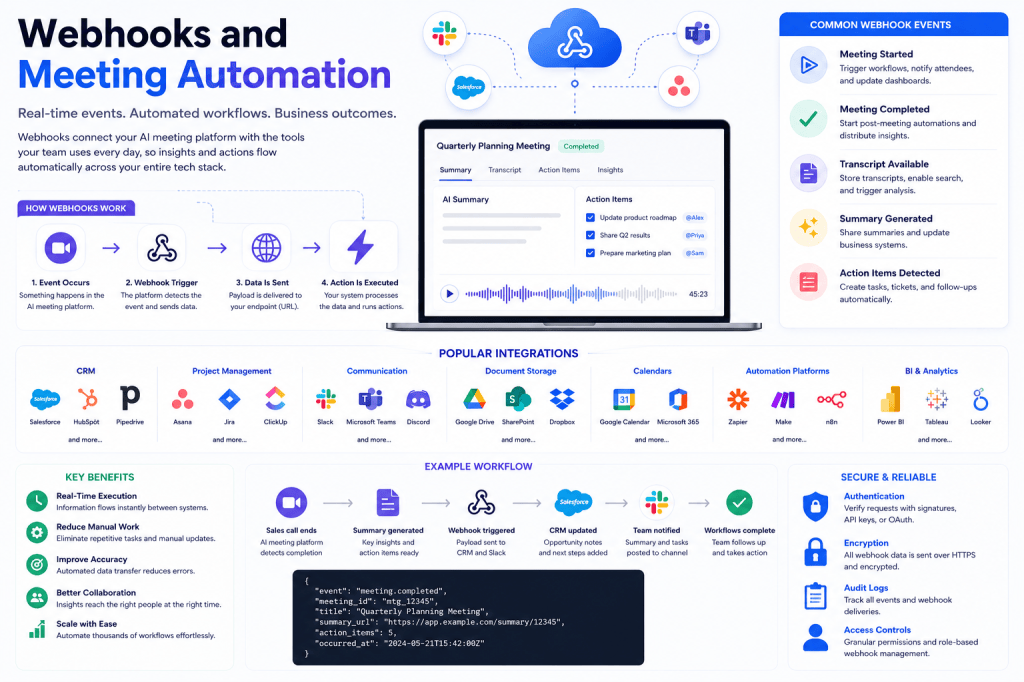
The AI platform communicates with enterprise systems using APIs, webhooks, and automation platforms.
Updates are synchronized across connected tools in real time.
Common Enterprise Workflow Automation Scenarios
Sales Workflow Automation
Customer meetings often generate important updates.
After a sales call, AI can automatically:
- Generate a meeting summary
- Update CRM opportunities
- Log customer interactions
- Create follow-up tasks
- Notify account managers
This improves pipeline visibility and reduces administrative work.
Customer Success Automation
Customer-facing teams frequently manage:
- Onboarding sessions
- Business reviews
- Renewal meetings
- Escalation discussions
AI workflows can automatically:
- Document customer concerns
- Update account records
- Assign follow-up actions
- Track renewal risks
This improves customer experience and operational efficiency.
Project Management Automation
Project meetings generate numerous tasks and decisions.
AI can:
- Create project tasks
- Assign owners
- Update project boards
- Record milestones
- Document decisions
Teams move directly from discussion to execution.
Executive Leadership Automation
Leadership meetings often involve strategic decisions that require organization-wide coordination.
AI workflows can:
- Distribute summaries
- Notify stakeholders
- Update dashboards
- Track initiatives
- Create accountability mechanisms
This improves organizational alignment.
Human Resources Automation
Recruitment and workforce management meetings can trigger:
- Candidate evaluations
- Interview documentation
- Hiring approvals
- Employee onboarding workflows
Administrative workloads are significantly reduced.
Enterprise Systems Commonly Connected to AI Meetings
CRM Platforms
AI meeting assistants frequently integrate with:
- Salesforce
- HubSpot
- Microsoft Dynamics 365
- Zoho CRM
- Pipedrive
Meeting insights flow directly into customer records.
Project Management Tools
Task automation often involves:
- Asana
- Jira
- Monday.com
- ClickUp
- Trello
- Wrike
Action items become immediately actionable.
Collaboration Platforms
Meeting outcomes are often distributed through:
- Slack
- Microsoft Teams
- Workplace communication systems
Stakeholders remain informed in real time.
Knowledge Management Platforms
Organizations can automatically archive meeting intelligence in:
- Notion
- Confluence
- SharePoint
- Google Drive
- OneDrive
Institutional knowledge becomes searchable and accessible.
Business Intelligence Platforms
Meeting data can contribute to enterprise analytics through:
- Power BI
- Tableau
- Looker
- Snowflake
- Data warehouses
This enables deeper operational visibility.
Benefits of Enterprise Workflow Automation
Increased Productivity
Employees spend less time on repetitive administrative tasks.
Faster Execution
Actions are initiated immediately after meetings conclude.
Improved Data Accuracy
Automation reduces manual entry errors and inconsistencies.
Better Accountability
Action items are documented, assigned, and tracked automatically.
Enhanced Collaboration
Meeting outcomes are shared across teams and departments in real time.
Scalable Operations
Organizations can automate thousands of workflows without increasing administrative overhead.
Technologies Behind AI Workflow Automation
Large Language Models
LLMs help understand context, identify actions, and summarize discussions.
Natural Language Processing
NLP extracts meaningful information from conversations.
APIs
Application Programming Interfaces connect AI meeting platforms with enterprise systems.
Webhooks
Webhooks enable real-time workflow triggering based on meeting events.
Automation Platforms
Organizations frequently use:
- Zapier
- Make
- Workato
- Tray.io
- Microsoft Power Automate
- n8n
These tools orchestrate workflow execution across multiple systems.
Security and Governance Considerations
Because enterprise meetings often contain sensitive information, governance is essential.
Organizations should evaluate:
Role-Based Access Controls
Ensure users only access relevant information.
Data Encryption
Protect information during transmission and storage.
Audit Logging
Maintain visibility into workflow execution and system activity.
Data Retention Policies
Align meeting data management with organizational requirements.
Regulatory Compliance
Support may be required for:
- GDPR
- SOC 2
- ISO 27001
- HIPAA (where applicable)
- Industry-specific regulations
Strong governance ensures automation remains secure and compliant.
The Future of Enterprise Workflow Automation
The next generation of AI meeting platforms will move beyond workflow execution and into workflow intelligence.
Future capabilities may include:
- Autonomous decision support
- Predictive workflow recommendations
- Real-time business process optimization
- AI-generated project plans
- Automated stakeholder coordination
- Cross-department orchestration
- Organizational intelligence systems
Meetings will become active inputs into enterprise operating systems rather than isolated events.
Conclusion
Enterprise workflow automation powered by AI meetings is transforming how organizations operate. By automatically capturing conversations, extracting actionable insights, and triggering workflows across business systems, AI meeting platforms eliminate manual work while improving speed, accuracy, and accountability.
As enterprises continue to modernize their operations, AI-powered meeting automation will become a foundational capability for driving productivity, accelerating execution, and ensuring that every conversation contributes directly to measurable business outcomes. Organizations that embrace this approach will be better positioned to scale efficiently, collaborate effectively, and compete in an increasingly automated business environment.

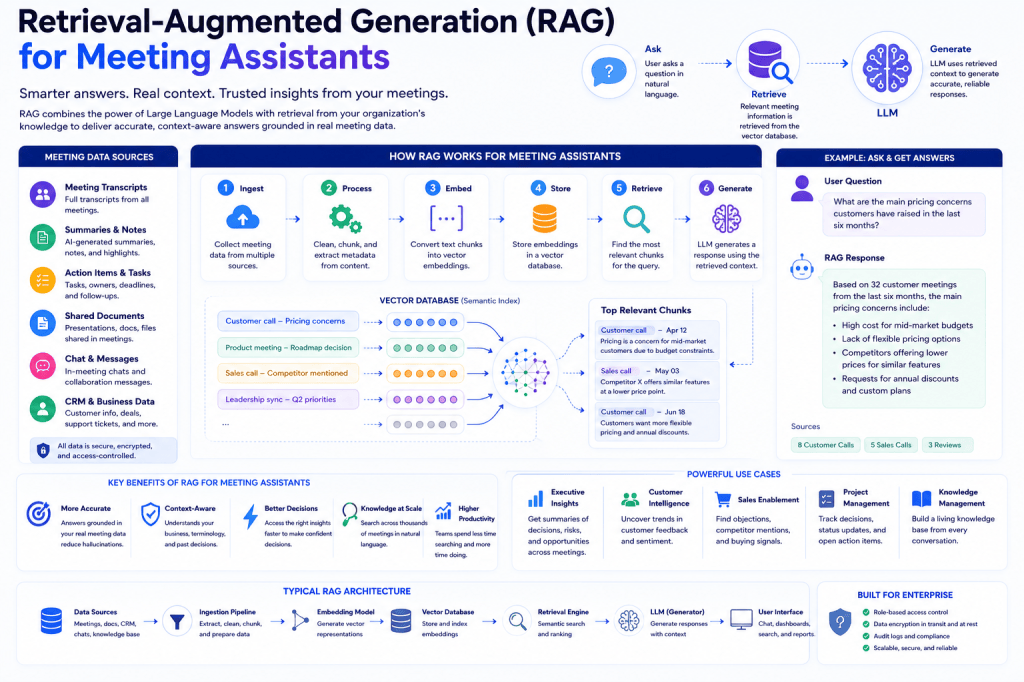
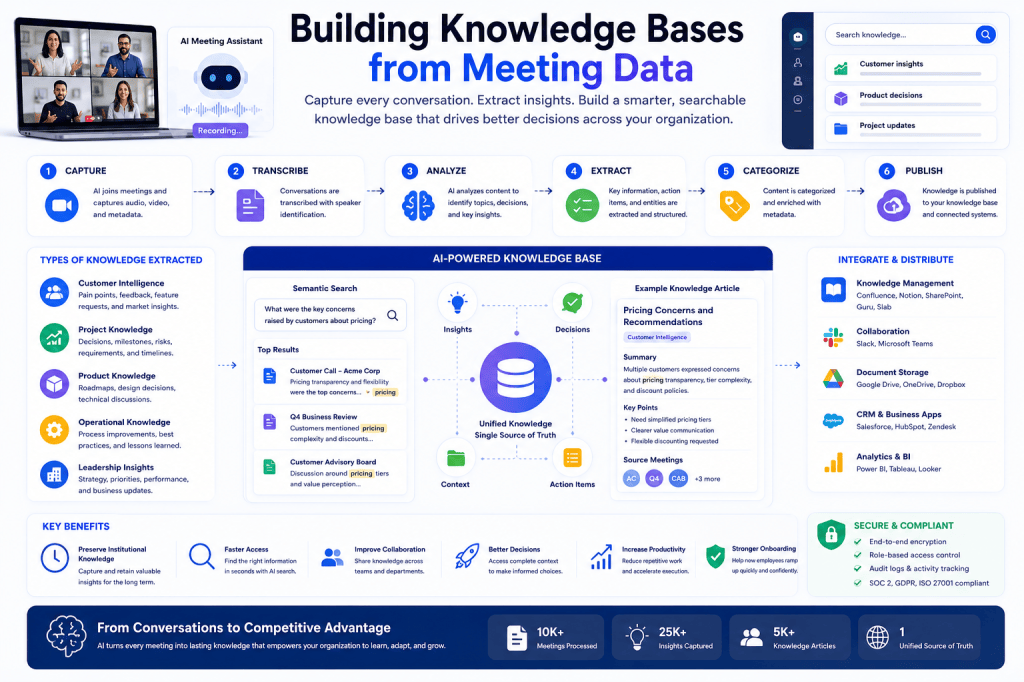
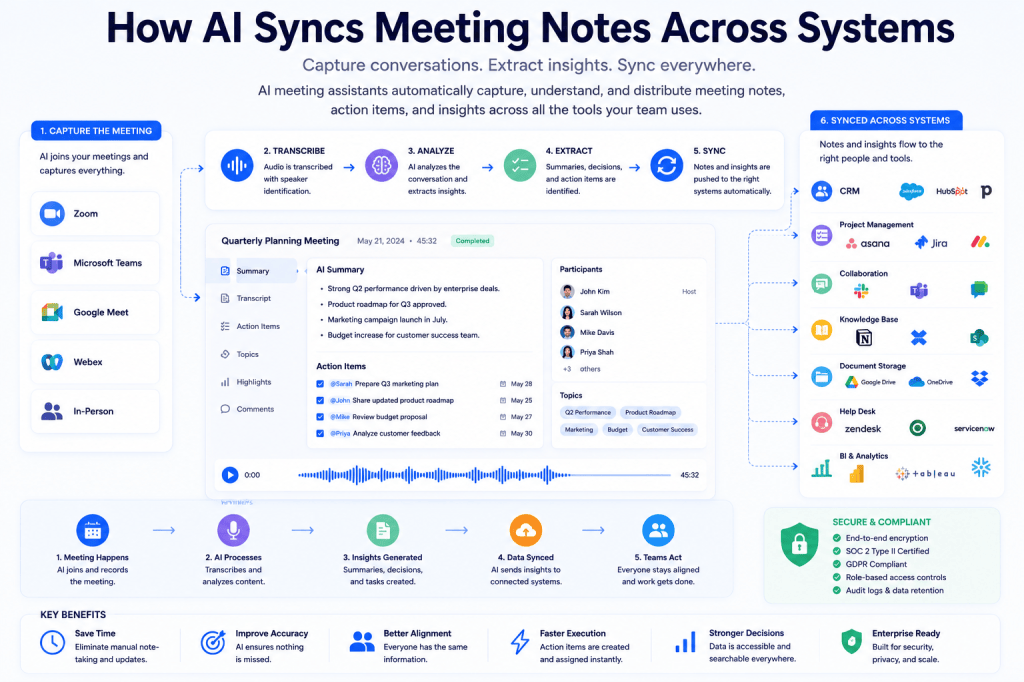
 Meeting Notes AI