AI meeting assistants have transformed the way organizations capture, summarize, and analyze conversations. Modern platforms can automatically record meetings, generate transcripts, identify action items, and provide valuable insights from discussions. However, as organizations generate larger volumes of meeting data, a new challenge emerges: how can AI assistants accurately answer questions and generate insights using information from thousands of past conversations?
This is where Retrieval-Augmented Generation (RAG) becomes essential.
RAG combines the power of large language models with enterprise knowledge retrieval systems, enabling AI meeting assistants to access relevant organizational information before generating responses. Instead of relying solely on what a language model learned during training, RAG allows AI systems to retrieve real-time, organization-specific knowledge from meeting records, documents, and knowledge bases.
The result is a more accurate, context-aware, and trustworthy meeting assistant that can deliver meaningful insights grounded in actual business information.
As enterprises continue to invest in AI-powered productivity tools, RAG is rapidly becoming one of the most important technologies powering next-generation meeting intelligence platforms.
What Is Retrieval-Augmented Generation (RAG)?
Retrieval-Augmented Generation is an AI architecture that combines two capabilities:
- Information Retrieval – Finding relevant information from a knowledge source.
- Language Generation – Using a large language model (LLM) to generate natural-language responses.
Instead of asking an AI model to answer questions based only on its training data, RAG first retrieves relevant information from organizational knowledge repositories and then uses that information to generate a response.
This approach helps reduce hallucinations, improve accuracy, and ensure responses are based on current business data.
For meeting assistants, RAG provides access to historical meeting intelligence, organizational knowledge, and business context.
Why Traditional AI Meeting Assistants Have Limitations
Standard AI meeting assistants typically focus on:
- Recording meetings
- Generating transcripts
- Creating summaries
- Extracting action items
While these capabilities are valuable, they often lack access to broader organizational context.
For example, an executive might ask:
- “What concerns have customers raised about pricing during the last six months?”
- “What decisions were made about the API roadmap?”
- “Which action items remain unresolved from leadership meetings?”
Without a retrieval system, the AI would struggle to answer accurately across large volumes of historical meeting data.
RAG solves this challenge by enabling AI assistants to search organizational knowledge before responding.
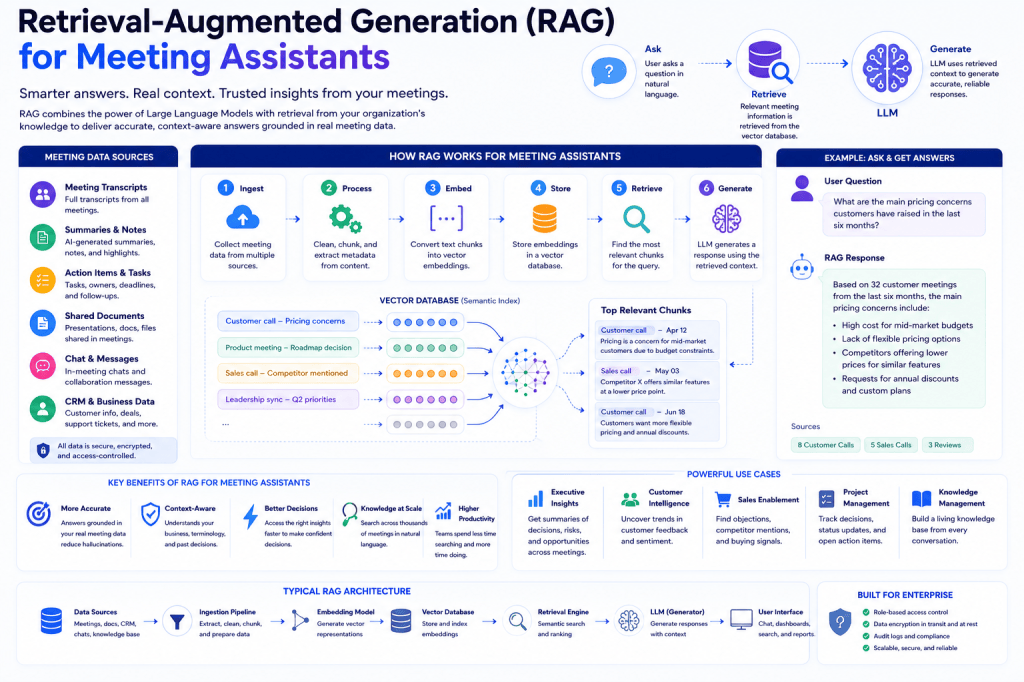
How RAG Works in Meeting Assistants
Step 1: Meeting Data Collection
The process begins when an AI meeting assistant captures conversations.
Data sources may include:
- Meeting transcripts
- Summaries
- Action items
- Decisions
- Notes
- Shared documents
- Chat messages
Every interaction becomes part of a growing knowledge repository.
Step 2: Knowledge Processing
Meeting content is processed and structured.
The AI extracts:
- Topics
- Decisions
- Participants
- Customer insights
- Tasks
- Risks
- Opportunities
This information is then prepared for retrieval.
Step 3: Vector Embedding Creation
The content is converted into vector embeddings.
Embeddings are numerical representations that capture semantic meaning.
This allows AI systems to understand relationships between concepts rather than relying solely on keyword matching.
For example:
- “Pricing concerns”
- “Subscription cost issues”
- “Budget objections”
may be recognized as related topics even if the exact words differ.
Step 4: Storage in a Vector Database
Embeddings are stored in specialized vector databases.
Popular options include:
- Pinecone
- Weaviate
- Qdrant
- Milvus
- Chroma
- pgvector
The vector database becomes the retrieval layer for meeting intelligence.
Step 5: Query and Retrieval
When a user asks a question, the system:
- Converts the question into an embedding.
- Searches the vector database.
- Finds the most relevant meeting content.
- Retrieves supporting information.
The AI gathers context before generating a response.
Step 6: Response Generation
The retrieved information is passed to a large language model.
The model generates a response grounded in actual meeting data rather than assumptions.
This significantly improves accuracy and relevance.
Why RAG Is Valuable for Meeting Assistants
Access to Organizational Memory
RAG enables meeting assistants to act as organizational memory systems.
Employees can ask:
- What decisions were made?
- What commitments were discussed?
- Which risks were identified?
- What customer feedback has been recurring?
The AI can search across thousands of conversations and return meaningful answers.
Reduced Hallucinations
One of the biggest challenges with generative AI is hallucination—the generation of incorrect or fabricated information.
Because RAG grounds responses in retrieved data, answers become more reliable and verifiable.
Context-Aware Insights
Meeting assistants gain access to broader organizational context.
Instead of analyzing a single meeting in isolation, AI can identify:
- Trends across meetings
- Recurring concerns
- Long-term project evolution
- Customer sentiment patterns
This leads to deeper insights.
Improved Searchability
Employees no longer need to manually search transcripts or recordings.
Natural-language queries make information easier to discover.
For example:
- “Show all discussions about GDPR compliance.”
- “What were the main objections during recent sales calls?”
- “Summarize roadmap decisions from Q1.”
The AI retrieves and synthesizes relevant information instantly.
Enterprise Use Cases
Sales Intelligence
RAG-powered meeting assistants can analyze customer conversations to identify:
- Buying signals
- Competitive mentions
- Pricing objections
- Product requests
Sales teams gain a comprehensive view of customer interactions.
Customer Success
Customer-facing teams can search historical meetings to understand:
- Account history
- Previous commitments
- Escalation patterns
- Renewal risks
This improves customer engagement and retention.
Product Management
Product teams can discover:
- Feature requests
- User pain points
- Roadmap discussions
- Technical concerns
Meeting intelligence becomes a valuable source of product feedback.
Executive Decision Support
Leadership teams can ask strategic questions such as:
- What operational risks were discussed this quarter?
- Which initiatives are behind schedule?
- What trends are emerging across departments?
RAG helps executives make better-informed decisions.
Building a RAG Architecture for Meeting Data
A typical architecture includes:
Data Sources
- Meeting transcripts
- Summaries
- CRM notes
- Project records
- Knowledge base articles
- Internal documents
Processing Layer
Responsible for:
- Data cleaning
- Chunking
- Metadata extraction
- Embedding generation
Vector Database
Stores embeddings for efficient semantic retrieval.
Retrieval Engine
Finds the most relevant information based on user queries.
Large Language Model
Generates context-aware responses using retrieved data.
User Interface
Provides:
- Conversational search
- Meeting intelligence dashboards
- Knowledge discovery tools
Together, these components create a powerful AI assistant.
Security and Governance Considerations
Because meeting data often contains sensitive information, organizations should prioritize governance.
Important considerations include:
Access Controls
Users should only retrieve information they are authorized to access.
Data Encryption
Meeting data should be protected both in transit and at rest.
Metadata Security
Sensitive metadata should be managed carefully.
Audit Logging
Organizations should track:
- Queries
- Retrieved content
- User activity
Regulatory Compliance
Support may be required for:
- GDPR
- SOC 2
- ISO 27001
- HIPAA (where applicable)
Strong governance ensures responsible AI deployment.
Benefits of RAG-Powered Meeting Assistants
Organizations implementing RAG can achieve:
Faster Information Access
Employees find answers in seconds rather than hours.
Better Decision-Making
AI provides context-rich insights from historical conversations.
Improved Knowledge Management
Meeting intelligence becomes searchable and reusable.
Greater Productivity
Teams spend less time searching and more time acting.
Stronger Organizational Memory
Critical knowledge remains accessible even as teams change.
The Future of RAG in Meeting Intelligence
RAG is expected to play a central role in the next generation of AI meeting platforms.
Future capabilities may include:
- Real-time meeting assistance
- Cross-meeting intelligence
- Predictive recommendations
- Autonomous workflow execution
- Enterprise knowledge graphs
- Personalized organizational memory
Meeting assistants will evolve from note-taking tools into intelligent business advisors that understand the full context of an organization’s knowledge.
Conclusion
Retrieval-Augmented Generation is transforming AI meeting assistants by enabling them to access and reason over organizational knowledge. By combining semantic retrieval with advanced language generation, RAG allows meeting platforms to deliver more accurate, context-aware, and trustworthy insights.
As organizations accumulate vast amounts of meeting data, the ability to retrieve and apply that knowledge effectively becomes a significant competitive advantage. Companies that embrace RAG-powered meeting intelligence can improve decision-making, strengthen collaboration, and unlock the full value of their organizational memory.

 Meeting Notes AI