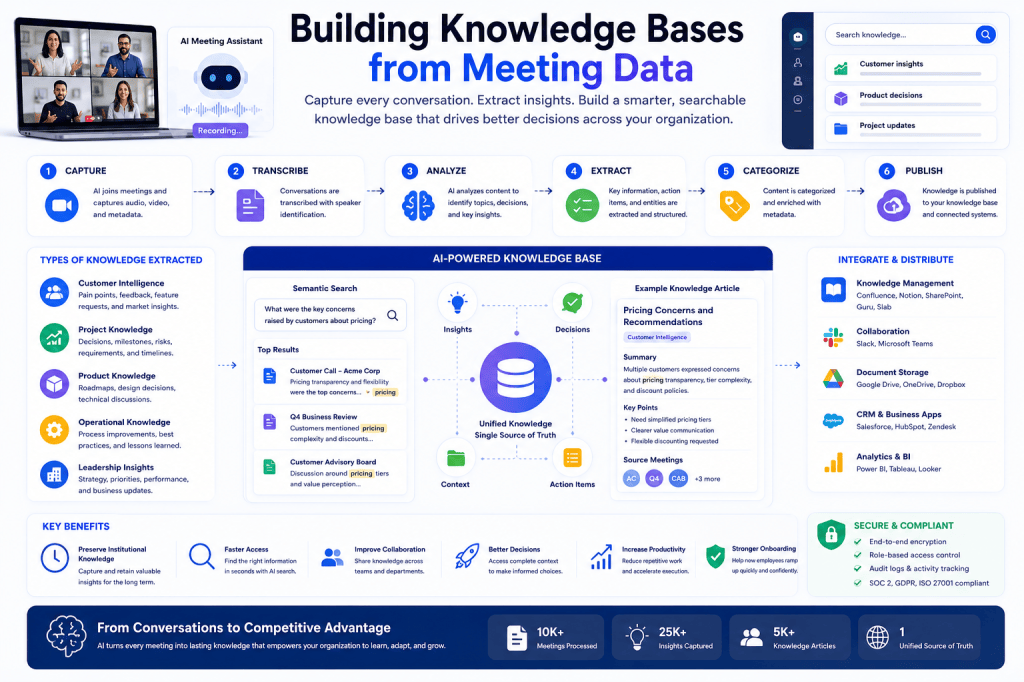
Every organization generates an enormous amount of knowledge through meetings. Customer calls reveal market needs, project discussions document decisions, leadership meetings define strategy, and team collaborations capture lessons learned. Yet despite the value of these conversations, much of this information is never formally documented or shared across the organization.
Important insights often remain buried in recordings, scattered across notes, or stored in individual employees’ memories. As teams grow and employee turnover increases, organizations risk losing valuable institutional knowledge that could otherwise improve decision-making, accelerate onboarding, and enhance operational efficiency.
Artificial Intelligence is changing this landscape.
Modern AI meeting platforms can automatically capture conversations, generate transcripts, identify key insights, and transform meeting content into structured knowledge assets. By leveraging AI-powered meeting intelligence, organizations can build dynamic knowledge bases that continuously evolve as new conversations occur.
As enterprises seek to become more data-driven and knowledge-centric, building knowledge bases from meeting data is emerging as one of the most powerful applications of AI meeting technology.
What Is a Knowledge Base?
A knowledge base is a centralized repository of information that allows employees to access, search, and share organizational knowledge.
Knowledge bases often contain:
- Policies and procedures
- Product documentation
- Customer insights
- Project records
- Best practices
- Technical documentation
- Training materials
- Decision histories
The goal is to create a single source of truth that helps employees find information quickly and make informed decisions.
Traditionally, knowledge bases rely on manually created content. AI meeting platforms introduce a new approach by generating knowledge directly from workplace conversations.
Why Meeting Data Is Valuable
Meetings are one of the richest sources of organizational intelligence.
Every day, teams discuss:
- Customer challenges
- Product improvements
- Strategic priorities
- Operational processes
- Project decisions
- Industry trends
- Risk assessments
- Lessons learned
These conversations often contain information that never makes its way into formal documentation.
Without a system for capturing and organizing this knowledge, organizations face challenges such as:
- Information silos
- Repeated discussions
- Lost expertise
- Inconsistent decision-making
- Slow onboarding
- Reduced productivity
AI-powered knowledge capture helps solve these problems.
How AI Converts Meetings into Knowledge
Step 1: Meeting Capture
The process begins when an AI meeting assistant records a conversation.
The platform captures:
- Audio
- Speaker participation
- Meeting metadata
- Shared content
- Discussion topics
Every meeting becomes a potential source of knowledge.
Step 2: Automatic Transcription
AI converts spoken conversations into searchable text.
Modern transcription systems can:
- Identify speakers
- Timestamp discussions
- Support multiple languages
- Recognize technical terminology
The transcript serves as the foundation for knowledge extraction.
Step 3: AI Analysis
Natural Language Processing (NLP) and Large Language Models (LLMs) analyze the content.
The AI identifies:
- Key topics
- Decisions
- Action items
- Risks
- Opportunities
- Frequently discussed themes
This transforms unstructured conversations into structured information.
Step 4: Knowledge Categorization
The system classifies information into relevant categories.
Examples include:
- Product Knowledge
- Customer Insights
- Project Documentation
- Technical Discussions
- Compliance Information
- Process Improvements
Categorization improves discoverability and organization.
Step 5: Knowledge Base Publication
Insights are automatically stored in a searchable repository.
Employees can access information through:
- Internal portals
- Knowledge management systems
- Enterprise search tools
- AI-powered assistants
Knowledge becomes accessible across the organization.
Types of Knowledge Extracted from Meetings
Customer Intelligence
Customer-facing meetings often contain valuable insights about:
- Customer pain points
- Product feedback
- Competitive threats
- Buying behavior
- Feature requests
Capturing this information helps improve products, services, and customer experiences.
Project Knowledge
Project meetings frequently generate:
- Decisions
- Requirements
- Milestones
- Risks
- Lessons learned
A knowledge base preserves project history and context.
Product Knowledge
Product teams discuss:
- Roadmaps
- User requirements
- Technical constraints
- Release planning
Documenting these conversations helps align teams and preserve institutional knowledge.
Operational Knowledge
Operational meetings often reveal:
- Process improvements
- Efficiency opportunities
- Compliance requirements
- Organizational best practices
This information supports continuous improvement initiatives.
Leadership Insights
Executive discussions often contain strategic information related to:
- Business priorities
- Organizational goals
- Market trends
- Investment decisions
Making this knowledge accessible improves alignment across teams.
Benefits of Building Knowledge Bases from Meeting Data
Preserving Institutional Knowledge
Organizations often lose valuable expertise when employees leave.
AI-generated knowledge bases help preserve:
- Historical decisions
- Best practices
- Tribal knowledge
- Organizational context
Knowledge remains available regardless of workforce changes.
Reducing Information Silos
Meeting insights become accessible to employees across departments.
Teams can learn from one another without needing direct participation in every discussion.
Accelerating Onboarding
New employees can quickly understand:
- Company processes
- Product history
- Customer challenges
- Project decisions
This reduces ramp-up time and improves productivity.
Improving Decision-Making
Employees gain access to historical context and organizational knowledge.
Better information often leads to better decisions.
Increasing Productivity
Instead of searching through recordings or asking colleagues for information, employees can quickly locate relevant knowledge.
This reduces time spent searching and increases operational efficiency.
AI-Powered Search and Discovery
Traditional knowledge bases often suffer from poor search experiences.
AI-powered systems improve discovery through:
Semantic Search
Employees can search using natural language rather than exact keywords.
For example:
- “What concerns did customers raise about pricing?”
- “Why was the Q3 roadmap changed?”
- “What decisions were made during the last product review?”
AI understands intent and returns relevant results.
Intelligent Summaries
Instead of reviewing entire transcripts, employees can access concise summaries of relevant discussions.
Knowledge Recommendations
AI can proactively suggest related content based on:
- User activity
- Current projects
- Search behavior
- Organizational context
This helps employees discover valuable information more efficiently.
Popular Knowledge Management Platforms
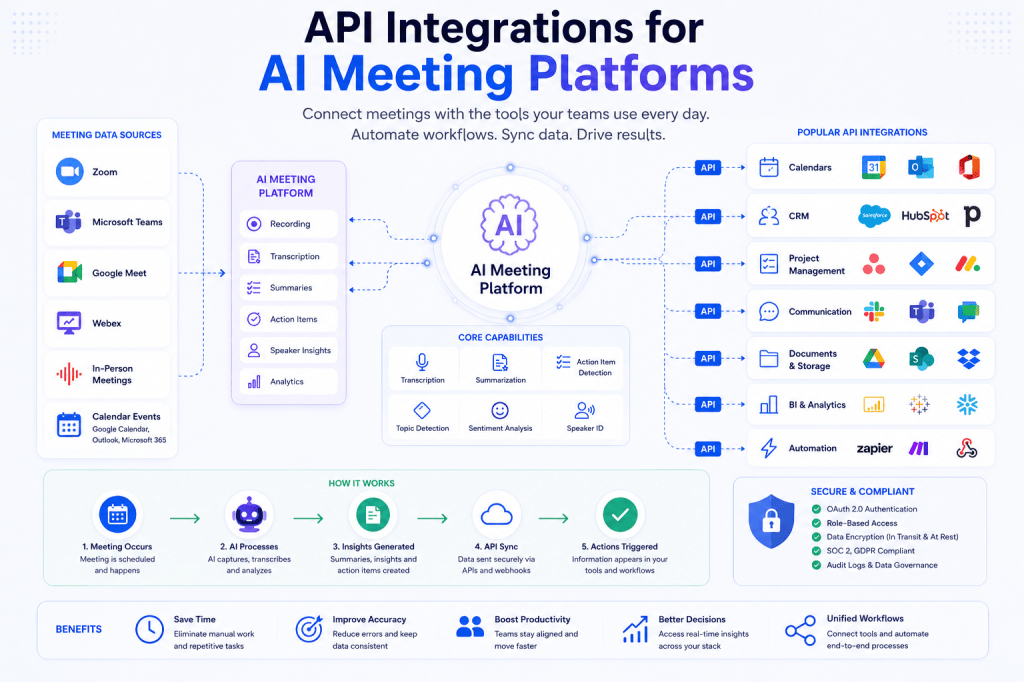
Organizations often integrate AI meeting platforms with:
- Notion
- Confluence
- SharePoint
- Guru
- Slab
- Google Drive
- Microsoft OneDrive
Meeting insights can automatically populate these systems and enrich existing knowledge repositories.
Security and Governance Considerations
Because meeting content often contains sensitive information, governance is critical.
Organizations should evaluate:
Access Controls
Users should only access information relevant to their roles.
Data Retention Policies
Knowledge assets should follow organizational retention requirements.
Audit Logging
Organizations should track:
- Content creation
- Access activity
- Knowledge updates
Regulatory Compliance
Support may be required for:
- GDPR
- SOC 2
- ISO 27001
- HIPAA (where applicable)
Strong governance ensures responsible knowledge management.
The Future of AI-Powered Knowledge Bases
The next generation of knowledge systems will move beyond static repositories.
Future capabilities may include:
- Autonomous knowledge generation
- Real-time organizational memory
- AI-generated documentation
- Decision intelligence systems
- Predictive knowledge recommendations
- Cross-functional insight discovery
- Enterprise knowledge graphs
Instead of simply storing information, AI systems will actively help organizations understand and apply their collective knowledge.
Best Practices for Building Knowledge Bases from Meeting Data
Organizations seeking to maximize value should:
- Capture meetings consistently.
- Define clear knowledge categories.
- Integrate meeting intelligence with existing knowledge platforms.
- Implement strong governance policies.
- Enable AI-powered search capabilities.
- Establish content review and validation processes.
- Continuously measure knowledge usage and impact.
These practices help ensure long-term success.
Conclusion
Building knowledge bases from meeting data represents one of the most valuable opportunities for organizations adopting AI meeting technology. By automatically capturing conversations, extracting insights, and transforming discussions into searchable organizational knowledge, businesses can preserve expertise, improve collaboration, and accelerate decision-making.
As AI continues to evolve, knowledge bases will become increasingly intelligent, dynamic, and context-aware. Organizations that invest in AI-powered knowledge management today will be better positioned to unlock the full value of their collective intelligence and create a lasting competitive advantage.

 Meeting Notes AI