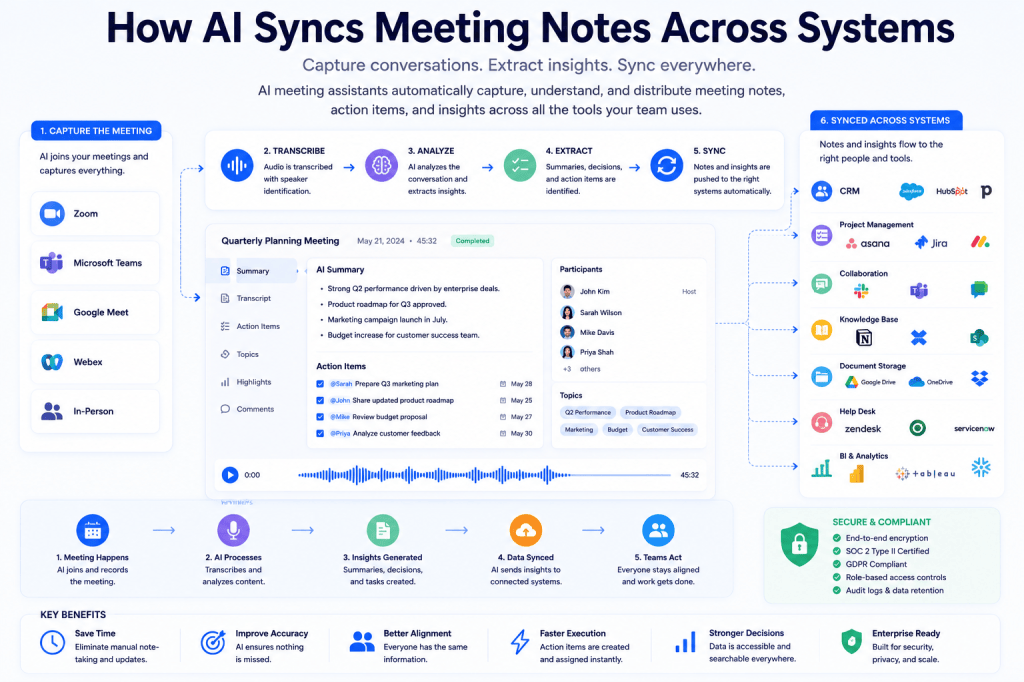
Meetings generate some of the most valuable information within an organization. Customer conversations reveal opportunities and risks, project meetings define next steps, leadership discussions shape strategy, and team collaborations drive execution. Yet despite their importance, meeting notes often remain scattered across emails, documents, collaboration tools, project management systems, and customer databases.
This fragmentation creates a significant challenge for organizations.
Important information becomes difficult to find, action items get lost, teams work from outdated records, and employees spend valuable time manually transferring information between systems.
Artificial Intelligence is helping solve this problem.
Modern AI meeting assistants can automatically capture meeting discussions, generate summaries, identify action items, and synchronize information across multiple business applications. By connecting meetings to the tools employees already use, AI creates a unified source of truth that improves collaboration, reduces administrative work, and ensures critical information is always accessible.
As organizations continue to embrace digital transformation, AI-powered note synchronization is becoming a foundational capability for workplace productivity.
The Challenge of Disconnected Meeting Notes
Most organizations use a variety of software tools to manage different aspects of their operations.
Common systems include:
- Customer Relationship Management (CRM) platforms
- Project management tools
- Collaboration platforms
- Knowledge bases
- Document management systems
- Help desk solutions
- Business intelligence platforms
While each system serves a specific purpose, meeting information often needs to exist in several of them simultaneously.
For example, a single customer meeting may generate:
- CRM updates
- Project tasks
- Product feedback
- Internal action items
- Team notifications
Manually updating every system is time-consuming and prone to errors.
This is where AI-powered synchronization becomes valuable.
What Is AI-Powered Meeting Note Synchronization?
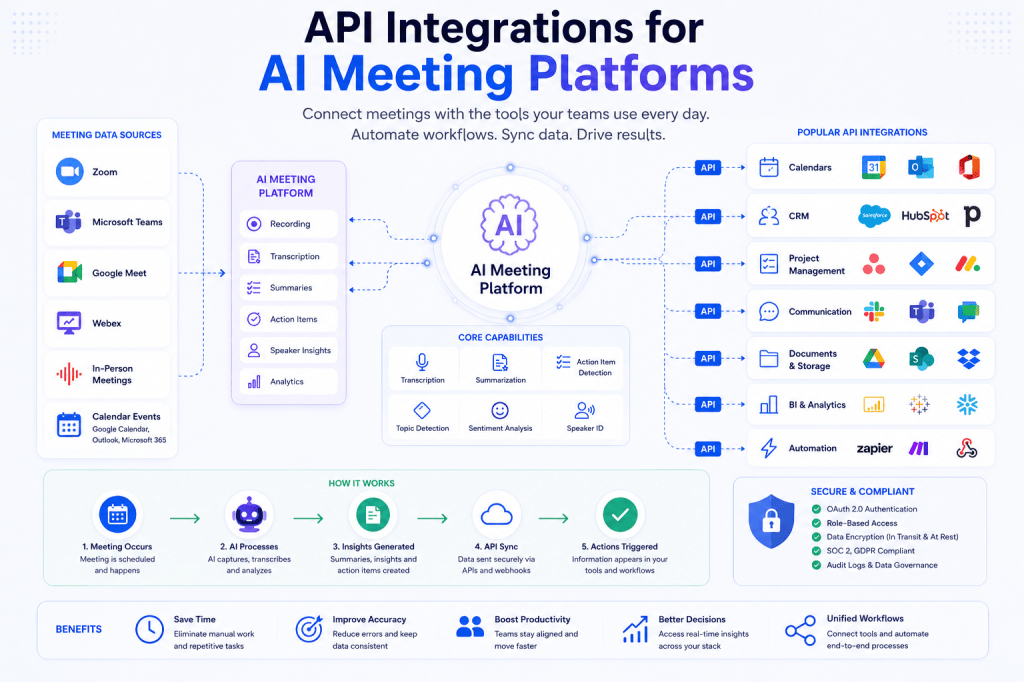
AI-powered synchronization is the process of automatically distributing meeting insights across connected business systems.
Instead of requiring employees to manually copy information between applications, AI analyzes conversations and updates relevant platforms automatically.
The process typically includes:
- Meeting recording
- Transcription
- Summarization
- Insight extraction
- Task identification
- System synchronization
The result is a consistent and accurate flow of information across the organization.
How AI Captures Meeting Information
The synchronization process begins with meeting capture.
AI meeting assistants can automatically join meetings conducted through platforms such as:
- Zoom
- Microsoft Teams
- Google Meet
- Webex
The system records and processes:
- Audio
- Speaker participation
- Meeting metadata
- Shared content
- Discussion topics
Every conversation becomes a structured source of information.
Step 1: Automatic Transcription
Once a meeting is recorded, AI converts spoken dialogue into searchable text.
Modern transcription systems can:
- Recognize multiple speakers
- Support multiple languages
- Identify timestamps
- Capture industry-specific terminology
The transcript serves as the foundation for further analysis.
Step 2: AI Summarization
Large Language Models (LLMs) and Natural Language Processing (NLP) technologies analyze transcripts to generate concise summaries.
These summaries often include:
- Key discussion points
- Decisions made
- Risks identified
- Opportunities discussed
- Next steps
This allows teams to review outcomes quickly without reading lengthy transcripts.
Step 3: Action Item Detection
AI identifies commitments and tasks mentioned during conversations.
Examples include:
- “Sarah will prepare the proposal by Friday.”
- “Engineering will review the API documentation.”
- “Marketing will launch the campaign next month.”
The AI extracts:
- Task descriptions
- Assigned owners
- Due dates
- Priorities
These action items can then be synchronized across systems automatically.
Step 4: Context Classification
One of the most powerful capabilities of modern AI systems is understanding context.
The platform can determine:
- Whether a meeting relates to a customer account
- Which project is being discussed
- Which department owns the information
- Which systems require updates
This enables intelligent routing of information.
For example:
A sales conversation may update a CRM, while a project review may update a project management platform.
Systems Commonly Synced by AI Meeting Assistants
CRM Platforms
Customer meetings often generate valuable account intelligence.
AI can automatically synchronize notes with:
- Salesforce
- HubSpot
- Microsoft Dynamics 365
- Pipedrive
- Zoho CRM
Updates may include:
- Contact notes
- Opportunity information
- Customer requirements
- Follow-up tasks
- Meeting histories
This improves customer visibility and reduces manual data entry.
Project Management Tools
Project-related meetings frequently produce tasks and decisions.
AI can synchronize information with:
- Asana
- Jira
- Monday.com
- ClickUp
- Trello
- Wrike
Updates may include:
- New tasks
- Project milestones
- Risk logs
- Sprint updates
- Status changes
This ensures execution aligns with meeting outcomes.
Collaboration Platforms
Meeting summaries and updates can be shared through:
- Slack
- Microsoft Teams
- Discord
- Workplace communication tools
This helps stakeholders stay informed even if they did not attend the meeting.
Knowledge Management Systems
Organizations often use meeting notes as part of their institutional knowledge.
AI can synchronize information with:
- Notion
- Confluence
- SharePoint
- Google Drive
- OneDrive
Meeting intelligence becomes searchable and accessible across the organization.
Help Desk and Support Platforms
Customer support discussions may generate updates for:
- Zendesk
- Freshdesk
- ServiceNow
- Jira Service Management
This improves customer issue tracking and resolution.
Technologies That Enable Synchronization
APIs
Application Programming Interfaces allow AI meeting assistants to exchange data with external systems.
APIs enable:
- Record creation
- Data updates
- Workflow execution
- Information retrieval
Most modern business applications provide APIs specifically for integrations.
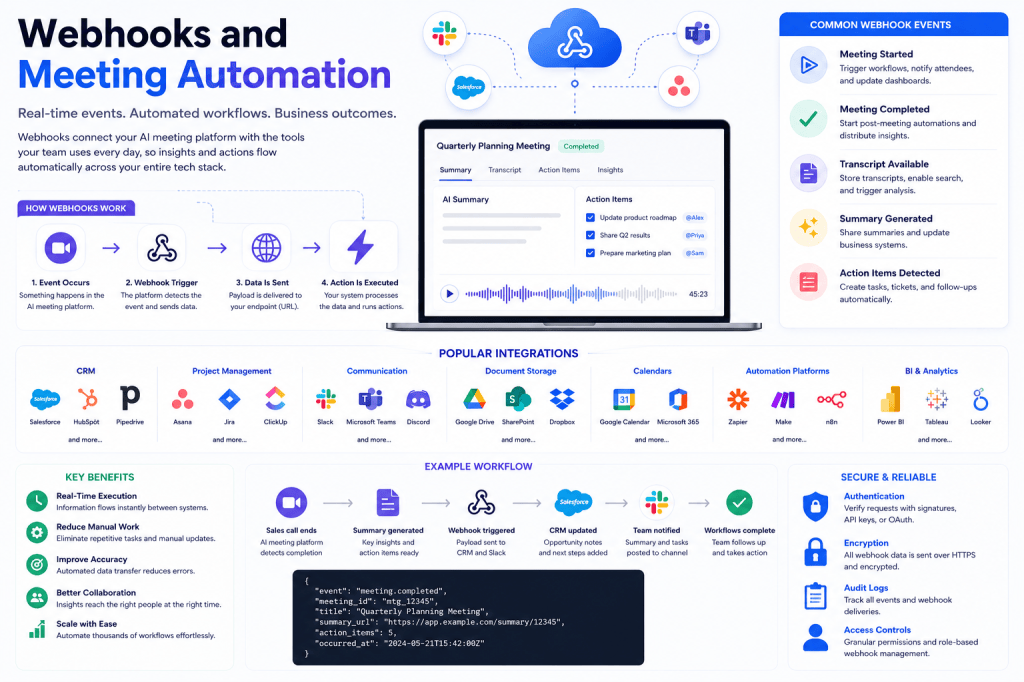
Webhooks
Webhooks provide real-time communication between systems.
When a meeting summary or action item becomes available, webhooks can instantly trigger updates in connected platforms.
Workflow Automation Platforms
Many organizations use automation platforms such as:
- Zapier
- Make
- Workato
- Tray.io
- Microsoft Power Automate
- n8n
These platforms help orchestrate synchronization workflows across multiple systems.
Benefits of AI-Powered Synchronization
Reduced Administrative Work
Employees spend less time manually updating records and more time focusing on strategic work.
Improved Data Accuracy
Automated synchronization minimizes errors and omissions associated with manual data entry.
Faster Information Sharing
Meeting insights become available immediately across connected systems.
Better Accountability
Action items are automatically documented and assigned.
Stronger Collaboration
Teams work from consistent and up-to-date information.
Increased Productivity
Organizations eliminate redundant processes and streamline workflows.
Security and Compliance Considerations
Because meeting notes often contain sensitive information, organizations should evaluate:
Access Controls
Only authorized users should access synchronized information.
Data Encryption
Information should be encrypted during transmission and storage.
Audit Logging
Organizations should maintain visibility into synchronization activity.
Data Retention Policies
Meeting records should follow organizational governance requirements.
Regulatory Compliance
Businesses may need support for:
- GDPR
- SOC 2
- ISO 27001
- HIPAA (where applicable)
Strong security practices help ensure responsible information management.
The Future of AI Note Synchronization
The next generation of AI meeting platforms will move beyond simple synchronization.
Future capabilities may include:
- Autonomous workflow execution
- Predictive task creation
- Intelligent prioritization
- Cross-system decision tracking
- Automated project updates
- AI-powered knowledge management
- Real-time organizational intelligence
Instead of merely distributing information, AI systems will increasingly coordinate actions across entire business ecosystems.
Conclusion
AI-powered meeting note synchronization is transforming how organizations manage and share information. By automatically capturing conversations, generating insights, identifying action items, and updating connected systems, AI eliminates manual work while improving consistency and collaboration.
As businesses continue to adopt AI-driven workflows, synchronized meeting intelligence will become a critical component of organizational productivity. Companies that embrace this technology can create a unified source of truth, accelerate execution, and ensure that valuable conversations lead to meaningful business outcomes.

 Meeting Notes AI