AI meeting platforms have transformed how organizations capture, analyze, and act on conversations. From automatic transcription and meeting summaries to action item extraction and conversation intelligence, these platforms generate valuable business insights from every meeting.
However, the true power of AI meeting platforms emerges when they connect with the broader technology ecosystem used by modern organizations.
This is where API integrations play a crucial role.
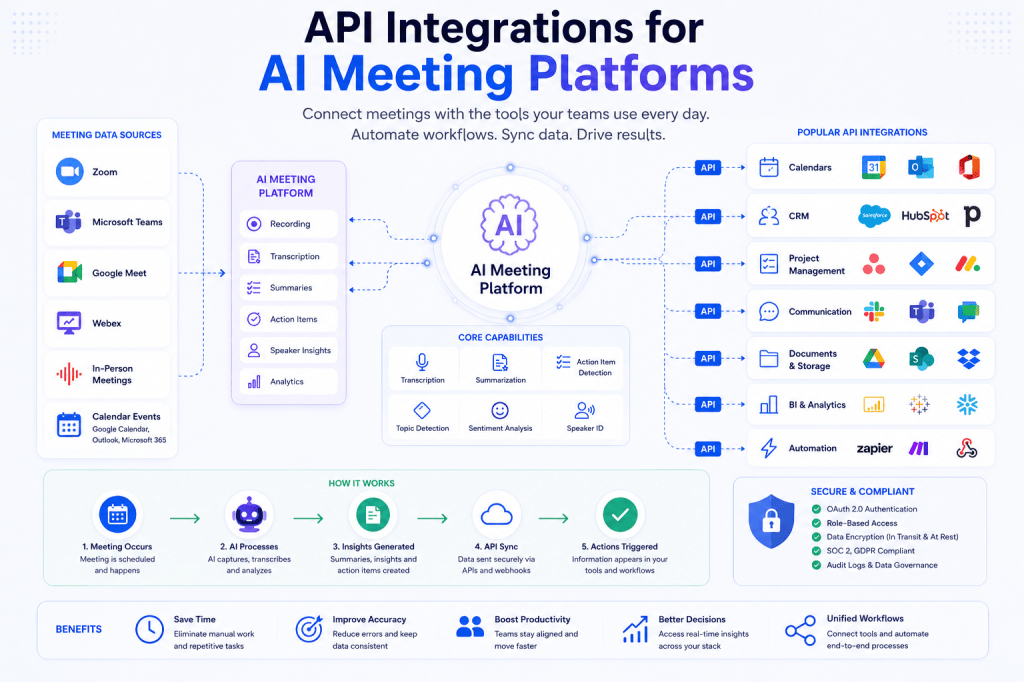
Application Programming Interfaces (APIs) enable AI meeting platforms to exchange information with calendars, CRM systems, project management tools, communication platforms, business intelligence solutions, and countless other applications. By creating seamless data flows across systems, APIs help organizations automate workflows, eliminate manual work, and unlock the full value of meeting intelligence.
As businesses increasingly rely on interconnected software ecosystems, API integrations have become a foundational component of successful AI meeting platform deployments.
What Are API Integrations?
An API, or Application Programming Interface, is a set of rules and protocols that allows different software applications to communicate with each other.
APIs enable systems to:
- Exchange data
- Trigger actions
- Synchronize information
- Automate workflows
- Access platform functionality
For AI meeting platforms, APIs serve as the bridge between meeting intelligence and other business applications.
Rather than operating as isolated tools, AI meeting solutions become part of a larger digital workplace ecosystem.
Why API Integrations Matter for AI Meeting Platforms
Meetings generate valuable information that impacts multiple departments and business processes.
Examples include:
- Customer insights
- Sales opportunities
- Project updates
- Action items
- Product feedback
- Strategic decisions
- Compliance records
Without integrations, this information often remains trapped inside meeting platforms.
API integrations ensure that meeting data flows directly into the systems where teams already work.
Benefits include:
- Reduced manual data entry
- Improved operational efficiency
- Better data accuracy
- Faster decision-making
- Enhanced collaboration
- Increased automation
The result is a more connected and intelligent organization.
How API Integrations Work
Data Collection
The process begins when an AI meeting platform captures information from a meeting.
This may include:
- Audio recordings
- Transcripts
- Summaries
- Action items
- Speaker information
- Meeting metadata
The platform organizes this information into structured formats.
API Requests
Once data is available, APIs enable the platform to communicate with external systems.
Typical API interactions include:
- Sending meeting summaries
- Creating CRM records
- Updating project tasks
- Posting collaboration messages
- Triggering workflow automations
Data is exchanged securely using standardized protocols such as REST APIs and webhooks.
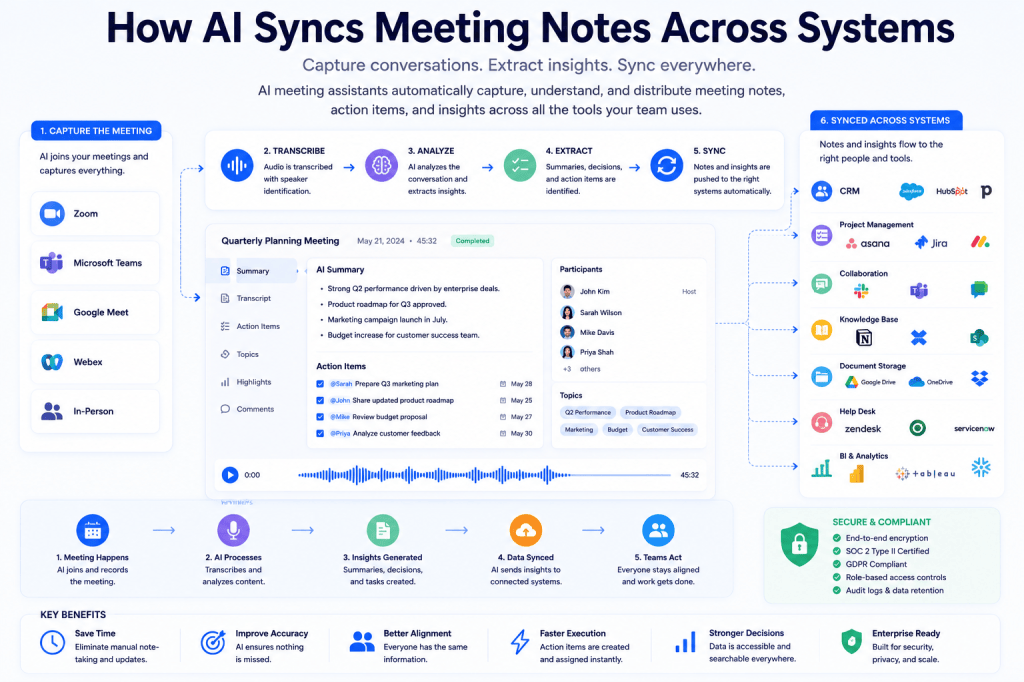
Real-Time Synchronization
Many integrations operate in real time.
For example:
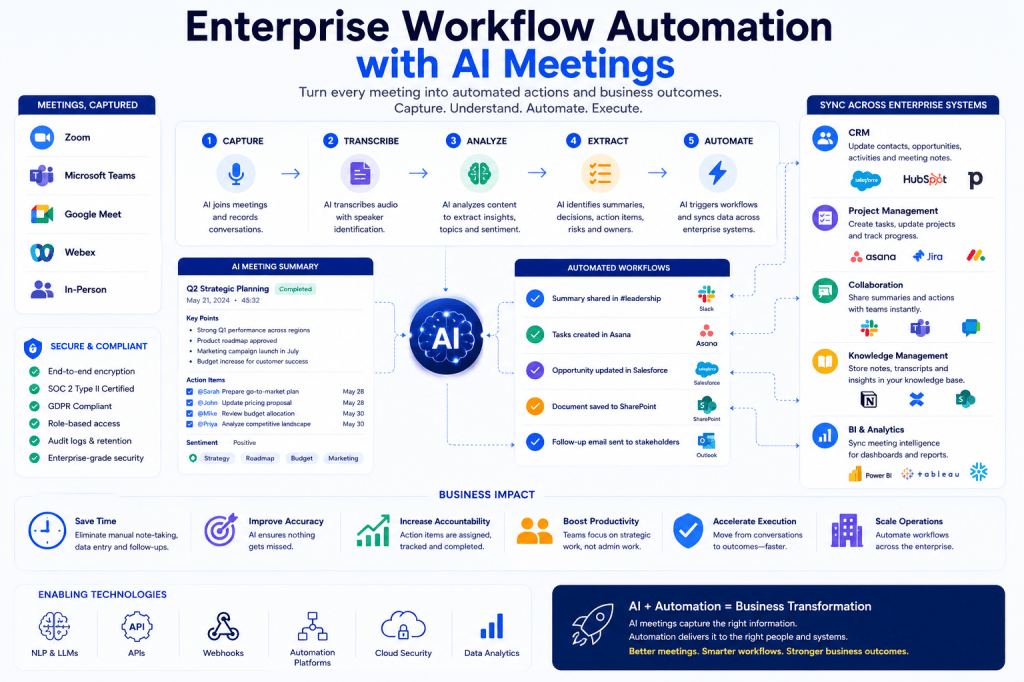
- A meeting ends.
- AI generates a summary.
- The summary is sent to a CRM.
- Action items are created in a project management tool.
- Notifications are posted to Slack.
This entire workflow can occur automatically within seconds.
Common API Integrations for AI Meeting Platforms
Calendar APIs
Calendar integrations help AI meeting assistants understand when meetings occur and who is attending.
Common integrations include:
- Google Calendar API
- Microsoft Graph API
- Outlook Calendar API
These APIs enable:
- Automatic meeting detection
- Scheduling automation
- Calendar synchronization
- Meeting preparation workflows
Calendar integrations often serve as the foundation for AI meeting automation.
CRM APIs
Customer conversations are among the most valuable sources of business intelligence.
CRM integrations allow AI meeting platforms to synchronize information with systems such as:
- Salesforce
- HubSpot
- Microsoft Dynamics 365
- Pipedrive
- Zoho CRM
Meeting insights can automatically update:
- Contact records
- Opportunities
- Account notes
- Activity histories
- Pipeline information
This improves customer visibility while reducing administrative work.
Project Management APIs
Meetings frequently generate tasks, assignments, and project updates.
Project management integrations connect AI meeting platforms with:
- Asana
- Jira
- Monday.com
- ClickUp
- Trello
- Wrike
These integrations can:
- Create tasks automatically
- Assign owners
- Set deadlines
- Update project boards
- Track action item completion
This helps organizations move from discussion to execution more efficiently.
Communication Platform APIs
Modern teams rely heavily on collaboration platforms.
AI meeting assistants often integrate with:
- Slack
- Microsoft Teams
- Discord
- Workplace platforms
Meeting intelligence can be distributed through:
- Automated summaries
- Channel notifications
- Task assignments
- Workflow triggers
This keeps stakeholders informed without requiring manual follow-up.
Document Management APIs
Meeting content often needs to be stored and shared.
Document integrations commonly include:
- Google Drive
- SharePoint
- OneDrive
- Dropbox
- Box
Organizations can automatically archive:
- Recordings
- Transcripts
- Meeting summaries
- Compliance documentation
This improves knowledge management and accessibility.
Business Intelligence APIs
Meeting data contains valuable organizational insights.
AI meeting platforms increasingly connect with:
- Power BI
- Tableau
- Looker
- Snowflake
- Data warehouses
These integrations help organizations analyze:
- Meeting trends
- Team productivity
- Customer sentiment
- Sales performance
- Operational efficiency
Meeting intelligence becomes part of broader business analytics initiatives.
Webhooks and Event-Driven Integrations
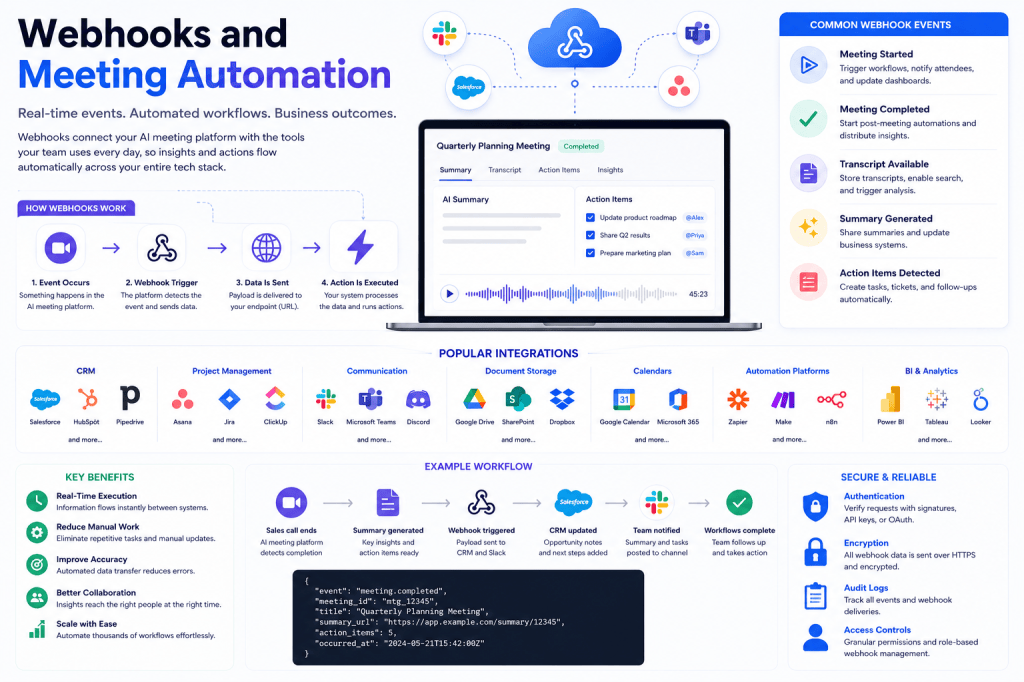
Many modern AI meeting platforms use webhooks to support real-time automation.
A webhook is an automated message sent when a specific event occurs.
Examples include:
- Meeting started
- Meeting completed
- Transcript generated
- Summary created
- Action item identified
External systems can respond immediately to these events.
This creates highly scalable automation workflows.
Benefits of API Integrations
Workflow Automation
Organizations can automate repetitive tasks that previously required manual effort.
Examples include:
- CRM updates
- Task creation
- Follow-up communications
- Document storage
Automation increases efficiency and consistency.
Improved Data Accuracy
Manual data entry often introduces errors and omissions.
API integrations ensure information is synchronized directly between systems.
This improves data quality across the organization.
Better Collaboration
Meeting insights become accessible across teams and departments.
Everyone works from the same information.
Faster Execution
Actions can be triggered immediately after meetings conclude.
Organizations spend less time managing information and more time acting on it.
Security and Compliance Considerations
Because APIs exchange business-critical information, security is essential.
Organizations should evaluate:
Authentication
Secure authentication mechanisms such as OAuth 2.0 should be supported.
Access Controls
Administrators should control who can access data and integrations.
Encryption
Data should be encrypted both in transit and at rest.
Audit Logging
Organizations should maintain visibility into:
- API activity
- Data access
- Workflow execution
Regulatory Compliance
Businesses may require support for:
- GDPR
- SOC 2
- ISO 27001
- HIPAA (where applicable)
- Industry-specific regulations
Strong governance ensures integrations remain secure and compliant.
The Future of API-Driven Meeting Intelligence
As AI capabilities evolve, API integrations will become increasingly sophisticated.
Future developments may include:
- Autonomous workflow execution
- AI-powered decision automation
- Predictive customer insights
- Real-time business intelligence updates
- Cross-platform orchestration
- Intelligent process recommendations
AI meeting platforms will evolve from conversation capture tools into central hubs for organizational intelligence and workflow automation.
Conclusion
API integrations are the foundation that enables AI meeting platforms to deliver maximum business value. By connecting meeting intelligence with calendars, CRM systems, project management tools, communication platforms, and analytics solutions, organizations can automate workflows, improve collaboration, and accelerate decision-making.
As businesses continue to embrace AI-driven operations, API integrations will remain a critical capability that transforms meetings from isolated conversations into connected, actionable, and measurable business outcomes.

 Meeting Notes AI