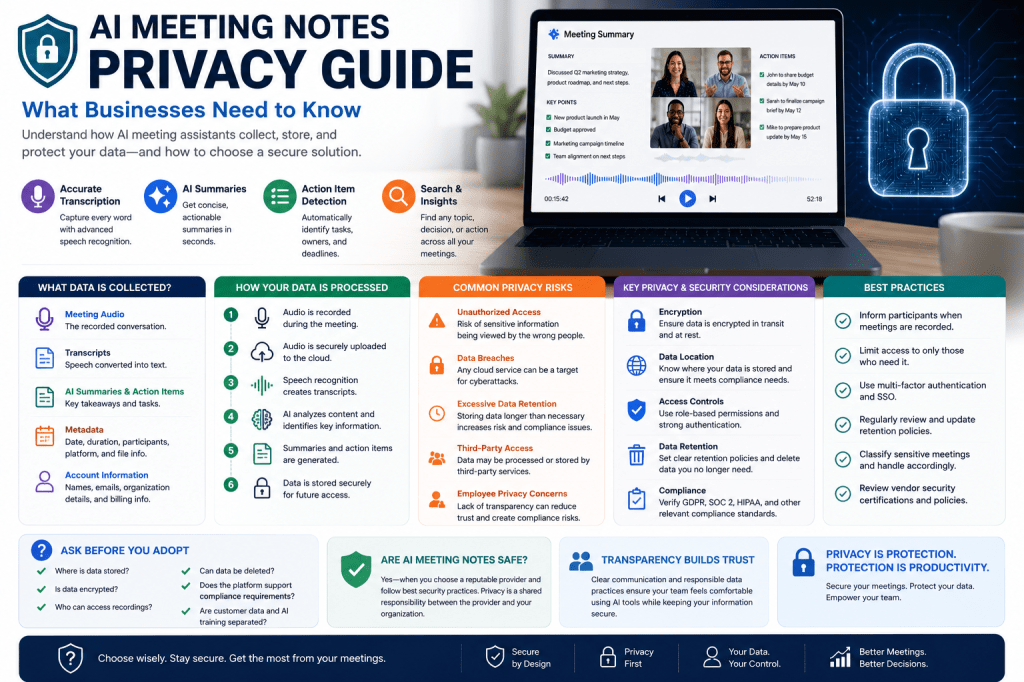
AI meeting notes tools have become essential productivity solutions for modern organizations. They can automatically transcribe meetings, generate summaries, identify action items, and create searchable records of important discussions.
While these capabilities offer significant benefits, they also raise important privacy and security questions.
When an AI meeting assistant records conversations, where does that information go? Who can access it? How long is it stored? And what happens if sensitive business information is discussed during a meeting?
Understanding these issues is critical before adopting any AI-powered meeting solution.
In this guide, we’ll examine how AI meeting note platforms handle data, the most common privacy concerns, and the steps organizations can take to protect sensitive information.
Why Privacy Matters for AI Meeting Notes
Meetings often contain valuable and confidential information.
Examples include:
- Business strategies
- Product roadmaps
- Financial discussions
- Customer information
- Employee matters
- Legal topics
- Intellectual property
When meetings are recorded and processed by AI systems, organizations must ensure that this information remains protected.
Unlike traditional note-taking, AI meeting assistants often store audio recordings, transcripts, summaries, and metadata in cloud environments.
This creates additional privacy considerations.
What Data Do AI Meeting Tools Collect?
Most AI meeting note platforms collect several types of information.
Meeting Audio
The recorded conversation itself.
Transcripts
Speech converted into text.
Meeting Summaries
AI-generated overviews of discussions.
Action Items
Tasks identified during meetings.
Metadata
Information such as:
- Meeting date
- Duration
- Participants
- Platform used
- File information
User Account Information
Depending on the platform, this may include:
- Names
- Email addresses
- Organization details
- Subscription information
Understanding what data is collected is the first step toward evaluating privacy risks.
How AI Meeting Notes Are Processed
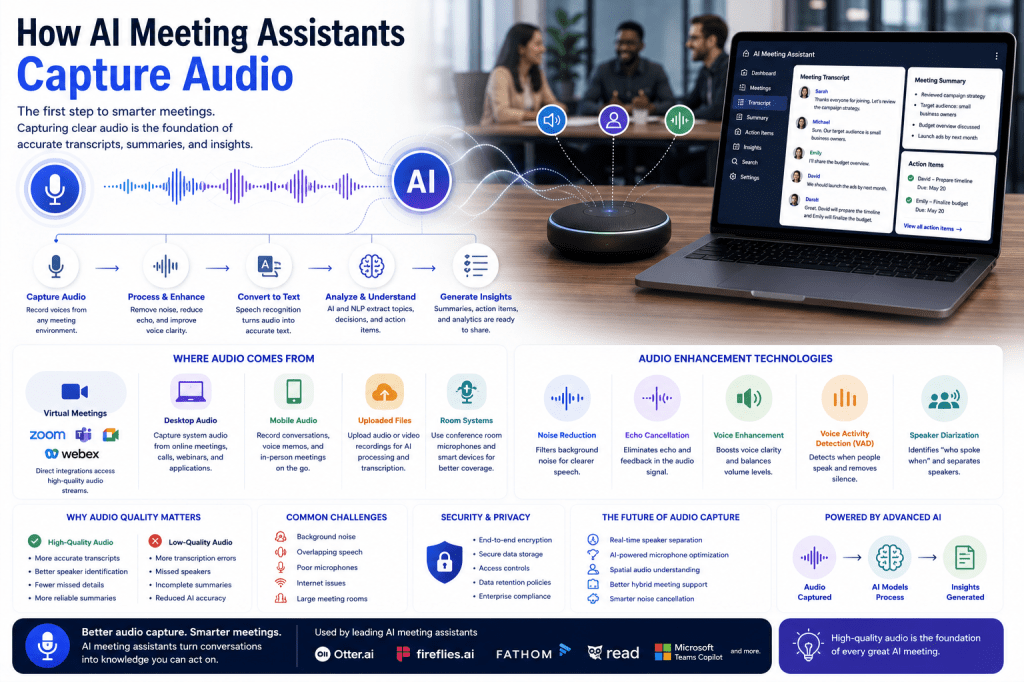
Most modern platforms follow a similar workflow.
- Audio is recorded.
- Audio is uploaded to cloud servers.
- Speech recognition creates transcripts.
- AI models analyze content.
- Summaries and action items are generated.
- Data is stored for future access.
Some providers process information entirely in the cloud, while others offer enterprise deployment options with additional controls.
The processing model can significantly affect privacy and compliance requirements.
Common Privacy Risks
Unauthorized Access
If meeting records are not properly secured, unauthorized users could gain access to sensitive information.
Organizations should review:
- Access controls
- User permissions
- Authentication methods
Data Breaches
Like any cloud service, AI meeting platforms may become targets for cyberattacks.
Strong encryption and security practices are essential.
Excessive Data Retention
Some organizations store meeting records indefinitely.
Long-term storage increases risk and may create compliance challenges.
Third-Party Access
Businesses should understand whether service providers use third-party systems to process or store meeting information.
Employee Privacy Concerns
Employees may feel uncomfortable if meetings are recorded without clear communication and policies.
Transparency is important.
Understanding Data Storage
Before selecting an AI meeting platform, organizations should ask:
Where Is Data Stored?
Different providers may store information in different geographic regions.
This can affect:
- Regulatory compliance
- Data sovereignty requirements
- Organizational policies
How Long Is Data Stored?
Retention policies vary.
Questions to consider:
- Can recordings be deleted?
- Can transcripts be removed?
- Can administrators set retention limits?
Is Data Encrypted?
Encryption should be applied:
- During transmission
- During storage
Strong encryption significantly reduces risk.
AI Meeting Notes and GDPR
Organizations operating in or serving customers within the European Union should pay particular attention to GDPR requirements.
Important considerations include:
Consent
Participants may need to be informed that meetings are being recorded and processed.
Data Minimization
Organizations should collect only the information necessary for legitimate business purposes.
Right to Access
Individuals may request access to their data.
Right to Erasure
Individuals may request deletion of certain personal information.
Organizations should ensure their chosen platform supports these requirements.
AI Meeting Notes and Business Compliance
Certain industries face additional compliance obligations.
Healthcare
Organizations may need to comply with healthcare privacy regulations.
Financial Services
Financial discussions often require strict recordkeeping and security controls.
Legal Services
Client confidentiality requirements are particularly important.
Government Organizations
Additional security standards may apply.
Organizations should evaluate compliance requirements before implementing AI meeting systems.
Questions to Ask Before Choosing a Platform
Before adopting an AI meeting assistant, consider asking:
- How is data stored?
- Is data encrypted?
- Who can access recordings?
- Can data be deleted?
- Does the platform support compliance requirements?
- Are enterprise security controls available?
- What is the retention policy?
- Are customer data and AI training separated?
These questions can help identify potential risks before deployment.
Best Practices for Protecting Meeting Privacy
Inform Participants
Clearly communicate when meetings are being recorded and processed.
Limit Access
Provide access only to individuals who need meeting information.
Use Strong Authentication
Enable:
- Multi-factor authentication
- Single sign-on
- Strong password policies
Review Retention Policies
Delete unnecessary recordings and transcripts.
Classify Sensitive Meetings
Not every meeting should necessarily be recorded.
Organizations should identify discussions that require additional safeguards.
Review Vendor Security Documentation
Evaluate:
- Security certifications
- Compliance programs
- Privacy policies
- Data processing agreements
Are AI Meeting Notes Safe?
For most organizations, AI meeting notes can be used safely when proper controls are in place.
Leading vendors invest heavily in:
- Encryption
- Security monitoring
- Compliance programs
- Access controls
However, organizations remain responsible for evaluating vendors and implementing appropriate policies.
Privacy should be considered a shared responsibility between the provider and the customer.
Frequently Asked Questions
Are AI meeting notes private?
Privacy depends on the platform, its security controls, and how organizations manage access.
Can AI meeting recordings be deleted?
Most platforms allow administrators to delete recordings and transcripts, although policies vary.
Do AI meeting tools use my data to train AI models?
Policies vary by vendor. Organizations should review provider documentation carefully.
Is recording meetings legal?
Requirements vary by jurisdiction. Organizations should ensure compliance with applicable laws and obtain any required consent.
Are AI meeting notes secure?
Leading platforms typically provide strong security features, but organizations should review each vendor’s security practices before adoption.
Final Thoughts
AI meeting notes offer significant productivity benefits, but privacy and security should never be overlooked. Organizations must understand how meeting data is collected, processed, stored, and protected before deploying AI meeting assistants.
By choosing reputable providers, implementing strong access controls, reviewing retention policies, and maintaining transparency with participants, businesses can enjoy the benefits of AI-powered meeting documentation while minimizing privacy risks.
The most successful organizations view privacy as a core part of their AI adoption strategy, not an afterthought.
Related Articles
What Are AI Meeting Notes?
How AI Meeting Notes Work
Benefits of AI Meeting Notes
Are AI Meeting Notes Accurate?
Best AI Meeting Notes Tools in 2026
Best AI Meeting Assistants in 2026
Meeting Transcription Explained
AI Meeting Notes for Remote Teams
AI Meeting Notes for Small Businesses

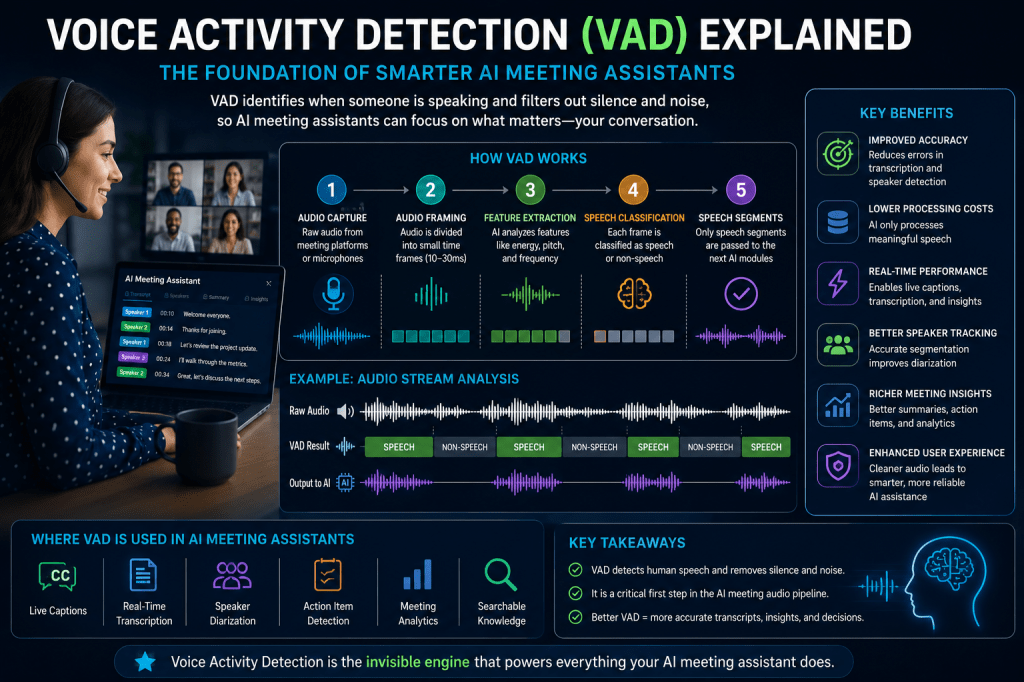
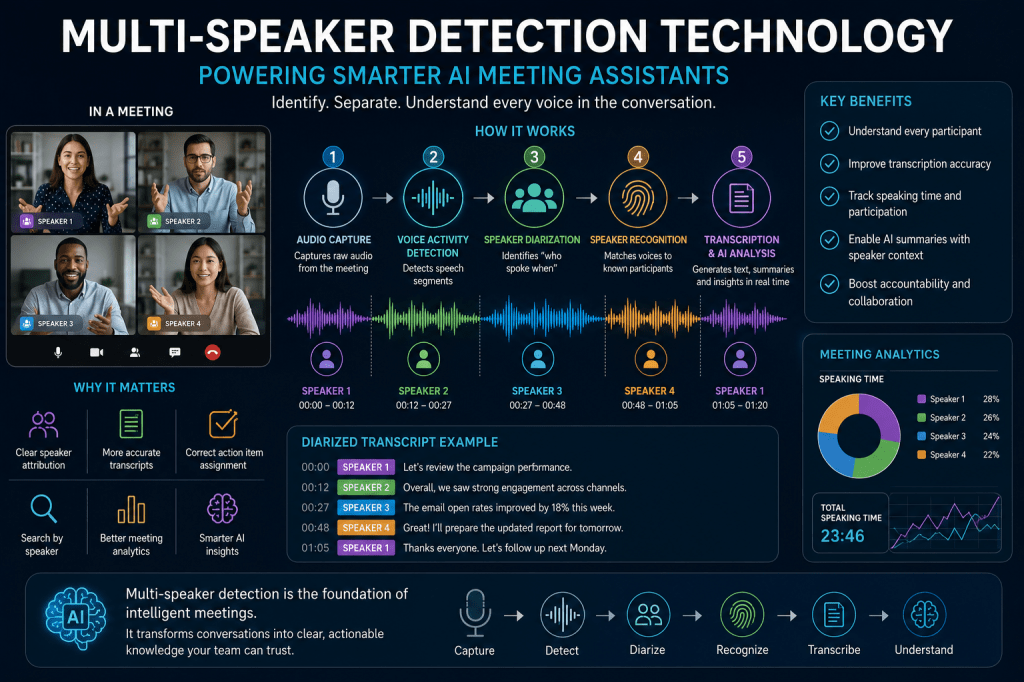
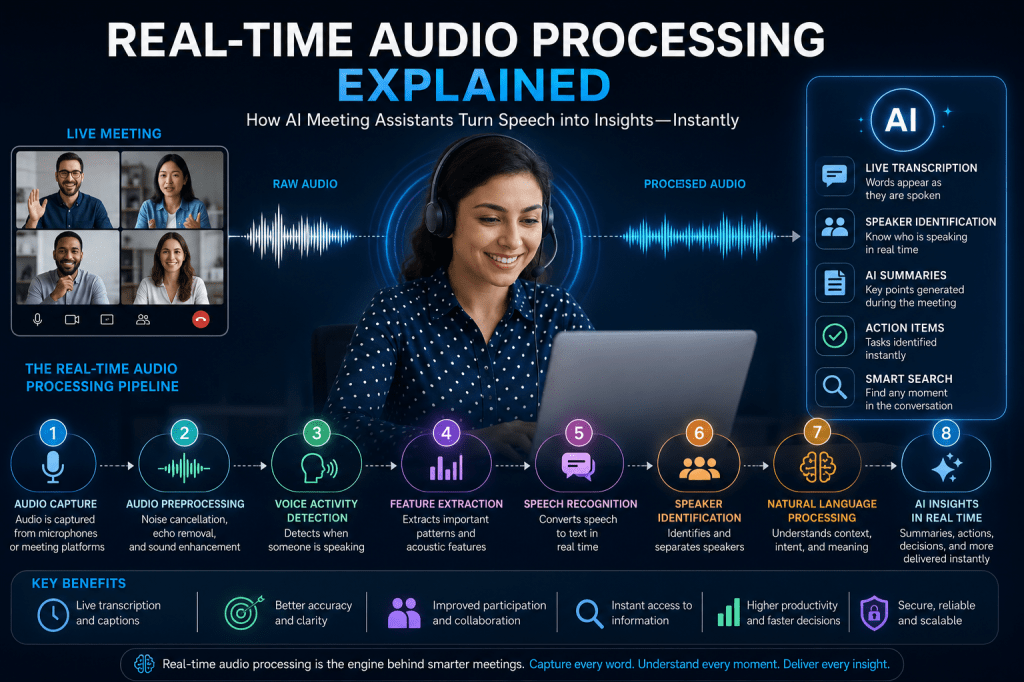
 Meeting Notes AI
Leave a comment