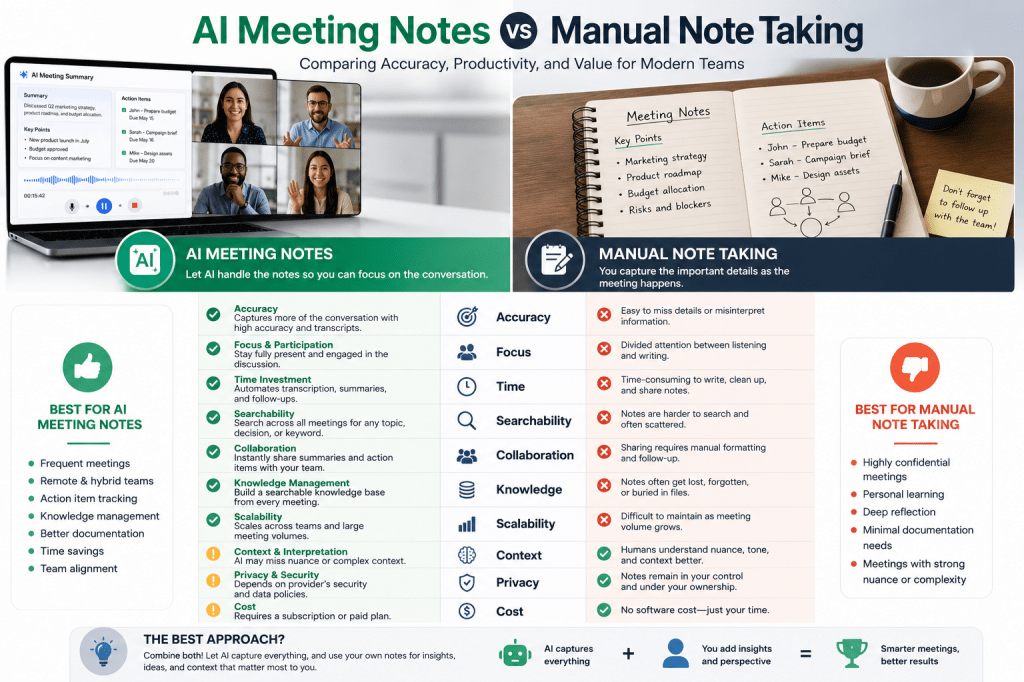
For decades, manual note-taking has been the standard way to document meetings. Whether using a notebook, laptop, or digital document, professionals have relied on handwritten or typed notes to capture important discussions, decisions, and action items.
Today, artificial intelligence is changing that process.
AI meeting notes can automatically record conversations, generate transcripts, identify action items, and create summaries within minutes. As these tools become more common, many organizations are asking an important question:
Should you continue taking notes manually, or is AI a better solution?
The answer depends on your goals, meeting style, and workflow. In this guide, we’ll compare AI meeting notes and manual note-taking across the factors that matter most.
Understanding Manual Note Taking
Manual note-taking involves actively listening during a meeting and recording important information yourself.
This may include:
- Key discussion points
- Decisions
- Action items
- Deadlines
- Questions
- Meeting outcomes
Many professionals prefer manual notes because they allow them to focus on the information they personally consider important.
However, manual note-taking requires attention and effort throughout the meeting.
Understanding AI Meeting Notes
AI meeting notes use artificial intelligence to automate meeting documentation.
Most AI systems can:
- Record conversations
- Generate transcripts
- Create summaries
- Identify action items
- Track decisions
- Organize information
Instead of documenting discussions manually, participants can focus on the conversation while the AI handles note-taking.
Comparison #1: Accuracy
Manual Note Taking
Accuracy depends entirely on the note taker’s attention and ability to keep up with the conversation.
Common challenges include:
- Missing details
- Incomplete notes
- Misunderstood information
- Selective recording
Even experienced professionals can overlook important information during fast-paced discussions.
AI Meeting Notes
AI systems capture much more of the conversation.
Benefits include:
- Comprehensive transcripts
- Consistent documentation
- Reduced risk of missing details
- Verifiable meeting records
While AI can occasionally misinterpret words or context, it typically records far more information than a human note taker.
Winner: AI Meeting Notes
For complete meeting documentation, AI generally provides greater accuracy and coverage.
Comparison #2: Focus and Participation
Manual Note Taking
Taking notes divides attention.
Participants often switch between:
- Listening
- Writing
- Thinking
- Speaking
This can reduce engagement during discussions.
AI Meeting Notes
Because the AI handles documentation, participants can focus entirely on the conversation.
Benefits include:
- Better listening
- Improved collaboration
- More active participation
- Stronger engagement
Winner: AI Meeting Notes
AI removes the distraction of note-taking and allows participants to contribute more effectively.
Comparison #3: Time Investment
Manual Note Taking
Manual notes require time before, during, and after meetings.
Additional tasks often include:
- Organizing notes
- Writing summaries
- Sending follow-ups
- Tracking action items
AI Meeting Notes
Most of this work is automated.
AI can generate:
- Summaries
- Action items
- Meeting recaps
- Follow-up documentation
within minutes.
Winner: AI Meeting Notes
The time savings can be significant, especially for professionals who attend many meetings.
Comparison #4: Context and Interpretation
Manual Note Taking
Humans excel at understanding context.
Experienced note takers can:
- Interpret nuance
- Recognize priorities
- Capture emotional context
- Highlight strategic importance
AI Meeting Notes
AI continues to improve but may occasionally misunderstand:
- Industry jargon
- Complex discussions
- Organizational politics
- Unspoken context
Winner: Manual Note Taking
Humans still have an advantage when it comes to interpretation and context.
Comparison #5: Searchability
Manual Note Taking
Traditional notes can be difficult to search.
Even digital notes may become scattered across multiple files or systems.
AI Meeting Notes
AI platforms typically create searchable databases of meeting information.
Users can search for:
- Keywords
- Decisions
- Projects
- Participants
- Action items
This makes historical information much easier to retrieve.
Winner: AI Meeting Notes
Searchable meeting records provide a major advantage for teams and organizations.
Comparison #6: Collaboration
Manual Note Taking
Sharing notes often requires:
- Editing
- Formatting
- Distribution
- Follow-up clarification
Different attendees may leave with different understandings of the meeting.
AI Meeting Notes
AI-generated summaries provide a consistent version of events for everyone.
Benefits include:
- Shared understanding
- Improved transparency
- Easier communication
- Better alignment
Winner: AI Meeting Notes
AI simplifies information sharing and improves collaboration.
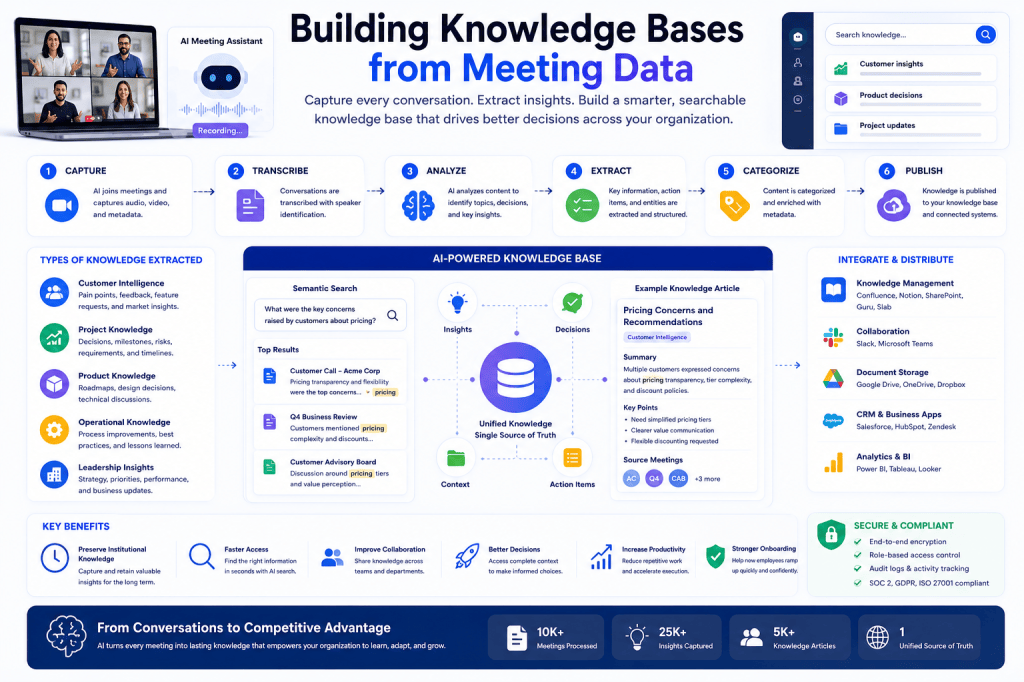
Comparison #7: Knowledge Management
Manual Note Taking
Over time, manual notes often become difficult to organize and maintain.
Important information may become buried in notebooks, folders, or disconnected documents.
AI Meeting Notes
AI meeting platforms create structured repositories of organizational knowledge.
Benefits include:
- Searchable transcripts
- Historical records
- Meeting intelligence
- Decision tracking
Organizations can build valuable knowledge bases from years of meeting data.
Winner: AI Meeting Notes
AI offers significantly better long-term knowledge management capabilities.
Comparison #8: Privacy and Security
Manual Note Taking
Personal notes remain under the control of the individual.
This may feel more secure for highly sensitive discussions.
AI Meeting Notes
AI systems often store recordings and transcripts in cloud environments.
Organizations must evaluate:
- Security policies
- Encryption
- Data retention practices
- Compliance standards
Winner: Depends on the Use Case
For highly sensitive meetings, manual notes may provide greater comfort. For most business environments, reputable AI providers offer strong security protections.
Comparison #9: Cost
Manual Note Taking
Manual note-taking requires no software subscriptions.
Costs are minimal.
AI Meeting Notes
Most AI meeting platforms charge monthly or annual subscription fees.
Pricing varies based on:
- Number of users
- Meeting volume
- Storage requirements
- Advanced features
Winner: Manual Note Taking
Manual note-taking is less expensive from a direct software cost perspective.
Comparison #10: Scalability
Manual Note Taking
As meeting volume increases, documentation becomes more difficult to manage.
AI Meeting Notes
AI scales easily across:
- Teams
- Departments
- Organizations
- Global workforces
Large numbers of meetings can be processed consistently and efficiently.
Winner: AI Meeting Notes
AI provides far better scalability.
When Manual Note Taking Still Makes Sense
Manual note-taking remains valuable when:
- Meetings are highly confidential
- Personal learning is the goal
- Participants want to process information actively
- Minimal documentation is needed
Some professionals also retain information better when taking notes themselves.
When AI Meeting Notes Are the Better Choice
AI meeting notes are ideal when:
- Multiple participants need access to information
- Meetings occur frequently
- Documentation accuracy is important
- Teams work remotely
- Action item tracking is required
- Knowledge management is a priority
Organizations with heavy meeting schedules often see the greatest benefits.
The Best Solution: Combining Both Approaches
Many professionals find the most effective strategy is combining AI and manual note-taking.
For example:
- AI captures the complete meeting record.
- Participants take personal notes on key insights and priorities.
This approach combines the strengths of both methods.
Users gain comprehensive documentation while maintaining personal engagement and context.
Frequently Asked Questions
Are AI meeting notes replacing manual note-taking?
Not entirely. Many professionals use AI-generated notes alongside personal notes.
Are AI meeting notes more accurate than humans?
For capturing complete conversations, AI generally records more information. Humans remain better at interpretation and context.
Do AI meeting notes save time?
Yes. Automated transcription, summaries, and action item tracking significantly reduce administrative work.
Are AI meeting notes worth paying for?
For organizations with frequent meetings, the productivity gains often justify the subscription cost.
What is the biggest advantage of AI meeting notes?
The ability to automatically create searchable, shareable, and actionable meeting records without manual effort.
Final Thoughts
Manual note-taking and AI meeting notes both have strengths. Manual notes offer human judgment, interpretation, and personal engagement. AI meeting notes provide comprehensive documentation, automation, searchability, and scalability.
For most modern organizations, AI meeting notes deliver substantial productivity advantages. However, the most effective approach is often a combination of AI-generated documentation and personal note-taking.
By leveraging both methods, teams can capture complete meeting information while maintaining the context and understanding that only humans can provide.

 Meeting Notes AI
Leave a comment