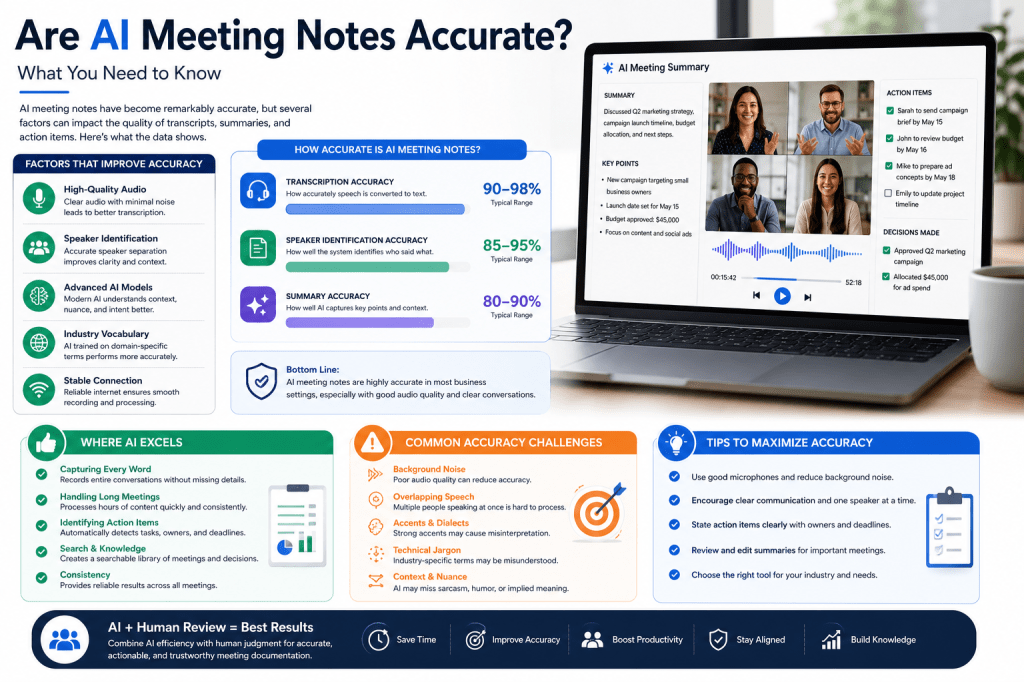
One of the most common questions organizations ask before adopting AI meeting assistants is whether the technology is accurate enough to trust.
After all, meetings often contain critical information, including business decisions, project updates, customer feedback, budgets, legal discussions, and action items. If AI-generated notes contain errors, misunderstandings can quickly follow.
The good news is that modern AI meeting note systems are more accurate than ever before. Advances in speech recognition, natural language processing, and large language models have dramatically improved the quality of meeting transcripts and summaries.
However, no AI system is perfect.
In this guide, we’ll explore how accurate AI meeting notes are, what factors affect performance, where errors still occur, and how businesses can improve results.
How AI Meeting Notes Generate Information
To understand accuracy, it helps to understand how AI meeting notes work.
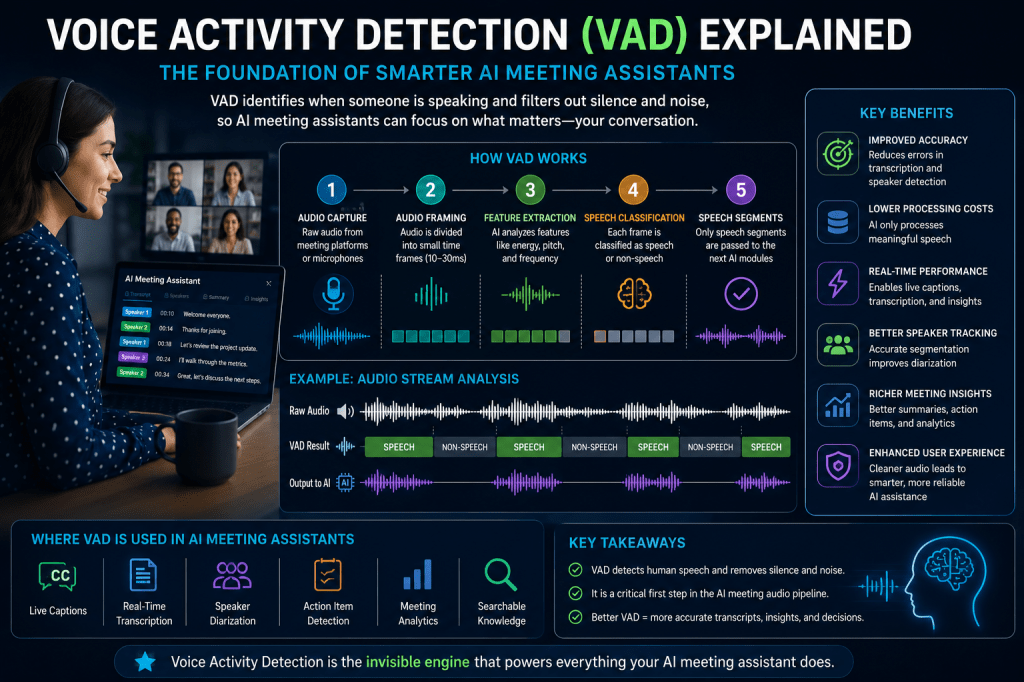
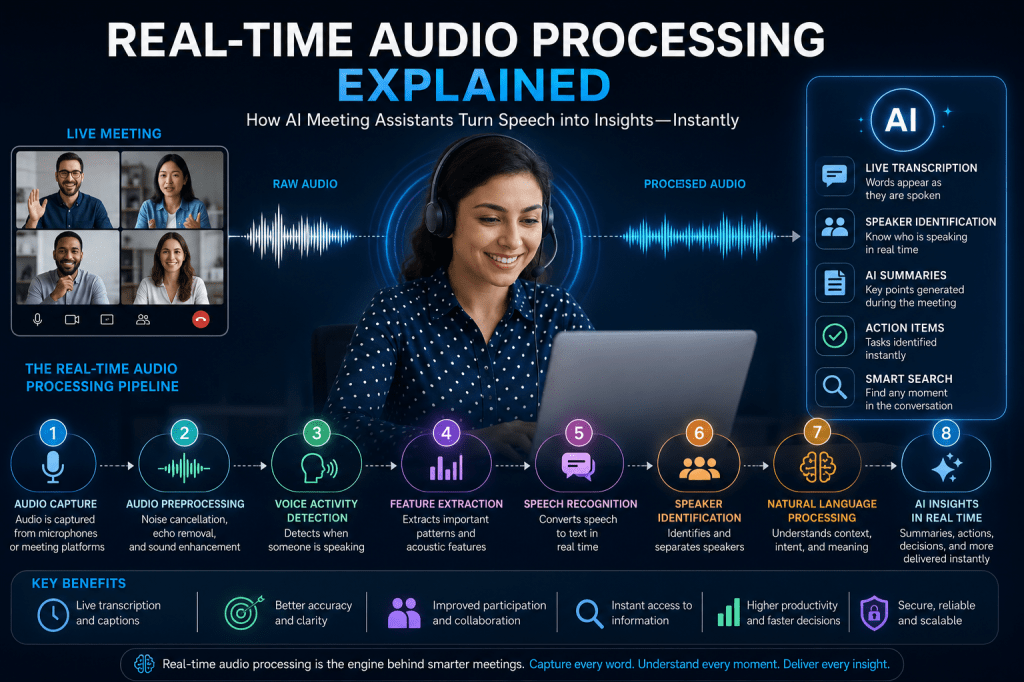
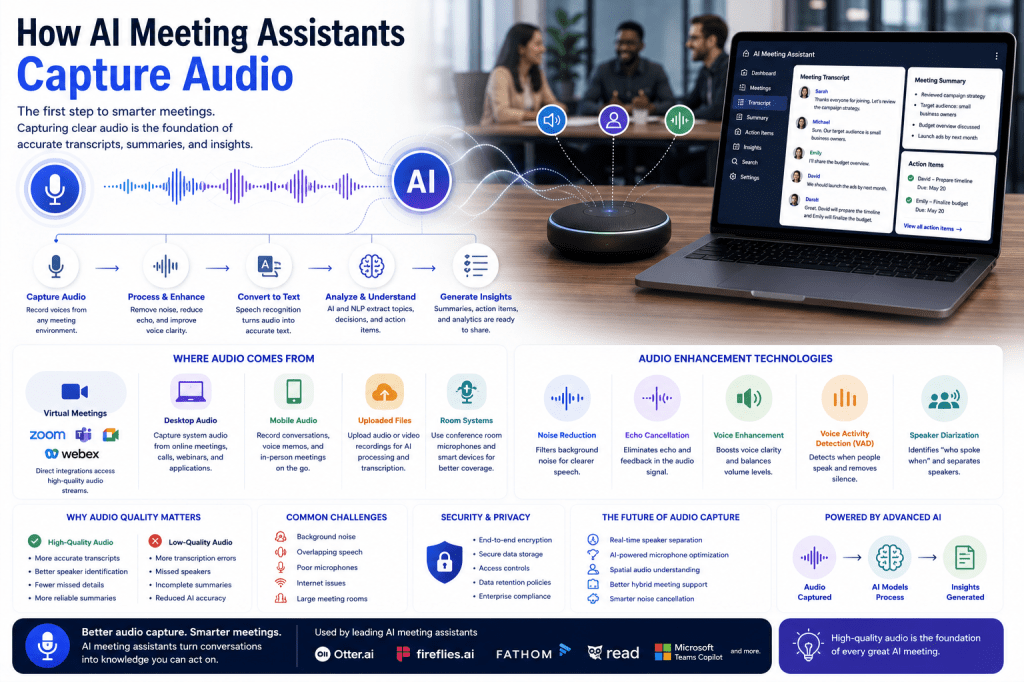
Most systems follow several steps:
- Capture meeting audio
- Convert speech into text
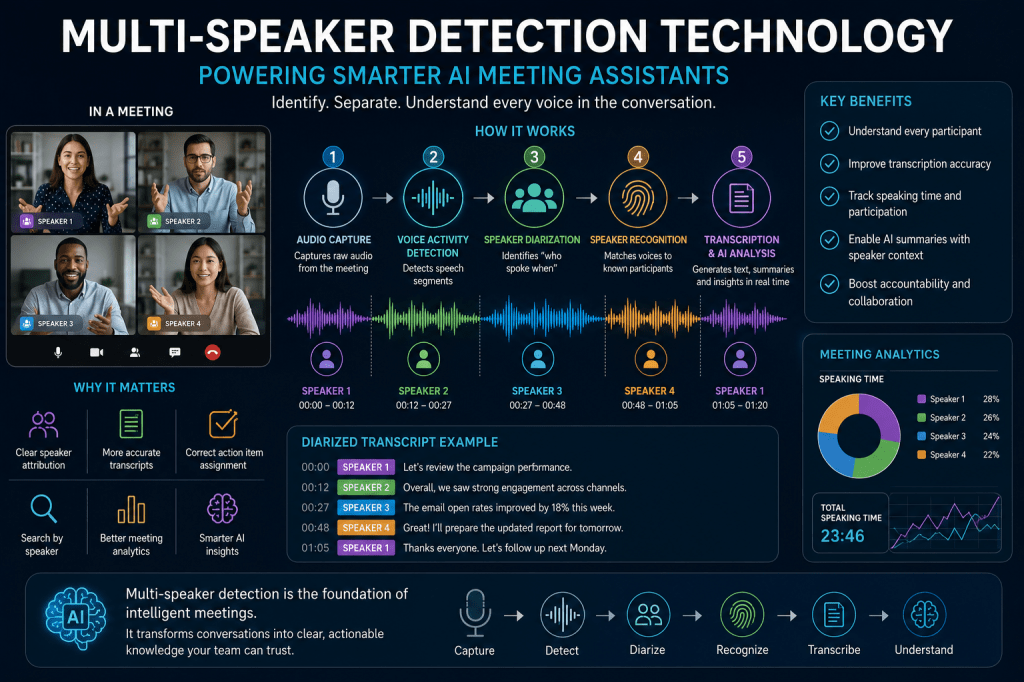
- Identify speakers
- Analyze conversations
- Extract action items
- Generate summaries
Each stage introduces opportunities for both accuracy and error.
The final output is only as reliable as the data captured throughout the process.
Understanding Transcription Accuracy
The foundation of AI meeting notes is speech-to-text transcription.
Modern speech recognition systems can achieve extremely high accuracy under ideal conditions.
In many business environments, transcription accuracy often exceeds 90% and may reach much higher levels when:
- Audio quality is clear
- Participants speak distinctly
- Background noise is minimal
- Speakers avoid interrupting one another
When transcription quality is high, the resulting summaries and action items become more reliable.
What Makes AI Meeting Notes Accurate?
Several factors contribute to accuracy.
High-Quality Audio
Clear audio is the single most important factor.
AI performs best when:
- Participants use quality microphones
- Internet connections are stable
- Background noise is limited
- Audio levels are balanced
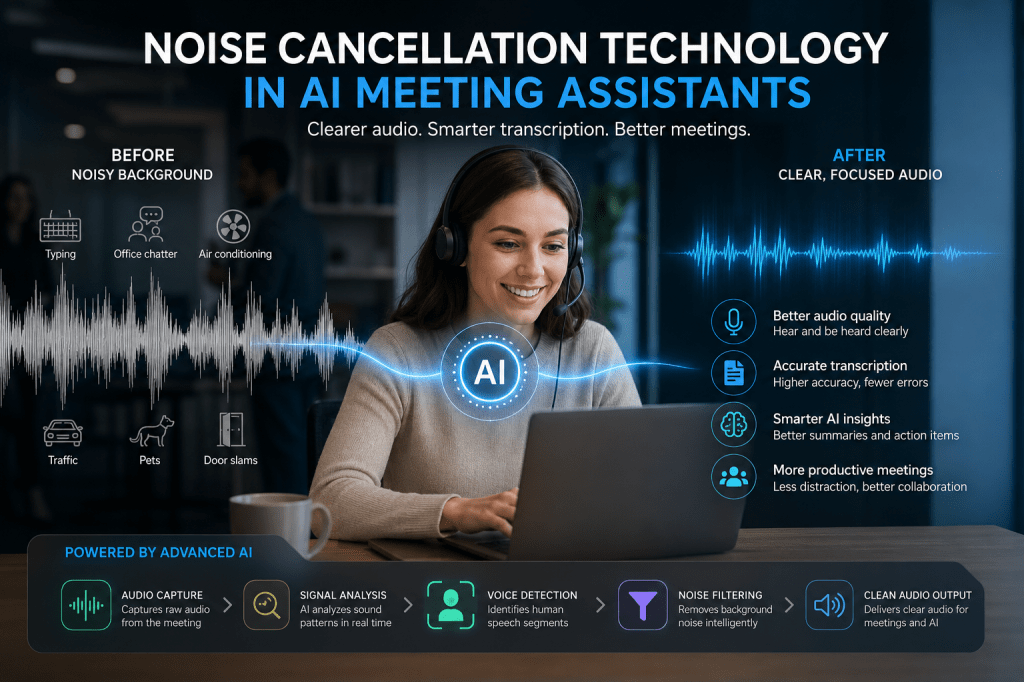
Poor audio quality remains one of the leading causes of transcription errors.
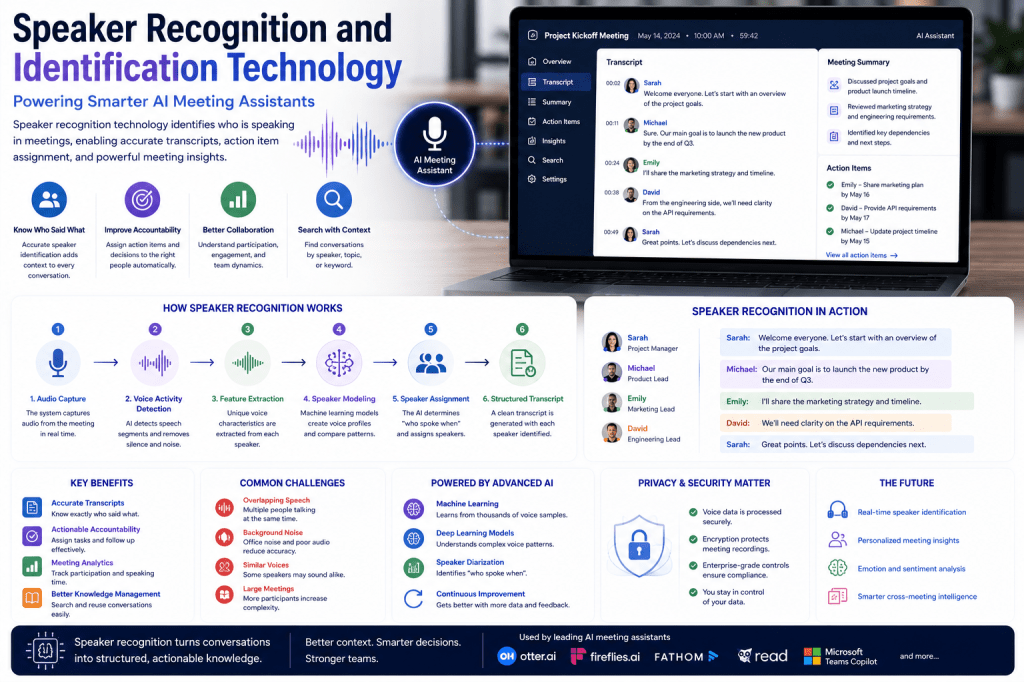
Speaker Separation
Modern systems use speaker identification technology to distinguish between participants.
Accurate speaker labeling improves:
- Meeting clarity
- Action item assignment
- Decision tracking
- Summary generation
The better the system can identify speakers, the more useful the final notes become.
Advanced Language Models
Recent improvements in generative AI have dramatically improved meeting summaries.
Modern AI systems can:
- Understand context
- Identify important topics
- Recognize action items
- Extract decisions
- Create concise summaries
Instead of simply repeating transcripts, AI can now generate meaningful insights from conversations.
Where AI Meeting Notes Excel
Capturing Large Volumes of Information
Humans naturally miss details during discussions.
AI systems can capture:
- Entire conversations
- Technical discussions
- Long meetings
- Multiple speakers
This provides a more complete record than manual note-taking.
Consistency
AI does not become tired, distracted, or forgetful.
Every meeting is processed using the same methodology.
This consistency is especially valuable for organizations that conduct frequent meetings.
Action Item Detection
Many AI meeting assistants are highly effective at identifying statements such as:
- “John will send the proposal tomorrow.”
- “Sarah will update the project plan.”
- “The team will review the budget next week.”
These commitments are often automatically extracted and highlighted.
Meeting Summaries
Generative AI has become remarkably effective at producing concise overviews of lengthy discussions.
This allows users to review important outcomes quickly.
Common Accuracy Challenges
Despite impressive progress, AI still faces limitations.
Background Noise
Busy offices, cafés, and poor-quality microphones can reduce accuracy.
Noise can make it difficult for speech recognition systems to identify words correctly.
Multiple People Speaking Simultaneously
Cross-talk remains challenging.
When several participants speak at the same time, transcription accuracy often decreases.
Industry-Specific Terminology
Specialized vocabulary may occasionally create errors.
Examples include:
- Medical terminology
- Legal language
- Scientific discussions
- Technical product names
- Acronyms
Many platforms continue improving their handling of domain-specific language.
Strong Accents and Dialects
Speech recognition systems have improved significantly, but unusual accents or dialects may still reduce transcription accuracy in some situations.
Context and Nuance
Humans naturally understand context, tone, and organizational dynamics.
AI may occasionally misunderstand:
- Sarcasm
- Humor
- Indirect statements
- Political considerations
- Unspoken assumptions
This can affect summary quality even when transcription is accurate.
Transcription Accuracy vs Summary Accuracy
These are two different measurements.
Transcription Accuracy
Measures how accurately spoken words are converted into text.
Summary Accuracy
Measures how accurately AI interprets and condenses discussions.
A transcript may be nearly perfect while the summary still misses important context.
For this reason, organizations should evaluate both aspects separately.
Can AI Accurately Identify Decisions?
In many cases, yes.
AI systems are increasingly capable of recognizing statements such as:
- Approvals
- Agreements
- Project decisions
- Budget decisions
- Policy changes
However, decisions that emerge gradually or are implied rather than explicitly stated may be harder for AI to recognize.
Human review remains valuable for important meetings.
Can AI Accurately Track Action Items?
This is one of AI’s strongest capabilities.
Many platforms successfully identify:
- Tasks
- Owners
- Deadlines
- Follow-up actions
When action items are clearly stated, AI performance is often excellent.
For example:
“Mike will finalize the contract by Friday.”
Most AI systems can detect and categorize this effectively.
How Businesses Can Improve Accuracy
Organizations can take several steps to maximize performance.
Use Good Microphones
Investing in quality audio equipment can significantly improve transcription results.
Minimize Background Noise
Quiet environments help AI understand conversations more effectively.
Encourage Clear Communication
Participants should:
- Speak clearly
- Avoid talking over one another
- State action items explicitly
Review Important Summaries
Critical meetings should include human review before summaries are distributed.
Choose the Right Platform
Different AI meeting tools vary in accuracy, features, and language support.
Testing multiple solutions can help identify the best fit.
Should You Trust AI Meeting Notes?
For most organizations, the answer is yes—with reasonable expectations.
AI meeting notes are highly effective for:
- Documentation
- Summaries
- Action items
- Collaboration
- Knowledge management
However, they should not be viewed as infallible.
Important legal, financial, or strategic discussions should still receive human review.
The most effective approach combines AI efficiency with human oversight.
Frequently Asked Questions
How accurate are AI meeting transcripts?
Under good conditions, many modern systems achieve very high transcription accuracy, often exceeding 90%.
Are AI meeting summaries reliable?
Generally yes, although summaries may occasionally miss nuance or context.
Can AI accurately identify action items?
Yes. This is one of the strongest capabilities of modern AI meeting assistants.
What causes transcription errors?
Poor audio quality, background noise, speaker overlap, technical terminology, and strong accents can reduce accuracy.
Should businesses review AI-generated meeting notes?
Yes. Human review is recommended for important meetings and high-stakes decisions.
Final Thoughts
AI meeting notes have become remarkably accurate thanks to advances in speech recognition, natural language processing, and generative AI. For most business meetings, modern systems can reliably transcribe conversations, identify action items, and generate useful summaries.
While challenges remain, particularly around context, nuance, and specialized terminology, AI meeting assistants now provide a level of documentation accuracy that often exceeds traditional manual note-taking.
The most successful organizations use AI as a productivity multiplier, combining automated documentation with human judgment to create reliable, actionable, and searchable meeting records.
Related Articles
What Are AI Meeting Notes?
How AI Meeting Notes Work
Benefits of AI Meeting Notes
AI Meeting Notes vs Manual Note Taking
Best AI Meeting Notes Tools
AI Meeting Notes Privacy Guide
Best AI Meeting Assistants in 2026
AI Voice Recorders Explained
Best AI Voice Recorders in 2026

 Meeting Notes AI
Leave a comment