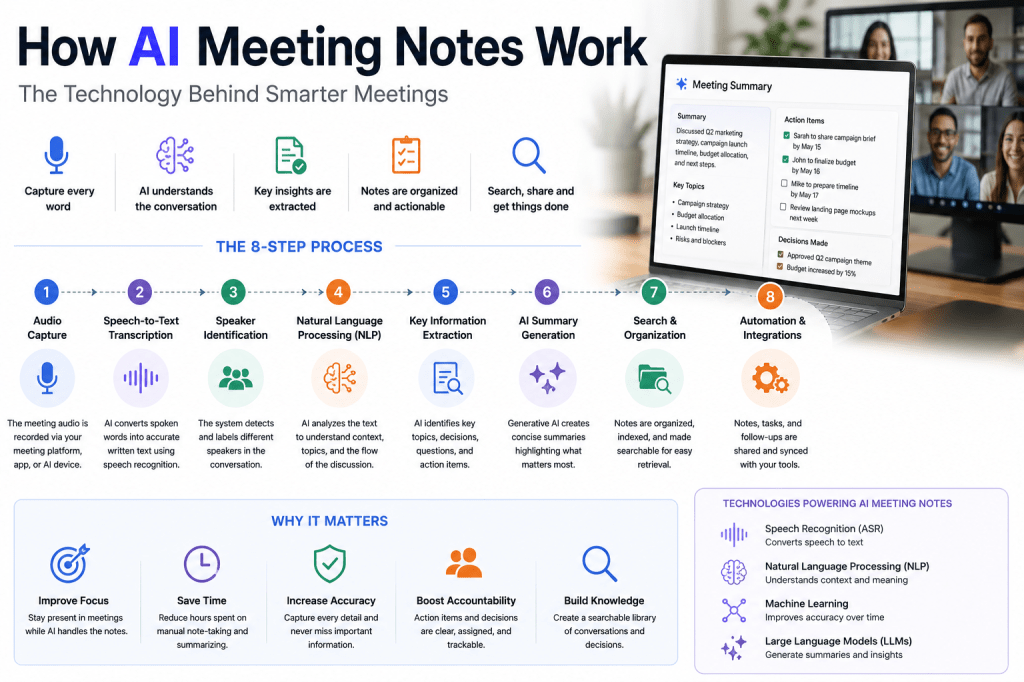
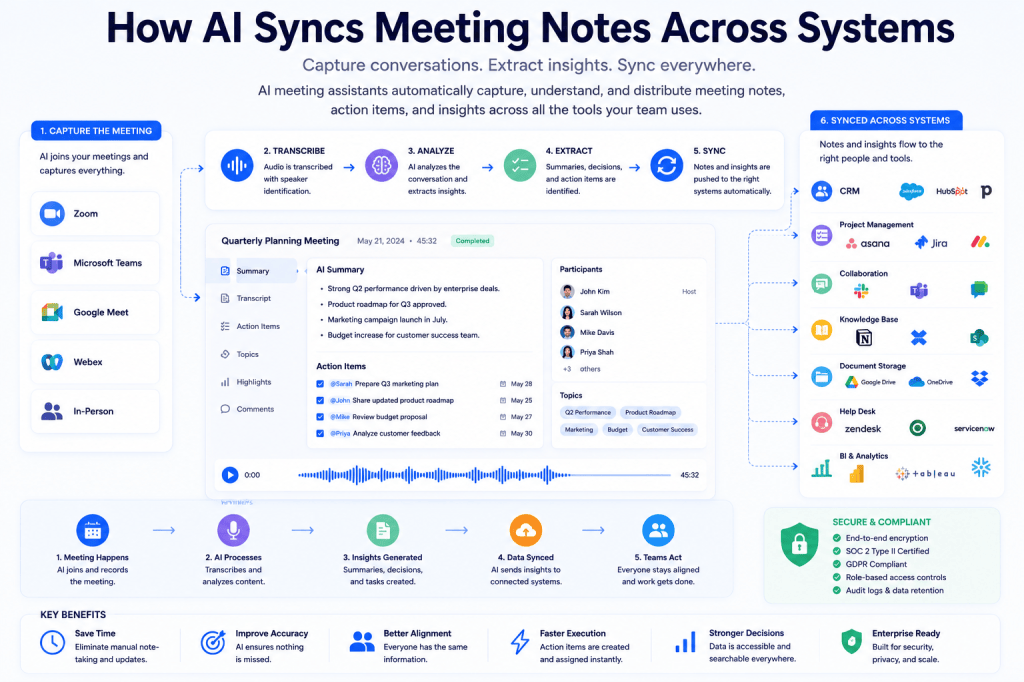
Artificial intelligence is transforming how businesses capture and manage meeting information. Instead of relying on manual note-taking, organizations are increasingly using AI-powered meeting tools to automatically record conversations, create transcripts, generate summaries, and track action items.
But how do AI meeting notes actually work?
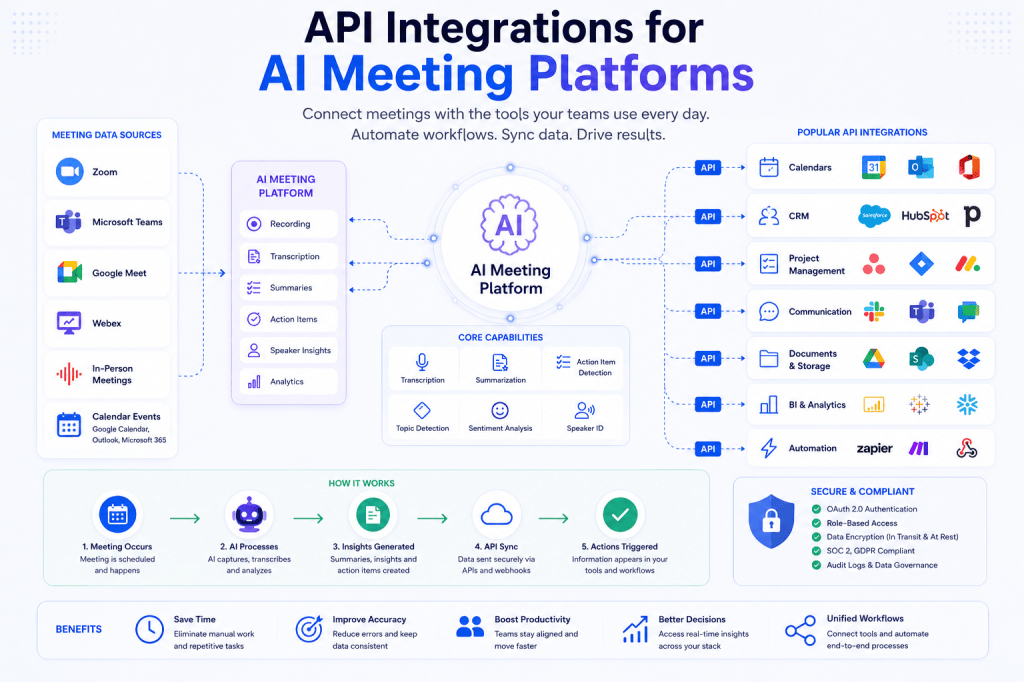
While the user experience may seem simple, several advanced technologies work together behind the scenes to convert spoken conversations into organized and actionable information.
In this guide, we’ll explore the complete process that powers AI meeting notes and explain how modern meeting assistants turn conversations into valuable business knowledge.
What Are AI Meeting Notes?
AI meeting notes are automatically generated records of meetings created using artificial intelligence technologies.
These systems listen to conversations, convert speech into text, analyze the content, identify key discussion points, and generate summaries that are easier to review than full transcripts.
The process combines several technologies, including:
- Audio processing
- Speech recognition
- Natural language processing (NLP)
- Machine learning
- Generative AI
- Knowledge extraction
Together, these technologies help eliminate the need for manual note-taking.
Step 1: Capturing Meeting Audio
The first stage is capturing the meeting itself.
AI meeting tools typically connect to:
- Zoom meetings
- Google Meet sessions
- Microsoft Teams meetings
- Phone calls
- In-person meetings
- AI voice recorders
Some platforms join meetings as virtual participants, while others record directly from a user’s device or dedicated hardware.
The quality of the audio captured at this stage significantly affects the accuracy of the final meeting notes.
Why Audio Quality Matters
Factors that improve transcription accuracy include:
- Clear microphones
- Minimal background noise
- Stable internet connections
- Limited speaker overlap
Poor audio quality can reduce transcription accuracy and make summary generation less reliable.
Step 2: Speech-to-Text Transcription
Once audio is captured, speech recognition systems convert spoken language into written text.
This process is commonly called Automatic Speech Recognition (ASR).
Modern AI transcription systems can:
- Recognize multiple speakers
- Understand different accents
- Handle technical vocabulary
- Process conversations in real time
- Support multiple languages
The resulting transcript becomes the foundation for all further analysis.
Real-Time vs Post-Meeting Transcription
Some systems generate transcripts during the meeting, while others process recordings afterward.
Real-time transcription offers immediate access to meeting content, while post-processing often allows for more detailed analysis and summary generation.
Step 3: Speaker Identification
After transcription, the system identifies who said what.
This process is known as speaker diarization.
Speaker identification allows meeting notes to separate conversations by participant rather than presenting one large block of text.
For example:
Sarah: We should launch the campaign next week.
John: I’ll finalize the budget today.
This structure makes transcripts much easier to review and understand.
Step 4: Natural Language Processing
Once the conversation has been transcribed and organized by speaker, natural language processing begins.
NLP enables AI systems to understand the meaning of conversations rather than simply recording words.
The AI analyzes:
- Topics discussed
- Questions asked
- Decisions made
- Tasks assigned
- Deadlines mentioned
- Sentiment and tone
This stage transforms raw transcripts into meaningful business information.
Step 5: Identifying Key Information
Modern AI meeting assistants automatically extract important details from conversations.
These systems can identify:
Action Items
Tasks that need to be completed after the meeting.
Example:
“Sarah will send the proposal by Friday.”
Decisions
Important conclusions reached during discussions.
Example:
“The team approved the Q4 marketing budget.”
Follow-Up Tasks
Items requiring future discussion or clarification.
Questions
Outstanding questions that remain unanswered.
This information is often displayed separately from the full transcript.
Step 6: AI Summary Generation
One of the most valuable features of modern meeting tools is automated summarization.
Generative AI models review the transcript and create concise summaries that highlight:
- Major topics
- Key decisions
- Action items
- Risks
- Opportunities
- Next steps
Instead of reading a 60-minute transcript, users can review a summary in a few minutes.
Types of AI Summaries
Most platforms offer multiple summary formats:
Executive Summary
A high-level overview for managers and executives.
Detailed Summary
A more comprehensive breakdown of discussions.
Action-Oriented Summary
Focuses primarily on tasks and responsibilities.
Meeting Highlights
Highlights important moments and decisions.
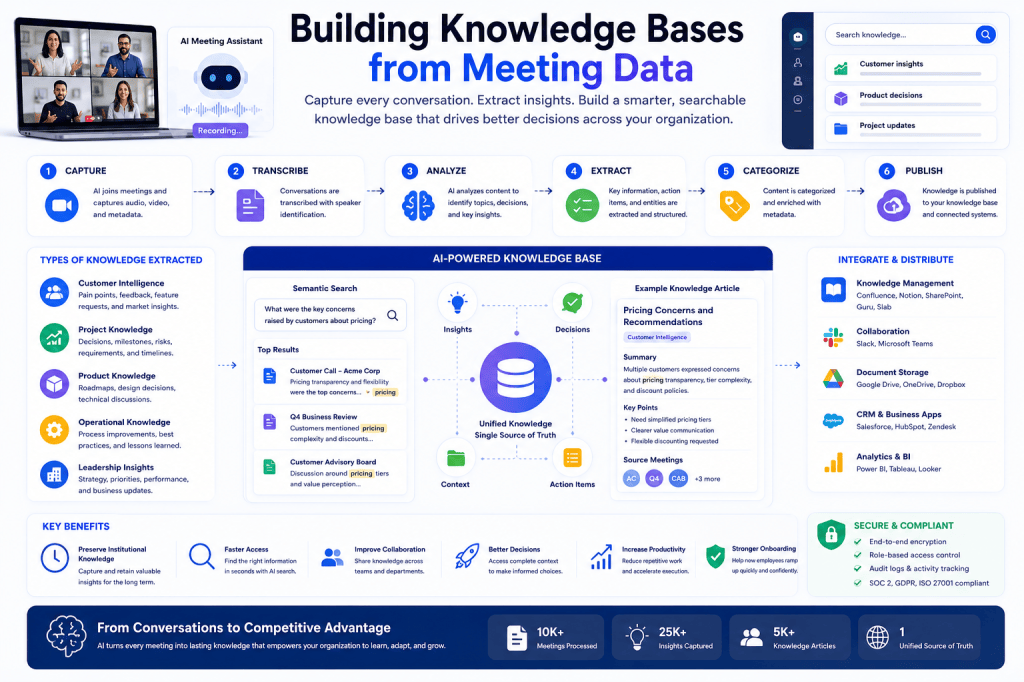
Step 7: Search and Knowledge Management
After the meeting is processed, the information is stored in a searchable database.
Users can search for:
- Keywords
- Topics
- Decisions
- Participants
- Action items
This creates a valuable organizational knowledge base.
Instead of asking, “What did we decide three months ago?” teams can simply search their meeting records.
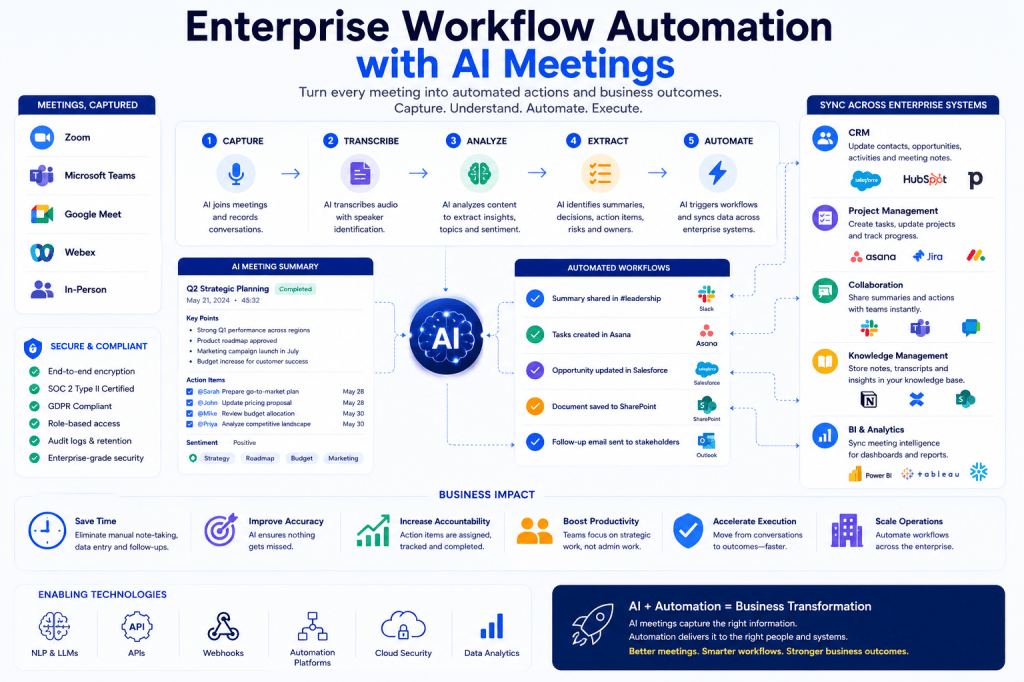
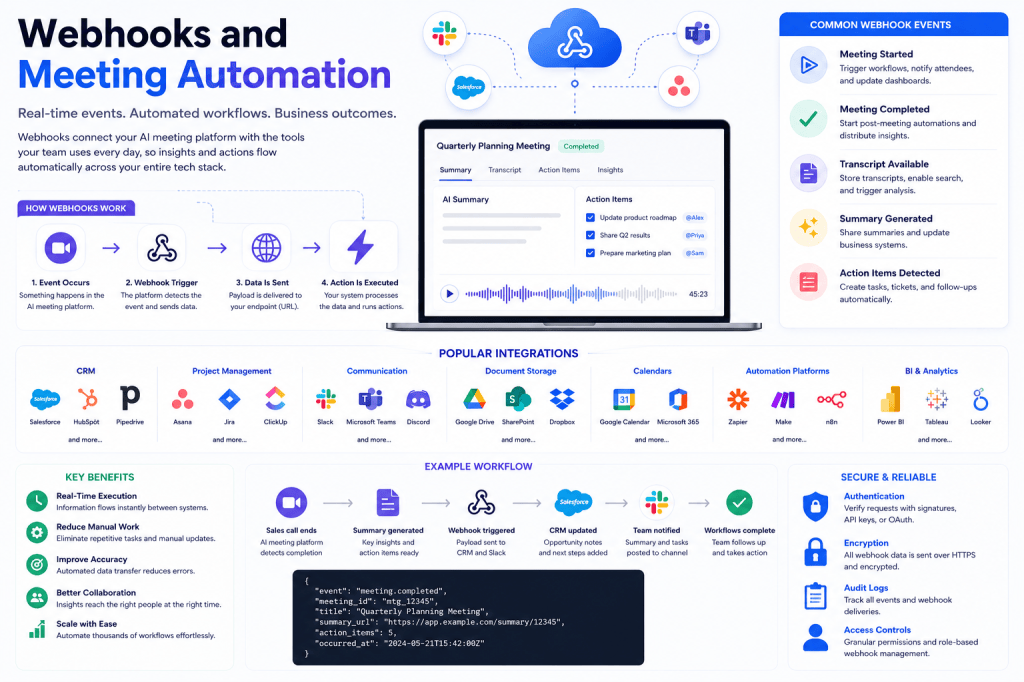
Step 8: Workflow Automation
Many AI meeting tools go beyond note-taking.
They can automatically:
- Create follow-up emails
- Update CRM systems
- Generate project tasks
- Notify team members
- Create meeting recaps
- Update knowledge bases
These automations reduce administrative work and help teams move faster.
The Role of Large Language Models
Recent advances in AI meeting notes have been driven by large language models (LLMs).
LLMs help systems:
- Understand context
- Summarize discussions
- Extract insights
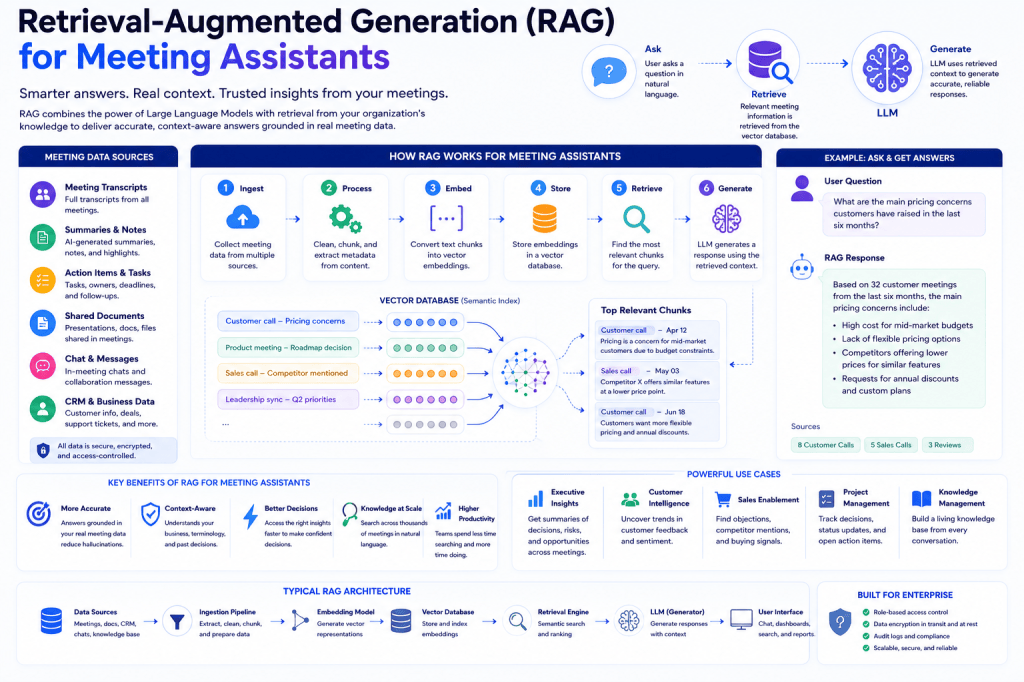
- Answer questions about meetings
- Generate follow-up content
Instead of simply storing transcripts, modern platforms can actively help users work with meeting information.
For example, a user might ask:
“What decisions were made during last week’s sales meeting?”
The AI can instantly provide an answer based on meeting records.
How Accurate Are AI Meeting Notes?
Accuracy depends on several factors.
Factors That Improve Accuracy
- High-quality microphones
- Clear speech
- Minimal background noise
- One speaker at a time
- Industry-specific language support
Common Challenges
- Heavy accents
- Cross-talk
- Poor audio quality
- Technical jargon
- Fast-paced discussions
Most modern systems achieve very high transcription accuracy under good conditions, but human review is still recommended for critical meetings.
Privacy and Security Considerations
Because AI meeting tools process sensitive conversations, organizations should carefully review:
- Data storage policies
- Encryption standards
- Compliance certifications
- Access controls
- Retention policies
Many vendors now offer enterprise-grade security features designed for business environments.
The Future of AI Meeting Notes
AI meeting notes are evolving beyond transcription and summaries.
Future systems may provide:
- Real-time coaching
- Automated project updates
- Predictive task management
- Meeting effectiveness scoring
- Knowledge graph generation
- Personalized meeting insights
The goal is to transform meetings from isolated conversations into continuously accessible organizational knowledge.
Frequently Asked Questions
Do AI meeting notes record the entire meeting?
Most systems record audio and generate transcripts, summaries, and action items from the recorded content.
Can AI meeting notes work without recording?
Some tools rely on live transcription instead of storing recordings, although functionality may be limited.
How quickly are summaries generated?
Many platforms generate summaries within minutes after a meeting ends.
Can AI meeting notes identify action items automatically?
Yes. Most modern systems can detect tasks, responsibilities, and deadlines discussed during meetings.
Are AI meeting notes accurate enough for business use?
For most business meetings, modern AI systems provide highly accurate transcripts and summaries, although important decisions should still be reviewed by humans.
Final Thoughts
AI meeting notes combine speech recognition, natural language processing, machine learning, and generative AI to transform conversations into structured and actionable information.
By automatically capturing discussions, identifying key decisions, generating summaries, and tracking action items, these tools help teams save time, improve collaboration, and build searchable organizational knowledge.
As AI technology continues to improve, meeting notes will become increasingly intelligent, making meetings more productive and easier to manage than ever before.
Internal links
What Are AI Meeting Notes?
Benefits of AI Meeting Notes
Are AI Meeting Notes Accurate?
Best AI Meeting Notes Tools
AI Meeting Notes Privacy Guide
Best AI Meeting Assistants in 2026
Best AI Voice Recorders in 2026
AI Meeting Notes vs Manual Note Taking

 Meeting Notes AI
Leave a comment