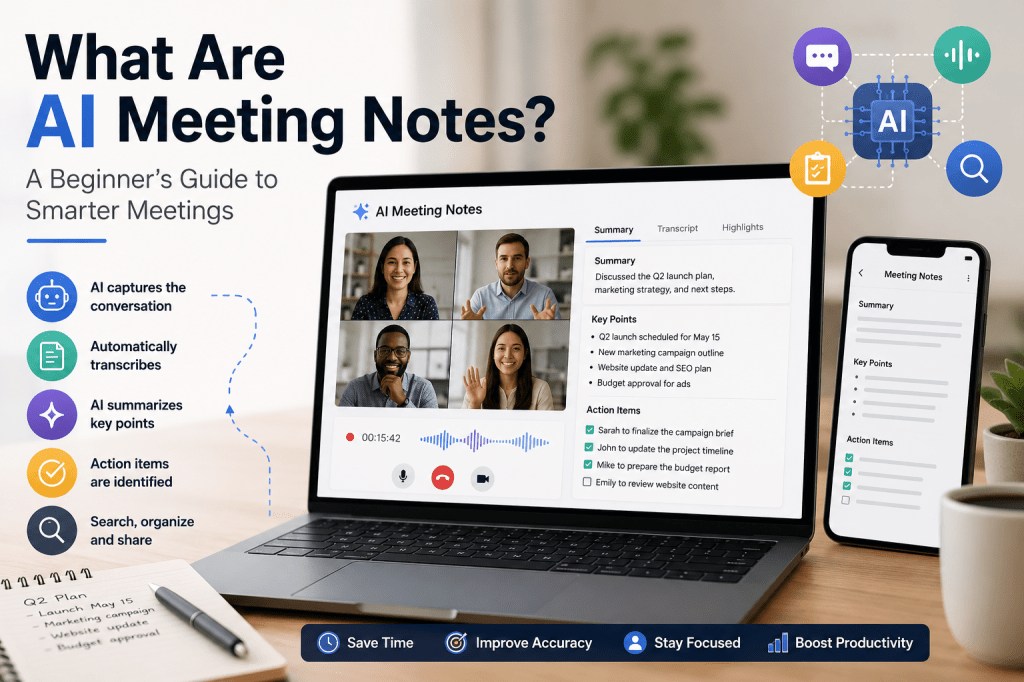
Meetings are an essential part of modern work, but keeping accurate notes can be challenging. Participants often struggle to stay engaged in discussions while simultaneously documenting key points, decisions, and action items.
AI meeting notes solve this problem by automatically recording, transcribing, and summarizing meetings using artificial intelligence. Instead of manually taking notes, teams can focus on the conversation while AI handles the documentation.
In this guide, we’ll explain what AI meeting notes are, how they work, their benefits, potential drawbacks, and why they are becoming an important productivity tool for businesses and professionals.
What Are AI Meeting Notes?
AI meeting notes are automatically generated records of a meeting created using artificial intelligence. These systems listen to conversations, convert speech into text, identify important topics, and generate structured summaries.
Unlike traditional note-taking, AI-powered tools can capture nearly every detail discussed during a meeting and organize the information into easy-to-review summaries.
Most AI meeting note systems provide:
- Meeting transcripts
- Key discussion points
- Action items
- Decisions made
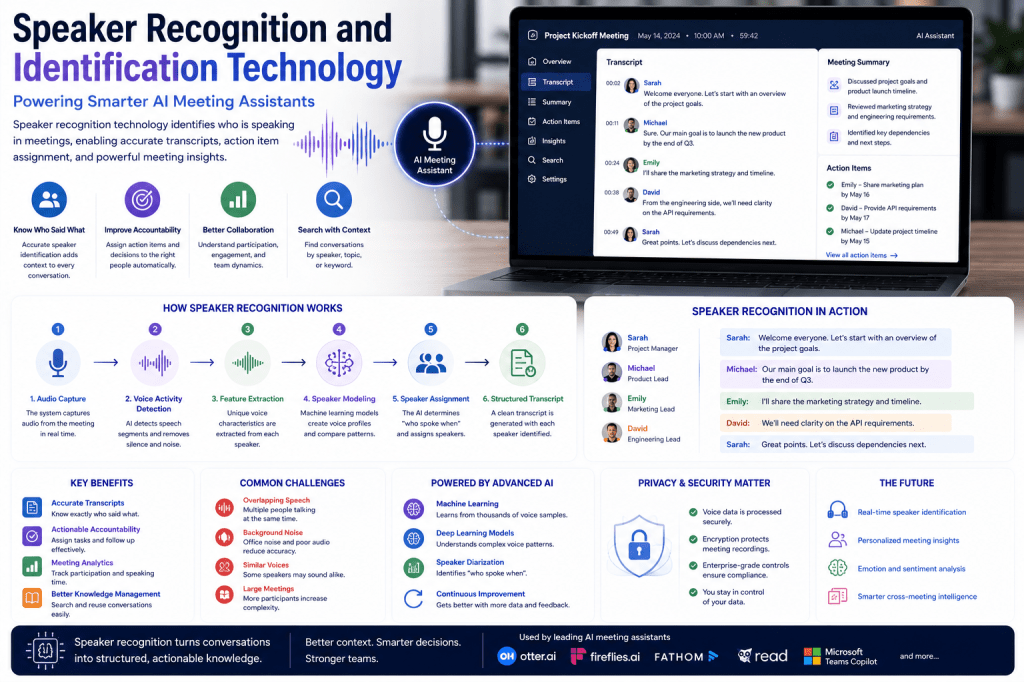
- Speaker identification
- Searchable meeting records
- Automated follow-up summaries
The goal is to reduce administrative work and ensure important information is not lost.
How AI Meeting Notes Work
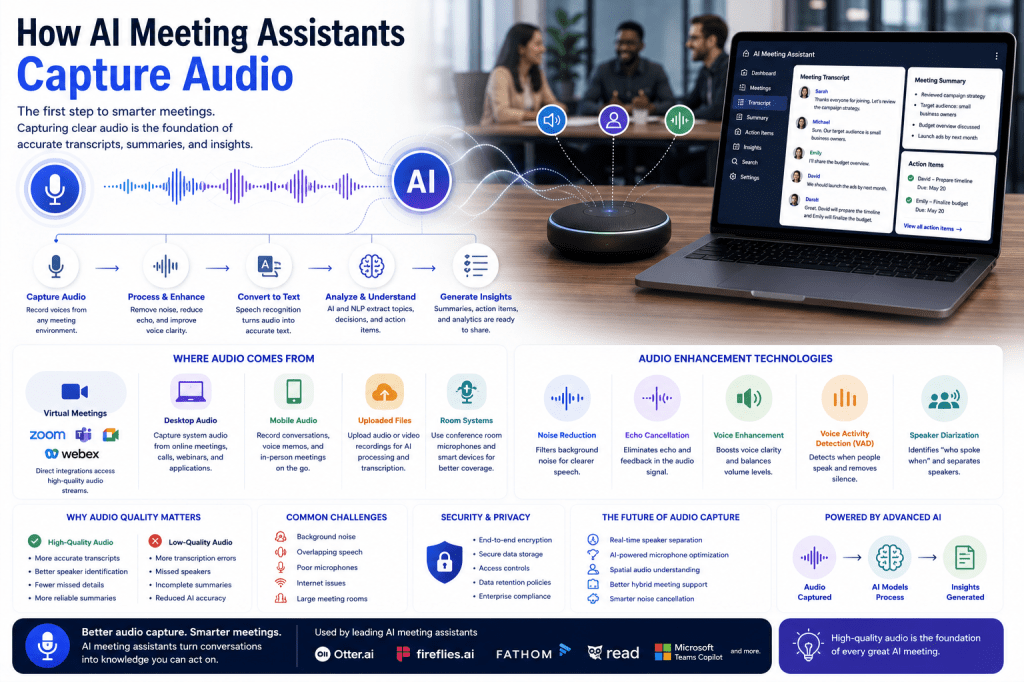
AI meeting note systems typically follow four main steps.
1. Audio Capture
The system records the meeting audio. This can happen through:
- Video conferencing platforms
- Dedicated meeting assistants
- AI voice recorders
- Mobile apps
- Desktop applications
2. Speech-to-Text Transcription
Artificial intelligence converts spoken words into written text.
Modern speech recognition models can accurately transcribe multiple speakers, various accents, and industry-specific terminology.
3. Natural Language Processing
After transcription, AI analyzes the conversation using natural language processing (NLP).
The system identifies:
- Important topics
- Decisions
- Tasks
- Deadlines
- Questions
- Follow-up items
4. Summary Generation
Generative AI creates concise meeting summaries that highlight the most important information.
Instead of reading a full transcript, users can review a brief summary and quickly understand what happened during the meeting.
Why Businesses Use AI Meeting Notes
Organizations adopt AI meeting notes because they improve productivity and reduce administrative overhead.
Key benefits include:
Improved Focus
Participants can concentrate on discussions instead of taking notes.
Better Accuracy
AI can capture details that humans may miss during fast-paced conversations.
Time Savings
Teams spend less time writing meeting summaries and follow-up emails.
Searchable Knowledge
Meeting records become searchable, making it easier to locate decisions and discussions later.
Better Accountability
Action items and responsibilities are automatically documented and shared.
Common Features of AI Meeting Notes Tools
Most modern platforms include:
Automated Transcription
Creates a complete written record of the meeting.
AI Summaries
Generates concise overviews of discussions.
Action Item Detection
Identifies tasks, owners, and deadlines.
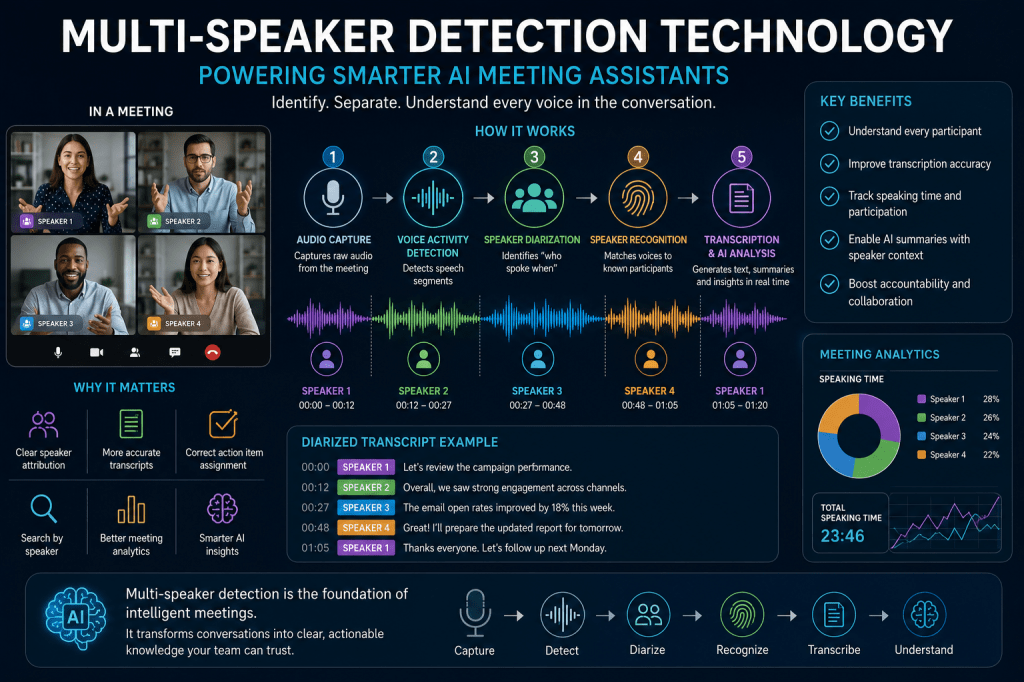
Speaker Recognition
Separates contributions from different participants.
Meeting Search
Allows users to search transcripts and summaries.
Integrations
Connects with tools such as CRM systems, project management platforms, and collaboration software.
Who Uses AI Meeting Notes?
AI meeting notes are useful across many industries.
Business Teams
Track decisions, projects, and follow-up actions.
Sales Professionals
Capture customer conversations and identify opportunities.
Recruiters
Document candidate interviews and hiring discussions.
Consultants
Maintain detailed records of client meetings.
Journalists
Record interviews and simplify transcription workflows.
Students
Capture lectures and study sessions more efficiently.
Researchers
Document interviews, focus groups, and discussions.
Are AI Meeting Notes Accurate?
Modern AI transcription systems are remarkably accurate, often exceeding 90% accuracy under good audio conditions.
However, accuracy can vary based on:
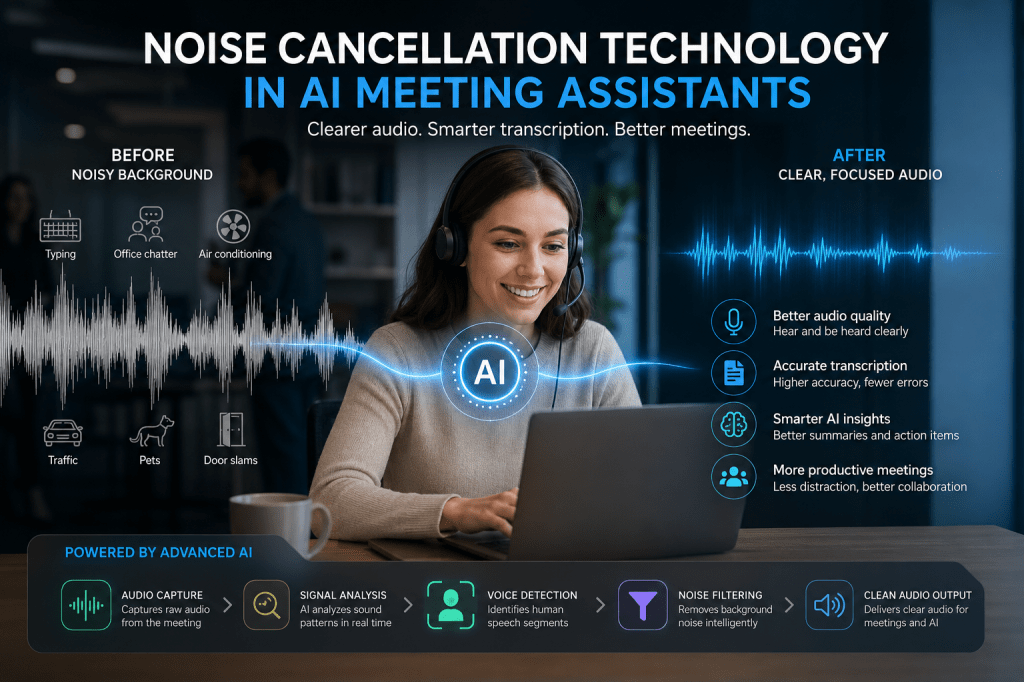
- Audio quality
- Background noise
- Speaker overlap
- Technical terminology
- Accents and dialects
While AI-generated notes are highly useful, important meetings should still be reviewed by humans before final distribution.
Potential Limitations
AI meeting notes are powerful but not perfect.
Some common limitations include:
Privacy Concerns
Organizations must ensure recordings comply with local privacy regulations.
Context Understanding
AI may occasionally misunderstand industry-specific terminology or nuanced discussions.
Sensitive Information
Companies should carefully evaluate how meeting data is stored and processed.
Dependence on Audio Quality
Poor recordings can reduce transcription accuracy.
Popular AI Meeting Notes Tools
Several platforms offer AI-powered meeting note capabilities.
Popular options include:
- Otter AI
- Fireflies.ai
- Read AI
- Fathom
- tl;dv
- Notion AI
- Granola
Many of these tools integrate directly with Zoom, Google Meet, and Microsoft Teams.
The Future of AI Meeting Notes
AI meeting notes are evolving rapidly.
Future systems are expected to provide:
- More accurate summaries
- Real-time action item tracking
- Meeting coaching insights
- Automated workflow creation
- Deeper CRM integrations
- Personalized knowledge management
As artificial intelligence continues to improve, meeting notes will become more valuable, actionable, and integrated into daily work.
Frequently Asked Questions
Are AI meeting notes free?
Many tools offer free plans with limited meeting hours and features. Advanced functionality typically requires a paid subscription.
Do AI meeting notes record meetings?
Most platforms record audio to generate transcripts and summaries, although some tools can work directly from live meeting streams.
Can AI meeting notes identify speakers?
Yes. Most modern platforms include speaker recognition capabilities that distinguish between participants.
Are AI meeting notes secure?
Security varies by provider. Organizations should review data storage, encryption, and compliance policies before adoption.
Are AI meeting notes worth it?
For many professionals, AI meeting notes save significant time, improve documentation quality, and increase productivity, making them a worthwhile investment.
Final Thoughts
AI meeting notes are transforming how organizations document and manage conversations. By automatically transcribing meetings, generating summaries, and tracking action items, these tools help teams stay focused, productive, and organized.
Whether you’re a business leader, consultant, recruiter, student, or remote worker, AI meeting notes can significantly reduce administrative work while ensuring important information is never lost.
As AI technology continues to improve, automated meeting documentation is likely to become a standard feature of modern workplace collaboration.

 Meeting Notes AI
Leave a comment