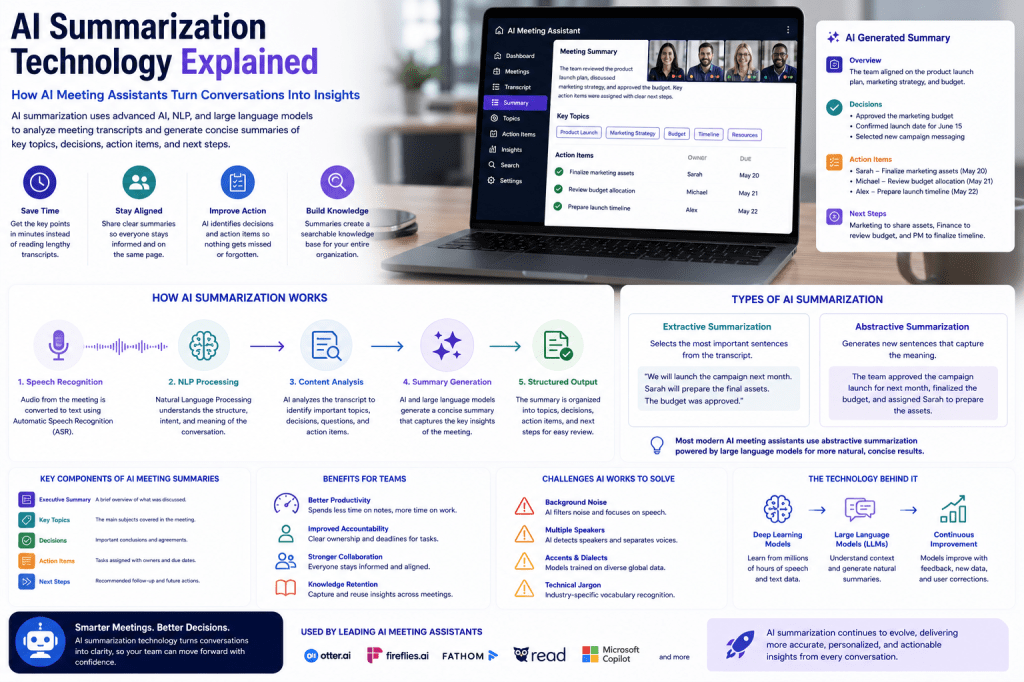
One of the most valuable features of modern AI meeting assistants is their ability to automatically summarize meetings. Instead of reading through lengthy transcripts or reviewing entire recordings, users receive concise summaries that highlight the most important discussions, decisions, action items, and next steps. Behind this capability is AI summarization technology, a combination of artificial intelligence, machine learning, Natural Language Processing (NLP), and Large Language Models (LLMs) that helps transform raw conversations into actionable knowledge.
In this guide, we’ll explore how AI summarization technology works, why it’s essential for AI meeting assistants, and how it is changing the way organizations manage information.
What Is AI Summarization Technology?
AI summarization technology is a branch of artificial intelligence that automatically condenses large amounts of text into shorter, more meaningful summaries.
Its goal is to:
- Reduce information overload
- Highlight important content
- Save time
- Improve knowledge sharing
- Increase productivity
In AI meeting assistants, summarization technology analyzes meeting transcripts and generates easy-to-read summaries that capture the most important outcomes of a conversation.
Why AI Meeting Assistants Need Summarization
Meetings often generate thousands of words of discussion.
A one-hour meeting can easily produce:
- 8,000–12,000 spoken words
- Multiple discussion topics
- Several decisions
- Numerous action items
- Follow-up commitments
Most professionals do not have time to review full transcripts.
AI summarization helps users quickly understand:
- What happened
- What was decided
- Who is responsible for tasks
- What needs to happen next
This dramatically improves efficiency and collaboration.
How AI Summarization Works
AI meeting assistants typically follow a multi-step process.
Step 1: Speech Recognition
The meeting assistant first converts spoken language into text using Automatic Speech Recognition (ASR).
This produces a complete transcript of the meeting.
Step 2: Natural Language Processing
Natural Language Processing helps the AI understand the structure and meaning of the conversation.
NLP identifies:
- Topics
- Participants
- Intent
- Questions
- Decisions
- Tasks
This step helps the AI determine what information is important.
Step 3: Content Analysis
The system evaluates the transcript and identifies:
- Frequently discussed subjects
- Important statements
- Decisions
- Action items
- Risks and opportunities
Not every sentence contributes equally to a summary.
AI must determine which information deserves attention.
Step 4: Summary Generation
The AI generates a concise summary based on its understanding of the discussion.
The final output may include:
- Meeting overview
- Key topics
- Decisions made
- Action items
- Follow-up requirements
The result is a readable summary that captures the essence of the meeting.
Types of AI Summarization
Modern meeting assistants generally use two approaches.
Extractive Summarization
Extractive summarization selects the most important sentences directly from the transcript.
Example:
Transcript
“We agreed to launch the campaign next month. Sarah will prepare the final assets. The budget was approved.”
Summary
“We agreed to launch the campaign next month. Sarah will prepare the final assets. The budget was approved.”
The sentences are copied directly from the meeting.
Abstractive Summarization
Abstractive summarization generates entirely new text that captures the meaning of the conversation.
Example:
Summary
“The team approved the campaign launch for next month, finalized the budget, and assigned Sarah responsibility for preparing creative assets.”
This approach produces more natural and concise summaries.
Most modern AI meeting assistants rely increasingly on abstractive summarization powered by Large Language Models.
The Role of Large Language Models
Large Language Models have significantly improved AI summarization quality.
Traditional summarization systems relied heavily on statistical techniques.
Modern LLMs can:
- Understand context
- Identify relationships
- Recognize priorities
- Generate human-like language
This allows meeting assistants to create summaries that are more accurate and easier to read.
What LLMs Understand
Modern systems can recognize:
- Strategic decisions
- Project milestones
- Customer concerns
- Team responsibilities
- Follow-up actions
This deeper understanding makes summaries significantly more useful.
AI Meeting Summary Components
Most AI meeting assistants generate several types of information.
Executive Summary
A brief overview of the meeting.
Example:
“The team reviewed the product launch timeline, approved the marketing budget, and assigned follow-up actions.”
Key Topics
The major subjects discussed during the meeting.
Examples:
- Product launch
- Budget planning
- Customer feedback
Decisions
Important conclusions reached by participants.
Examples:
- Launch date approved
- Vendor selected
- Budget finalized
Action Items
Tasks assigned during the discussion.
Examples:
- Sarah will update the campaign assets.
- Marketing will finalize messaging.
- Finance will review budget allocations.
Next Steps
Recommendations for future activities and follow-up meetings.
Benefits of AI Summarization in Meetings
Saves Time
Professionals can review a summary in minutes instead of reading lengthy transcripts.
Improves Productivity
Teams spend less time documenting meetings and more time acting on decisions.
Enhances Collaboration
Summaries ensure everyone receives the same information.
Improves Accountability
Action items are clearly identified and assigned.
Preserves Organizational Knowledge
Meeting summaries become part of a searchable knowledge base.
AI Summarization and Action Item Detection
One of the most valuable applications of summarization technology is action item extraction.
The AI identifies statements such as:
“We need the proposal by Friday.”
“Sarah will update the presentation.”
“Let’s schedule a follow-up meeting next week.”
The assistant converts these statements into structured tasks.
This helps organizations:
- Track responsibilities
- Improve follow-through
- Reduce missed commitments
Many platforms automatically integrate action items into project management tools.
AI Summarization and Knowledge Management
Organizations conduct hundreds or thousands of meetings every year.
AI summarization helps create a searchable knowledge repository.
Employees can quickly access:
- Previous decisions
- Project discussions
- Customer conversations
- Strategic planning sessions
This reduces the need to revisit recordings or ask colleagues for historical information.
Challenges of AI Summarization
Although AI summarization has advanced significantly, challenges remain.
Context Complexity
Meetings often contain complex discussions that require deep understanding.
Industry-Specific Language
Technical terminology can be difficult to summarize accurately.
Long Meetings
Very long meetings contain large amounts of information that must be prioritized.
Ambiguous Statements
Some conversations require additional context to interpret correctly.
Human review remains important for critical decisions and sensitive discussions.
How AI Summarization Continues to Improve
Modern AI systems improve through:
- Better language models
- Larger training datasets
- More meeting-specific training
- User feedback
- Advanced NLP techniques
Each generation of AI models becomes better at understanding and summarizing conversations.
The Future of AI Summarization
AI summarization technology is evolving rapidly.
Future capabilities may include:
Personalized Summaries
Different summaries for executives, managers, and team members.
Real-Time Summaries
Live updates while meetings are taking place.
Predictive Insights
Identifying risks and opportunities during discussions.
Cross-Meeting Intelligence
Connecting information across multiple meetings.
Autonomous Follow-Up
Automatically generating emails, tasks, and project updates.
These advancements will make AI meeting assistants even more valuable.
Popular AI Meeting Assistants Using Summarization Technology
Many leading platforms leverage advanced summarization systems, including:
- Microsoft Teams Copilot
- Otter.ai
- Fireflies.ai
- Read AI
- Fellow
- Fathom
While their implementations vary, AI summarization remains one of the core features that differentiate modern meeting assistants from traditional transcription tools.
Final Thoughts
AI summarization technology is one of the most important innovations in modern AI meeting assistants. By combining speech recognition, Natural Language Processing, machine learning, and Large Language Models, these systems can transform lengthy conversations into concise, actionable insights. As the technology continues to improve, AI-generated summaries will become increasingly accurate, personalized, and valuable, helping organizations save time, improve collaboration, and make better decisions from every meeting.

 Meeting Notes AI