Voice-to-text technology has become a core component of modern productivity software, powering everything from virtual assistants and mobile dictation tools to AI meeting assistants and transcription platforms. Every time spoken words are converted into written text automatically, voice-to-text technology is at work behind the scenes.
In the world of AI meeting assistants, voice-to-text technology serves as the foundation for meeting transcripts, AI-generated summaries, action item extraction, and meeting intelligence. Without accurate voice-to-text conversion, the advanced capabilities of modern meeting software would not be possible.
In this guide, we’ll explore how voice-to-text technology works, the artificial intelligence systems behind it, and its role in modern AI meeting assistants.
What Is Voice-to-Text Technology?
Voice-to-text technology is a form of artificial intelligence that converts spoken language into written text automatically.
It is often referred to as:
- Speech-to-text
- Automatic Speech Recognition (ASR)
- Voice recognition technology
- Speech transcription technology
The primary purpose of voice-to-text systems is to allow computers to understand spoken language and represent it accurately as text.
Examples include:
- AI meeting assistants
- Smartphone dictation features
- Virtual assistants
- Customer support systems
- Accessibility tools
- Transcription software
Why Voice-to-Text Matters
Human communication is naturally spoken.
However, computers work best with structured text.
Voice-to-text technology acts as a bridge between these two worlds by transforming conversations into digital information that can be:
- Stored
- Searched
- Analyzed
- Shared
- Automated
In AI meeting assistants, this technology enables:
- Meeting transcripts
- Searchable meeting archives
- AI summaries
- Action item tracking
- Knowledge management
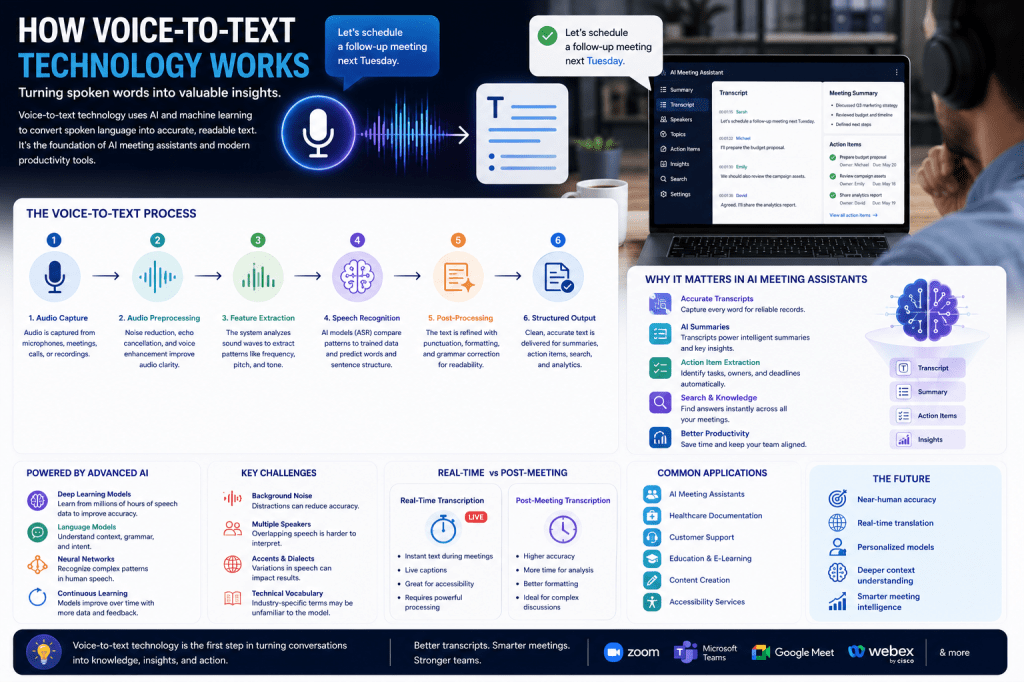
The Voice-to-Text Process
Modern voice-to-text systems rely on multiple layers of artificial intelligence working together.
The process typically follows several stages.
Step 1: Audio Capture
Everything begins with audio.
The system captures sound from:
- Microphones
- Video meetings
- Phone calls
- Recorded files
- Mobile devices
The quality of the audio input significantly impacts the accuracy of the final transcript.
Step 2: Audio Preprocessing
Raw audio often contains unwanted sounds.
Before speech recognition begins, the system cleans the audio using signal-processing techniques.
This may include:
- Noise reduction
- Echo cancellation
- Voice enhancement
- Volume normalization
The goal is to make spoken words as clear as possible.
Step 3: Converting Sound Into Data
Computers cannot directly understand speech.
The audio signal must first be transformed into a format that machine learning models can analyze.
The system extracts features such as:
- Frequency
- Pitch
- Tone
- Timing
- Voice patterns
These features become the data used by speech recognition algorithms.
Step 4: Speech Recognition
The system then uses Automatic Speech Recognition (ASR) models to identify words.
Machine learning algorithms compare audio patterns against massive training datasets.
The AI predicts:
- Individual words
- Sentence structures
- Contextual meaning
For example:
Audio
“Let’s schedule a follow-up meeting next Tuesday.”
Voice-to-Text Output
Let’s schedule a follow-up meeting next Tuesday.
This process can occur in real time or after a recording has been uploaded.
The Role of Machine Learning
Modern voice-to-text technology is powered by machine learning.
Instead of relying on fixed rules, machine learning models learn patterns from enormous amounts of speech data.
Training data often includes:
- Millions of recorded conversations
- Different accents
- Multiple languages
- Various speaking styles
- Industry-specific terminology
As more data is processed, the system becomes increasingly accurate.
Deep Learning and Neural Networks
Most modern voice-to-text systems use deep learning.
What Is Deep Learning?
Deep learning is a branch of machine learning that uses artificial neural networks to recognize complex patterns.
Neural networks are particularly effective at:
- Speech recognition
- Language understanding
- Audio analysis
Deep learning has dramatically improved voice-to-text accuracy compared to earlier systems.
Why Deep Learning Matters
Deep learning helps systems:
- Understand accents
- Handle fast speech
- Recognize technical terminology
- Adapt to different speaking styles
This is one reason why modern AI meeting assistants perform significantly better than older transcription tools.
Language Models and Context
Recognizing individual words is not enough.
The system must also understand context.
Consider the phrases:
- “Their meeting was productive.”
- “They’re meeting tomorrow.”
The words sound similar but have different meanings.
Language models help the AI determine the most likely interpretation based on surrounding words and context.
This significantly improves transcription quality.
Voice-to-Text in AI Meeting Assistants
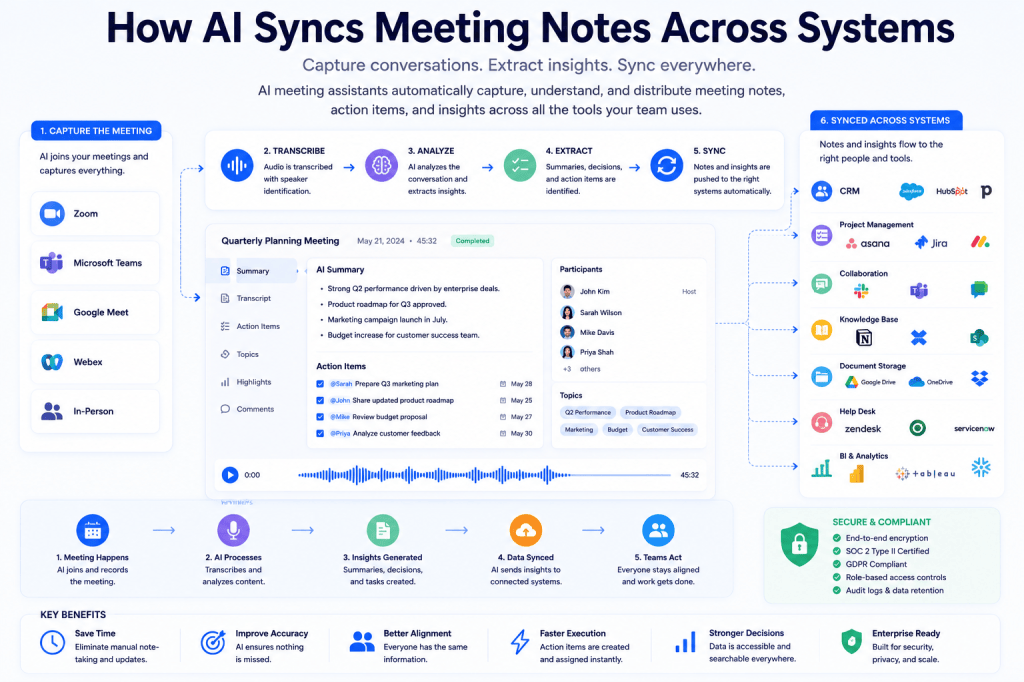
Voice-to-text technology serves as the first stage of the AI meeting assistant workflow.
Meeting Workflow
- Capture audio
- Convert speech to text
- Generate transcript
- Analyze conversation
- Create summaries
- Extract action items
- Store meeting knowledge
Without accurate transcription, none of the later AI features would be possible.
Real-Time Voice-to-Text
Many AI meeting assistants provide live transcription.
As participants speak, text appears instantly on screen.
Benefits include:
- Live captions
- Accessibility support
- Immediate note-taking
- Improved comprehension
Real-time processing requires powerful AI systems capable of analyzing speech within milliseconds.
Post-Meeting Voice-to-Text
Some systems process recordings after the meeting ends.
Advantages include:
- More processing time
- Potentially higher accuracy
- Additional language analysis
- Better formatting
Many platforms combine real-time and post-meeting processing to provide the best results.
Speaker Recognition
Meetings often involve multiple participants.
Modern voice-to-text systems frequently include speaker diarization technology.
This allows transcripts to identify speakers:
Sarah: We should launch the campaign next month.
Michael: I’ll prepare the budget proposal.
Speaker recognition improves:
- Accountability
- Context
- Meeting summaries
- Task assignment
This feature is particularly valuable in team meetings.
Multilingual Voice-to-Text Technology
Modern AI meeting assistants increasingly support multiple languages.
Voice-to-text systems can process:
- English
- Spanish
- French
- German
- Dutch
- Portuguese
- Japanese
- Chinese
- Many others
Some advanced platforms can even handle multilingual conversations within the same meeting.
This capability supports global collaboration and international teams.
Common Challenges
Although voice-to-text technology has improved dramatically, challenges still exist.
Background Noise
Noisy environments can reduce transcription accuracy.
Multiple Speakers
Overlapping conversations can be difficult to interpret.
Accents and Dialects
Speech patterns vary significantly across regions.
Technical Vocabulary
Industry-specific language may not always be recognized correctly.
Poor Audio Quality
Low-quality microphones can negatively impact results.
Leading AI platforms use sophisticated machine learning models to address these challenges.
How Voice-to-Text Technology Continues to Improve
Modern systems continuously learn and improve.
Improvements come from:
- Additional training data
- User corrections
- Better neural networks
- More advanced language models
- Improved computing power
As a result, transcription accuracy continues to increase year after year.
The Future of Voice-to-Text Technology
Voice-to-text technology is evolving rapidly.
Future developments may include:
Near-Human Accuracy
More reliable recognition of accents, jargon, and natural speech.
Better Context Awareness
Understanding conversations more deeply.
Real-Time Translation
Automatic translation during meetings.
Personalized Recognition Models
Systems tailored to individual users and organizations.
Context-Aware Meeting Intelligence
Using organizational history to improve transcription quality.
These innovations will further enhance AI meeting assistants and workplace productivity tools.
Popular Applications Beyond Meetings
Voice-to-text technology is used across many industries.
Examples include:
- Healthcare documentation
- Customer support
- Education
- Legal transcription
- Content creation
- Accessibility services
- Mobile productivity apps
Its applications continue to expand as AI capabilities improve.
Final Thoughts
Voice-to-text technology is one of the most important building blocks of modern AI meeting assistants. By converting spoken conversations into searchable, structured text, it enables everything from meeting summaries and action item extraction to knowledge management and business intelligence. Advances in machine learning, deep learning, and language modeling have made voice-to-text systems faster, more accurate, and more useful than ever before. As the technology continues to evolve, it will play an increasingly important role in helping organizations capture, understand, and benefit from the knowledge shared during conversations.

 Meeting Notes AI