Introduction
Artificial intelligence has transformed how organizations capture, analyze, and learn from meetings. Modern AI meeting assistants can generate transcripts, summarize discussions, identify action items, track decisions, and create searchable knowledge bases from conversations.
However, all of these capabilities depend on one critical factor:
Audio quality.
No matter how advanced an AI meeting assistant becomes, its ability to understand a conversation is limited by the quality of the audio it receives. Poor audio leads to transcription errors, missed action items, inaccurate summaries, and unreliable meeting insights.
This is why audio quality sits at the foundation of meeting intelligence.
This guide explores the relationship between audio quality and meeting intelligence and explains why improving audio has become a top priority for AI meeting assistant providers.
What Is Meeting Intelligence?
Meeting intelligence refers to the use of artificial intelligence to analyze conversations and extract valuable information.
Modern AI meeting assistants can generate:
- Meeting transcripts
- Executive summaries
- Action items
- Follow-up recommendations
- Speaker analytics
- Participation insights
- Topic tracking
- Decision records
- Searchable meeting archives
These capabilities transform meetings from temporary conversations into long-term organizational knowledge.
However, every one of these outputs begins with audio.
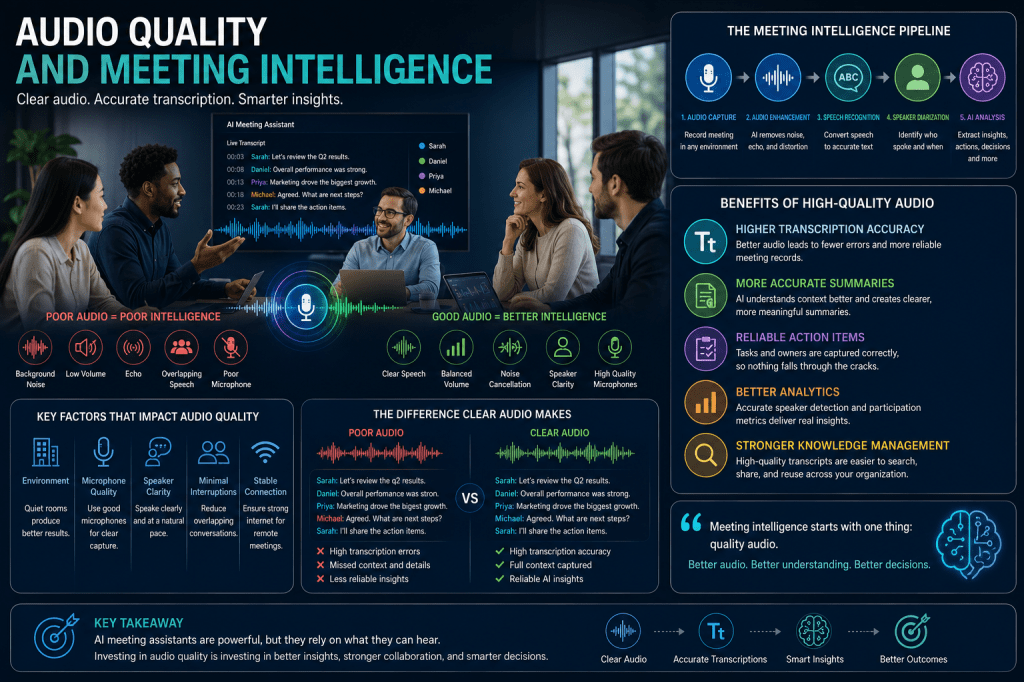
Why Audio Quality Matters
AI systems cannot understand what they cannot hear.
The process looks like this:
Audio → Speech Recognition → Transcript → AI Analysis → Meeting Intelligence
If audio quality is poor, errors occur at the very beginning of the pipeline.
These errors then propagate through every downstream system.
For example:
Poor audio may lead to:
- Incorrect transcription
- Missing context
- Misidentified speakers
- Faulty summaries
- Inaccurate action items
This is often referred to as the “garbage in, garbage out” problem.
Better audio leads to better intelligence.
Understanding Audio Quality
Audio quality refers to how clearly speech can be heard and understood.
Several factors contribute to quality.
Speech Clarity
The speaker’s voice should be distinct and understandable.
Signal-to-Noise Ratio
Speech should be louder than background noise.
Volume Consistency
Audio levels should remain balanced across speakers.
Low Distortion
Speech should not be clipped, compressed, or degraded.
Minimal Echo
Audio reflections should be reduced or eliminated.
Together, these factors determine how effectively AI can process conversations.
Common Audio Problems in Meetings
Modern workplaces introduce many audio challenges.
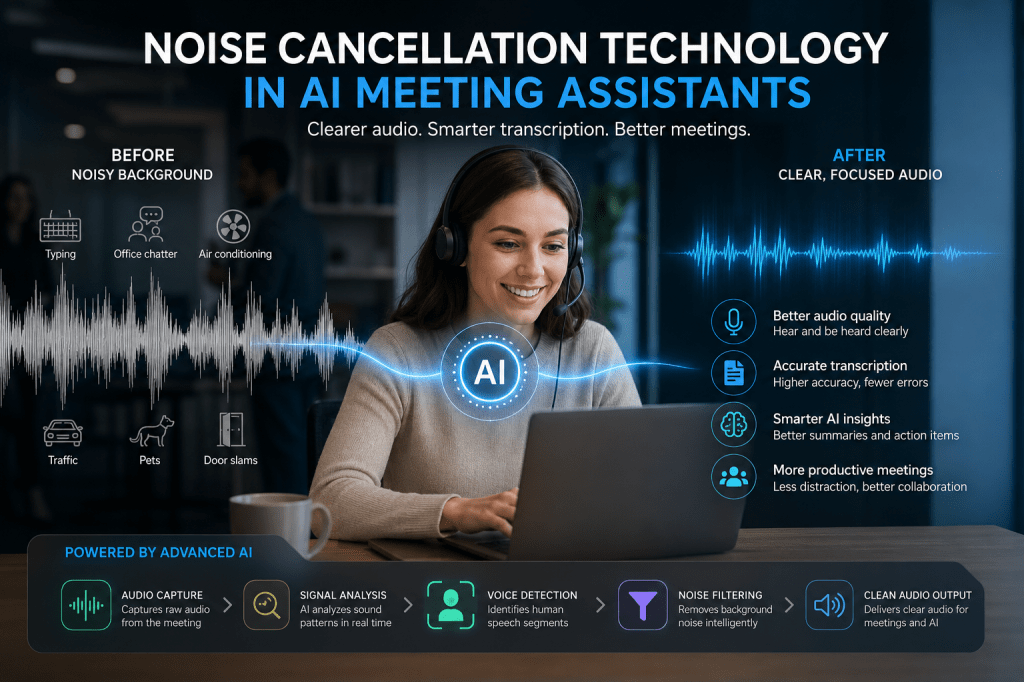
Background Noise
Examples include:
- Keyboard typing
- Office conversations
- Traffic
- Construction
- Air conditioning
- Pets
Echo and Reverberation
Large rooms often create reflected audio.
Poor Microphones
Low-quality microphones reduce speech clarity.
Multiple Speakers
Group conversations create complexity.
Overlapping Speech
Interruptions and simultaneous speaking are difficult to process.
Remote Connections
Network instability can affect audio quality.
AI meeting assistants must address these challenges before analysis begins.
The Meeting Intelligence Pipeline
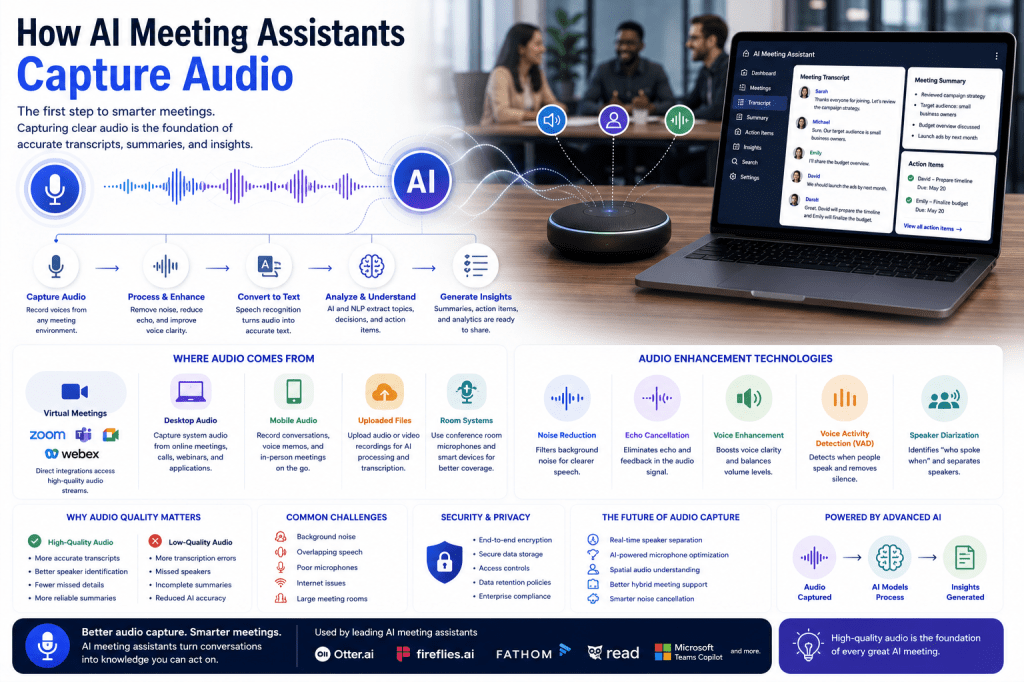
Most AI meeting assistants follow a similar workflow.
Step 1: Audio Capture
Audio is recorded from:
- Zoom meetings
- Microsoft Teams
- Google Meet
- Conference rooms
- Mobile devices
- Uploaded recordings
Step 2: Audio Enhancement
The system improves audio quality.
Step 3: Speech Recognition
Speech is converted into text.
Step 4: Speaker Identification
Participants are identified and tracked.
Step 5: Natural Language Processing
The AI analyzes meaning and context.
Step 6: Meeting Intelligence
Insights, summaries, and action items are generated.
The quality of every stage depends heavily on the quality of the original audio.
Audio Enhancement Technology
Modern AI meeting assistants use sophisticated enhancement systems.
These technologies include:
Noise Cancellation
Removes unwanted environmental sounds.
Speech Enhancement
Improves vocal clarity.
Echo Cancellation
Eliminates reflected audio.
Gain Control
Balances participant volume levels.
Audio Normalization
Creates consistent recording quality.
Audio enhancement dramatically improves AI understanding.
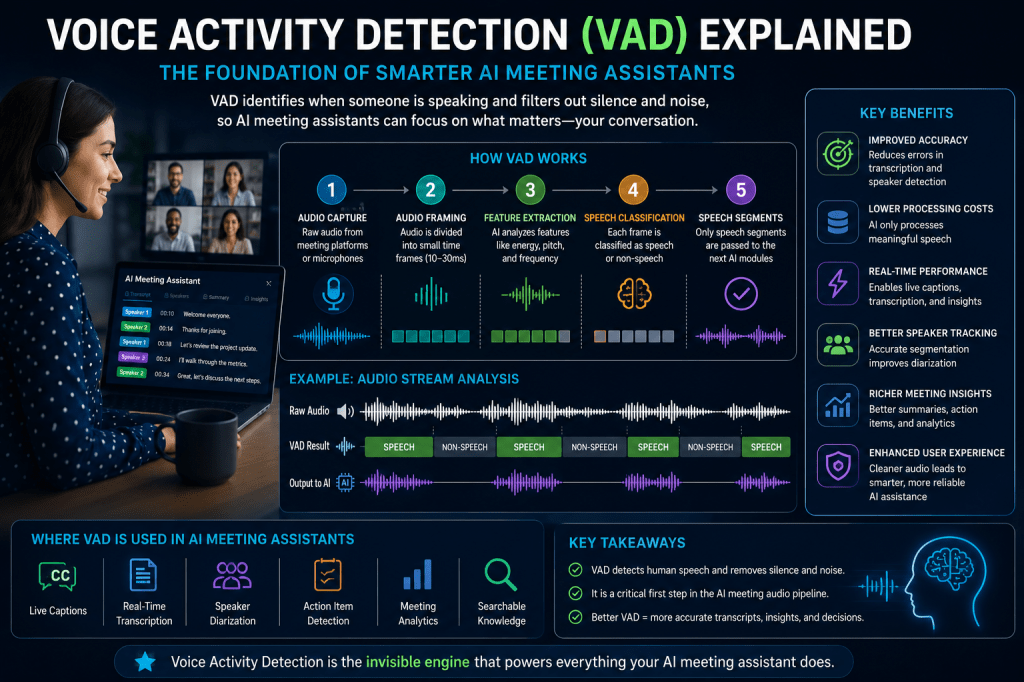
Voice Activity Detection
Voice Activity Detection (VAD) identifies when speech is present.
The system distinguishes between:
- Human speech
- Silence
- Background sounds
Benefits include:
- Improved processing efficiency
- Better transcription accuracy
- Reduced false detections
VAD acts as an important gatekeeper for meeting intelligence systems.
Speech Recognition Accuracy
Meeting intelligence begins with transcription.
Speech recognition systems convert spoken language into text.
Audio quality directly affects:
Word Recognition
Clear speech improves accuracy.
Context Understanding
Fewer transcription errors improve comprehension.
Meeting Searchability
Accurate transcripts are easier to search.
Summary Quality
Better transcripts lead to better summaries.
Even small improvements in transcription accuracy can significantly improve meeting intelligence.
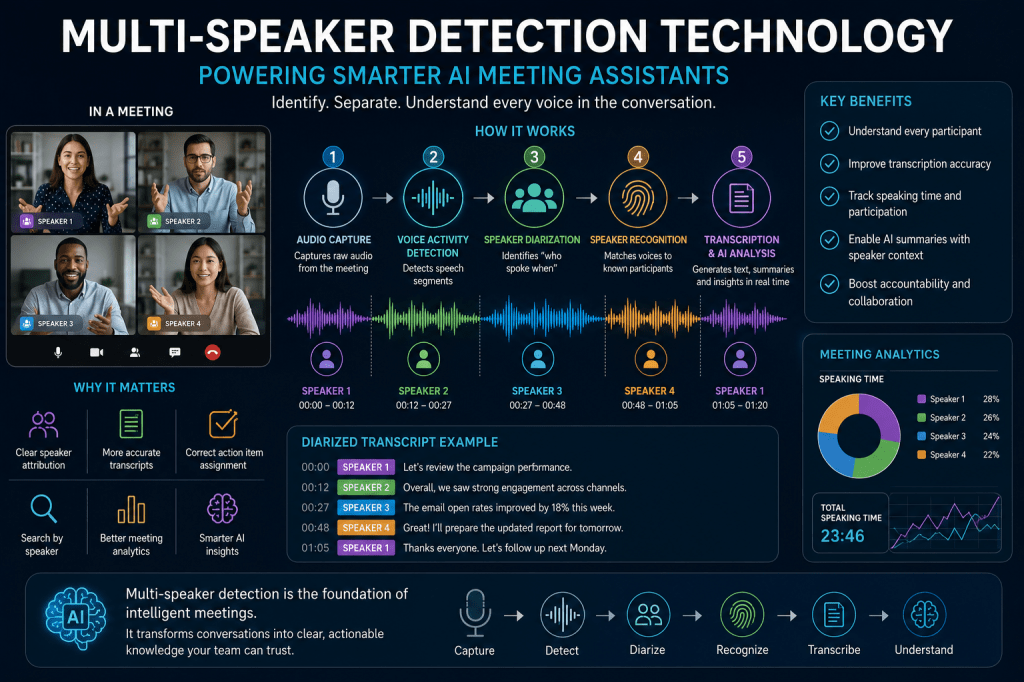
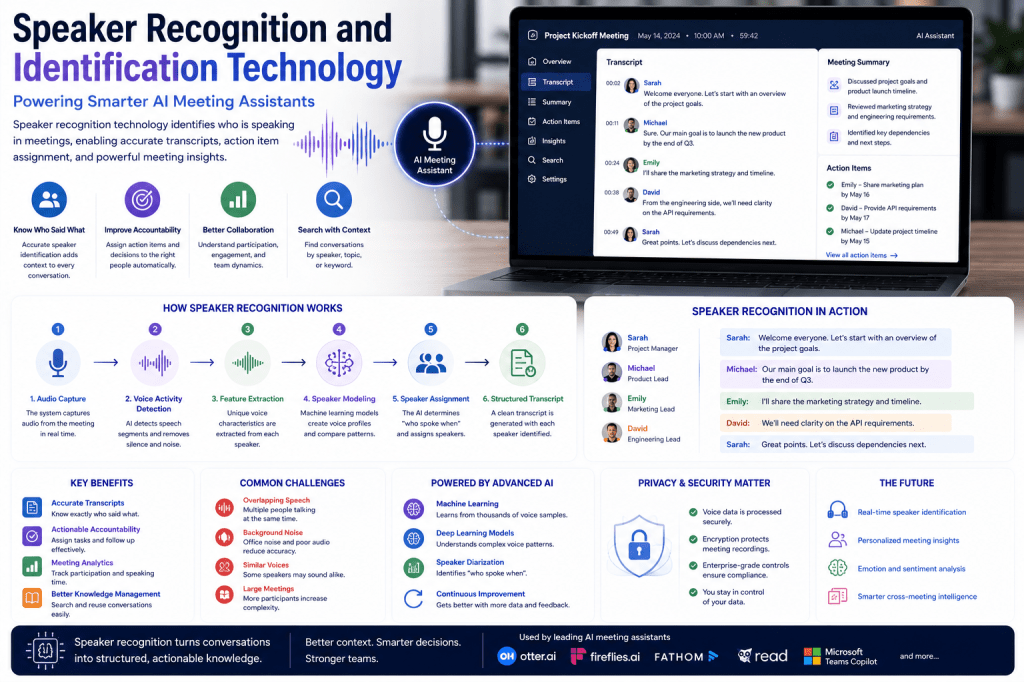
Speaker Diarization and Audio Quality
Speaker diarization answers:
“Who spoke when?”
To perform this task effectively, AI systems must detect:
- Voice changes
- Speaker transitions
- Individual speech characteristics
Poor audio makes these distinctions difficult.
High-quality audio improves:
- Speaker attribution
- Participation analytics
- Action item ownership
- Meeting accountability
How Audio Quality Affects AI Summaries
AI-generated summaries depend on transcript quality.
Consider the chain of events:
Clear Audio
→ Accurate Transcript
→ Accurate Context
→ Reliable Summary
Poor Audio
→ Faulty Transcript
→ Missing Context
→ Less Reliable Summary
Summary quality often reflects audio quality more than users realize.
Audio Quality and Action Item Extraction
Meeting assistants identify tasks by analyzing conversations.
Examples:
- “I’ll send the report tomorrow.”
- “Let’s schedule a follow-up meeting.”
- “Marketing will prepare the campaign.”
If these statements are transcribed incorrectly, action items may be:
- Missed
- Misassigned
- Incomplete
Improved audio quality helps AI capture responsibilities accurately.
Audio Quality and Meeting Analytics
Many AI meeting assistants provide analytics such as:
- Speaking time
- Participation rates
- Conversation balance
- Team engagement
These metrics rely on accurate speaker detection.
Poor audio can distort analytics and reduce insight quality.
Machine Learning and Audio Quality
Modern meeting assistants use machine learning models trained on:
- Millions of speech samples
- Various accents
- Different microphones
- Diverse environments
These models learn to compensate for audio challenges.
However, even the best models perform better when audio quality is high.
Machine learning improves resilience, but it cannot completely overcome poor recordings.
Large Language Models and Audio Intelligence
Large Language Models (LLMs) add another layer of intelligence.
They help:
- Correct transcription errors
- Interpret context
- Improve summaries
- Identify decisions
- Generate action items
However, LLMs still depend on the transcript generated from the audio.
The better the audio, the better the LLM output.
Hybrid Meetings Create New Challenges
Hybrid meetings combine:
- In-office participants
- Remote attendees
- Conference room microphones
- Individual devices
This creates inconsistent audio conditions.
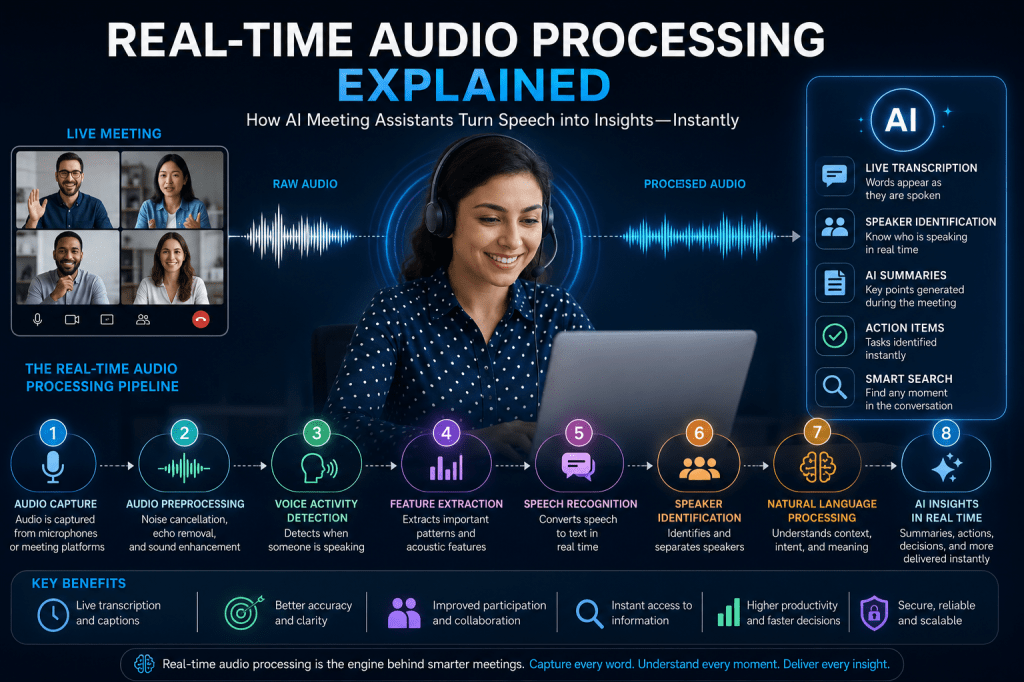
Modern meeting assistants address these challenges through:
- Adaptive audio enhancement
- Multi-channel audio capture
- Speaker separation
- Real-time processing
Improved audio quality helps ensure equal participation regardless of location.
Best Practices for Improving Meeting Intelligence
Organizations can improve meeting intelligence by improving audio quality.
Use Quality Microphones
Better input produces better results.
Reduce Background Noise
Choose quieter meeting environments.
Encourage Clear Speaking
Avoid speaking too quickly.
Minimize Interruptions
Reduce overlapping conversations.
Enable Audio Enhancement Features
Use built-in noise cancellation and speech enhancement tools.
Review Critical Meetings
Verify important transcripts and action items.
These practices maximize AI performance.
Benefits of High-Quality Audio
Organizations experience several advantages.
Better Transcription Accuracy
Fewer recognition errors.
More Reliable Summaries
Improved AI understanding.
Better Action Item Tracking
Tasks are identified correctly.
Enhanced Collaboration
Participants communicate more effectively.
Stronger Knowledge Management
Meeting records become more valuable.
Greater Trust in AI
Teams rely more confidently on meeting assistant outputs.
Future of Audio Quality in Meeting Intelligence
Several innovations are expected to improve performance further.
Personalized Voice Models
AI learns recurring speakers.
Generative Audio Reconstruction
Systems restore degraded speech.
Advanced Speaker Separation
Better handling of overlapping voices.
Context-Aware Audio Processing
AI adapts to meeting environments.
Edge-Based Enhancement
Lower latency and greater privacy.
These developments will further strengthen meeting intelligence systems.
Conclusion
Audio quality is the foundation of meeting intelligence. Every transcript, summary, action item, insight, and analytic generated by an AI meeting assistant depends on the quality of the audio entering the system.
Through noise cancellation, speech enhancement, voice activity detection, speaker diarization, machine learning, and large language models, modern meeting assistants work hard to maximize audio quality and understanding. Yet the principle remains simple: better audio produces better intelligence.
As organizations continue adopting AI meeting assistants, investing in audio quality will remain one of the most effective ways to improve the accuracy, reliability, and value of AI-powered meeting insights.

 Meeting Notes AI