Introduction
AI meeting assistants have become powerful workplace tools capable of transcribing conversations, identifying speakers, generating summaries, extracting action items, and creating searchable knowledge bases from meetings.
Behind these capabilities lies a critical architectural decision:
Where should audio processing happen?
Some AI meeting assistants process audio on remote cloud servers, while others perform part or all of the processing locally on user devices using Edge AI. Increasingly, modern platforms combine both approaches in hybrid architectures.
The choice between Edge AI and Cloud Audio Processing affects performance, latency, privacy, scalability, costs, and user experience.
This guide explains how both approaches work and why they are becoming increasingly important in the evolution of AI meeting assistants.
What Is Audio Processing in AI Meeting Assistants?
Audio processing refers to the technologies used to analyze and improve speech before it reaches AI systems.
Typical processing tasks include:
- Noise cancellation
- Speech enhancement
- Voice Activity Detection (VAD)
- Speaker diarization
- Speech recognition
- Language detection
- Audio analytics
- Real-time transcription
The question is:
Should this processing occur on the device or in the cloud?
Understanding Edge AI
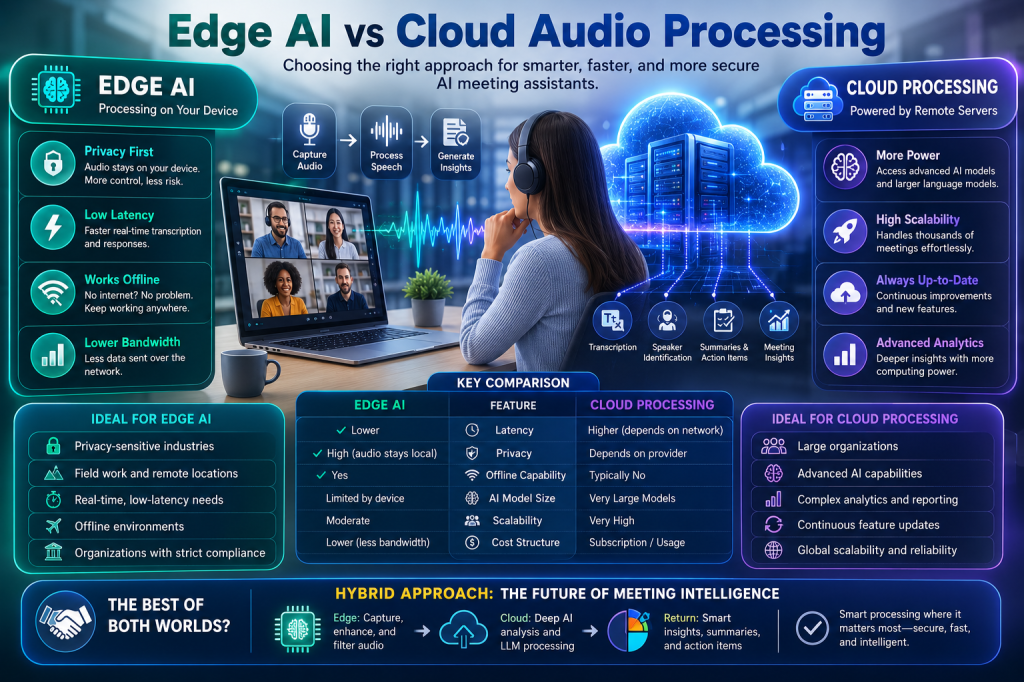
Edge AI refers to artificial intelligence systems that operate locally on a device rather than sending data to remote servers.
Examples include:
- Laptops
- Smartphones
- Tablets
- Conference room hardware
- Dedicated AI appliances
In an Edge AI architecture, audio processing occurs directly on the user’s device.
The audio never needs to leave the local environment for certain tasks.
Understanding Cloud Audio Processing
Cloud audio processing relies on remote data centers.
The workflow typically looks like this:
- Audio is captured.
- Audio is transmitted to cloud servers.
- AI models process the audio.
- Results are returned to users.
Most current AI meeting assistants use cloud-based architectures because they provide access to large-scale AI infrastructure.
How Edge AI Audio Processing Works
When a meeting begins, the local device handles audio processing.
The system performs tasks such as:
Noise Cancellation
Removing environmental sounds.
Voice Activity Detection
Identifying speech segments.
Speech Enhancement
Improving voice clarity.
Speaker Separation
Distinguishing multiple speakers.
Local Transcription
Generating text directly on the device.
All processing occurs without transmitting raw audio externally.
How Cloud Audio Processing Works
Cloud systems process audio using powerful server infrastructure.
The workflow includes:
Audio Upload
Meeting audio is streamed to cloud servers.
Large-Scale AI Processing
Powerful models analyze speech.
Speech Recognition
Audio becomes text.
Meeting Intelligence
AI generates summaries, action items, and insights.
Result Delivery
Outputs are returned to users.
Cloud platforms can utilize significantly larger AI models than most local devices.
The Importance of Latency
Latency refers to the delay between speech and AI output.
Low latency is essential for:
- Live transcription
- Real-time captions
- Speaker identification
- Interactive meeting assistants
Edge AI Latency
Since processing occurs locally:
- Minimal network delays
- Faster response times
- More consistent performance
Cloud Latency
Requires:
- Uploading audio
- Server processing
- Downloading results
This introduces additional delays.
For real-time features, Edge AI often provides an advantage.
Privacy and Security Considerations
Privacy is one of the biggest factors driving Edge AI adoption.
Edge AI Privacy Benefits
Audio remains on the local device.
Benefits include:
- Reduced data exposure
- Greater regulatory compliance
- Better protection of sensitive discussions
- Increased user trust
This is particularly important for:
- Healthcare
- Finance
- Legal services
- Government organizations
Cloud Privacy Considerations
Cloud providers implement strong security controls, but:
- Audio leaves the device
- Data traverses networks
- Storage may occur externally
Organizations with strict privacy requirements may prefer local processing whenever possible.
Performance and AI Model Size
One advantage of cloud systems is access to powerful infrastructure.
Cloud Advantages
Cloud servers can run:
- Larger speech models
- Advanced LLMs
- Complex analytics engines
- Massive language models
These systems often deliver superior accuracy.
Edge Limitations
Local devices have constraints:
- CPU power
- GPU availability
- Memory capacity
- Battery life
As a result, Edge AI models are often smaller.
Offline Capabilities
Edge AI provides an important benefit:
Offline Processing
Users can continue working without internet connectivity.
Examples include:
- Airplanes
- Remote locations
- Secure facilities
- Field operations
Cloud systems generally require internet access.
Offline functionality is becoming increasingly valuable.
Scalability
Cloud architectures excel at scaling.
Cloud Scalability
Providers can:
- Allocate additional servers
- Handle thousands of concurrent meetings
- Deploy updates instantly
Edge Scalability
Performance depends on individual devices.
Older hardware may struggle with advanced AI workloads.
Cloud infrastructure offers greater scalability for enterprise deployments.
Cost Considerations
Cost structures differ significantly.
Cloud Costs
Expenses may include:
- Server usage
- Storage
- Bandwidth
- AI inference
Providers often charge recurring subscription fees.
Edge Costs
Costs are shifted toward:
- Device hardware
- Local processing resources
- Battery consumption
Organizations must balance infrastructure costs against hardware investments.
Audio Quality and Processing
Audio enhancement is critical for meeting intelligence.
Edge Audio Enhancement
Advantages include:
- Faster noise cancellation
- Lower latency
- Immediate feedback
Cloud Audio Enhancement
Advantages include:
- More advanced AI models
- Larger enhancement systems
- Greater computational resources
Both approaches can produce excellent results depending on implementation.
Speech Recognition Accuracy
Speech recognition quality depends on:
- Model sophistication
- Training data
- Computational resources
Cloud systems often achieve higher accuracy because they can deploy larger models.
However, Edge AI models continue improving rapidly.
Many local speech recognition engines now achieve impressive performance.
Large Language Models and Meeting Intelligence
Meeting assistants increasingly use Large Language Models (LLMs).
These models generate:
- Summaries
- Action items
- Meeting insights
- Conversational search
Cloud LLM Advantages
Most advanced LLMs remain cloud-based due to:
- Large model sizes
- High computational requirements
Edge LLM Trends
Smaller language models are increasingly running on local hardware.
This trend is expected to accelerate.
Hybrid Architectures: The Best of Both Worlds
Many AI meeting assistants are adopting hybrid approaches.
A typical workflow might include:
Edge Processing
- Noise cancellation
- VAD
- Audio enhancement
- Initial transcription
Cloud Processing
- Large language models
- Meeting summaries
- Advanced analytics
- Knowledge extraction
This architecture balances:
- Speed
- Privacy
- Accuracy
- Scalability
Hybrid systems are likely to become the dominant approach.
Benefits of Edge AI in Meeting Assistants
Lower Latency
Faster responses.
Better Privacy
Audio remains local.
Offline Functionality
Works without internet.
Reduced Bandwidth Usage
Less data transmission.
Improved Reliability
Less dependence on network quality.
Benefits of Cloud Audio Processing
Larger AI Models
Access to more advanced systems.
Greater Accuracy
Enhanced recognition capabilities.
Easier Updates
Continuous model improvements.
Enterprise Scalability
Supports large deployments.
Advanced Analytics
More computational resources available.
Future of Audio Processing in AI Meeting Assistants
Several trends are shaping the future.
More Powerful Edge Hardware
AI-capable laptops and smartphones are becoming common.
Smaller AI Models
Efficient models designed for local execution.
On-Device LLMs
Language models increasingly running at the edge.
Privacy-First Architectures
Organizations demanding greater control over data.
Hybrid AI Platforms
Combining local and cloud intelligence seamlessly.
These developments will blur the line between edge and cloud processing.
Which Approach Is Better?
The answer depends on organizational priorities.
Edge AI Is Ideal For
- Privacy-sensitive environments
- Offline scenarios
- Low-latency applications
- Secure industries
Cloud Processing Is Ideal For
- Maximum AI capability
- Large-scale deployments
- Advanced analytics
- Continuous model improvements
Hybrid Architectures Are Ideal For
- Most modern organizations
- Balanced performance
- Strong privacy
- Advanced AI capabilities
For many AI meeting assistants, hybrid processing represents the most practical solution.
Conclusion
The debate between Edge AI and Cloud Audio Processing is becoming increasingly important as AI meeting assistants evolve. Edge AI offers lower latency, stronger privacy, and offline capabilities, while cloud processing provides access to larger AI models, greater scalability, and more advanced analytics.
Rather than choosing one approach exclusively, many vendors are moving toward hybrid architectures that combine local audio processing with cloud-based meeting intelligence. This allows organizations to benefit from both speed and intelligence while maintaining strong privacy and performance.
As AI hardware improves and language models become more efficient, Edge AI will continue gaining capabilities. The future of AI meeting assistants will likely be defined by intelligent collaboration between edge devices and cloud infrastructure, delivering faster, smarter, and more secure meeting experiences.

 Meeting Notes AI