Introduction
Every AI meeting assistant relies on one foundational technology that makes modern meeting intelligence possible: Automatic Speech Recognition (ASR).
Whether an AI meeting assistant is generating live captions, creating meeting transcripts, identifying action items, or producing AI-powered summaries, it must first convert spoken language into text. That critical task is performed by ASR.
Over the past decade, advances in machine learning, deep learning, cloud computing, and large language models have dramatically improved speech recognition accuracy. Modern AI meeting assistants can now understand conversations involving multiple speakers, different accents, technical terminology, and even multilingual discussions.
This guide explains how Automatic Speech Recognition works and why it serves as the backbone of today’s AI meeting assistants.
What Is Automatic Speech Recognition?
Automatic Speech Recognition (ASR) is a technology that converts spoken language into written text automatically.
Its primary goal is simple:
Transform human speech into machine-readable text.
For AI meeting assistants, ASR enables:
- Live transcription
- Meeting recordings
- Searchable transcripts
- Real-time captions
- AI summaries
- Action item extraction
- Meeting analytics
Without ASR, AI meeting assistants would have no way to understand spoken conversations.
Why ASR Matters in AI Meeting Assistants
Meeting intelligence begins with speech recognition.
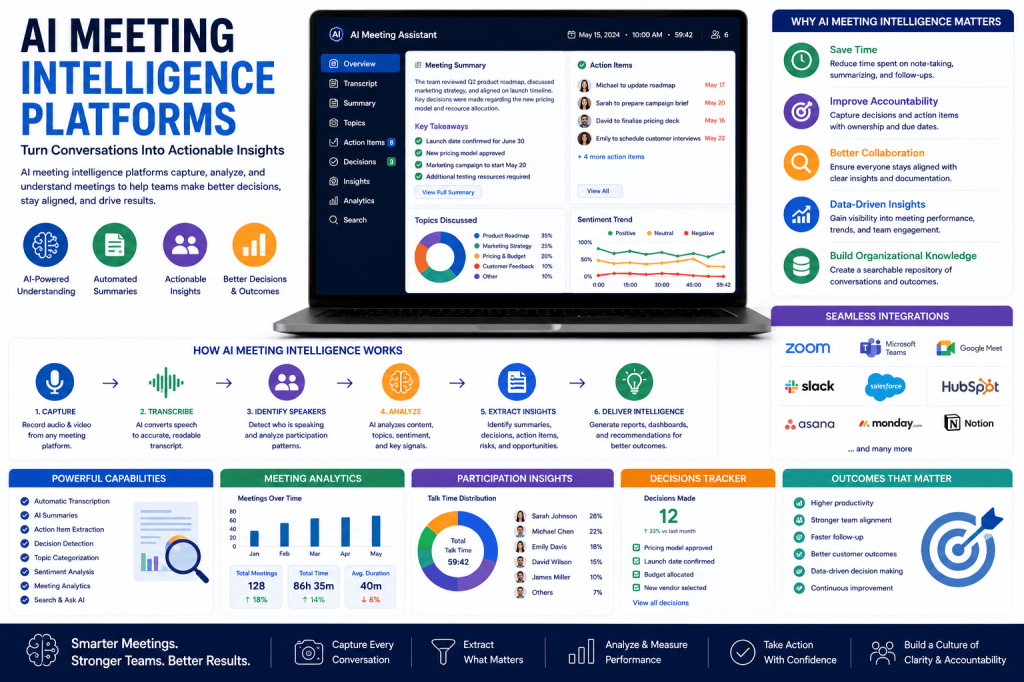
The typical workflow looks like this:
Audio Capture → ASR → Transcript → AI Analysis → Meeting Intelligence
Everything downstream depends on transcription quality.
If ASR performs poorly:
- Transcripts become inaccurate
- Summaries become unreliable
- Action items may be missed
- Analytics become less useful
The better the ASR system, the better the overall meeting assistant.
A Brief History of Speech Recognition
Early speech recognition systems were highly limited.
They often required:
- Controlled environments
- Small vocabularies
- Individual speaker training
Performance was often poor outside carefully managed conditions.
Modern ASR systems are dramatically different.
Advances in:
- Deep learning
- Neural networks
- Cloud computing
- Massive training datasets
have made speech recognition practical for real-world meetings.
Today’s systems can recognize speech with remarkable accuracy across many languages and environments.
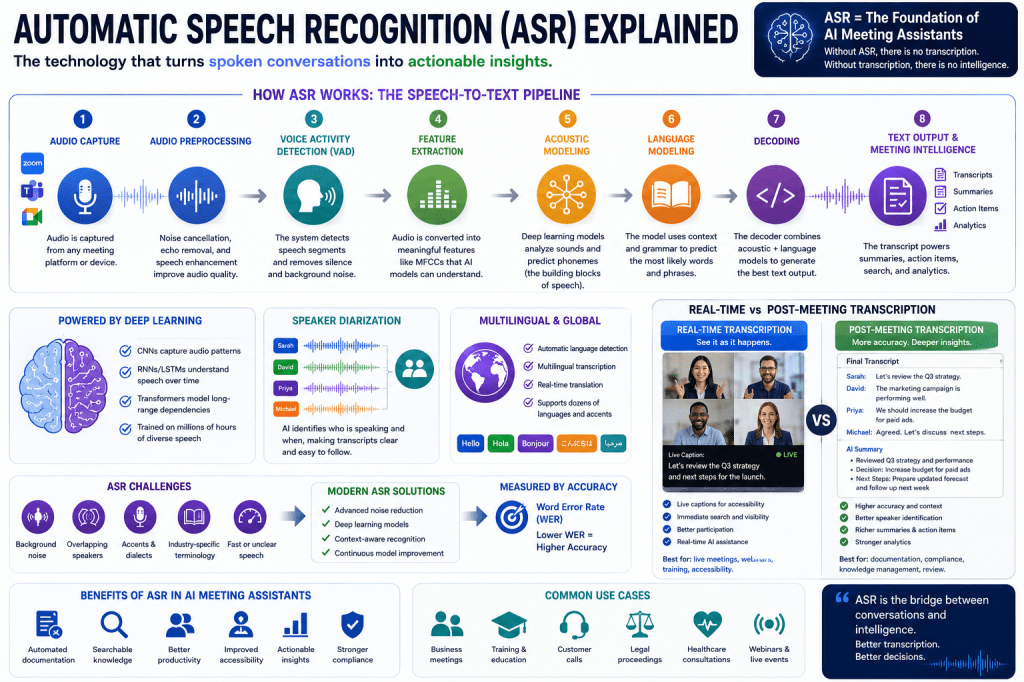
How ASR Works
Modern ASR systems follow several processing stages.
Step 1: Audio Capture
The process begins when audio is captured from:
- Zoom meetings
- Microsoft Teams
- Google Meet
- Conference rooms
- Smartphones
- Microphones
- Uploaded recordings
The captured audio becomes the input for the recognition system.
Step 2: Audio Preprocessing
Before speech recognition begins, the audio is cleaned.
Common preprocessing tasks include:
Noise Cancellation
Removing background sounds.
Echo Cancellation
Reducing audio reflections.
Speech Enhancement
Improving voice clarity.
Volume Normalization
Balancing audio levels.
Better audio quality improves recognition accuracy.
Step 3: Voice Activity Detection (VAD)
Voice Activity Detection identifies when speech is present.
The system separates:
- Human speech
- Silence
- Background noise
This allows ASR to focus only on meaningful speech segments.
VAD improves efficiency while reducing transcription errors.
Step 4: Feature Extraction
The audio signal is converted into a format that machine learning models can understand.
Important speech features include:
Frequency Patterns
Characteristics of human speech.
Pitch
Voice tone and frequency.
Energy Levels
Speech intensity.
Spectral Information
Frequency distribution over time.
One of the most common feature extraction techniques is:
Mel-Frequency Cepstral Coefficients (MFCCs)
MFCCs capture important speech characteristics and remain widely used in speech recognition systems.
Step 5: Acoustic Modeling
The acoustic model analyzes sounds.
Its job is to answer:
“What sounds am I hearing?”
The model learns relationships between:
- Audio patterns
- Speech sounds
- Phonemes
Phonemes are the smallest units of sound in a language.
For example:
The word:
“Meeting”
contains multiple phonetic components.
The acoustic model identifies these sound patterns before converting them into words.
Step 6: Language Modeling
Understanding sounds alone is not enough.
The AI must also determine:
“What words make sense together?”
Language models provide context.
For example:
Suppose the acoustic model is uncertain whether a speaker said:
- Sales pipeline
- Sails pipeline
The language model recognizes that “sales pipeline” is far more likely in a business meeting.
Context dramatically improves transcription accuracy.
Step 7: Decoding
The decoder combines outputs from:
- Acoustic models
- Language models
The system predicts the most likely sequence of words.
The result becomes the transcript.
This process occurs continuously throughout the meeting.
Deep Learning and Modern ASR
Most modern ASR systems rely on deep learning.
Deep learning models learn directly from enormous speech datasets.
Common architectures include:
Convolutional Neural Networks (CNNs)
Analyze audio patterns and frequencies.
Recurrent Neural Networks (RNNs)
Track speech over time.
Long Short-Term Memory Networks (LSTMs)
Capture long-range speech dependencies.
Transformer Models
Model relationships across entire conversations.
These approaches have dramatically improved recognition quality.
End-to-End Speech Recognition
Many modern systems use end-to-end architectures.
Instead of relying on separate components, these models learn:
Audio → Text
directly.
Benefits include:
- Simplified architecture
- Better accuracy
- Easier training
- Faster deployment
End-to-end systems are increasingly common in AI meeting assistants.
Speaker Diarization and ASR
Meetings often involve multiple participants.
Speaker diarization answers:
“Who spoke when?”
While ASR converts speech into text, diarization identifies speaker boundaries.
Example:
Sarah: Let’s review the budget.
David: Marketing is ready.
Combining ASR with speaker diarization produces readable and actionable transcripts.
Handling Accents and Dialects
One of the biggest challenges in speech recognition is accent variation.
Modern ASR systems improve performance through:
- Diverse training datasets
- Multilingual learning
- Adaptive modeling
- Context-aware language models
This helps AI meeting assistants support global teams more effectively.
Multilingual Speech Recognition
Many AI meeting assistants support multiple languages.
Capabilities may include:
Automatic Language Detection
Identifying the spoken language.
Multilingual Transcription
Generating transcripts in different languages.
Real-Time Translation
Translating conversations during meetings.
Global organizations increasingly depend on these features.
ASR and Large Language Models
Large Language Models (LLMs) have further improved speech recognition systems.
LLMs help:
Correct Errors
Resolve transcription mistakes.
Improve Punctuation
Add formatting and readability.
Understand Context
Interpret business conversations.
Enhance Summaries
Transform transcripts into actionable insights.
ASR provides the raw transcript.
LLMs refine and interpret it.
Together they power modern meeting intelligence.
Common Challenges for ASR
Despite major advances, challenges remain.
Background Noise
Environmental sounds reduce accuracy.
Overlapping Speakers
Multiple simultaneous voices create complexity.
Poor Microphones
Low-quality recordings affect recognition.
Specialized Vocabulary
Industry-specific terminology can be difficult.
Fast Speech
Rapid conversations remain challenging.
Meeting assistant vendors continuously improve models to address these issues.
Measuring ASR Accuracy
The most common metric is:
Word Error Rate (WER)
WER measures:
- Insertions
- Deletions
- Substitutions
Lower WER indicates higher accuracy.
Meeting assistant providers often use WER to benchmark transcription quality.
Benefits of ASR in AI Meeting Assistants
Organizations gain significant advantages.
Automated Documentation
Meetings become searchable records.
Better Productivity
Less manual note-taking.
Improved Accessibility
Live captions support participants.
Better Knowledge Management
Conversations become reusable organizational knowledge.
Enhanced Meeting Intelligence
AI generates summaries, decisions, and action items.
ASR serves as the foundation for all these capabilities.
Future of Automatic Speech Recognition
Several trends are shaping the future.
Personalized Speech Models
Recognition tailored to individual speakers.
Better Speaker Separation
Improved handling of overlapping conversations.
Edge AI Processing
Faster local speech recognition.
Multimodal AI
Combining audio, video, and text understanding.
Near-Human Accuracy
Continued improvements in deep learning and language modeling.
These innovations will make AI meeting assistants even more powerful.
Conclusion
Automatic Speech Recognition is the core technology that enables AI meeting assistants to transform conversations into valuable business information. By converting spoken language into text, ASR provides the foundation for meeting transcripts, summaries, action items, analytics, and knowledge management.
Modern ASR systems combine audio processing, machine learning, acoustic modeling, language modeling, and deep learning to achieve impressive levels of accuracy across diverse speakers, accents, and meeting environments. As AI continues to evolve, Automatic Speech Recognition will remain one of the most important technologies driving the future of meeting intelligence and workplace productivity.





 Meeting Notes AI