AI Meeting Assistants have become essential tools for modern organizations. They automatically record meetings, generate transcripts, create summaries, identify action items, and build searchable knowledge repositories. While these capabilities provide tremendous productivity benefits, they also create a growing volume of meeting data that organizations must manage responsibly.
One of the most important aspects of managing meeting information is establishing clear data retention policies.
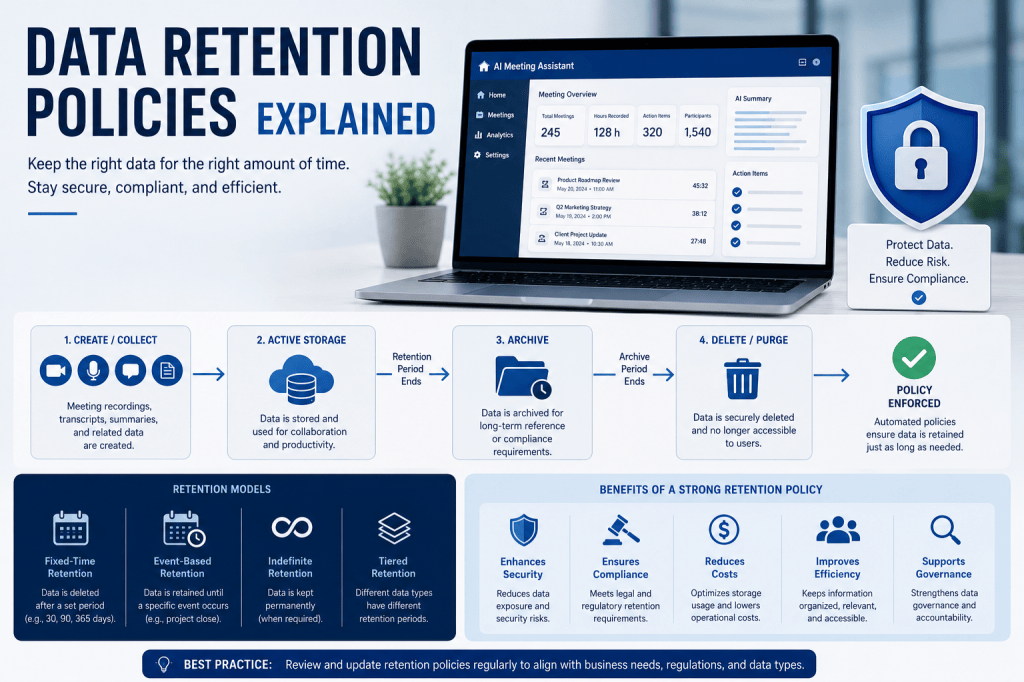
Data retention policies determine how long meeting recordings, transcripts, summaries, and related information are stored before they are archived or deleted. These policies play a critical role in security, privacy, compliance, governance, and operational efficiency.
In this article, we’ll explain what data retention policies are, why they matter, and how organizations use them to manage meeting data effectively.
What Is a Data Retention Policy?
A data retention policy is a set of rules that defines:
- What data is stored
- How long data is kept
- When data is archived
- When data is deleted
- Who can manage retention settings
- How retention requirements are enforced
For AI Meeting Assistants, retention policies apply to information such as:
- Meeting recordings
- Audio files
- Video files
- Meeting transcripts
- AI-generated summaries
- Action items
- Decisions
- Analytics
- Meeting metadata
Rather than keeping everything forever, organizations define rules that align with business, legal, and compliance requirements.
Why Data Retention Matters
Many organizations initially focus on collecting and storing information.
However, retaining data indefinitely creates several challenges.
Security Risks
The more information that is stored, the larger the potential attack surface becomes.
Older meeting recordings may contain:
- Confidential discussions
- Financial information
- Customer data
- Strategic plans
Reducing unnecessary data storage reduces risk.
Privacy Requirements
Privacy regulations often require organizations to limit how long personal information is retained.
Meeting transcripts frequently contain:
- Employee names
- Customer information
- Personal identifiers
- Sensitive conversations
Retention policies help organizations comply with privacy laws.
Storage Costs
Although cloud storage has become relatively affordable, large organizations can accumulate enormous amounts of meeting data.
Thousands of meetings can generate:
- Terabytes of recordings
- Millions of transcript entries
- Large analytics datasets
Retention policies help control storage expenses.
Regulatory Compliance
Many industries are subject to regulations governing how information must be retained and protected.
Retention policies help organizations satisfy compliance requirements while maintaining operational efficiency.
Types of Meeting Data Subject to Retention Policies
Modern AI Meeting Assistants generate multiple categories of information.
Each category may require different retention periods.
Meeting Recordings
Audio and video recordings often consume the most storage space.
Organizations frequently apply shorter retention periods to recordings.
Meeting Transcripts
Transcripts are often retained longer because they provide searchable records while requiring less storage.
AI Summaries
Summaries are compact and highly valuable for knowledge management.
Many organizations retain summaries longer than recordings.
Action Items
Action items may be retained until completed or archived.
Decisions
Meeting decisions often have long-term business value and may be retained for extended periods.
Analytics and Metadata
Participation metrics, engagement data, and meeting statistics may be governed by separate retention schedules.
Common Data Retention Models
Organizations typically adopt one of several approaches.
Fixed-Time Retention
Data is automatically deleted after a predefined period.
Examples:
- 30 days
- 90 days
- 1 year
- 3 years
This is one of the most common retention strategies.
Event-Based Retention
Data is retained until a specific event occurs.
Examples include:
- Project completion
- Contract expiration
- Employee departure
- Case closure
Event-based retention aligns data management with business processes.
Indefinite Retention
Some organizations choose to retain information indefinitely.
This approach is common for:
- Strategic decisions
- Historical records
- Research data
- Long-term knowledge repositories
However, indefinite retention increases security and compliance risks.
Tiered Retention
Different types of meeting data receive different retention periods.
For example:
- Recordings: 90 days
- Transcripts: 2 years
- Summaries: 5 years
- Decisions: Permanent archive
Tiered retention balances knowledge preservation with risk management.
Retention Policies and Privacy Regulations
Data retention policies often support compliance with privacy regulations.
GDPR
The General Data Protection Regulation requires organizations to retain personal information only as long as necessary.
Key principles include:
- Data minimization
- Purpose limitation
- Storage limitation
Organizations operating in Europe frequently implement retention controls to support GDPR compliance.
CCPA
The California Consumer Privacy Act also emphasizes transparency and responsible data management.
Retention policies help organizations demonstrate compliance.
HIPAA
Healthcare organizations must manage retention requirements for protected health information (PHI).
Meeting platforms used in healthcare environments often implement specialized retention controls.
Legal Hold Requirements
In some situations, organizations must preserve data regardless of normal retention schedules.
This is known as a legal hold.
Examples include:
- Litigation
- Regulatory investigations
- Audits
- Compliance reviews
When a legal hold is applied:
- Automatic deletion is suspended
- Data remains preserved
- Retention policies are temporarily overridden
Legal hold capabilities are common in enterprise-grade meeting platforms.
Automated Retention Management
Modern AI Meeting Assistants often provide automated retention controls.
Administrators can configure rules such as:
- Delete recordings after 90 days
- Archive transcripts after one year
- Remove inactive meeting data
- Purge deleted files permanently
Automation reduces manual effort and ensures policy consistency.
Data Archiving
Not all data needs to remain immediately accessible.
Archiving allows organizations to:
- Preserve information
- Reduce active storage costs
- Maintain compliance
- Improve system performance
Archived meeting data can often be retrieved when necessary while remaining separate from active workloads.
Data Deletion Policies
Deletion is an important component of retention management.
Organizations should understand:
- How deletion occurs
- Whether deletion is permanent
- Recovery options
- Backup retention policies
Questions to ask vendors include:
- Is deleted data immediately removed?
- How long do backups retain deleted content?
- Can deleted recordings be recovered?
- What happens to associated transcripts and summaries?
Transparent deletion practices support both compliance and trust.
Retention Policies and Security
Retention policies directly influence security.
Benefits include:
Reduced Attack Surface
Less stored data means fewer assets for attackers to target.
Lower Insider Risk
Older sensitive information becomes unavailable after deletion.
Improved Compliance
Organizations can demonstrate responsible data management.
Simplified Incident Response
Smaller data inventories make investigations more manageable.
Retention policies are therefore an important security control—not just a storage management tool.
AI Meeting Assistant Retention Features
Many AI Meeting Assistants now include advanced retention capabilities.
Common features include:
- Organization-wide policies
- Department-specific retention schedules
- User-level controls
- Automated deletion workflows
- Archiving options
- Legal hold support
- Compliance reporting
- Audit logging
These capabilities help organizations align retention practices with business and regulatory requirements.
Best Practices for Data Retention Policies
Organizations should consider the following recommendations:
Classify Meeting Data
Identify different categories of information and assign appropriate retention periods.
Retain Only What Is Necessary
Avoid storing data longer than required.
Automate Retention Enforcement
Manual processes are prone to errors and inconsistencies.
Document Retention Policies
Clearly communicate retention practices to employees and stakeholders.
Review Policies Regularly
Business requirements and regulations evolve over time.
Coordinate With Legal and Compliance Teams
Retention schedules should align with applicable laws and industry requirements.
Audit Retention Processes
Regular reviews help ensure policies are functioning as intended.
Emerging Trends in Data Retention
As AI Meeting Intelligence Platforms evolve, retention strategies are becoming more sophisticated.
Emerging trends include:
AI-Powered Data Classification
Automatically identifying sensitive content and assigning retention policies.
Context-Aware Retention
Adjusting retention periods based on meeting type and content.
Automated Compliance Monitoring
Detecting policy violations and recommending corrective actions.
Customer-Controlled Retention
Providing organizations with greater flexibility and control over data lifecycles.
These innovations help organizations balance knowledge preservation with security and privacy concerns.
Conclusion
Data retention policies are a critical component of modern meeting intelligence platforms. They determine how long recordings, transcripts, summaries, action items, and analytics are stored while helping organizations balance security, compliance, privacy, and operational needs.
Without effective retention policies, organizations risk accumulating unnecessary data, increasing storage costs, expanding security exposure, and creating compliance challenges. By implementing clear, well-managed retention practices, organizations can maximize the value of meeting intelligence while maintaining responsible data governance.
As AI Meeting Assistants continue to generate increasing amounts of organizational knowledge, data retention policies will remain a foundational element of secure and compliant meeting data management.

 Meeting Notes AI