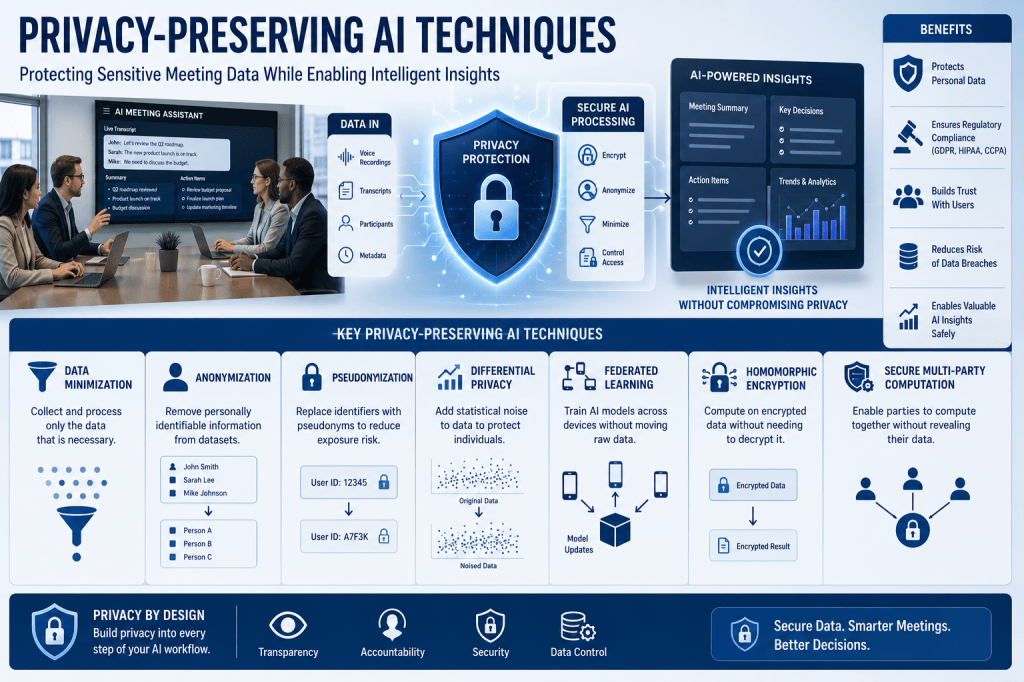
Artificial Intelligence has become the driving force behind modern AI Meeting Assistants. Technologies such as speech recognition, natural language processing, large language models, sentiment analysis, and meeting intelligence systems help organizations automatically generate transcripts, summaries, action items, and business insights from conversations.
However, as AI systems process increasing amounts of sensitive meeting information, privacy concerns continue to grow.
Organizations want the benefits of AI-powered meeting intelligence without exposing confidential business discussions, customer information, employee data, or intellectual property. This challenge has led to the development of Privacy-Preserving AI techniques.
These technologies aim to allow AI systems to learn from, analyze, and process data while minimizing privacy risks and reducing exposure of sensitive information.
In this article, we’ll explore the most important privacy-preserving AI techniques and how they are shaping the future of AI Meeting Assistants.
Why Privacy Matters in AI Meeting Assistants
Meetings often contain highly sensitive information such as:
- Financial forecasts
- Product roadmaps
- Customer conversations
- Legal discussions
- Employee performance reviews
- Acquisition strategies
- Research and development plans
AI Meeting Assistants process this information to generate valuable outputs, including:
- Meeting transcripts
- Summaries
- Action items
- Decisions
- Analytics
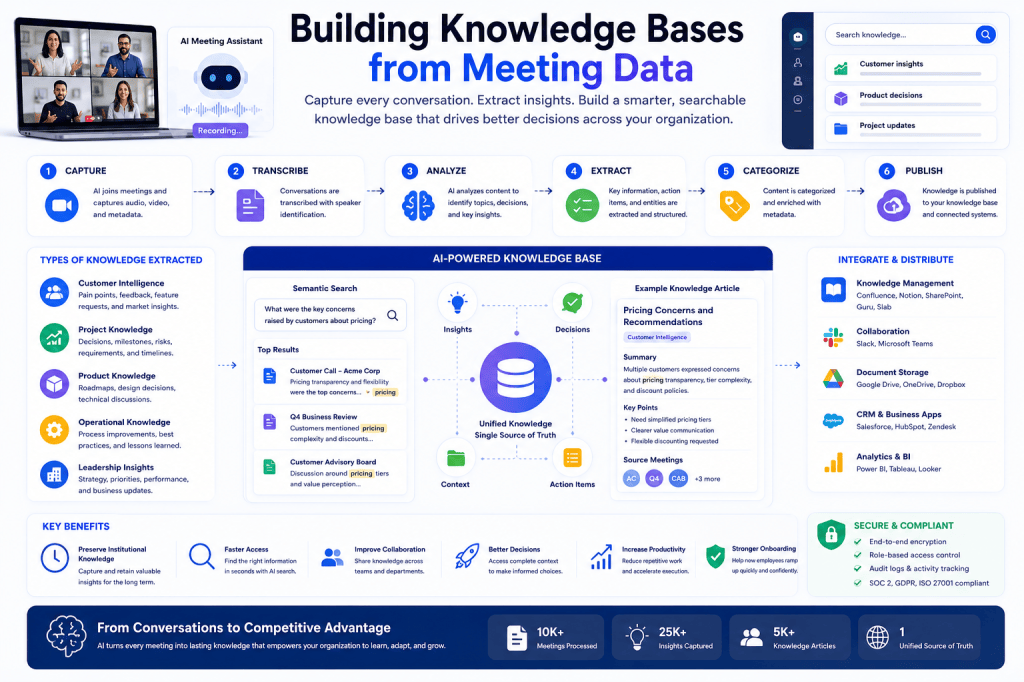
- Knowledge repositories
Without strong privacy protections, organizations may face:
- Data breaches
- Regulatory violations
- Intellectual property exposure
- Loss of customer trust
- Insider threats
Privacy-preserving AI seeks to reduce these risks while maintaining AI functionality.
What Is Privacy-Preserving AI?
Privacy-Preserving AI refers to a collection of technologies and techniques that enable AI systems to use data while minimizing exposure of sensitive information.
The primary goals are:
- Protect user privacy
- Limit data exposure
- Reduce security risks
- Support regulatory compliance
- Enable secure AI processing
Rather than relying solely on traditional security controls, privacy-preserving AI embeds privacy protections directly into AI workflows.
Data Minimization
One of the simplest but most effective privacy techniques is data minimization.
The principle is straightforward:
Only collect and process the data that is truly necessary.
For AI Meeting Assistants, this may include:
- Recording only required meetings
- Limiting stored metadata
- Removing unnecessary personal information
- Restricting transcript retention periods
Reducing the amount of collected data lowers both privacy and security risks.
Data Anonymization
Anonymization removes information that can identify individuals.
Examples include replacing:
John Smith approved the budget.
with:
Employee A approved the budget.
Anonymized data can still be useful for:
- Trend analysis
- Meeting analytics
- Productivity studies
- AI model improvement
While anonymization is valuable, modern AI systems can sometimes re-identify individuals through contextual clues, making proper implementation essential.
Data Pseudonymization
Pseudonymization replaces identifiers with temporary substitutes.
For example:
Customer Name: Sarah Johnson
becomes:
Customer ID: USER-8421
Unlike anonymization, pseudonymized information can be restored when authorized.
Benefits include:
- Reduced privacy exposure
- Regulatory compliance support
- Continued operational usefulness
Many privacy regulations recognize pseudonymization as an important protection mechanism.
Differential Privacy
Differential Privacy is one of the most advanced privacy-preserving AI techniques.
The idea is to introduce carefully controlled statistical noise into datasets.
This makes it difficult to determine whether any specific individual’s data is present while still allowing accurate analysis of larger patterns.
Benefits include:
- Strong mathematical privacy guarantees
- Protection against re-identification
- Useful aggregate insights
Major technology companies use differential privacy for privacy-sensitive analytics.
Future AI Meeting Assistants may apply differential privacy to:
- Meeting analytics
- Team performance metrics
- Organizational trend reporting
Federated Learning
Traditional AI training often requires centralizing large datasets.
Federated Learning takes a different approach.
Instead of sending data to a central server:
- AI models are sent to local devices.
- Training occurs locally.
- Only model updates are shared.
- Raw data remains on the original device.
Benefits include:
- Reduced data exposure
- Improved privacy
- Lower regulatory risk
- Greater organizational control
Federated learning could eventually allow AI Meeting Assistants to improve performance without requiring sensitive meeting data to leave customer environments.
Homomorphic Encryption
Homomorphic Encryption allows AI systems to perform computations on encrypted data.
Traditionally:
Decrypt → Process → Encrypt
With homomorphic encryption:
Encrypted Data → Process → Encrypted Results
Benefits include:
- Minimal data exposure
- Strong privacy protection
- Secure cloud processing
Challenges include:
- Computational complexity
- Performance overhead
- Implementation difficulty
Although still emerging, homomorphic encryption represents a promising future direction for privacy-preserving AI.
Confidential Computing
Confidential Computing protects information while it is actively being processed.
Traditional encryption protects:
- Data at rest
- Data in transit
Confidential computing protects:
- Data in use
This is achieved through secure hardware environments known as Trusted Execution Environments (TEEs).
Benefits include:
- Protection during AI inference
- Reduced insider risk
- Stronger cloud security
Confidential computing is increasingly being explored for enterprise AI applications.
Secure Multi-Party Computation
Secure Multi-Party Computation (SMPC) allows multiple parties to collaborate on computations without revealing their underlying data.
For example:
Several organizations could jointly analyze meeting trends without exposing their actual meeting content.
Benefits include:
- Collaborative analytics
- Privacy protection
- Reduced data sharing requirements
While currently more common in research and specialized industries, SMPC may play a larger role in future AI ecosystems.
Synthetic Data Generation
Synthetic data is artificially generated information that resembles real data but does not contain actual personal information.
Organizations may use synthetic meeting data for:
- AI model testing
- Development environments
- Benchmarking
- Research
Benefits include:
- Lower privacy risk
- Reduced compliance burden
- Safe experimentation
Synthetic data is becoming increasingly valuable for AI development.
Access Control and Data Segmentation
Privacy-preserving AI is not limited to advanced algorithms.
Practical controls also play a critical role.
Examples include:
Role-Based Access Control
Limiting access based on job responsibilities.
Data Segmentation
Separating customer environments and datasets.
Least Privilege Access
Providing only necessary permissions.
These measures reduce the likelihood of unauthorized exposure.
AI Model Isolation
Organizations increasingly want assurance that their data remains isolated from other customers.
Modern AI Meeting Assistants may provide:
- Dedicated AI environments
- Private AI deployments
- Tenant isolation
- Customer-specific processing
These approaches reduce the risk of data leakage between organizations.
Redaction of Sensitive Information
AI systems can automatically detect and remove sensitive information from transcripts.
Examples include:
- Credit card numbers
- Government identifiers
- Medical information
- Account numbers
- Confidential project names
Redaction helps organizations share information safely while protecting sensitive details.
Privacy-Preserving Large Language Models
As large language models become more common in meeting intelligence platforms, privacy concerns increase.
Emerging approaches include:
Private LLM Deployments
Running models within customer-controlled environments.
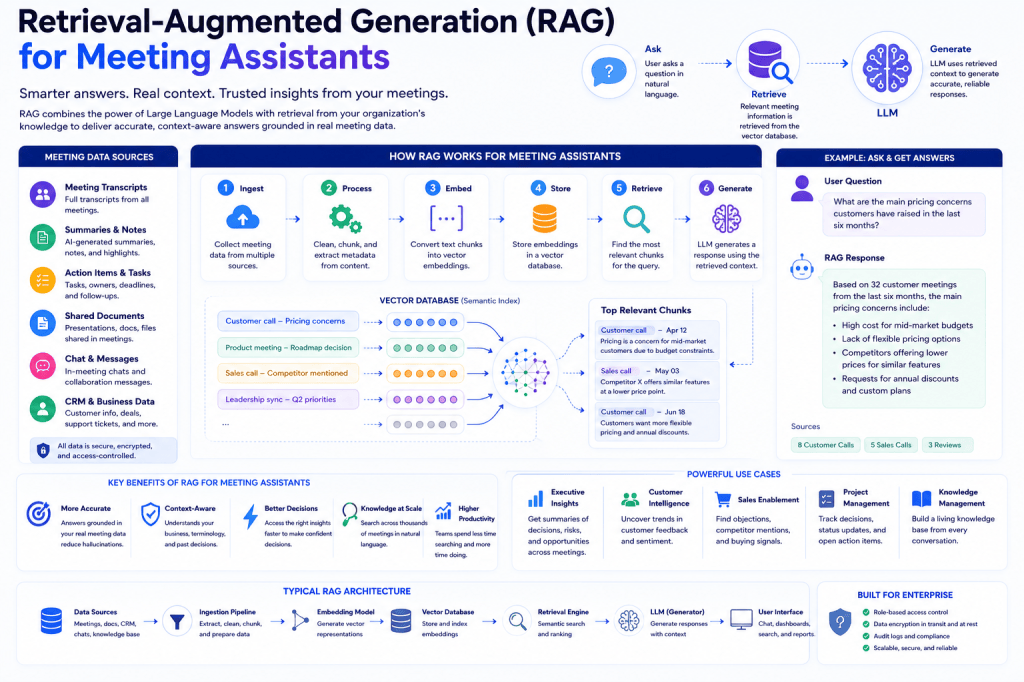
Retrieval-Augmented Generation (RAG)
Limiting AI access to specific approved knowledge sources.
Customer Data Isolation
Preventing cross-customer exposure.
No-Training Policies
Ensuring customer meeting data is not used to train future models.
These controls are becoming increasingly important in enterprise AI deployments.
Privacy and Regulatory Compliance
Privacy-preserving AI helps organizations comply with regulations such as:
GDPR
Requires protection of personal information and data minimization.
CCPA
Promotes transparency and consumer privacy rights.
HIPAA
Protects healthcare information.
ISO 27001
Supports information security management.
Privacy-preserving technologies help organizations reduce compliance risks while enabling AI innovation.
Challenges of Privacy-Preserving AI
Although powerful, these techniques are not without limitations.
Challenges include:
- Increased computational costs
- Implementation complexity
- Performance trade-offs
- Infrastructure requirements
- Scalability concerns
Organizations must balance privacy, performance, and usability when deploying AI systems.
The Future of Privacy-Preserving AI
Several trends are likely to shape the future of AI Meeting Assistants.
These include:
- Wider adoption of confidential computing
- Improved homomorphic encryption performance
- Federated learning ecosystems
- Privacy-aware large language models
- Customer-controlled AI environments
- Stronger regulatory requirements
- AI governance frameworks
As AI becomes more deeply integrated into workplace collaboration, privacy-preserving technologies will become increasingly important.
Conclusion
Privacy-Preserving AI techniques enable organizations to benefit from AI-powered meeting intelligence while reducing risks associated with sensitive information. Technologies such as data minimization, anonymization, pseudonymization, differential privacy, federated learning, homomorphic encryption, confidential computing, and AI model isolation provide powerful tools for protecting meeting data.
As organizations continue adopting AI Meeting Assistants, privacy will become just as important as functionality. The most successful meeting intelligence platforms will not only deliver valuable insights but will also ensure that conversations, recordings, transcripts, and analytics remain protected throughout their lifecycle.
The future of AI-powered collaboration depends on building systems that are both intelligent and privacy-conscious.

 Meeting Notes AI