Introduction
Modern AI meeting assistants are expected to do far more than transcribe everyday conversations. They are increasingly used in industries such as software development, healthcare, finance, legal services, engineering, manufacturing, and scientific research, where meetings are filled with specialized terminology, acronyms, product names, technical jargon, and industry-specific language.
Accurately understanding technical terminology is one of the biggest challenges for any AI meeting assistant.
If a meeting assistant misinterprets a product name, software framework, medical term, legal phrase, or financial concept, the resulting transcript, summary, and action items may become inaccurate and potentially misleading.
Fortunately, advances in speech recognition, machine learning, natural language processing, and large language models have significantly improved how AI systems recognize and understand specialized language.
This guide explains how AI meeting assistants handle technical terminology and why this capability is essential for accurate meeting intelligence.
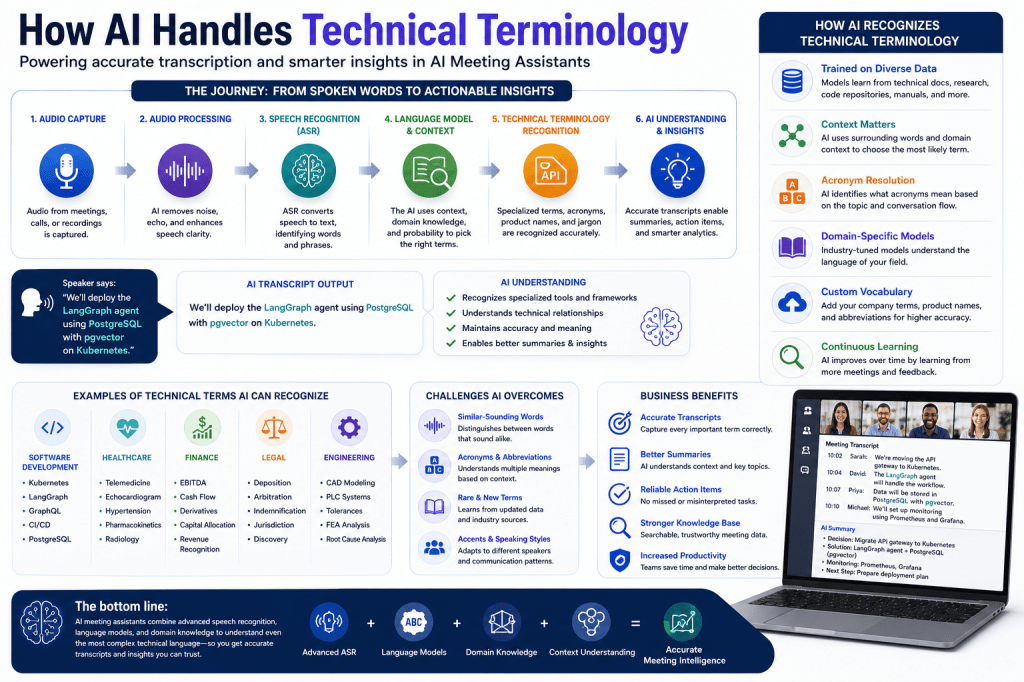
Why Technical Terminology Matters
Many workplace conversations contain language that rarely appears in everyday speech.
Examples include:
Software Development
- Kubernetes
- LangGraph
- PostgreSQL
- GraphQL
- Docker Compose
- CI/CD
- Retrieval-Augmented Generation (RAG)
Healthcare
- Echocardiogram
- Hypertension
- Telemedicine
- Radiology
- Pharmacokinetics
Finance
- EBITDA
- Cash Flow
- Revenue Recognition
- Derivatives
- Capital Allocation
Legal
- Indemnification
- Discovery
- Deposition
- Arbitration
- Jurisdiction
Engineering
- Finite Element Analysis
- CAD Modeling
- Tolerances
- PLC Systems
- Root Cause Analysis
A meeting assistant must correctly recognize these terms to provide useful outputs.
The Challenge of Technical Language
Technical terminology creates several challenges.
Rare Words
Many specialized terms occur infrequently in general speech datasets.
Similar-Sounding Words
Technical terms may resemble common words.
For example:
- Kubernetes
- Cybernetics
or
- Cache
- Cash
Acronyms
Meetings often contain abbreviations such as:
- API
- CRM
- NLP
- LLM
- ERP
- SQL
AI must determine the intended meaning based on context.
New Terminology
Technology evolves rapidly.
New products, frameworks, and concepts emerge constantly.
Speech recognition systems must adapt quickly.
The Role of Automatic Speech Recognition
The first step in understanding technical terminology is recognizing it accurately.
Automatic Speech Recognition (ASR) converts speech into text.
The system analyzes:
- Pronunciation
- Acoustic patterns
- Context
- Language probabilities
Modern ASR models perform significantly better than earlier systems because they are trained on much larger datasets.
However, recognizing specialized terminology requires additional techniques.
Language Models and Context
Modern speech recognition systems use language models alongside acoustic models.
The language model helps answer:
“Which word is most likely in this context?”
For example:
A software engineer says:
“We deployed the application to Kubernetes.”
The acoustic model identifies speech sounds.
The language model recognizes that “Kubernetes” is more likely than similar-sounding alternatives in a technical discussion.
Context dramatically improves recognition accuracy.
Training on Diverse Data
One of the most effective ways to improve terminology recognition is through training data.
Modern AI systems learn from:
- Technical articles
- Documentation
- Industry publications
- Developer forums
- Business communications
- Academic research
Exposure to specialized language helps models understand uncommon terminology.
The broader the training data, the stronger the recognition capabilities.
Domain-Specific Language Models
Some AI systems use specialized models designed for particular industries.
Examples include:
Healthcare Models
Trained on:
- Clinical notes
- Medical literature
- Healthcare terminology
Legal Models
Trained on:
- Legal documents
- Court filings
- Regulatory content
Financial Models
Trained on:
- Financial reports
- Earnings calls
- Investment research
Domain-specific models often outperform general-purpose systems in specialized environments.
Large Language Models and Technical Terminology
Large Language Models (LLMs) have transformed how AI handles specialized language.
Unlike traditional systems that focus primarily on speech recognition, LLMs understand context and meaning.
They help AI meeting assistants:
Recognize Industry Concepts
Understand specialized topics.
Resolve Ambiguity
Interpret unclear terms using surrounding context.
Correct Recognition Errors
Fix transcription mistakes.
Improve Summaries
Generate more accurate meeting insights.
This contextual understanding is one of the biggest improvements introduced by LLMs.
Example: Technical Context in Software Meetings
Consider the following sentence:
“We’re integrating LangGraph with our RAG pipeline using PostgreSQL and pgvector.”
A general speech recognition system might struggle.
An AI meeting assistant enhanced with LLMs can recognize:
- LangGraph
- RAG
- PostgreSQL
- pgvector
because these concepts frequently appear together within software engineering contexts.
Context enables more accurate interpretation.
Acronym Recognition
Technical meetings frequently contain acronyms.
Examples include:
- API
- CRM
- ERP
- SQL
- NLP
- ASR
- VAD
- KPI
AI systems use contextual analysis to determine:
What the acronym represents
Whether multiple meanings exist
Which interpretation fits the discussion
For example:
“API” in a software meeting almost certainly refers to an Application Programming Interface.
Context reduces ambiguity.
Speaker Context and Terminology
AI meeting assistants often learn from recurring participants.
If a speaker regularly discusses:
- Cloud architecture
- Machine learning
- Financial planning
the system can build stronger contextual expectations.
This helps improve recognition of recurring terminology over time.
Knowledge Bases and Custom Vocabulary
Many enterprise AI meeting assistants allow organizations to define:
Custom Vocabulary
Company-specific terms.
Product Names
Internal products and services.
Customer Names
Important accounts and stakeholders.
Industry Terms
Frequently used specialized language.
Adding custom terminology can significantly improve transcription accuracy.
Retrieval-Augmented AI Systems
Some advanced meeting platforms use Retrieval-Augmented Generation (RAG).
RAG systems combine:
- Large Language Models
- Internal knowledge sources
- Documentation repositories
- Enterprise data
When technical terminology appears, the AI can reference relevant knowledge sources.
This improves:
- Accuracy
- Context understanding
- Summary quality
RAG is becoming increasingly important in enterprise meeting intelligence.
Handling New Terminology
One challenge with technical language is constant change.
New examples include:
- Agentic AI
- Multimodal AI
- Synthetic Data
- AI Agents
- Vector Databases
Modern AI systems continuously update their models to accommodate emerging terminology.
Cloud-based AI meeting assistants often receive regular model improvements automatically.
Technical Terminology and Meeting Summaries
Recognizing terminology is only the first step.
Meeting assistants must also understand its meaning.
For example:
“We need to migrate our vector database to a PostgreSQL pgvector implementation.”
A strong AI system understands that:
- A database migration is being discussed.
- PostgreSQL is the target platform.
- pgvector is a vector search extension.
This enables better summary generation.
Technical Terminology and Action Item Extraction
Action item extraction depends heavily on terminology understanding.
Example:
“Ben will update the Kubernetes deployment manifests before Friday.”
The AI must correctly identify:
- The responsible person
- The action
- Kubernetes
- Deployment manifests
- The deadline
Misunderstanding technical language can lead to incorrect task tracking.
Benefits for Organizations
Accurate terminology recognition provides several advantages.
Better Transcripts
Technical conversations remain understandable.
Improved Summaries
Key concepts are preserved.
Better Action Items
Tasks remain accurate.
Stronger Knowledge Management
Meeting records become more valuable.
Increased User Trust
Teams gain confidence in AI-generated outputs.
These benefits are especially important in technical organizations.
Best Practices for Improving Technical Recognition
Organizations can improve AI performance by:
Using High-Quality Audio
Better speech input improves recognition.
Defining Custom Vocabulary
Add company-specific terminology.
Maintaining Knowledge Bases
Support contextual understanding.
Reviewing Critical Meetings
Verify important technical discussions.
Using Industry-Specific Platforms
Select solutions optimized for your field.
These practices improve overall accuracy.
Future of Technical Terminology Recognition
Several innovations are expected to improve performance further.
Personalized AI Models
Adapt to individual teams.
Company-Specific Language Learning
Continuous vocabulary updates.
Deeper Context Awareness
Improved understanding of technical discussions.
Enterprise Knowledge Integration
Direct access to documentation and repositories.
Real-Time Technical Assistance
AI providing contextual explanations during meetings.
These advancements will make AI meeting assistants increasingly valuable for specialized industries.
Conclusion
Handling technical terminology is one of the most important challenges for AI meeting assistants. Through a combination of speech recognition, language models, machine learning, domain-specific training, retrieval systems, and large language models, modern platforms can accurately recognize and understand highly specialized language.
As organizations continue adopting AI meeting assistants across technical fields, the ability to understand industry-specific terminology will become an increasingly important competitive advantage. Accurate terminology recognition leads to better transcripts, stronger summaries, more reliable action items, and more valuable meeting intelligence overall.

 Meeting Notes AI