Introduction
Modern organizations operate across countries, cultures, and languages. A single virtual meeting may include participants speaking English, Spanish, French, German, Dutch, Mandarin, Japanese, or other languages. In many global organizations, meetings frequently involve multilingual discussions where participants switch between languages naturally.
For AI meeting assistants, this presents a significant challenge.
To generate accurate transcripts, summaries, action items, and meeting insights, the AI must recognize multiple languages, understand different accents, and accurately convert speech into text regardless of the language being spoken.
This capability is powered by Multilingual Meeting Transcription Technology.
Modern AI meeting assistants increasingly support multilingual transcription, allowing global teams to collaborate more effectively and ensuring that important information is captured regardless of language barriers.
This guide explores how multilingual meeting transcription works and why it has become a critical feature in AI-powered meeting intelligence platforms.
What Is Multilingual Meeting Transcription?
Multilingual meeting transcription is the process of automatically converting spoken conversations in multiple languages into written text.
Unlike traditional speech recognition systems that focus on a single language, multilingual systems can:
- Recognize multiple languages
- Detect language changes
- Transcribe multilingual conversations
- Handle mixed-language meetings
- Support international teams
- Enable translation workflows
The goal is to accurately capture conversations regardless of the language being spoken.
Why Multilingual Transcription Matters
Global business communication continues to expand.
Organizations increasingly operate across:
- Multiple countries
- Distributed teams
- International clients
- Global partners
- Multilingual workforces
Without multilingual transcription, organizations may struggle to:
- Document discussions
- Share knowledge
- Search meeting records
- Support international collaboration
AI meeting assistants help solve these challenges.
Common Multilingual Meeting Scenarios
Multilingual transcription is valuable in many situations.
International Team Meetings
Participants speak different native languages.
Customer Support Calls
Representatives interact with customers globally.
Sales Meetings
International prospects require language flexibility.
Healthcare Consultations
Providers communicate with diverse patient populations.
Educational Settings
Students and instructors may use multiple languages.
Government and Public Services
Multilingual communication is often essential.
In each case, accurate transcription improves understanding and record keeping.
How Multilingual Meeting Transcription Works
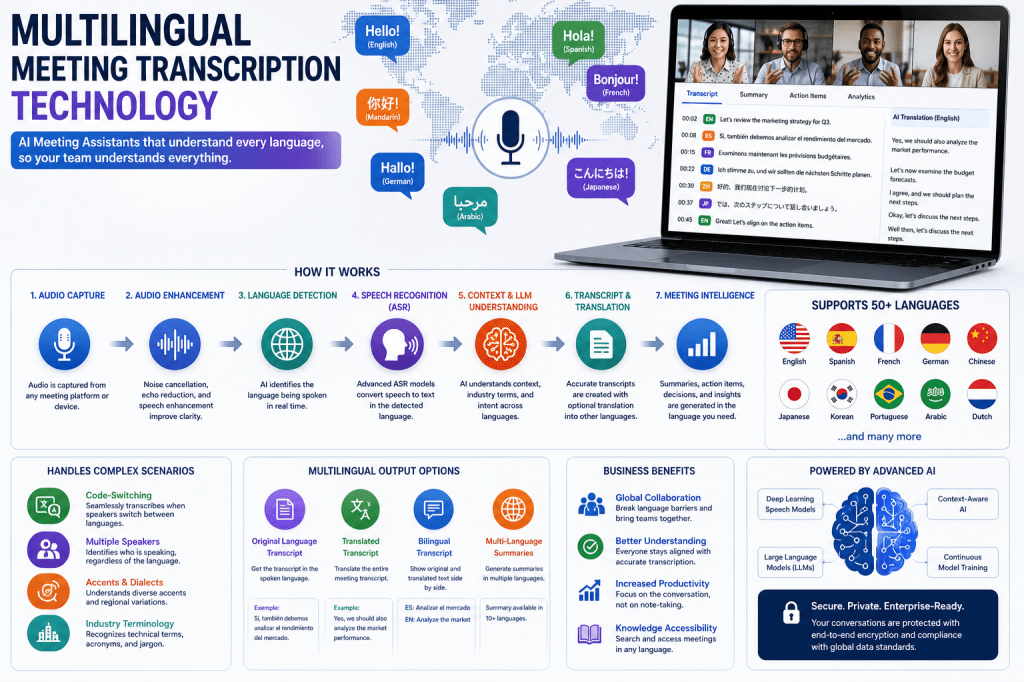
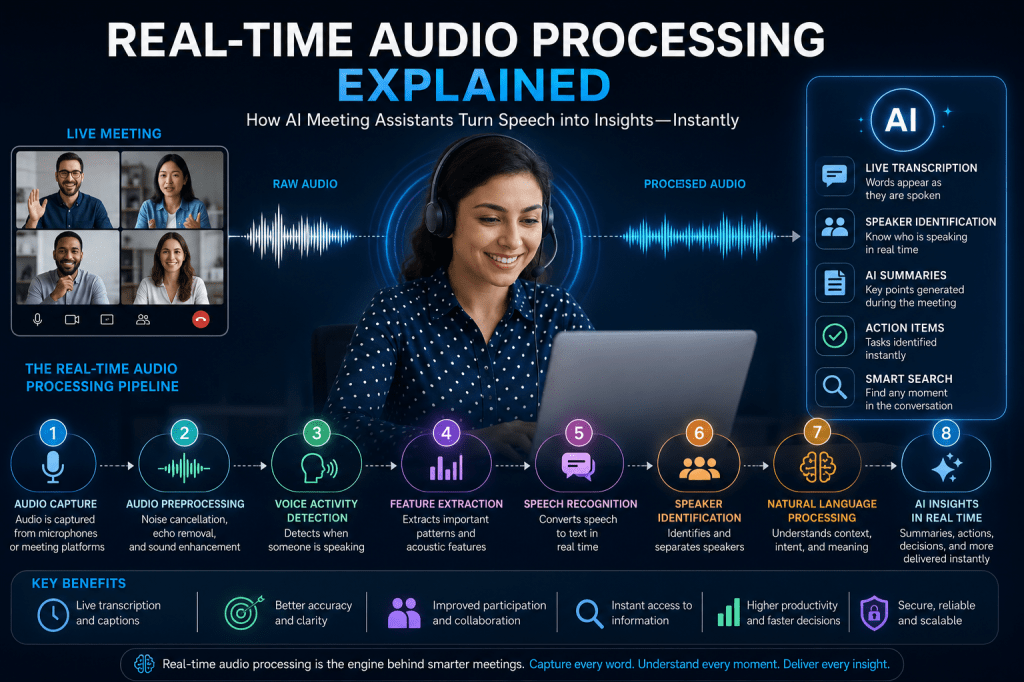
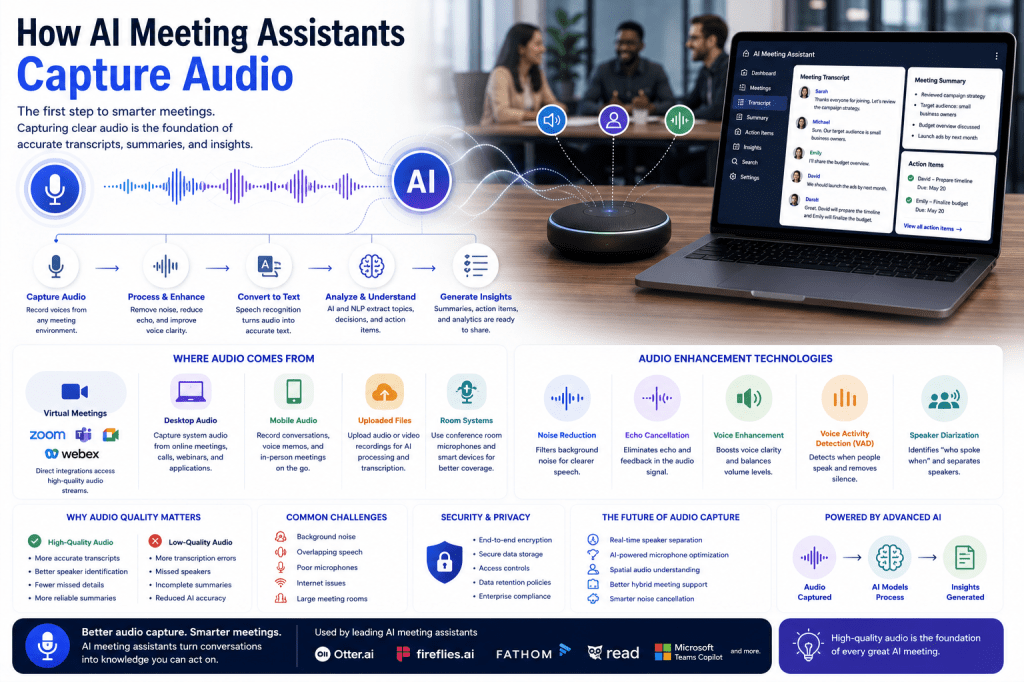
Modern AI meeting assistants use a multi-stage process.
Step 1: Audio Capture
The meeting assistant captures audio from:
- Zoom
- Microsoft Teams
- Google Meet
- Conference room systems
- Mobile devices
- Uploaded recordings
The audio becomes the input for language analysis.
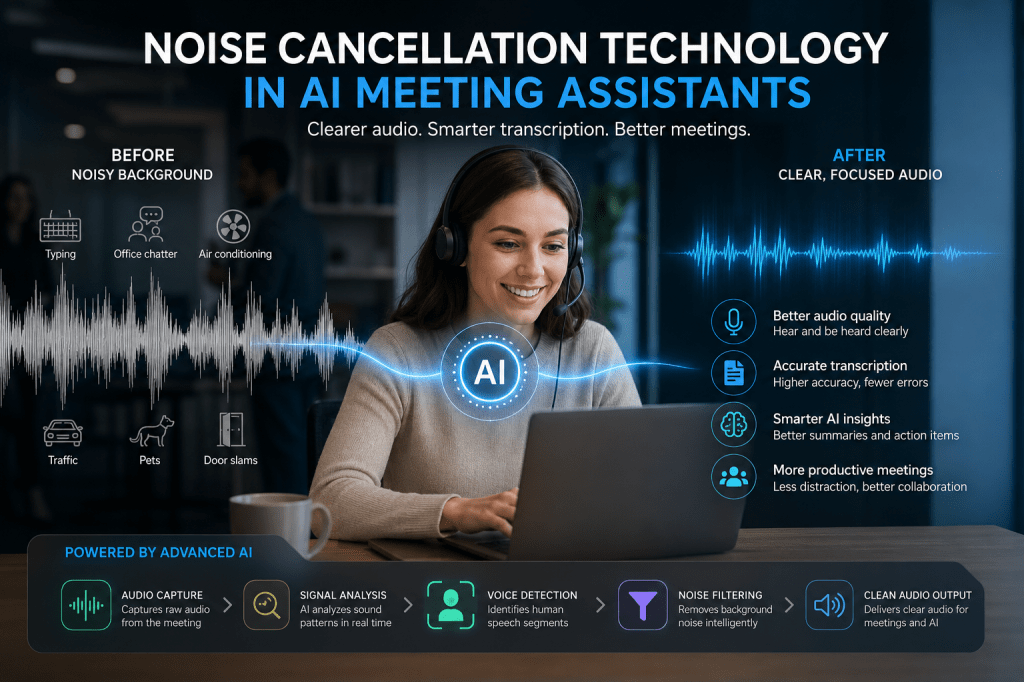
Step 2: Audio Enhancement
Before transcription begins, audio quality is improved.
Enhancement technologies include:
Noise Cancellation
Removes background sounds.
Echo Cancellation
Eliminates reflected audio.
Speech Enhancement
Improves vocal clarity.
Better audio improves language recognition accuracy.
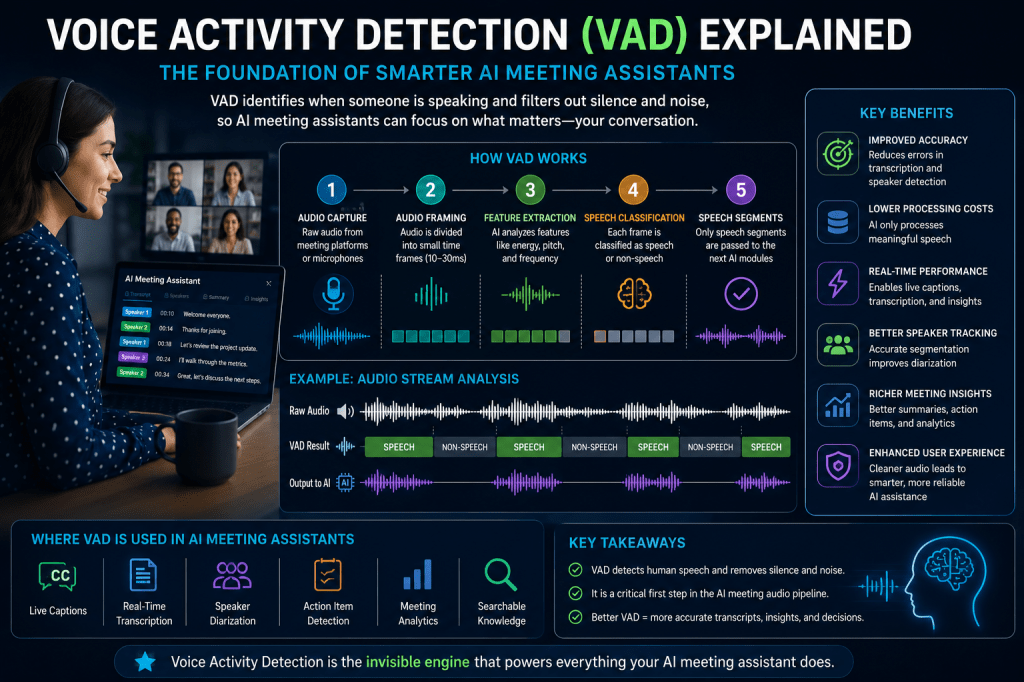
Step 3: Voice Activity Detection
Voice Activity Detection (VAD) identifies:
- Speech
- Silence
- Background noise
Only speech segments proceed to transcription systems.
This improves efficiency and accuracy.
Step 4: Language Identification
One of the most important stages is language detection.
The AI must determine:
“Which language is being spoken?”
Language Identification (LID) models analyze:
- Pronunciation
- Vocabulary
- Acoustic patterns
- Speech characteristics
The system identifies the language before transcription begins.
Automatic Language Detection
Modern AI meeting assistants can automatically recognize dozens of languages.
Examples include:
- English
- Spanish
- French
- German
- Dutch
- Italian
- Portuguese
- Japanese
- Korean
- Mandarin Chinese
- Arabic
Automatic detection eliminates the need for manual language selection in many cases.
Step 5: Speech Recognition
Once the language is identified, Automatic Speech Recognition (ASR) converts speech into text.
The ASR engine uses:
- Acoustic models
- Language models
- Deep learning
- Neural networks
Each language may have its own specialized speech recognition model.
The result is an accurate transcript in the original language.
Multilingual Speech Recognition Models
Traditional systems often required separate models for each language.
Modern AI systems increasingly use multilingual models.
These models learn from:
- Multiple languages
- Diverse accents
- Global speech datasets
Benefits include:
Improved Scalability
One model supports many languages.
Better Language Switching
Handles multilingual conversations more effectively.
Faster Deployment
Simplified model management.
Multilingual models have become increasingly common in AI meeting assistants.
Handling Code-Switching
One of the most difficult challenges is code-switching.
Code-switching occurs when speakers switch languages during a conversation.
Example:
“Let’s review the marketing plan before la próxima reunión.”
This sentence contains both English and Spanish.
Modern multilingual transcription systems can:
- Detect language changes
- Continue transcription seamlessly
- Maintain context across languages
This capability is particularly important in international workplaces.
Deep Learning and Multilingual Recognition
Modern multilingual transcription relies heavily on deep learning.
Common architectures include:
Convolutional Neural Networks (CNNs)
Analyze speech features.
Recurrent Neural Networks (RNNs)
Process sequential speech.
Transformer Models
Capture long-range language relationships.
End-to-End Speech Models
Convert speech directly into text.
These architectures have significantly improved multilingual performance.
Large Language Models and Multilingual Meetings
Large Language Models (LLMs) further enhance multilingual transcription.
They help:
Improve Context Understanding
Interpret multilingual conversations.
Correct Recognition Errors
Resolve ambiguities.
Generate Better Summaries
Understand conversations regardless of language.
Support Cross-Language Knowledge Management
Make meeting insights accessible to global teams.
LLMs have become a key component of modern meeting intelligence systems.
Multilingual Meeting Summaries
Many AI meeting assistants go beyond transcription.
They generate:
- Executive summaries
- Action items
- Key decisions
- Follow-up recommendations
Some platforms can produce summaries:
In the Original Language
Maintaining native-language context.
In a Different Language
Making information accessible across international teams.
This significantly improves organizational communication.
Real-Time Translation
Some advanced AI meeting assistants include translation capabilities.
Features may include:
Live Captions
Displayed in multiple languages.
Real-Time Translation
Speech translated during meetings.
Multilingual Notes
Meeting notes generated in different languages.
Cross-Language Collaboration
Participants communicate more effectively.
Real-time translation is becoming increasingly important in global organizations.
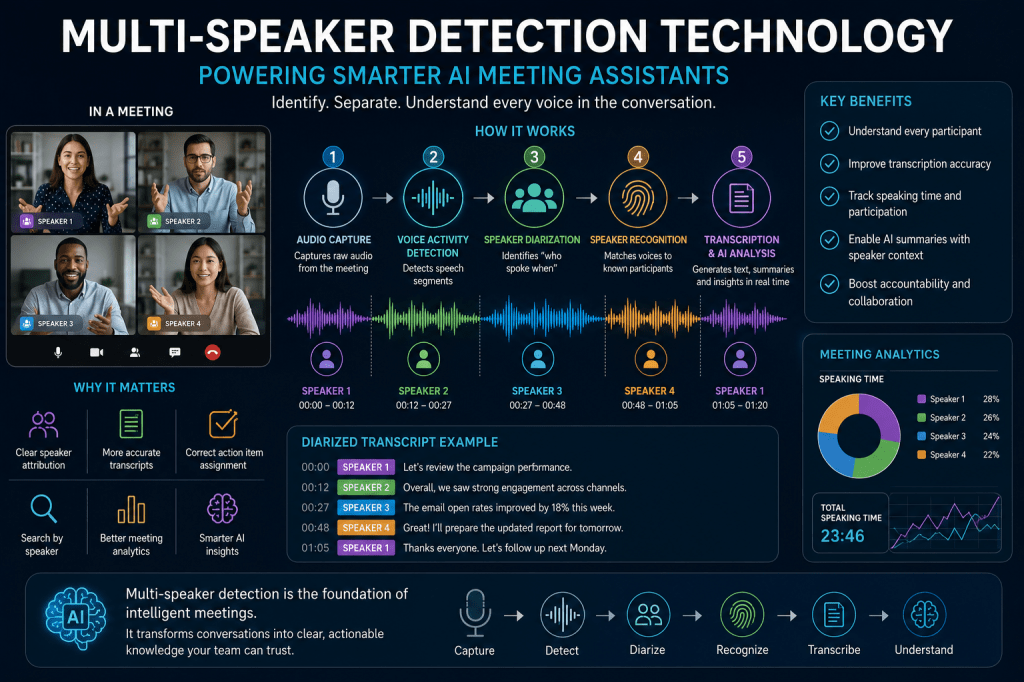
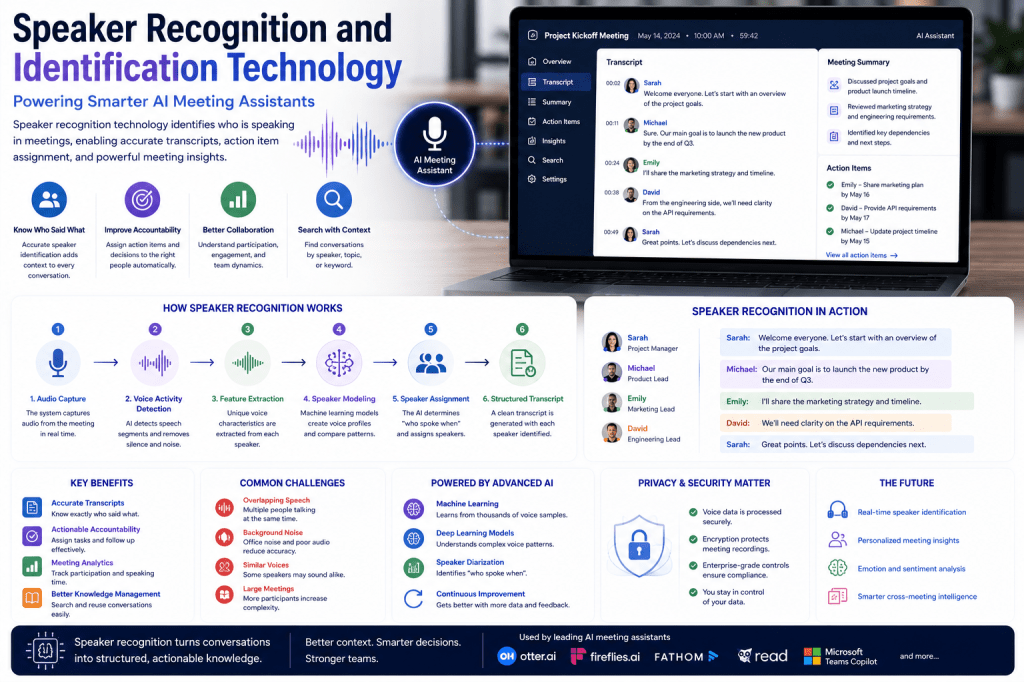
Speaker Identification Across Languages
Speaker diarization remains important in multilingual meetings.
The system must determine:
- Who is speaking
- When speakers change
- Which language each speaker uses
Modern AI systems can perform speaker tracking regardless of language.
This improves transcript organization and meeting analytics.
Challenges in Multilingual Transcription
Although the technology has improved dramatically, challenges remain.
Similar Languages
Closely related languages can be difficult to distinguish.
Examples:
- Spanish and Portuguese
- Dutch and German
Accents and Regional Variations
Pronunciation differences increase complexity.
Code-Switching
Frequent language changes require advanced models.
Industry Terminology
Technical terms may appear in multiple languages.
Overlapping Speech
Multiple speakers create additional challenges.
AI providers continuously improve models to address these issues.
Benefits for Organizations
Multilingual transcription provides significant advantages.
Improved Global Collaboration
Teams communicate more effectively.
Better Accessibility
Language barriers are reduced.
Stronger Knowledge Management
Meetings become searchable regardless of language.
Better Documentation
Conversations are preserved accurately.
Improved Productivity
Less manual translation work is required.
Greater Inclusion
Participants can communicate in their preferred language.
These benefits make multilingual meeting assistants increasingly valuable.
Future of Multilingual Meeting Transcription
Several innovations are expected to drive future improvements.
Larger Multilingual Models
Support for more languages and dialects.
Better Code-Switching Detection
More natural multilingual conversation handling.
Real-Time Cross-Language Meetings
Instant transcription and translation.
Personalized Language Models
Adaptation to specific users and organizations.
Multimodal AI
Combining speech, text, video, and context.
These advances will continue improving global collaboration.
Conclusion
Multilingual meeting transcription technology is transforming how global organizations communicate and collaborate. By combining language identification, speech recognition, deep learning, speaker diarization, and large language models, modern AI meeting assistants can accurately transcribe conversations across multiple languages and cultures.
As international business continues to expand, multilingual transcription will become an increasingly important component of meeting intelligence. Organizations that adopt these capabilities can improve communication, reduce language barriers, enhance knowledge management, and create more inclusive workplaces for teams around the world.

 Meeting Notes AI