As AI meeting assistants become increasingly popular, organizations often compare platforms based on one critical capability: transcription accuracy. Vendors frequently claim industry-leading performance, but understanding how transcription quality is actually measured requires a closer look at meeting transcription benchmarking.
Benchmarking provides a standardized way to evaluate how accurately AI meeting assistants convert spoken conversations into written text. By measuring performance across different meeting environments, languages, accents, and speaking conditions, benchmarking helps organizations make informed decisions when selecting transcription solutions.
What Is Meeting Transcription Benchmarking?
Meeting transcription benchmarking is the process of evaluating and comparing the performance of speech recognition systems used by AI meeting assistants.
The goal is to determine how accurately a platform can:
- Recognize spoken words
- Identify speakers
- Handle multiple participants
- Understand technical terminology
- Process accents and dialects
- Perform in noisy environments
- Generate reliable transcripts
Benchmarking allows researchers, vendors, and customers to compare systems using consistent performance metrics.
Why Benchmarking Matters
Transcription accuracy directly affects the quality of:
- Meeting summaries
- Action item extraction
- AI-generated insights
- Searchable meeting records
- Compliance documentation
- Knowledge management systems
Even small transcription errors can change the meaning of discussions and reduce the value of meeting intelligence.
Reliable benchmarking helps organizations identify which AI meeting assistant performs best under real-world conditions.
The Most Important Benchmark Metric: Word Error Rate (WER)
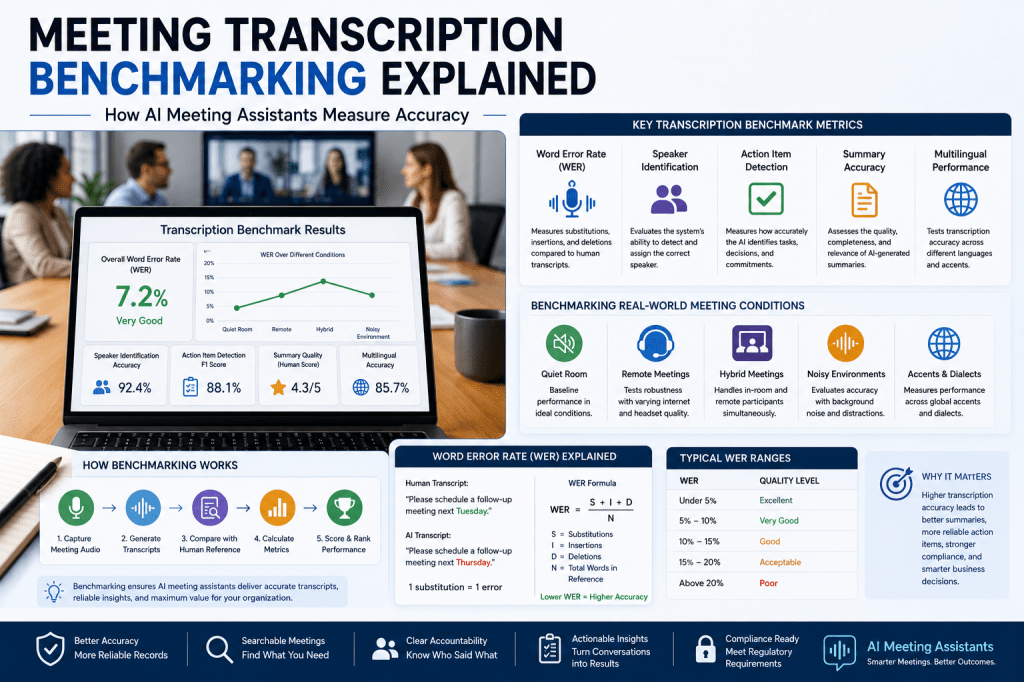
The most widely used metric in speech recognition benchmarking is Word Error Rate (WER).
WER measures how many mistakes a transcription system makes compared to a human-generated reference transcript.
The formula evaluates:
- Substitutions (incorrect words)
- Insertions (extra words)
- Deletions (missing words)
For example:
Human transcript:
“Please schedule a follow-up meeting next Tuesday.”
AI transcript:
“Please schedule a follow-up meeting next Thursday.”
One word substitution occurred.
The lower the WER, the more accurate the transcription system.
Typical WER Ranges
| Word Error Rate | Quality Level |
|---|---|
| Under 5% | Excellent |
| 5% – 10% | Very Good |
| 10% – 15% | Good |
| 15% – 20% | Acceptable |
| Above 20% | Poor |
Modern AI meeting assistants often achieve WER scores below 10% in ideal conditions.
Beyond Word Error Rate
Although WER is important, it does not tell the complete story.
Modern benchmarking often evaluates additional metrics.
Speaker Identification Accuracy
AI meeting assistants must correctly determine who is speaking.
Benchmarking measures:
- Speaker attribution accuracy
- Speaker change detection
- Multi-speaker performance
This process is commonly called speaker diarization benchmarking.
Action Item Detection Accuracy
Many meeting assistants automatically identify tasks and commitments.
Benchmarking evaluates:
- Precision
- Recall
- Task extraction quality
Summary Accuracy
Generative AI summaries are increasingly important.
Benchmark tests may compare:
- Coverage of key topics
- Accuracy of decisions captured
- Action item inclusion
- Overall usefulness
Named Entity Recognition
Systems are evaluated on their ability to recognize:
- Company names
- Product names
- Customer names
- Technical terminology
- Industry-specific vocabulary
Benchmarking Real-World Meeting Conditions
The best benchmarks simulate realistic workplace environments.
Quiet Meeting Rooms
These tests establish baseline transcription performance under ideal conditions.
Remote Meetings
Remote meetings introduce:
- Internet compression artifacts
- Headset variability
- Background noise
Benchmarking evaluates system resilience in these environments.
Hybrid Meetings
Hybrid meetings are particularly challenging because some participants are in a conference room while others join remotely.
This creates:
- Variable microphone quality
- Uneven speaker volume
- Audio overlap
Noisy Environments
Benchmark datasets often include:
- Office noise
- Keyboard typing
- HVAC systems
- Traffic sounds
- Café environments
These scenarios reveal how effectively audio enhancement and noise cancellation systems perform.
Accent and Dialect Benchmarking
Global organizations require speech recognition systems that understand diverse speakers.
Benchmarking often includes:
- American English
- British English
- Australian English
- Indian English
- Non-native speakers
- Regional accents
Accent benchmarking helps identify systems that perform consistently across global teams.
Technical Terminology Benchmarking
Many meetings involve specialized language.
Examples include:
Healthcare
- Medical terminology
- Drug names
- Clinical procedures
Software Development
- Programming languages
- Technical acronyms
- Product names
Finance
- Financial instruments
- Regulatory terminology
- Industry-specific jargon
Benchmarking measures how effectively systems handle these domain-specific terms.
Multilingual Benchmarking
As global collaboration increases, multilingual transcription has become a major evaluation category.
Modern benchmarks test:
- Multiple languages
- Language switching
- Code-switching
- Translation quality
- Mixed-language meetings
AI meeting assistants increasingly support dozens of languages, making multilingual benchmarking essential.
Human Evaluation vs Automated Evaluation
Benchmarking generally combines both automated and human assessments.
Automated Evaluation
Automated metrics include:
- WER
- Speaker accuracy
- Entity recognition scores
- Latency measurements
These provide objective performance data.
Human Evaluation
Human reviewers assess:
- Readability
- Context understanding
- Summary usefulness
- Action item accuracy
Human evaluation often reveals issues that automated metrics cannot capture.
Benchmarking Meeting Intelligence Features
Modern AI meeting assistants do much more than transcription.
Advanced benchmarking increasingly evaluates:
Meeting Summaries
Can the AI accurately summarize discussions?
Action Items
Does the system correctly identify tasks?
Decision Tracking
Can important decisions be extracted reliably?
Topic Detection
Can the AI organize discussions into meaningful themes?
Search Performance
Can users easily locate information within transcripts?
These capabilities are becoming important differentiators between competing platforms.
Challenges in Meeting Transcription Benchmarking
Benchmarking speech recognition remains difficult because real meetings are unpredictable.
Challenges include:
- Overlapping speech
- Poor microphones
- Fast speakers
- Multiple languages
- Technical terminology
- Background noise
- Informal language
- Audio interruptions
No benchmark can perfectly replicate every real-world scenario.
As a result, organizations should view benchmark results as guidance rather than absolute performance guarantees.
How Organizations Can Use Benchmark Results
When evaluating AI meeting assistants, organizations should consider:
Accuracy
How well does the system transcribe speech?
Consistency
Does performance remain strong across different meeting conditions?
Speaker Recognition
Can the system correctly identify participants?
Language Support
Does it support the languages your organization uses?
Meeting Intelligence
How effectively does it generate summaries, action items, and insights?
The best platform is often the one that performs most consistently within your specific environment.
The Future of Meeting Transcription Benchmarking
As large language models become more integrated into meeting assistants, benchmarking will expand beyond speech recognition.
Future benchmarks will likely evaluate:
- Context understanding
- Decision extraction
- Meeting summarization quality
- Action item generation
- Knowledge retrieval
- AI meeting coaching
- Real-time meeting intelligence
The focus will shift from simply measuring transcription accuracy to measuring overall meeting understanding.
Conclusion
Meeting transcription benchmarking provides a structured framework for evaluating the performance of AI meeting assistants. While Word Error Rate remains the most common metric, modern benchmarking also examines speaker identification, summary quality, action item extraction, multilingual performance, and meeting intelligence capabilities. As AI meeting assistants continue to evolve, benchmarking will play an increasingly important role in helping organizations identify solutions that deliver accurate transcripts, actionable insights, and reliable meeting intelligence. Understanding these benchmarks allows businesses to make more informed technology decisions and maximize the value of their meeting data.

 Meeting Notes AI