Introduction
One of the most important measures of an AI meeting assistant is transcription accuracy. No matter how advanced a platform’s meeting summaries, action item extraction, speaker analytics, or meeting intelligence capabilities may be, everything depends on the quality of the transcript.
If the transcript contains errors, those mistakes can affect:
- Meeting summaries
- Action items
- Decision tracking
- Meeting analytics
- Knowledge management
- Search functionality
This is why improving transcription accuracy remains a primary focus for AI meeting assistant providers.
Modern transcription systems are far more accurate than those available just a few years ago. However, accuracy can still vary significantly depending on several technical, environmental, and human factors.
This guide explores the key factors that affect transcription accuracy and explains how AI meeting assistants work to overcome these challenges.
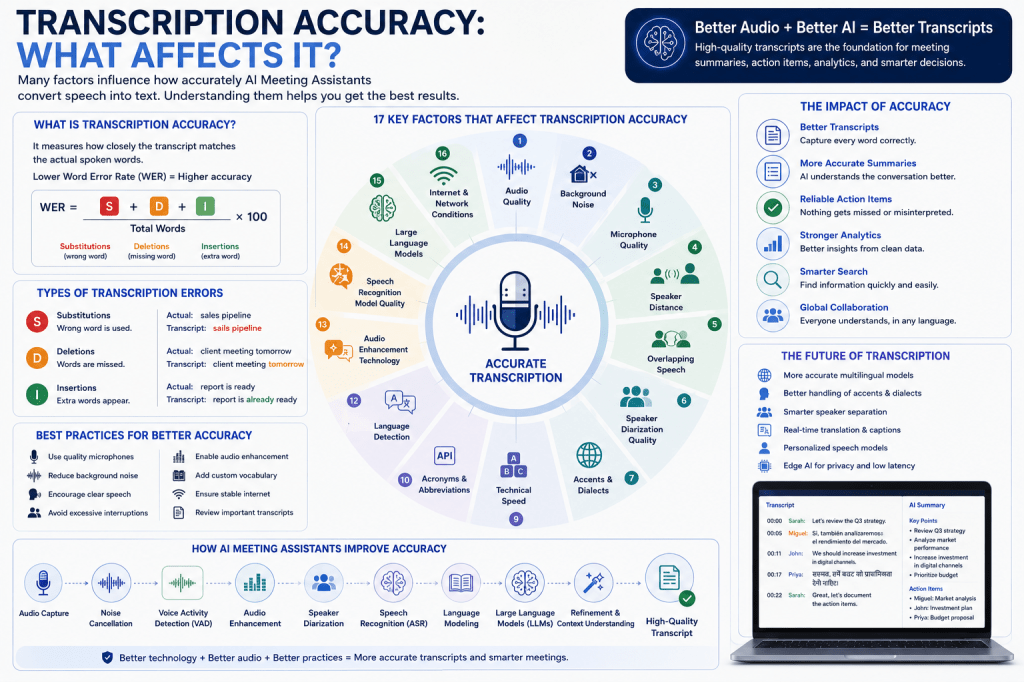
What Is Transcription Accuracy?
Transcription accuracy measures how closely a transcript matches the actual spoken conversation.
The goal is simple:
Convert speech into text with as few errors as possible.
Errors generally fall into three categories:
Substitutions
Incorrect words are inserted.
Example:
Actual speech:
“Let’s review the sales pipeline.”
Transcript:
“Let’s review the sails pipeline.”
Deletions
Words are omitted.
Example:
Actual speech:
“Let’s schedule the client meeting tomorrow.”
Transcript:
“Let’s schedule the meeting tomorrow.”
Insertions
Extra words appear in the transcript.
Example:
Actual speech:
“The report is ready.”
Transcript:
“The report is already ready.”
These errors influence overall transcription quality.
Understanding Word Error Rate (WER)
Most speech recognition providers use:
Word Error Rate (WER)
WER measures:
- Insertions
- Deletions
- Substitutions
Lower WER indicates higher transcription accuracy.
Although WER is not the only measure of quality, it remains one of the most common industry benchmarks.
Factor #1: Audio Quality
Audio quality is arguably the single most important factor affecting transcription accuracy.
The AI can only work with the audio it receives.
Poor audio creates problems before speech recognition even begins.
High-Quality Audio
Benefits include:
- Clear speech
- Better speaker separation
- Fewer recognition errors
Poor Audio
Can result from:
- Low-quality microphones
- Compression artifacts
- Weak connections
- Distortion
Better audio almost always leads to better transcripts.
Factor #2: Background Noise
Meetings often occur in imperfect environments.
Common sources of noise include:
- Keyboard typing
- Air conditioning
- Office conversations
- Traffic
- Construction
- Pets
- Café environments
Noise competes with speech for the AI’s attention.
Modern meeting assistants use:
Noise Cancellation
Speech Enhancement
Audio Filtering
to improve speech clarity before transcription begins.
Factor #3: Microphone Quality
Microphone quality directly impacts recognition accuracy.
High-Quality Microphones
Provide:
- Better signal clarity
- More natural speech capture
- Reduced distortion
Low-Quality Microphones
May introduce:
- Muffled speech
- Static
- Echoes
- Missing frequencies
Organizations that invest in quality audio equipment often see immediate improvements in transcription quality.
Factor #4: Speaker Distance
Participants speaking far from microphones can be difficult to understand.
Common issues include:
- Reduced volume
- Reverberation
- Poor speech definition
Conference room setups often require specialized audio systems to maintain accuracy.
Factor #5: Overlapping Speech
One of the biggest challenges for AI meeting assistants is simultaneous speech.
Examples include:
- Interruptions
- Group discussions
- Fast-paced brainstorming sessions
When multiple people speak at once, speech recognition becomes significantly more difficult.
Modern AI systems use:
Speaker Separation
Multi-Speaker Detection
Speaker Diarization
to improve performance in these situations.
Factor #6: Speaker Diarization Quality
Speaker diarization answers:
“Who spoke when?”
Accurate diarization improves:
- Transcript readability
- Action item assignment
- Meeting analytics
Poor diarization can create confusion even when transcription itself is accurate.
Speaker tracking has become an increasingly important component of meeting intelligence.
Factor #7: Accents and Dialects
Global organizations involve speakers from many regions.
Accents can affect:
- Pronunciation
- Speech rhythm
- Vocabulary
Examples include:
- American English
- British English
- Australian English
- Indian English
- South African English
Modern speech recognition systems train on diverse datasets to improve performance across accents and dialects.
Factor #8: Speaking Speed
Fast speech creates additional challenges.
When speakers talk rapidly:
- Words blend together
- Pronunciation becomes less distinct
- Speaker transitions occur more frequently
Modern AI systems perform much better than earlier technologies, but extremely rapid conversations can still reduce accuracy.
Factor #9: Technical Terminology
Industry-specific language is another major factor.
Examples include:
Software Development
- Kubernetes
- LangGraph
- PostgreSQL
- GraphQL
Healthcare
- Echocardiogram
- Pharmacokinetics
Finance
- EBITDA
- Derivatives
Technical terminology may not appear frequently in general speech datasets.
AI meeting assistants improve performance through:
- Domain-specific training
- Language models
- Custom vocabulary support
Factor #10: Acronyms and Abbreviations
Meetings often contain abbreviations such as:
- API
- CRM
- ERP
- NLP
- ASR
- KPI
Correct interpretation depends heavily on context.
Modern language models help resolve these ambiguities more effectively.
Factor #11: Language Detection
Multilingual meetings create additional complexity.
The AI must first determine:
“Which language is being spoken?”
Errors in language detection can affect:
- Transcription
- Translation
- Summaries
Modern multilingual meeting assistants use advanced language identification models to improve accuracy.
Factor #12: Code-Switching
Code-switching occurs when speakers alternate between languages.
Example:
“Let’s review the proposal before la próxima reunión.”
The AI must recognize:
- Language transitions
- Context
- Speaker intent
Code-switching remains one of the more difficult speech recognition challenges.
Factor #13: Audio Enhancement Technology
Modern AI meeting assistants rely heavily on audio enhancement.
Key technologies include:
Noise Reduction
Echo Cancellation
Speech Enhancement
Gain Control
Audio Normalization
Improved audio quality directly improves transcription performance.
Factor #14: Speech Recognition Model Quality
Not all speech recognition systems are equal.
Performance depends on:
- Model architecture
- Training data
- Computational resources
- Language support
Advanced AI meeting assistants typically use state-of-the-art ASR systems trained on millions of hours of speech data.
Factor #15: Large Language Models (LLMs)
Large Language Models have dramatically improved transcription quality.
They help:
Correct Recognition Errors
Improve Punctuation
Understand Context
Interpret Technical Language
Refine Meeting Summaries
Instead of simply recognizing words, modern systems understand conversations more intelligently.
Factor #16: Internet and Network Conditions
Cloud-based meeting assistants often depend on internet connectivity.
Poor network conditions can affect:
- Audio quality
- Streaming performance
- Real-time transcription
Stable connections generally improve results.
Factor #17: Meeting Environment
Environmental conditions influence transcription quality.
Examples include:
Quiet Conference Rooms
Typically produce excellent results.
Open Offices
May introduce competing sounds.
Public Locations
Often create substantial audio challenges.
The meeting environment plays a larger role than many users realize.
How AI Meeting Assistants Improve Accuracy
Modern platforms combine multiple technologies.
These include:
Noise Cancellation
Voice Activity Detection (VAD)
Audio Enhancement
Speaker Diarization
Speech Recognition
Natural Language Processing
Large Language Models
Together, these systems significantly improve transcription quality.
Best Practices for Better Transcripts
Organizations can improve results through simple practices.
Use Quality Microphones
Reduce Background Noise
Encourage Clear Speech
Avoid Excessive Interruptions
Enable Audio Enhancement Features
Add Custom Vocabulary
Review Important Transcripts
These practices complement AI technologies and improve outcomes.
Future of Transcription Accuracy
Several innovations are expected to improve performance further.
Personalized Speech Models
Recognition adapted to individual speakers.
Better Speaker Separation
Improved handling of overlapping speech.
Context-Aware AI
Deeper understanding of conversations.
Larger Multilingual Models
Support for more languages and dialects.
Edge AI Processing
Lower latency and greater privacy.
The gap between human transcription and AI transcription continues to narrow.
Conclusion
Transcription accuracy is the foundation of every AI meeting assistant. Factors such as audio quality, background noise, microphone performance, accents, technical terminology, speaker overlap, and speech recognition technology all influence how accurately a conversation can be converted into text.
Modern AI meeting assistants use sophisticated combinations of speech recognition, machine learning, audio enhancement, speaker diarization, and large language models to maximize accuracy. As these technologies continue to improve, organizations can expect even more reliable transcripts, better meeting summaries, stronger action item extraction, and increasingly valuable meeting intelligence.

 Meeting Notes AI