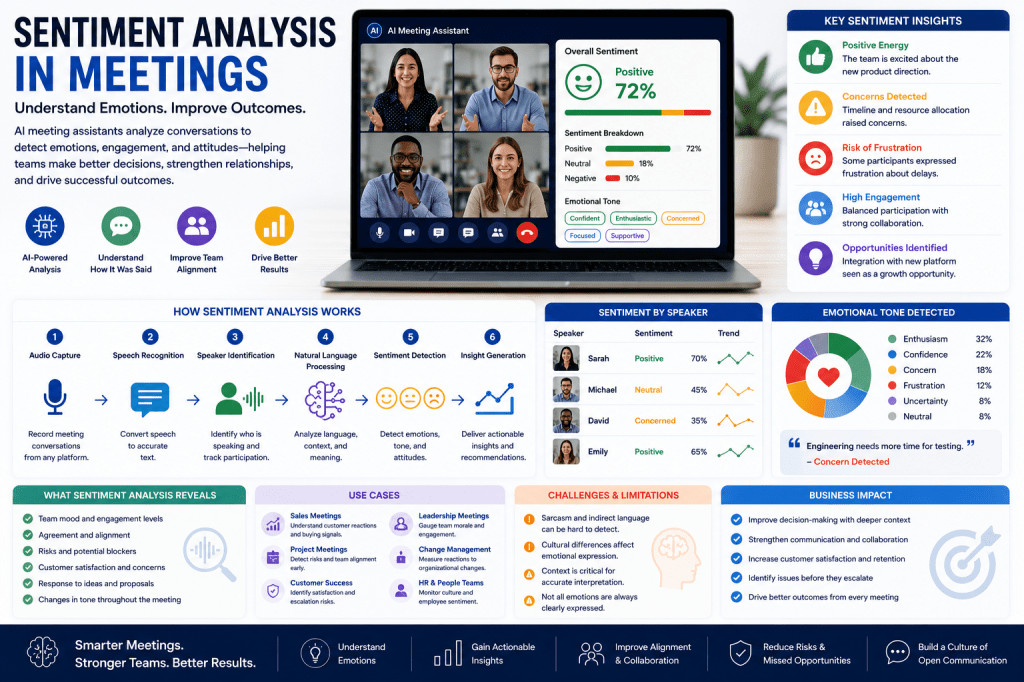
Modern AI meeting assistants do far more than record conversations and generate transcripts. Today’s platforms can analyze the emotional tone of discussions, identify patterns in participant engagement, and provide valuable insights into how people feel during meetings. This capability is known as sentiment analysis.
Sentiment analysis helps organizations move beyond understanding what was said to understanding how it was said. By examining language, tone, context, and conversational patterns, AI meeting assistants can reveal levels of agreement, concern, enthusiasm, frustration, and engagement that might otherwise go unnoticed.
As workplace collaboration becomes increasingly digital, sentiment analysis is emerging as an important component of meeting intelligence and organizational decision-making.
What Is Sentiment Analysis?
Sentiment analysis is the process of using artificial intelligence to identify and classify emotions, opinions, attitudes, and emotional tone within written or spoken communication.
In AI meeting assistants, sentiment analysis is applied to:
- Meeting transcripts
- Conversation patterns
- Participant responses
- Discussion topics
- Team interactions
The goal is to determine whether the overall sentiment is:
- Positive
- Neutral
- Negative
More advanced systems can also identify specific emotional states such as:
- Confidence
- Enthusiasm
- Concern
- Frustration
- Uncertainty
- Agreement
- Disagreement
These insights help organizations better understand team dynamics and meeting effectiveness.
Why Sentiment Analysis Matters
Meetings often contain valuable emotional signals that influence decision-making and team performance.
For example:
A project team may verbally agree with a proposal while expressing subtle concerns throughout the discussion.
Without sentiment analysis, leaders may miss these warning signs.
Benefits of sentiment analysis include:
- Improved team alignment
- Early risk detection
- Better decision-making
- Stronger employee engagement
- Enhanced customer understanding
- More effective leadership
Understanding emotional context helps organizations make more informed decisions.
How Sentiment Analysis Works
Modern AI meeting assistants use multiple technologies to analyze meeting sentiment.
The process typically includes:
- Audio capture
- Speech recognition
- Speaker identification
- Natural language processing
- Context analysis
- Sentiment classification
- Insight generation
Each stage contributes to understanding the emotional tone of the conversation.
Step 1: Meeting Transcription
Sentiment analysis begins with transcription.
Automatic Speech Recognition (ASR) converts spoken conversations into text.
Example:
Spoken statement:
I’m concerned that we may not finish testing before launch.
Transcript:
I’m concerned that we may not finish testing before launch.
The transcript becomes the foundation for sentiment analysis.
Step 2: Natural Language Processing
Natural Language Processing (NLP) helps AI understand language structure and meaning.
NLP analyzes:
- Words
- Phrases
- Sentence structure
- Context
- Relationships between statements
This allows the AI to determine whether language expresses positive, negative, or neutral sentiment.
For example:
Positive:
The results exceeded expectations.
Negative:
The timeline is becoming a problem.
Neutral:
The meeting will begin at 2 PM.
Step 3: Identifying Emotional Signals
AI systems are trained to recognize emotional indicators within language.
Positive Signals
Examples include:
- Excited
- Successful
- Great
- Excellent
- Opportunity
- Confident
Negative Signals
Examples include:
- Concerned
- Delayed
- Problem
- Risk
- Frustrated
- Difficult
Neutral Signals
Informational statements without emotional content.
The frequency and context of these signals contribute to sentiment scoring.
Step 4: Contextual Understanding
Individual words do not always reveal sentiment accurately.
Consider:
The project is not bad.
The word “bad” appears, but the overall sentiment is positive.
Large language models help AI understand:
- Negation
- Sarcasm
- Context
- Conversation history
- Speaker intent
This contextual understanding significantly improves sentiment accuracy.
Beyond Positive and Negative
Modern sentiment analysis is much more sophisticated than simple classifications.
AI meeting assistants increasingly identify specific emotional categories.
Enthusiasm
Example:
This is exactly what our customers have been asking for.
Concern
Example:
I’m worried about the implementation timeline.
Frustration
Example:
We’ve discussed this issue for months without progress.
Confidence
Example:
The team is fully prepared for launch.
Uncertainty
Example:
We still need more information before deciding.
These granular insights provide a richer understanding of meeting dynamics.
Speaker-Level Sentiment Analysis
Advanced AI meeting assistants can analyze sentiment at the participant level.
Example:
| Participant | Sentiment |
|---|---|
| Sarah | Positive |
| Michael | Neutral |
| Emily | Concerned |
| David | Positive |
This helps leaders identify:
- Supporters
- Skeptics
- Potential blockers
- Engagement levels
Speaker-level analysis provides valuable context for decision-making.
Team Sentiment Analysis
AI systems can also evaluate overall team mood.
Examples include:
Highly Positive Meetings
Strong alignment and enthusiasm.
Balanced Discussions
Healthy debate with constructive participation.
Concern-Oriented Meetings
Frequent discussion of risks and obstacles.
Conflict-Heavy Meetings
Significant disagreement or tension.
Understanding team sentiment can help managers improve collaboration and communication.
Sentiment Analysis for Sales Meetings
Sales teams are among the biggest users of meeting sentiment analysis.
AI meeting assistants can identify:
Buying Signals
Positive customer reactions.
Objections
Customer concerns and hesitations.
Competitive References
Mentions of alternative vendors.
Risk Indicators
Signals that a deal may be stalled.
These insights help sales teams prioritize opportunities and improve conversion rates.
Sentiment Analysis for Customer Success
Customer-facing teams can use sentiment analysis to identify:
- Satisfaction levels
- Escalation risks
- Product concerns
- Support issues
- Renewal opportunities
Early detection of negative sentiment can help prevent customer churn.
Sentiment Analysis for Internal Meetings
Within organizations, sentiment analysis supports:
Employee Engagement
Understanding team morale.
Change Management
Measuring reactions to organizational changes.
Project Health
Detecting concerns before they become major problems.
Leadership Effectiveness
Evaluating communication impact.
These insights help leaders make more informed decisions.
Combining Sentiment Analysis with Other Meeting Intelligence
Sentiment analysis becomes even more powerful when combined with other AI capabilities.
Decision Detection
How did participants feel about the decision?
Action Item Detection
Were commitments made confidently?
Risk Detection
Does negative sentiment indicate emerging problems?
Topic Analysis
Which topics generate positive or negative reactions?
The combination creates a more complete understanding of meeting outcomes.
Challenges and Limitations
Although sentiment analysis has improved dramatically, challenges remain.
Sarcasm
Humans often communicate indirectly.
Example:
Well, that worked perfectly.
Depending on context, this may be positive or sarcastic.
Cultural Differences
Emotional expression varies across cultures.
Industry Language
Technical discussions may contain language that appears negative but is routine.
Context Ambiguity
Short statements can be difficult to interpret accurately.
Emotional Complexity
People often experience multiple emotions simultaneously.
These challenges require increasingly sophisticated AI models.
Privacy and Ethical Considerations
Organizations should use sentiment analysis responsibly.
Important considerations include:
- Employee privacy
- Transparency
- Data security
- Regulatory compliance
- Ethical AI practices
Sentiment analysis should support collaboration rather than create surveillance concerns.
The Future of Sentiment Analysis in Meetings
Future AI meeting assistants are expected to provide increasingly sophisticated emotional intelligence.
Emerging capabilities include:
Real-Time Sentiment Tracking
Understanding meeting mood as discussions unfold.
Emotion Trend Analysis
Tracking sentiment across multiple meetings.
Team Health Monitoring
Identifying engagement trends over time.
Predictive Risk Detection
Using sentiment patterns to anticipate project challenges.
Personalized Insights
Providing different sentiment perspectives for leaders and contributors.
As AI continues to evolve, sentiment analysis will become a central component of workplace intelligence.
Conclusion
Sentiment analysis enables AI meeting assistants to understand the emotional tone, attitudes, and engagement levels within conversations. By combining speech recognition, natural language processing, contextual analysis, and large language models, these systems help organizations move beyond simple transcription to gain deeper insight into team dynamics, customer interactions, and decision-making processes. While challenges remain, sentiment analysis is becoming an increasingly valuable tool for improving collaboration, identifying risks, enhancing leadership effectiveness, and transforming meetings into actionable business intelligence. As meeting intelligence platforms continue to evolve, sentiment analysis will play an increasingly important role in helping organizations understand not only what was discussed, but how people truly felt about it.

 Meeting Notes AI