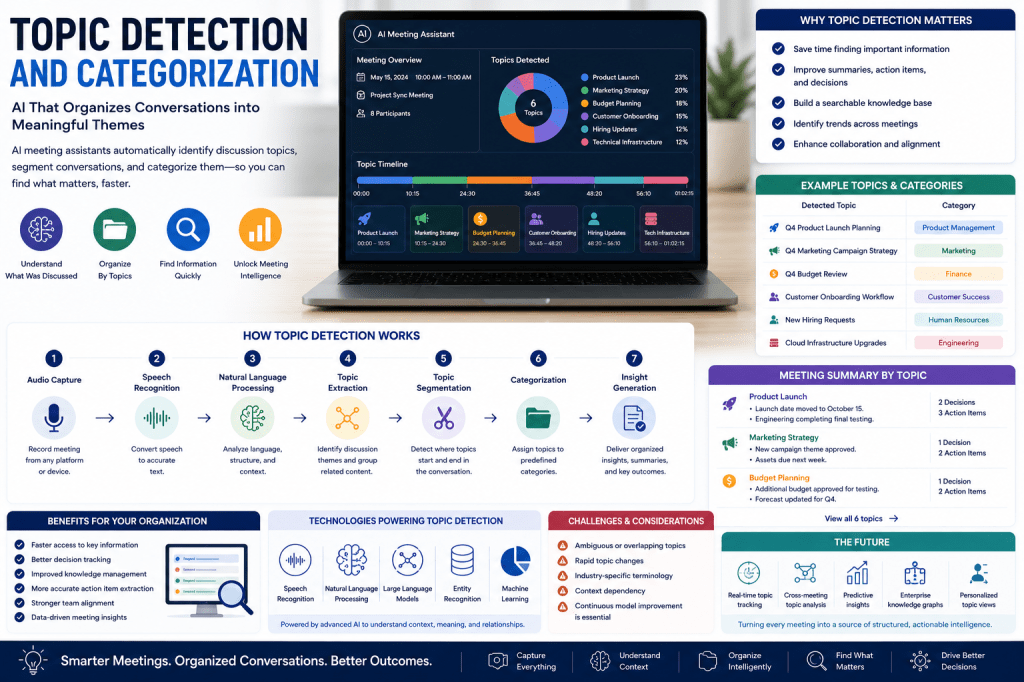
Modern meetings often cover dozens of subjects within a single discussion. Teams may begin by reviewing project updates, shift to budget planning, discuss customer feedback, identify risks, assign action items, and finish with strategic planning. Without structure, finding important information later can become difficult.
This is where Topic Detection and Categorization plays a critical role. Modern AI meeting assistants use artificial intelligence to automatically identify discussion topics, group related conversations together, and organize meeting content into meaningful categories.
Rather than presenting users with a long transcript, AI meeting assistants transform conversations into structured knowledge that is easier to search, analyze, and act upon. Topic detection is one of the foundational technologies behind meeting intelligence, AI-powered summaries, decision detection, and organizational knowledge management.
What Is Topic Detection?
Topic detection is the process of automatically identifying the subjects being discussed during a meeting.
For example, a one-hour meeting might include conversations about:
- Product development
- Marketing campaigns
- Budget planning
- Customer onboarding
- Hiring plans
- Project timelines
An AI meeting assistant can automatically detect these topics and separate them into distinct sections.
Instead of viewing one large transcript, users see organized discussion segments that make information easier to consume.
What Is Topic Categorization?
Topic categorization goes a step further.
After identifying discussion topics, AI systems assign them to predefined categories or themes.
For example:
| Discussion Topic | Category |
|---|---|
| Product Launch Planning | Product Management |
| Q4 Budget Review | Finance |
| Customer Renewal Strategy | Customer Success |
| New Hiring Requests | Human Resources |
| Technical Infrastructure Upgrades | Engineering |
Categorization helps organizations analyze meeting content at scale.
Why Topic Detection Matters
Organizations generate enormous amounts of conversational data.
Without organization, valuable information becomes difficult to locate.
Topic detection provides several benefits:
- Faster information retrieval
- Better meeting summaries
- Improved knowledge management
- Enhanced search capabilities
- More accurate action item detection
- Better decision tracking
Rather than reading entire transcripts, users can jump directly to the topics they need.
How AI Meeting Assistants Detect Topics
Topic detection relies on several AI technologies working together.
The typical process includes:
- Audio capture
- Speech recognition
- Natural language processing
- Topic extraction
- Topic classification
- Categorization
- Insight generation
Each step helps transform conversations into structured information.
Step 1: Meeting Transcription
The process begins with transcription.
Automatic Speech Recognition (ASR) converts spoken conversations into text.
Example:
We need to finalize the October launch date and review marketing campaign readiness.
The transcript becomes the input for topic analysis.
Without accurate transcription, topic detection quality decreases significantly.
Step 2: Natural Language Processing
Natural Language Processing (NLP) helps AI understand the meaning of text.
NLP analyzes:
- Keywords
- Phrases
- Sentence structure
- Relationships between concepts
- Context
This analysis allows AI to recognize recurring discussion themes.
For example:
Words such as:
- Launch
- Product
- Release
- Roadmap
may indicate a product management topic.
Step 3: Keyword and Entity Recognition
AI systems identify important entities within conversations.
Examples include:
People
- Sarah
- Michael
- Customers
- Vendors
Products
- Product X
- Mobile App
- Analytics Platform
Projects
- Q4 Launch
- Migration Project
- CRM Upgrade
Departments
- Marketing
- Finance
- Engineering
Recognizing these entities helps AI understand discussion context.
Step 4: Topic Extraction
Once language has been analyzed, AI identifies clusters of related concepts.
Example conversation:
The product launch date is currently scheduled for October. Marketing materials need to be finalized, and the engineering team is completing testing.
Possible topic:
Product Launch Planning
The AI groups related statements together under a single topic.
This creates a structured representation of the discussion.
Step 5: Topic Segmentation
Meetings frequently shift between subjects.
AI meeting assistants identify where topic transitions occur.
Example:
Topic 1: Product Launch
- Launch date
- Testing
- Marketing assets
Topic 2: Budget Planning
- Additional resources
- Forecast adjustments
- Spending approvals
Topic 3: Hiring Plans
- Open positions
- Recruiting timelines
- Interview scheduling
Segmentation helps create clear meeting structure.
Step 6: Topic Categorization
After detecting topics, AI assigns categories.
For example:
Detected Topic
Customer onboarding workflow
Assigned Category
Customer Success
Another example:
Detected Topic
Cloud infrastructure upgrades
Assigned Category
Engineering
Categorization helps organizations organize information consistently across meetings.
How Large Language Models Improve Topic Detection
Traditional topic detection relied heavily on keyword matching.
This approach had limitations.
For example:
Conversation:
We need to improve the onboarding experience for new customers.
A keyword-only system may struggle to classify this discussion accurately.
Large language models understand context and intent.
The AI recognizes that the discussion relates to:
- Customer onboarding
- User experience
- Customer success
This deeper understanding dramatically improves categorization accuracy.
Topic Detection vs Keyword Search
Many people confuse topic detection with keyword search.
However, they are fundamentally different.
Keyword Search
Looks for exact words.
Example:
Searching for “budget.”
Topic Detection
Understands related concepts.
Example:
- Budget planning
- Resource allocation
- Financial forecasting
- Spending approvals
All may belong to the Finance category even if the word “budget” never appears.
This semantic understanding makes AI-powered meeting intelligence far more powerful.
Topic Detection and Meeting Summaries
Topic detection significantly improves summary generation.
Instead of producing a single block of text, AI meeting assistants can organize summaries by topic.
Example:
Product Launch
Launch date moved to October 15.
Marketing
Campaign assets will be finalized next week.
Engineering
Additional testing required before launch.
Structured summaries are easier to read and act upon.
Topic Detection and Action Items
Topic categorization improves action item extraction.
Example:
Marketing Topic
Action Item:
Emily to finalize campaign assets.
Engineering Topic
Action Item:
Michael to complete testing review.
Linking action items to discussion topics provides valuable context.
Topic Detection and Decision Tracking
Decision detection also benefits from topic organization.
Example:
Topic: Product Launch
Decision:
Launch postponed until October 15.
Topic: Budget Planning
Decision:
Additional testing budget approved.
Organizing decisions by topic improves visibility and accountability.
Organizational Knowledge Management
One of the most important benefits of topic categorization is knowledge management.
Organizations can build searchable repositories organized by:
- Projects
- Departments
- Customers
- Products
- Initiatives
Instead of searching thousands of transcripts, employees can locate information through topic-based navigation.
This helps preserve institutional knowledge over time.
Common Challenges
Despite major advances, topic detection remains challenging.
Ambiguous Discussions
Some conversations overlap multiple topics.
Rapid Topic Changes
Meetings may switch subjects frequently.
Industry-Specific Terminology
Specialized vocabulary can complicate categorization.
Cross-Functional Discussions
Topics may involve multiple departments simultaneously.
Context Dependency
The same phrase can have different meanings in different situations.
Large language models continue improving performance in these areas.
Real-Time Topic Detection
Future AI meeting assistants are increasingly moving toward real-time topic analysis.
Potential capabilities include:
Live Topic Tracking
View current discussion themes during meetings.
Dynamic Agendas
Automatically update meeting structure as conversations evolve.
Topic-Based Recommendations
Suggest related documents and information.
Real-Time Meeting Intelligence
Generate insights as discussions occur.
These capabilities will make meetings more productive and actionable.
The Future of Topic Detection
Topic detection is becoming increasingly sophisticated.
Future developments may include:
Cross-Meeting Topic Analysis
Track discussions across multiple meetings.
Organizational Trend Detection
Identify recurring themes and emerging issues.
Predictive Insights
Anticipate future challenges based on topic patterns.
Personalized Topic Views
Show different topic perspectives for executives, managers, and contributors.
Enterprise Knowledge Graphs
Connect meeting topics with projects, customers, teams, and documents.
These advances will transform meeting data into strategic organizational intelligence.
Conclusion
Topic Detection and Categorization are foundational technologies that enable AI meeting assistants to transform unstructured conversations into organized, searchable knowledge. By combining speech recognition, natural language processing, entity recognition, contextual understanding, and large language models, AI systems can automatically identify discussion themes, categorize conversations, and improve meeting intelligence. These capabilities support better summaries, action item extraction, decision tracking, and knowledge management. As AI continues to evolve, topic detection will become increasingly important for helping organizations unlock the full value of their meetings and conversations.

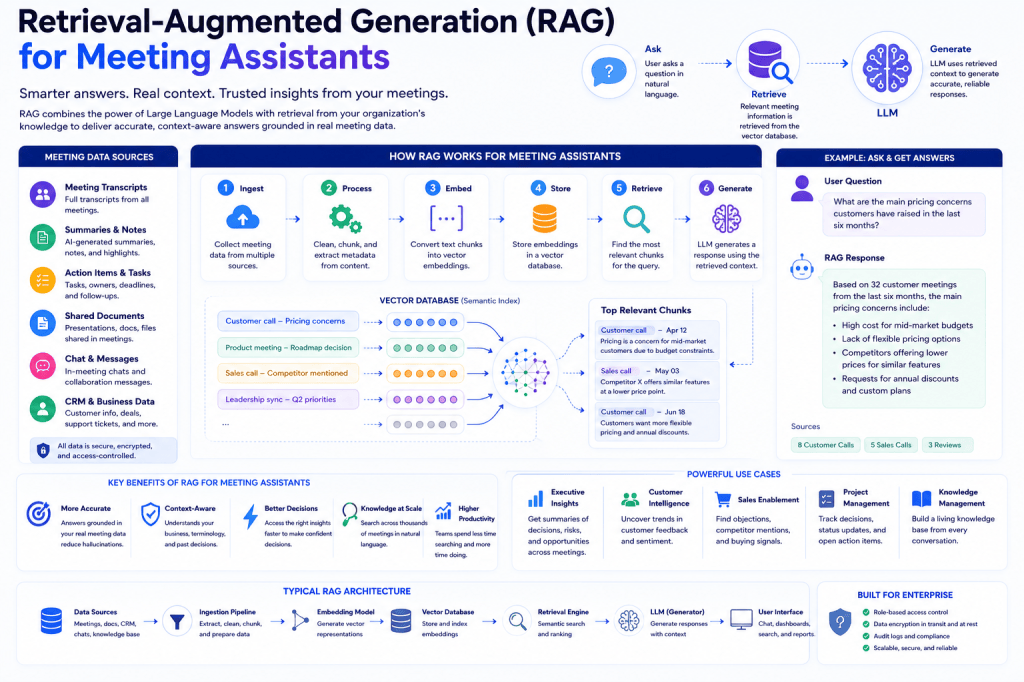
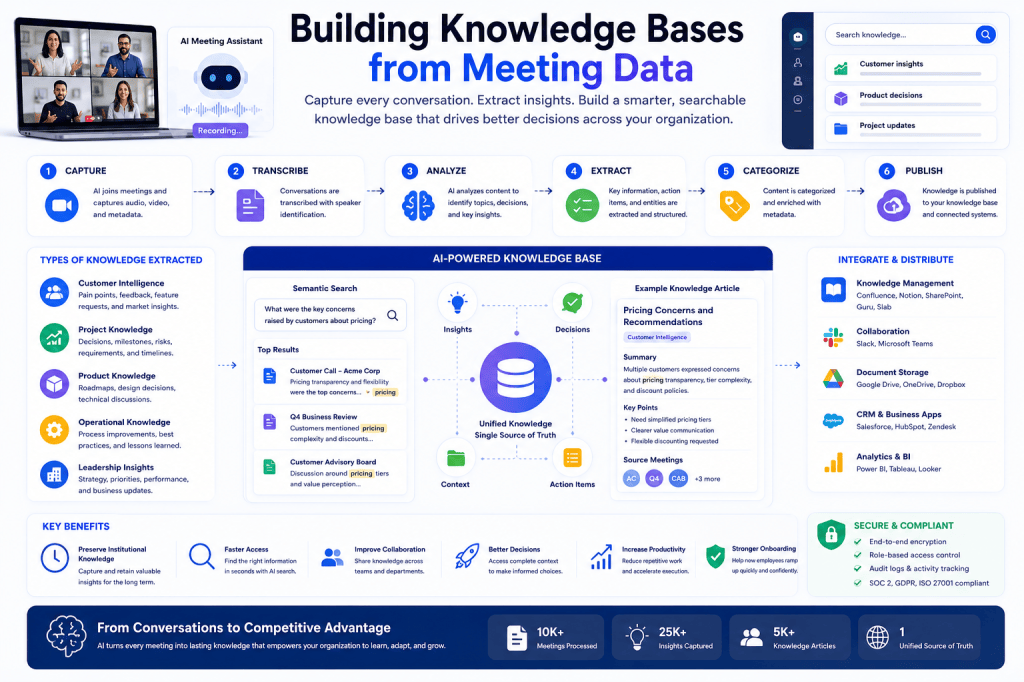
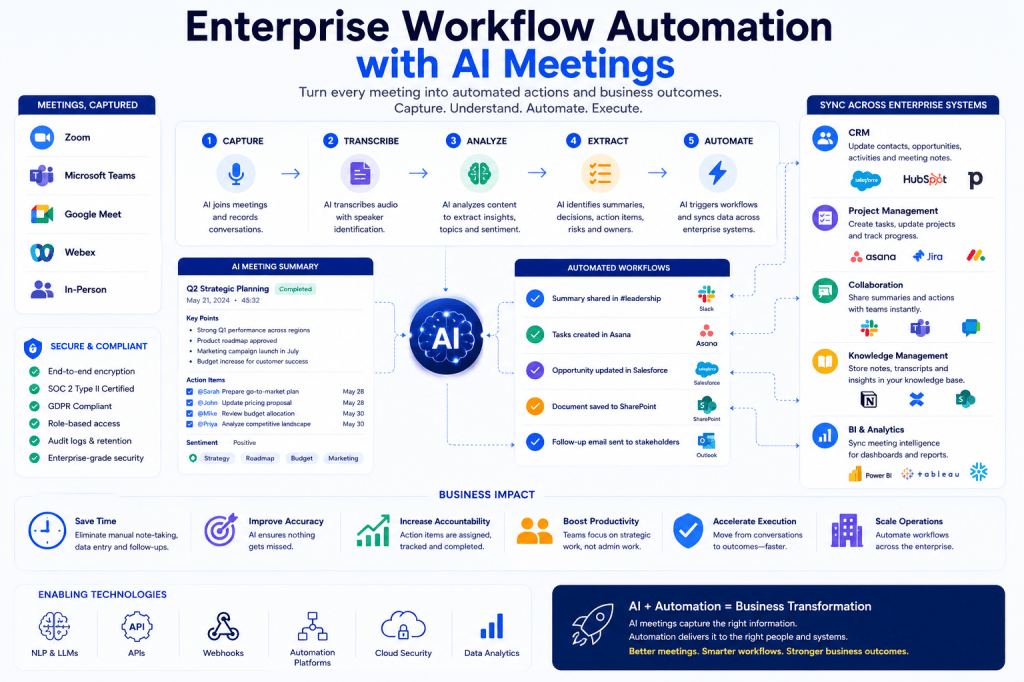
 Meeting Notes AI