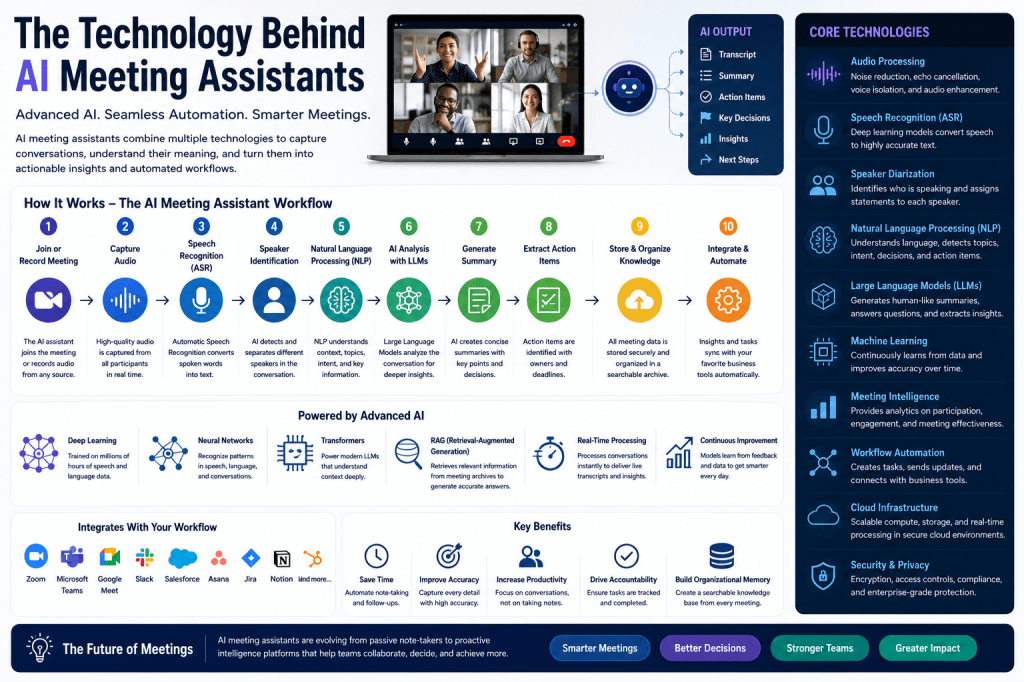
AI meeting assistants have transformed the way businesses capture, organize, and act on information from meetings. What once required manual note-taking and hours of administrative work can now be automated through a combination of artificial intelligence, machine learning, speech recognition, and workflow automation technologies. While most users simply see a transcript or meeting summary, a sophisticated technology stack operates behind the scenes to make these capabilities possible.
In this article, we’ll explore the core technologies behind AI meeting assistants and how they work together to turn conversations into actionable business intelligence.
Why Technology Matters
Modern organizations generate enormous amounts of information during meetings.
Important discussions often include:
- Strategic decisions
- Client requirements
- Project updates
- Product feedback
- Action items
- Team collaboration
Without technology, much of this knowledge remains trapped inside conversations. AI meeting assistants transform spoken information into searchable, structured, and reusable business assets.
The Core Technology Stack
Most AI meeting assistants rely on multiple AI systems working together.
The primary technologies include:
- Audio Processing
- Speech Recognition
- Speaker Identification
- Natural Language Processing
- Large Language Models
- Machine Learning
- Meeting Intelligence Systems
- Workflow Automation
- Cloud Computing
- Security Infrastructure
Let’s examine each component.
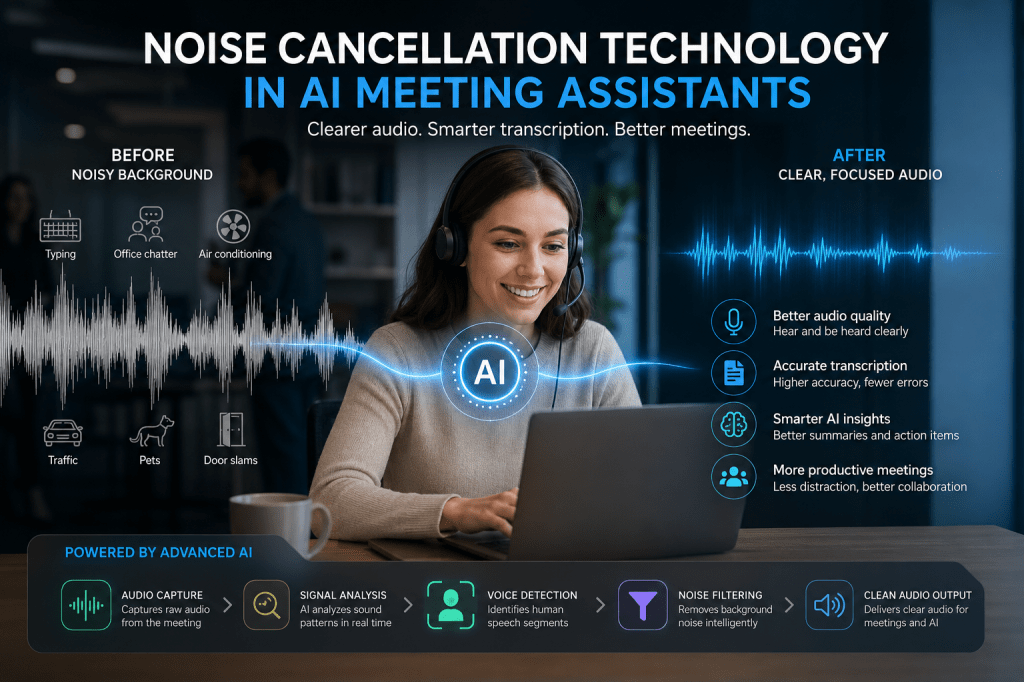
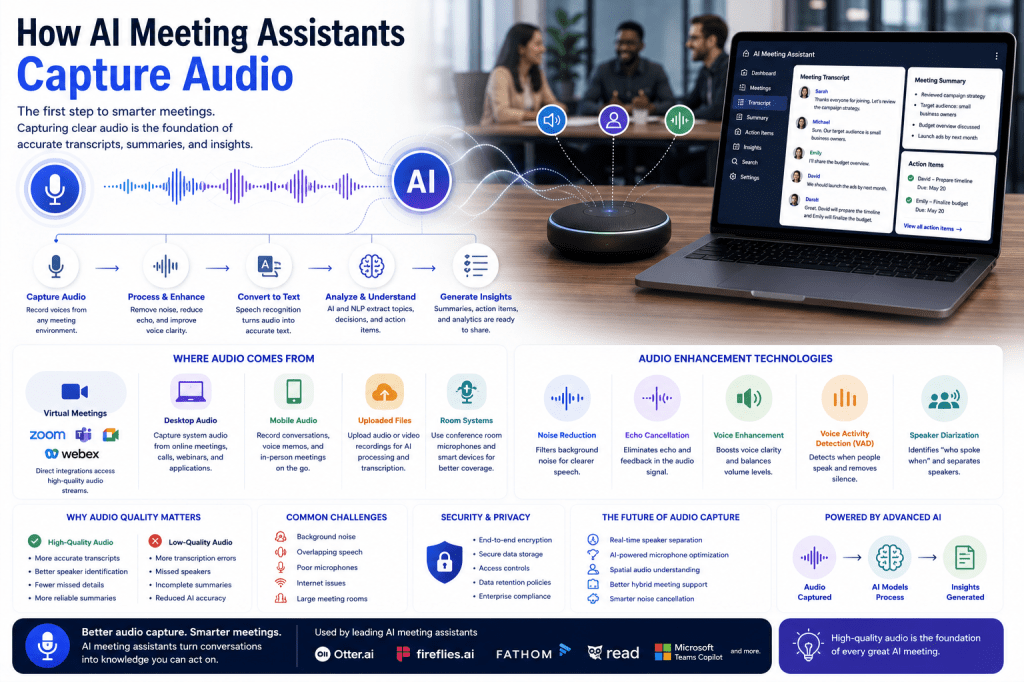
Audio Processing Technology
Every AI meeting assistant begins with audio.
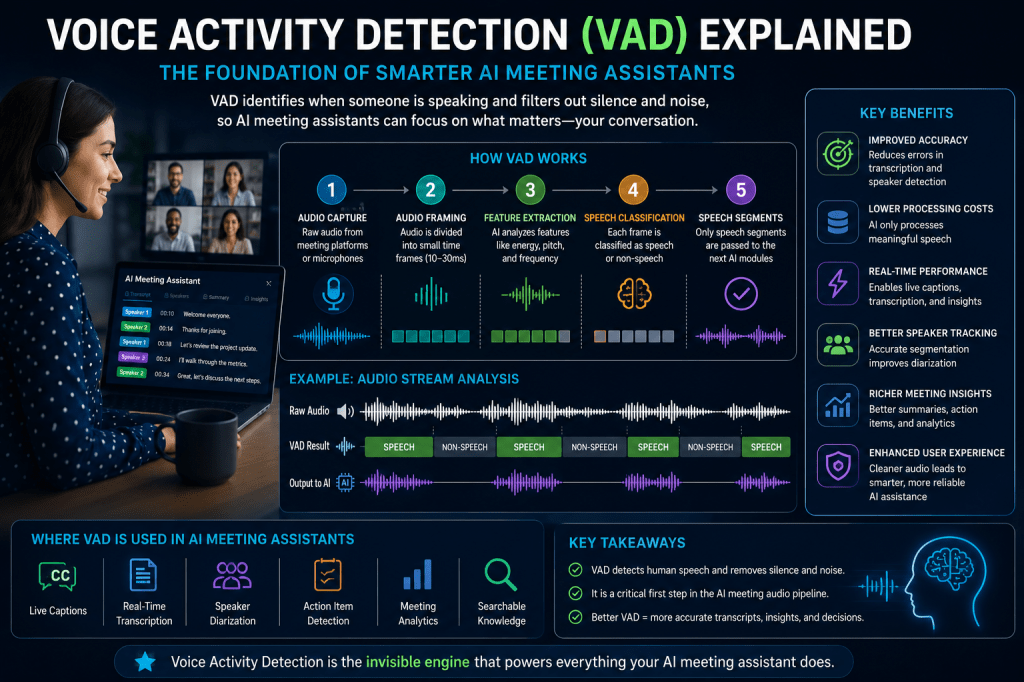
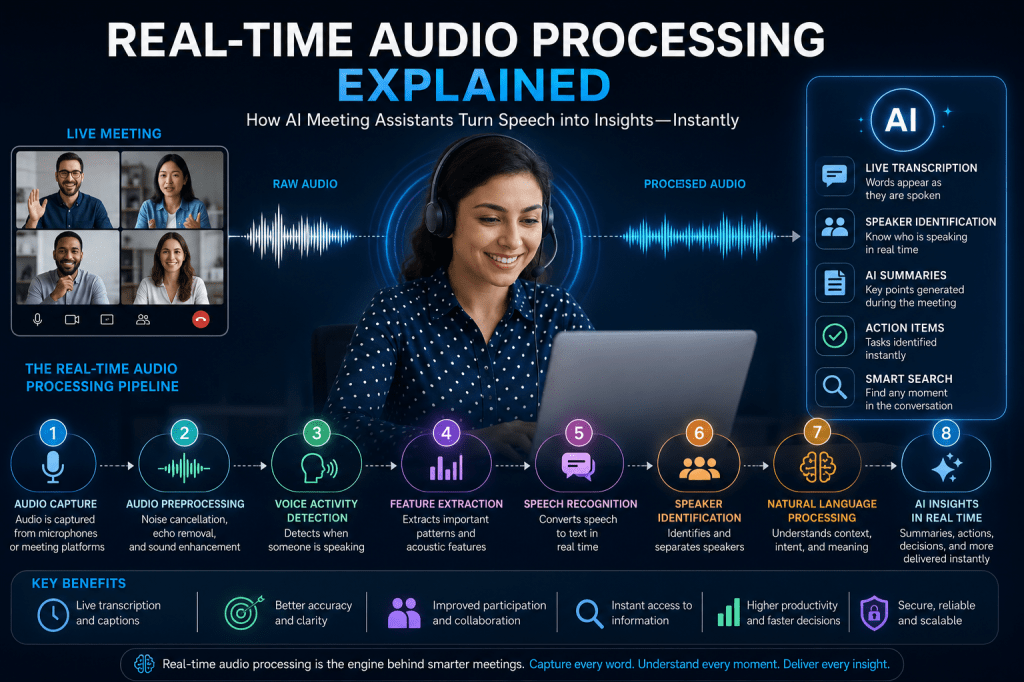
Before the AI can understand a conversation, it must capture and clean the audio stream.
Audio processing technologies help:
- Remove background noise
- Reduce echo
- Improve speech clarity
- Isolate voices
- Enhance recording quality
This step is essential because transcription accuracy depends heavily on audio quality.
Common Audio Challenges
AI systems must handle:
- Multiple speakers
- Overlapping conversations
- Remote meeting audio
- Poor microphones
- Background noise
- Different accents and speaking styles
Advanced audio processing improves the quality of the data before transcription begins.
Automatic Speech Recognition (ASR)
Automatic Speech Recognition converts spoken language into text.
This technology powers the transcription engine used by AI meeting assistants.
How ASR Works
Speech recognition systems use deep neural networks trained on vast amounts of audio data.
The process involves:
- Capturing audio
- Identifying speech patterns
- Matching sounds to words
- Predicting sentence structure
- Producing readable text
Modern ASR systems achieve impressive accuracy and continue improving through machine learning.
Benefits of ASR
- Real-time transcription
- Searchable meeting records
- Accessibility improvements
- Reduced note-taking effort
ASR serves as the foundation for all other AI meeting assistant capabilities.
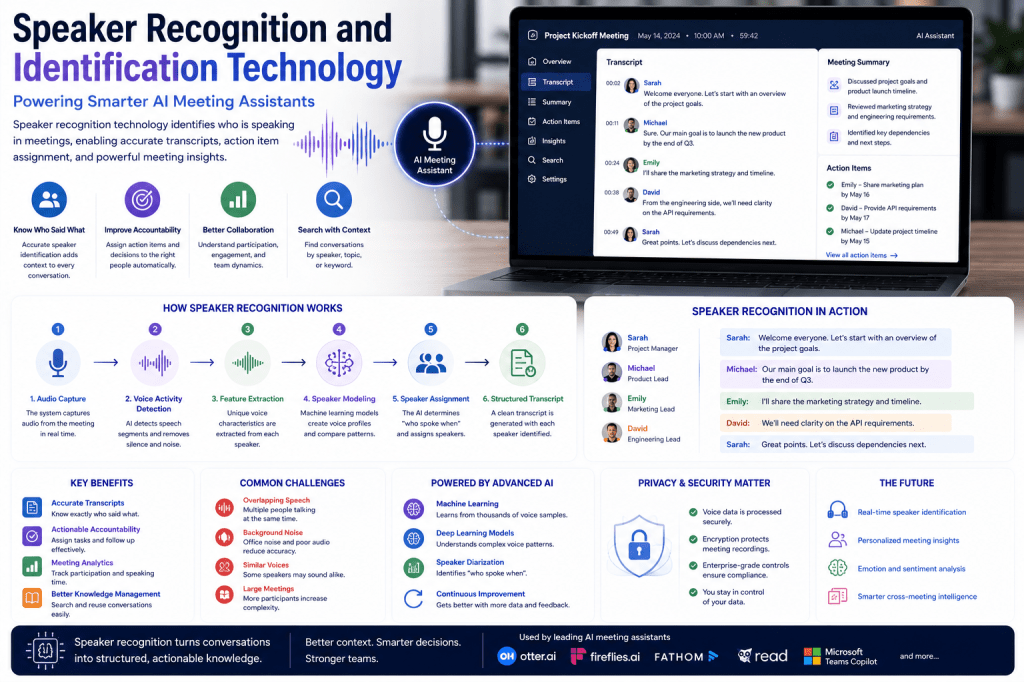
Speaker Diarization Technology
Knowing what was said is useful.
Knowing who said it is often even more important.
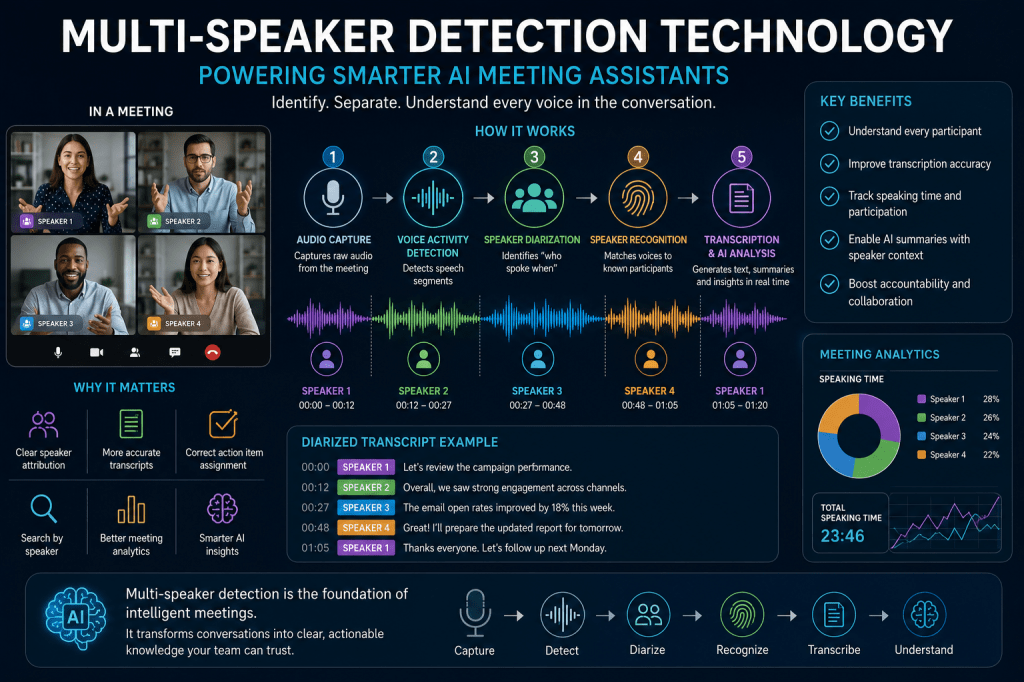
Speaker diarization identifies and separates individual speakers during a conversation.
For example:
Sarah: Let’s launch the campaign next month.
Michael: I’ll prepare the budget proposal.
The AI assigns statements to specific participants.
Why Speaker Identification Matters
Speaker recognition improves:
- Accountability
- Meeting context
- Action item ownership
- Collaboration analysis
- Meeting summaries
This technology is particularly valuable in large meetings with multiple participants.
Natural Language Processing (NLP)
After transcription, the AI must understand the meaning of the conversation.
This is where Natural Language Processing comes in.
What NLP Does
NLP helps computers interpret human language.
It allows AI meeting assistants to:
- Understand context
- Detect topics
- Identify intent
- Recognize decisions
- Extract important information
Instead of treating transcripts as plain text, NLP helps the system understand what participants actually mean.
NLP Applications in Meetings
AI meeting assistants use NLP for:
- Topic categorization
- Action item extraction
- Meeting summaries
- Keyword identification
- Question detection
- Sentiment analysis
Without NLP, meeting assistants would simply be transcription tools rather than intelligent productivity platforms.
Large Language Models (LLMs)
Large Language Models have dramatically expanded the capabilities of AI meeting assistants.
These advanced AI systems can process large amounts of text and generate human-like responses.
How LLMs Help
Modern meeting assistants use LLMs to:
- Generate summaries
- Create meeting recaps
- Answer questions about meetings
- Extract key insights
- Organize information
Instead of reading a lengthy transcript, users receive concise summaries generated by AI.
Examples of LLM Tasks
The AI may automatically generate:
- Executive summaries
- Action item lists
- Follow-up recommendations
- Project updates
- Discussion highlights
This is one of the most valuable features of modern meeting intelligence platforms.
Machine Learning Systems
Machine learning enables AI meeting assistants to improve over time.
What Machine Learning Does
Machine learning algorithms learn from:
- Meeting data
- User behavior
- Feedback
- Corrections
- Usage patterns
As more meetings are processed, the system becomes better at:
- Understanding terminology
- Identifying speakers
- Recognizing tasks
- Generating summaries
This continuous improvement helps increase accuracy and usefulness.
Meeting Intelligence Technology
Many platforms now go beyond note-taking and provide meeting intelligence.
Meeting intelligence systems analyze conversations to uncover patterns and insights.
Common Meeting Analytics
These systems can measure:
- Speaking time
- Participation levels
- Meeting effectiveness
- Team engagement
- Collaboration trends
Organizations can use this information to improve communication and productivity.
Strategic Insights
Advanced platforms may identify:
- Frequently discussed topics
- Recurring issues
- Project risks
- Decision bottlenecks
- Team collaboration patterns
This transforms meetings into a source of business intelligence.
Retrieval-Augmented Generation (RAG)
Newer AI meeting assistants are increasingly using Retrieval-Augmented Generation.
What Is RAG?
RAG combines:
- Information retrieval
- Large language models
Instead of relying only on model knowledge, the AI searches meeting archives for relevant information before generating responses.
Example
A user might ask:
“What did the team decide about the product launch last month?”
The AI retrieves relevant meeting notes and provides an accurate answer.
Benefits of RAG
- Improved accuracy
- Better context awareness
- Reduced hallucinations
- Enhanced search capabilities
RAG is becoming a key technology in enterprise AI meeting platforms.
Workflow Automation Technology
Meeting information becomes much more valuable when connected to business processes.
Workflow automation systems allow AI meeting assistants to:
- Create tasks automatically
- Update CRM records
- Send summaries
- Trigger notifications
- Update project management systems
Common Integrations
AI meeting assistants often connect with:
- Salesforce
- HubSpot
- Slack
- Microsoft Teams
- Asana
- Jira
- ClickUp
- Notion
These integrations help organizations turn conversations into actions.
Cloud Computing Infrastructure
Most AI meeting assistants operate in the cloud.
Cloud platforms provide:
- Scalable computing power
- Large storage capacity
- Global availability
- Real-time processing
The computational requirements of speech recognition and large language models make cloud infrastructure essential for most solutions.
Advantages of Cloud-Based AI
- Faster processing
- Continuous updates
- Reduced hardware requirements
- Better scalability
This allows businesses to access advanced AI capabilities without investing in specialized hardware.
Security and Privacy Technologies
Because meetings often contain sensitive information, security is a critical component of AI meeting assistants.
Common Security Features
Leading platforms use:
- End-to-end encryption
- Access controls
- Role-based permissions
- Data retention policies
- Audit logging
- Compliance frameworks
Compliance Standards
Enterprise platforms often support:
- GDPR
- SOC 2
- HIPAA
- ISO certifications
These technologies help organizations protect sensitive meeting data.
Emerging Technologies
The next generation of AI meeting assistants is already beginning to appear.
Emerging capabilities include:
Real-Time AI Coaching
Providing suggestions during meetings.
Autonomous Follow-Up
Automatically sending reminders and updates.
Predictive Insights
Identifying risks and opportunities before they become problems.
Long-Term Organizational Memory
Creating AI systems that remember and connect information across thousands of meetings.
AI Agents
Taking action based on meeting outcomes without requiring manual intervention.
These technologies will make AI meeting assistants increasingly proactive rather than reactive.
Final Thoughts
AI meeting assistants are powered by a sophisticated combination of audio processing, speech recognition, speaker identification, natural language processing, large language models, machine learning, workflow automation, and cloud computing. Together, these technologies transform ordinary conversations into structured knowledge, actionable insights, and automated workflows. As AI continues to advance, meeting assistants are evolving from simple transcription tools into intelligent business platforms that help organizations communicate more effectively, collaborate more efficiently, and make better decisions.

 Meeting Notes AI