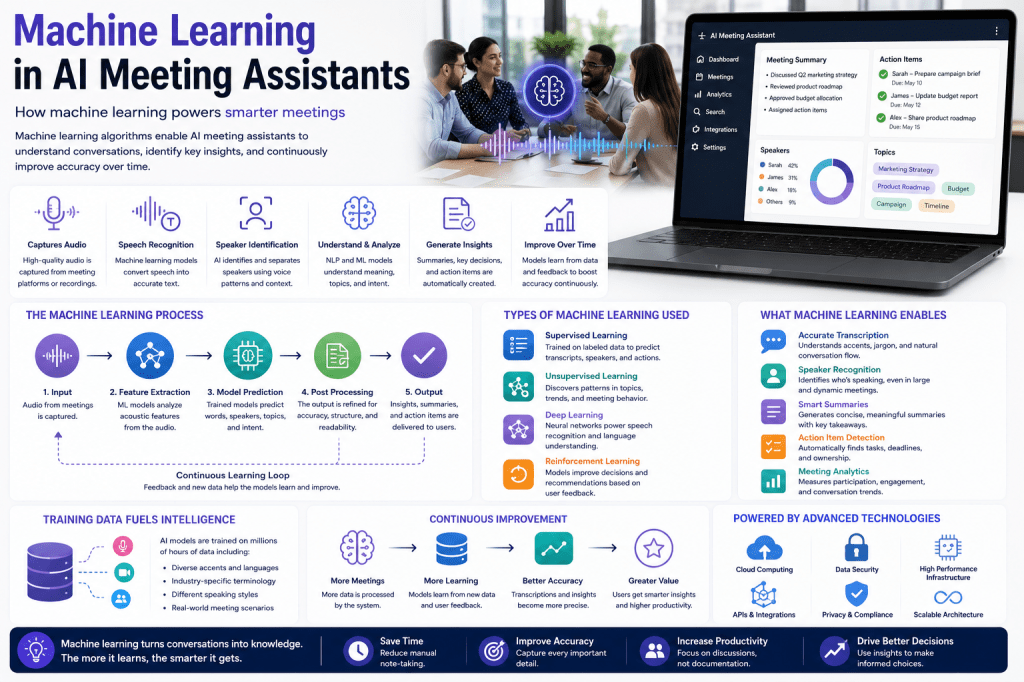
Machine learning is one of the foundational technologies that makes modern AI meeting assistants possible. From transcribing conversations and identifying speakers to generating summaries and extracting action items, machine learning algorithms power many of the intelligent features that help professionals save time and improve productivity. Without machine learning, AI meeting assistants would be little more than basic recording tools.
In this article, we’ll explore how machine learning works in AI meeting assistants, the different types of machine learning models involved, and how these systems continuously improve over time.
What Is Machine Learning?
Machine learning is a branch of artificial intelligence that enables computer systems to learn from data without being explicitly programmed for every task.
Instead of relying solely on fixed rules, machine learning systems identify patterns within data and use those patterns to make predictions, classifications, and decisions.
For example, rather than programming a system to recognize every possible way someone might say “schedule a follow-up meeting,” a machine learning model learns from millions of examples and can recognize similar phrases it has never encountered before.
Why Machine Learning Is Essential for AI Meeting Assistants
Meetings generate large amounts of unstructured information.
Conversations include:
- Different speaking styles
- Multiple accents
- Technical terminology
- Informal language
- Questions and answers
- Interruptions and overlaps
Traditional software struggles to process this complexity.
Machine learning allows AI meeting assistants to:
- Understand spoken language
- Recognize speakers
- Identify important topics
- Generate summaries
- Detect action items
- Improve accuracy over time
This transforms raw conversations into structured and useful business information.
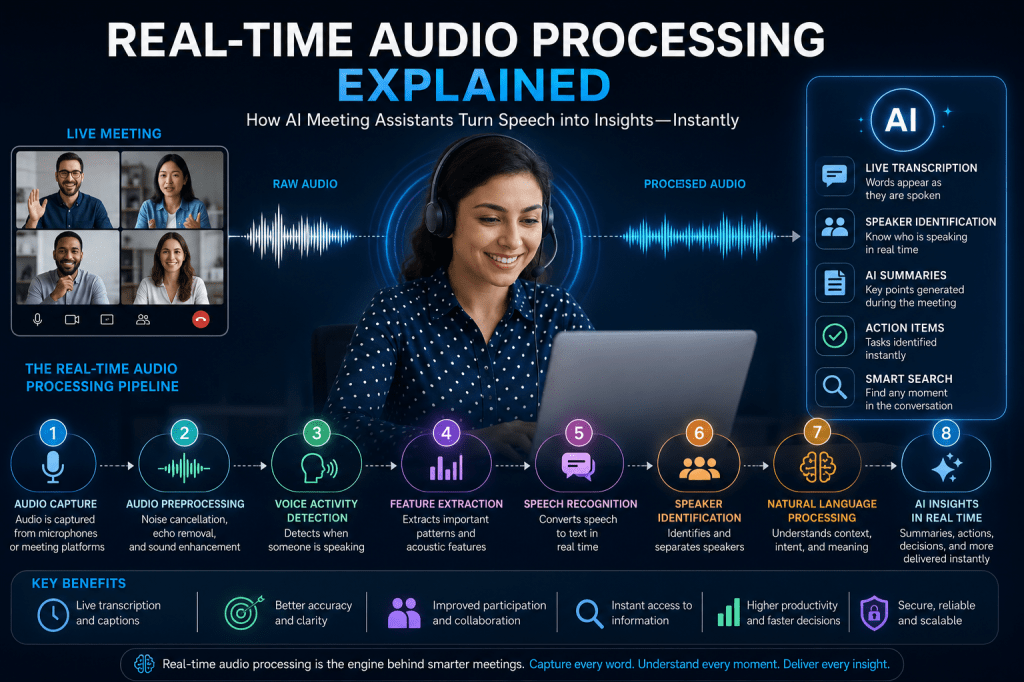
The Role of Machine Learning in the Meeting Workflow
Machine learning is involved at multiple stages of the AI meeting assistant process.
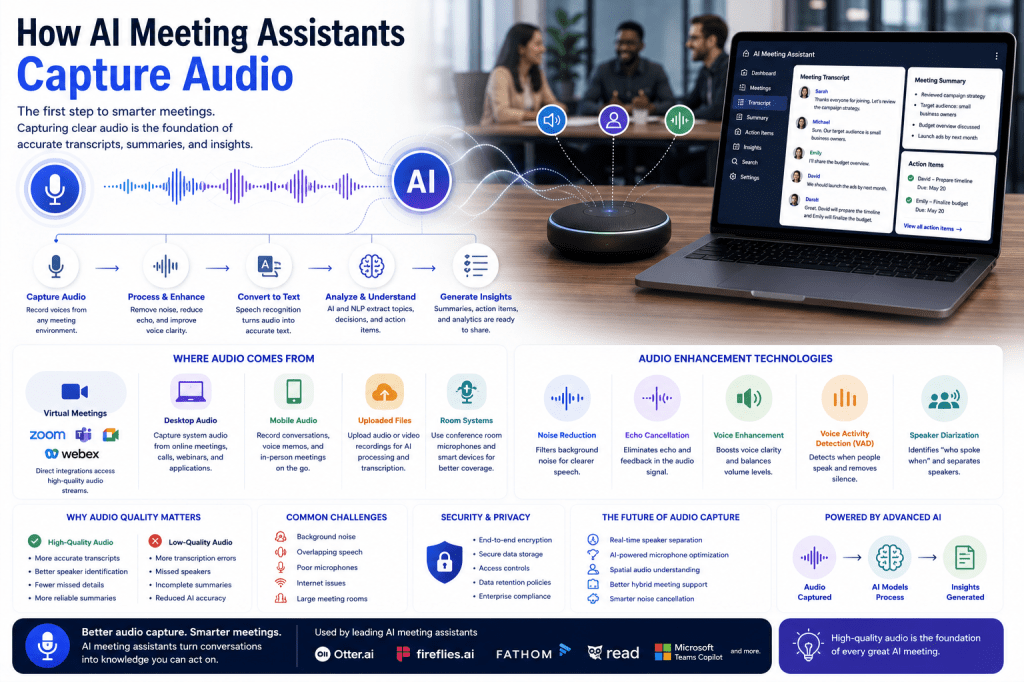
Audio Processing
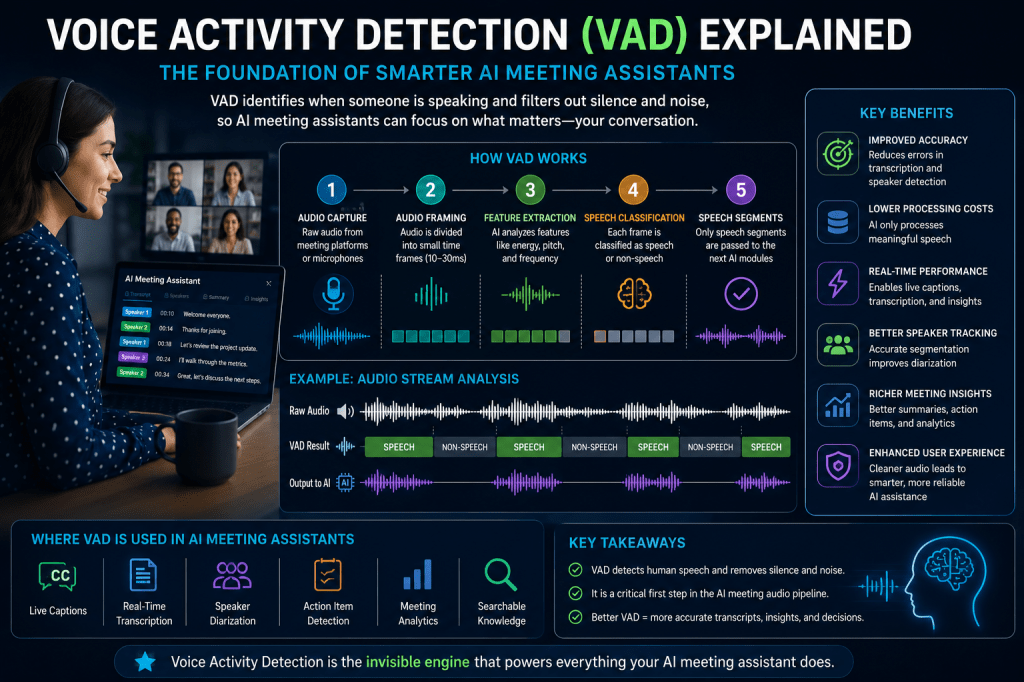
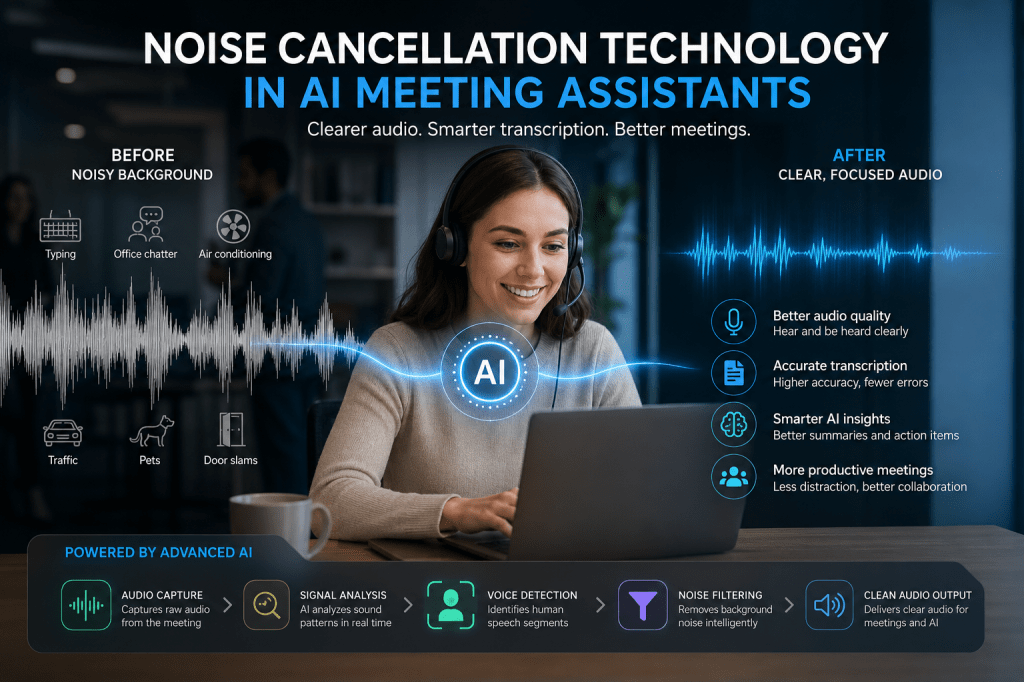
Before transcription begins, machine learning models help improve audio quality.
These systems can:
- Remove background noise
- Reduce echo
- Enhance speech clarity
- Isolate voices
By improving audio quality, machine learning helps increase transcription accuracy.
Speech Recognition
One of the most visible applications of machine learning is Automatic Speech Recognition (ASR).
Machine learning models analyze audio signals and predict which words are being spoken.
Modern speech recognition systems are trained on:
- Millions of voice recordings
- Multiple languages
- Different accents
- Industry-specific terminology
The result is highly accurate real-time transcription.
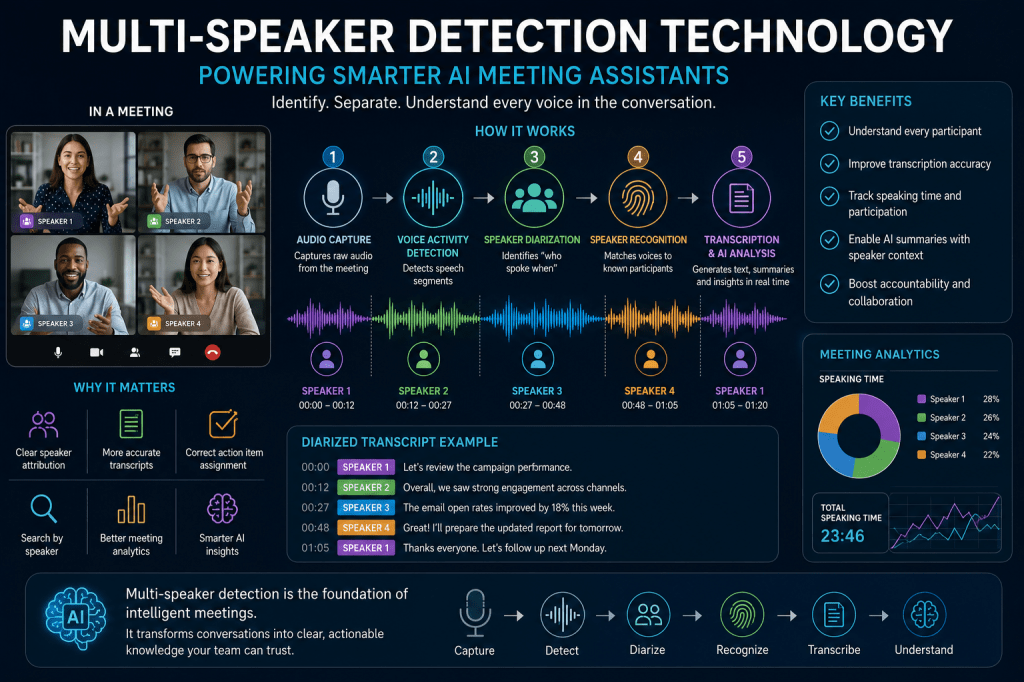
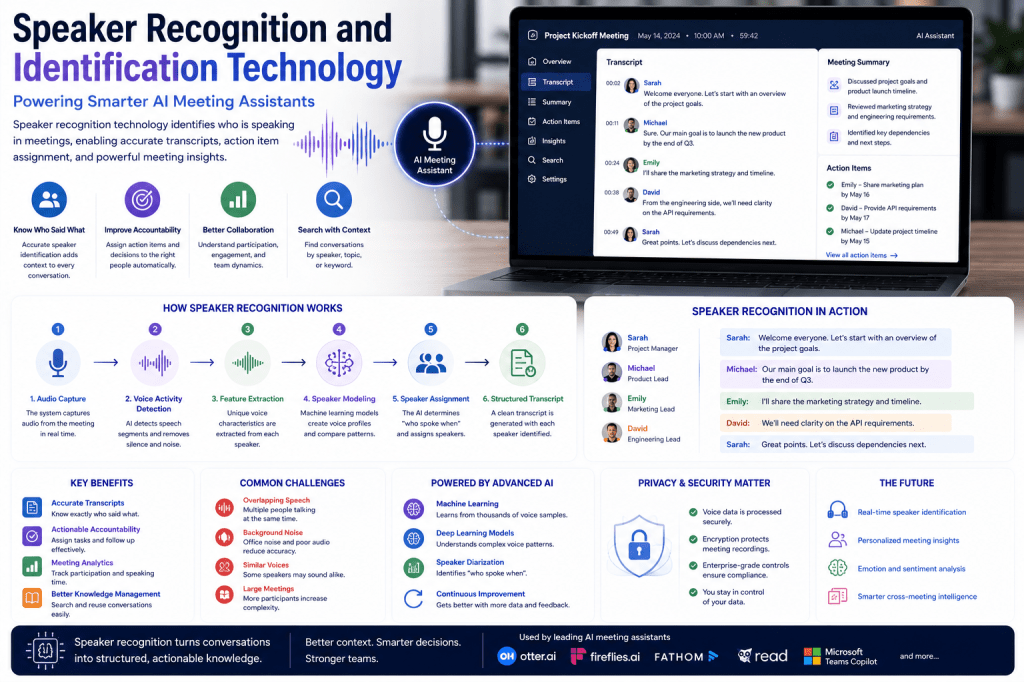
Speaker Recognition
AI meeting assistants often need to determine who said what during a conversation.
Machine learning models analyze:
- Voice characteristics
- Speaking patterns
- Audio signatures
This process, known as speaker diarization, allows transcripts to attribute statements to individual participants.
Natural Language Understanding
After transcription, machine learning helps the AI understand the meaning of the conversation.
The system can identify:
- Discussion topics
- Decisions
- Questions
- Commitments
- Action items
Instead of simply storing text, the AI understands the context behind the words.
Types of Machine Learning Used in AI Meeting Assistants
Supervised Learning
Supervised learning is one of the most common approaches used in AI meeting assistants.
In supervised learning, models are trained using labeled examples.
For example:
Audio Clip → Correct Transcript
By processing millions of examples, the model learns how to convert speech into text accurately.
Applications include:
- Speech recognition
- Speaker identification
- Action item detection
- Sentiment analysis
Unsupervised Learning
Unsupervised learning helps AI discover patterns without labeled examples.
This approach is often used for:
- Topic clustering
- Meeting categorization
- Trend analysis
- Knowledge organization
The system can group similar conversations together and identify recurring themes.
Deep Learning
Deep learning uses artificial neural networks with multiple layers to process large and complex datasets.
Deep learning powers many modern AI meeting assistant features, including:
- Speech recognition
- Natural language processing
- Summarization
- Language translation
Most leading meeting assistant platforms rely heavily on deep learning models.
Machine Learning and Meeting Transcription
Meeting transcription is one of the most demanding machine learning tasks.
The AI must accurately recognize:
- Multiple speakers
- Industry jargon
- Fast speech
- Interruptions
- Background noise
Machine learning models continuously improve by learning from vast amounts of speech data.
Challenges
Common transcription challenges include:
- Strong accents
- Poor audio quality
- Technical vocabulary
- Overlapping conversations
Advanced machine learning systems are specifically trained to handle these situations.
Machine Learning and Meeting Summaries
One of the most valuable features of AI meeting assistants is automatic summarization.
Machine learning models analyze transcripts and identify:
- Key discussion points
- Decisions made
- Action items
- Risks and concerns
- Next steps
Rather than reading thousands of words, users receive concise summaries generated by AI.
Extractive Summarization
This approach selects important sentences directly from the transcript.
Abstractive Summarization
This approach generates entirely new summaries that capture the meaning of the conversation.
Most modern AI meeting assistants increasingly rely on abstractive techniques powered by large language models.
Machine Learning for Action Item Extraction
Meetings frequently contain tasks and commitments.
Examples include:
- “I’ll send the proposal tomorrow.”
- “Let’s schedule a review next week.”
- “Marketing will prepare the campaign plan.”
Machine learning models identify these statements and convert them into structured action items.
This improves:
- Accountability
- Follow-up tracking
- Project management
Many platforms automatically sync extracted tasks with productivity tools.
Meeting Intelligence and Analytics
Advanced AI meeting assistants use machine learning to analyze meeting behavior.
These systems can evaluate:
Participation Levels
Who contributed most to the discussion?
Speaking Time
How balanced was the conversation?
Engagement
Were participants actively involved?
Topic Trends
Which subjects are discussed most frequently?
Organizations use these insights to improve communication and meeting effectiveness.
Continuous Learning and Improvement
One of the biggest advantages of machine learning is that systems improve over time.
AI meeting assistants learn from:
- New meeting data
- User corrections
- Feedback signals
- Additional training datasets
As more meetings are processed, the system becomes better at:
- Understanding terminology
- Recognizing speakers
- Generating summaries
- Extracting insights
This continuous learning cycle helps improve performance across the platform.
Large Language Models and Machine Learning
Large Language Models (LLMs) represent one of the most significant advances in machine learning.
These models are trained on enormous datasets and can:
- Understand context
- Generate summaries
- Answer questions
- Extract insights
- Produce natural language responses
Many modern AI meeting assistants now combine traditional machine learning systems with LLM-powered capabilities.
This creates a more intelligent and useful user experience.
Challenges and Limitations
While machine learning has dramatically improved AI meeting assistants, limitations still exist.
Common challenges include:
Data Quality
Poor audio leads to poorer predictions.
Bias
Training data can influence model behavior.
Industry-Specific Language
Specialized terminology may reduce accuracy.
Context Understanding
Complex discussions can still be difficult for AI to interpret perfectly.
Human review remains important for critical business decisions.
The Future of Machine Learning in AI Meeting Assistants
Machine learning capabilities continue to advance rapidly.
Future developments may include:
- Real-time coaching during meetings
- Predictive action recommendations
- Improved multilingual support
- Better speaker recognition
- Autonomous follow-up management
- Personalized meeting intelligence
As models become more sophisticated, AI meeting assistants will evolve from passive note-taking tools into proactive workplace assistants.
Final Thoughts
Machine learning is the engine that powers modern AI meeting assistants. From speech recognition and speaker identification to meeting summaries and action item extraction, machine learning enables these platforms to understand conversations and transform them into valuable business insights. As machine learning technology continues to improve, AI meeting assistants will become increasingly accurate, intelligent, and capable of helping organizations communicate, collaborate, and make decisions more effectively.

 Meeting Notes AI