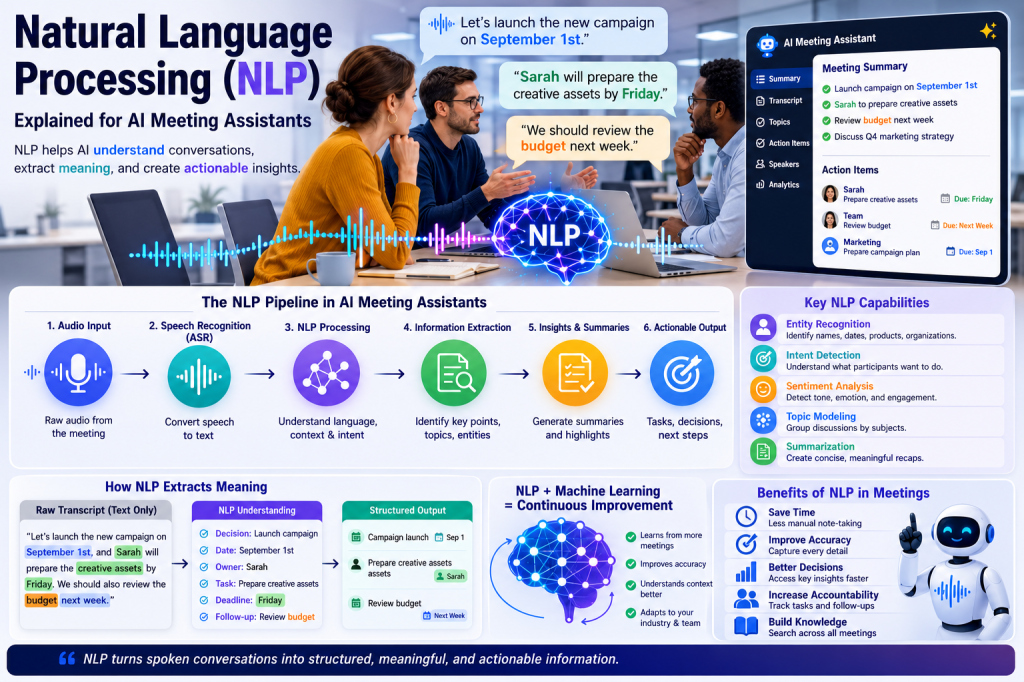
Natural Language Processing (NLP) is one of the most important technologies behind modern AI meeting assistants. While speech recognition converts spoken words into text, NLP helps artificial intelligence understand what those words actually mean. Without NLP, an AI meeting assistant could produce a transcript, but it would not be able to generate summaries, identify action items, recognize decisions, or answer questions about a meeting.
In this guide, we’ll explore what Natural Language Processing is, how it works, and why it plays a critical role in AI meeting assistants.
What Is Natural Language Processing?
Natural Language Processing, commonly known as NLP, is a branch of artificial intelligence that enables computers to understand, interpret, analyze, and generate human language.
NLP combines:
- Artificial intelligence
- Machine learning
- Linguistics
- Data science
Its goal is to bridge the gap between human communication and computer understanding.
For AI meeting assistants, NLP transforms raw transcripts into meaningful insights and actionable information.
Why NLP Matters in AI Meeting Assistants
Meetings contain far more than just words.
Participants discuss:
- Goals
- Problems
- Decisions
- Tasks
- Questions
- Ideas
- Strategies
A transcript alone cannot determine what information is important.
NLP allows AI meeting assistants to understand:
- What was discussed
- Which topics were important
- What decisions were made
- Who owns specific tasks
- Which actions need follow-up
This is what turns a meeting recorder into an intelligent meeting assistant.
The Role of NLP in the AI Meeting Workflow
A typical AI meeting assistant follows several steps.
Step 1: Speech Recognition
The meeting audio is converted into text using Automatic Speech Recognition (ASR).
For example:
Audio
“Let’s launch the campaign on September 1st and have Sarah prepare the final creative assets.”
Transcript
Let’s launch the campaign on September 1st and have Sarah prepare the final creative assets.
At this stage, the system only knows the words.
Step 2: NLP Analysis
NLP analyzes the sentence and identifies:
- Topic: Marketing Campaign
- Decision: Launch date is September 1st
- Action Item: Prepare creative assets
- Owner: Sarah
This understanding is what enables AI-generated summaries and task tracking.
Core NLP Technologies Used in AI Meeting Assistants
Tokenization
Tokenization breaks text into smaller units called tokens.
For example:
“We need to schedule a product review.”
becomes:
- We
- need
- to
- schedule
- a
- product
- review
This is one of the first steps in language processing.
Part-of-Speech Tagging
NLP identifies the grammatical role of words.
For example:
- Schedule = Verb
- Product = Noun
- Review = Noun
Understanding sentence structure helps the AI interpret meaning more accurately.
Named Entity Recognition (NER)
Named Entity Recognition identifies important entities within conversations.
Examples include:
- People
- Companies
- Dates
- Locations
- Products
Example:
“John will meet with Acme Corporation on July 15.”
The AI identifies:
- Person: John
- Organization: Acme Corporation
- Date: July 15
This information helps generate more structured meeting records.
Intent Recognition
Intent recognition helps the AI determine what participants are trying to accomplish.
For example:
“Can we schedule a follow-up meeting next week?”
The AI recognizes:
Intent = Scheduling Request
This allows the assistant to classify information appropriately.
Sentiment Analysis
Some AI meeting assistants use sentiment analysis to evaluate emotional tone.
Examples include:
- Positive sentiment
- Negative sentiment
- Neutral sentiment
This capability is often used for:
- Sales calls
- Customer success meetings
- Team engagement analysis
Organizations can gain deeper insights into conversations and relationships.
NLP and Meeting Summaries
One of the most visible applications of NLP is automatic summarization.
Instead of requiring users to read thousands of words, NLP identifies the most important information.
Extractive Summarization
Extractive summarization selects important sentences directly from the transcript.
Abstractive Summarization
Abstractive summarization creates entirely new summaries that capture the meaning of the discussion.
Modern AI meeting assistants increasingly use abstractive approaches powered by large language models.
The result is:
- Shorter summaries
- Better readability
- More useful insights
NLP and Action Item Extraction
Action item detection is one of the most valuable NLP applications.
The AI analyzes conversations to identify commitments and tasks.
Examples include:
“We’ll finalize the proposal by Friday.”
“Sarah will send the budget report.”
“Marketing will review the campaign assets.”
NLP identifies:
- Task
- Owner
- Deadline
Many meeting assistants automatically organize these items into task lists and workflows.
NLP and Topic Detection
Meetings often cover multiple subjects.
NLP can automatically identify discussion topics such as:
- Product Development
- Marketing Strategy
- Budget Planning
- Customer Support
- Hiring
This allows AI meeting assistants to:
- Organize meeting content
- Improve search functionality
- Build knowledge bases
- Generate topic-based summaries
Topic detection makes large meeting archives easier to navigate.
NLP and Meeting Search
One of the most powerful features of AI meeting assistants is conversational search.
Instead of searching for exact keywords, users can ask questions such as:
- “What did we decide about the product launch?”
- “Who was responsible for the budget proposal?”
- “When did the team discuss customer retention?”
NLP helps the AI understand the user’s intent and retrieve relevant information from meeting archives.
This dramatically improves knowledge discovery.
NLP and Large Language Models
Modern AI meeting assistants increasingly combine traditional NLP techniques with Large Language Models (LLMs).
LLMs enhance NLP by providing:
- Better context understanding
- More accurate summaries
- Improved question answering
- Natural language generation
Together, NLP and LLMs create a more intelligent meeting experience.
For example, the AI can understand:
“The client was concerned about pricing but agreed to continue discussions.”
The assistant understands:
- Concern = Pricing
- Outcome = Continued engagement
- Importance = High
This level of contextual understanding was difficult to achieve with older NLP systems.
Challenges for NLP in Meetings
Although NLP has advanced significantly, meeting conversations remain challenging.
Common difficulties include:
Informal Language
People often speak differently than they write.
Interruptions
Meetings frequently involve overlapping conversations.
Industry Jargon
Technical terminology varies by profession.
Ambiguous Statements
Some statements require context to interpret correctly.
Example:
“We’ll go with that option.”
The AI must determine what “that option” refers to.
Modern NLP systems continue improving at handling these challenges.
How NLP Improves Over Time
NLP models learn from large amounts of language data.
Training datasets may include:
- Books
- Articles
- Websites
- Conversations
- Business communications
Machine learning helps NLP systems improve their ability to:
- Understand context
- Recognize intent
- Extract information
- Generate summaries
As more meeting data becomes available, AI meeting assistants become increasingly accurate and useful.
The Future of NLP in AI Meeting Assistants
NLP technology is evolving rapidly.
Future capabilities may include:
Real-Time Meeting Guidance
AI providing suggestions during discussions.
Improved Decision Detection
Automatically identifying critical decisions as they happen.
Personalized Meeting Intelligence
Tailored summaries based on user roles.
Multilingual Understanding
Supporting seamless communication across languages.
Deeper Context Awareness
Understanding organizational history and project context across multiple meetings.
These advances will make AI meeting assistants even more valuable productivity tools.
Final Thoughts
Natural Language Processing is one of the core technologies that transforms AI meeting assistants from simple transcription tools into intelligent workplace assistants. By understanding language, identifying topics, extracting action items, generating summaries, and enabling conversational search, NLP helps organizations unlock the value hidden within their meetings. As NLP continues to evolve alongside machine learning and large language models, AI meeting assistants will become even more capable of helping teams communicate, collaborate, and make better decisions.

 Meeting Notes AI