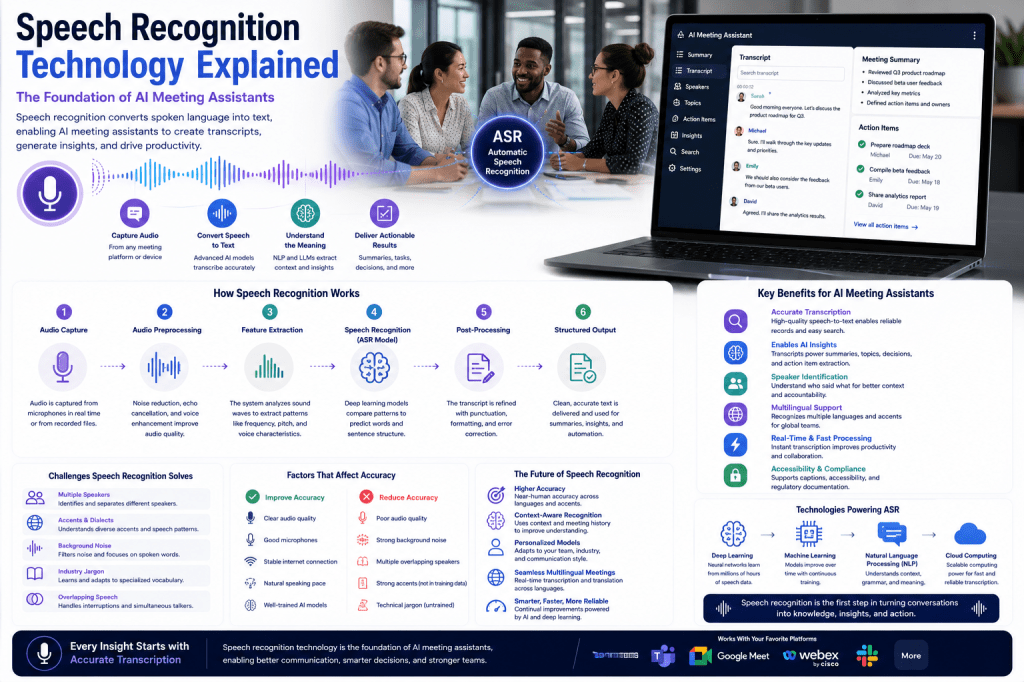
Speech recognition technology is one of the most important innovations behind modern AI meeting assistants. Every meeting summary, transcript, action item, and AI-generated insight begins with a single task: accurately converting spoken language into text. Without speech recognition, AI meeting assistants would not be able to understand conversations or transform them into useful business information.
In this guide, we’ll explore what speech recognition technology is, how it works, the role it plays in AI meeting assistants, and why it has become a foundational technology for modern workplace productivity.
What Is Speech Recognition Technology?
Speech recognition is a branch of artificial intelligence that enables computers to recognize spoken language and convert it into written text.
The technology is often referred to as:
- Speech-to-text
- Voice recognition
- Automatic Speech Recognition (ASR)
Its primary goal is to allow machines to understand human speech and process it in a usable format.
For AI meeting assistants, speech recognition acts as the first step in transforming conversations into searchable knowledge and actionable insights.
Why Speech Recognition Matters in AI Meeting Assistants
Meetings generate valuable information, but spoken conversations are inherently difficult to organize and analyze.
Without speech recognition:
- Conversations remain audio recordings
- Meeting notes must be created manually
- Important information can be missed
- Knowledge is difficult to search and retrieve
Speech recognition solves these challenges by creating accurate transcripts that can be analyzed by other AI systems.
The transcript becomes the foundation for:
- Meeting summaries
- Action item extraction
- Topic detection
- Meeting analytics
- Knowledge management
How Speech Recognition Works
Modern speech recognition systems rely heavily on machine learning and deep learning models.
The process typically follows several stages.
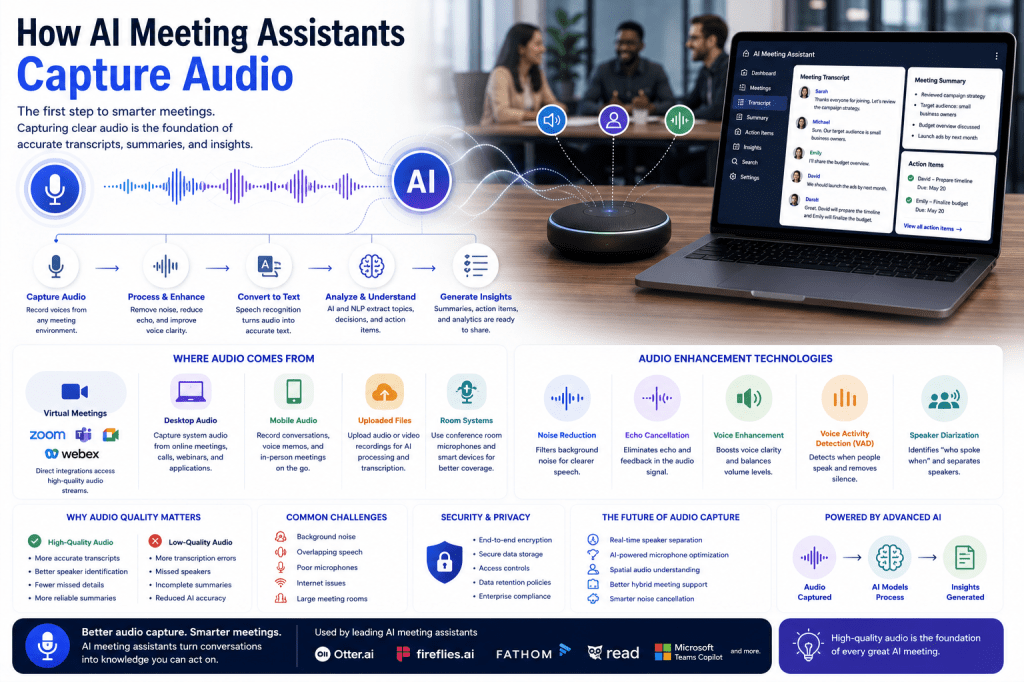
Step 1: Audio Capture
The meeting assistant captures audio from sources such as:
- Zoom meetings
- Microsoft Teams meetings
- Google Meet sessions
- Phone calls
- Recorded audio files
The quality of the input audio significantly affects transcription accuracy.
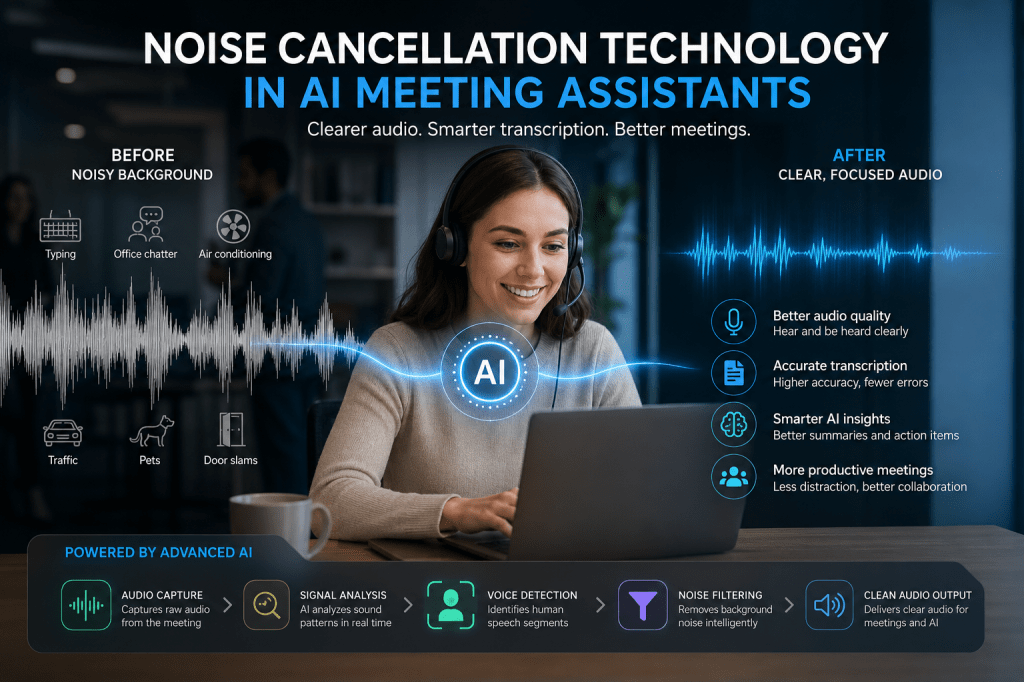
Step 2: Audio Preprocessing
Before transcription begins, the audio is cleaned and enhanced.
This may include:
- Noise reduction
- Echo cancellation
- Voice enhancement
- Background noise filtering
The goal is to improve clarity before speech analysis begins.
Step 3: Feature Extraction
The AI analyzes characteristics of the audio signal.
It examines factors such as:
- Frequency patterns
- Pitch
- Tone
- Timing
- Voice characteristics
These features help the system distinguish speech from other sounds.
Step 4: Speech Recognition Model
Machine learning models compare the audio patterns against language models trained on massive datasets.
The system predicts:
- Individual words
- Sentence structure
- Contextual meaning
The result is a text transcript that closely matches the original conversation.
Step 5: Post-Processing
Additional AI systems refine the output by:
- Correcting errors
- Adding punctuation
- Formatting sentences
- Improving readability
This creates a cleaner and more useful transcript.
Automatic Speech Recognition (ASR)
Most modern AI meeting assistants use Automatic Speech Recognition technology.
What Is ASR?
ASR is an AI-driven process that automatically converts spoken language into text without human intervention.
Modern ASR systems can:
- Process speech in real time
- Handle multiple speakers
- Support multiple languages
- Adapt to accents and dialects
ASR has become significantly more accurate thanks to advances in deep learning and large-scale training data.
Deep Learning and Speech Recognition
Traditional speech recognition systems relied heavily on predefined linguistic rules.
Modern systems use deep learning.
Neural Networks
Deep neural networks learn speech patterns from enormous collections of audio recordings.
These models are trained using:
- Millions of conversations
- Diverse accents
- Multiple languages
- Industry-specific terminology
As a result, modern systems can achieve remarkably high transcription accuracy.
Continuous Improvement
Deep learning systems continue improving as they process additional data and receive feedback.
This allows speech recognition technology to become more accurate over time.
Challenges Speech Recognition Must Solve
Human speech is complex and unpredictable.
AI meeting assistants must overcome several challenges.
Multiple Speakers
Meetings often involve several participants speaking in rapid succession.
The system must determine:
- When speakers change
- Who is speaking
- Which words belong to each participant
Accents and Dialects
People speak differently depending on:
- Geography
- Culture
- Language background
Modern ASR systems are trained to recognize a wide variety of speaking styles.
Background Noise
Meetings may contain:
- Keyboard sounds
- Office noise
- Traffic sounds
- Poor microphone quality
Noise reduction technologies help minimize these disruptions.
Industry-Specific Vocabulary
Technical meetings often contain specialized terminology.
Examples include:
- Medical terms
- Legal language
- Engineering jargon
- Financial terminology
Many AI meeting assistants improve accuracy through custom vocabulary training.
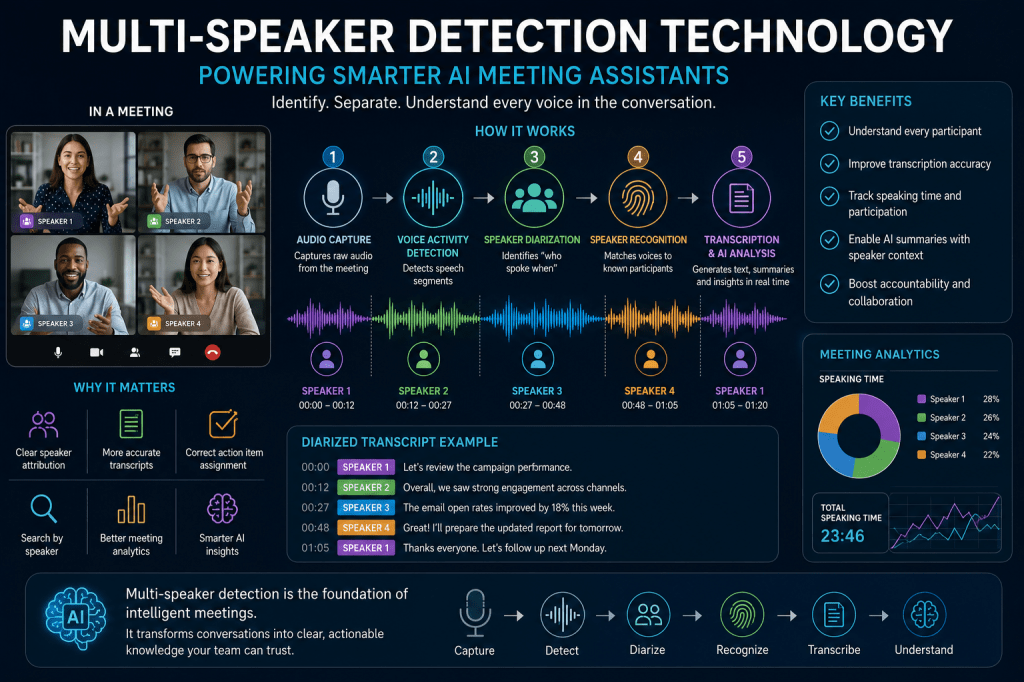
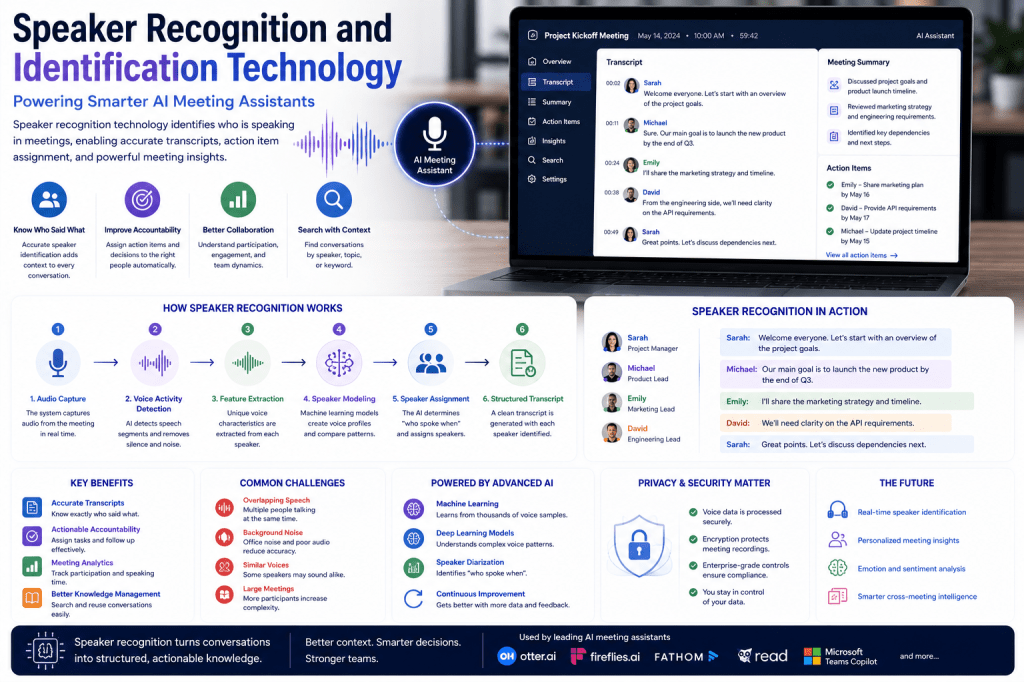
Speech Recognition and Speaker Identification
Accurate transcripts are valuable, but understanding who said what is equally important.
Many meeting assistants combine speech recognition with speaker diarization technology.
This enables transcripts such as:
Sarah: We should launch the campaign next month.
Michael: I’ll finalize the budget proposal.
Speaker identification improves:
- Accountability
- Meeting summaries
- Action item assignment
- Collaboration tracking
Speech Recognition and Meeting Summaries
Speech recognition creates the transcript that powers AI-generated summaries.
Without transcription:
- NLP cannot analyze conversations
- LLMs cannot generate summaries
- Action items cannot be extracted
Speech recognition is therefore the foundation upon which all other meeting intelligence features are built.
Multilingual Speech Recognition
Global organizations increasingly require multilingual meeting support.
Modern speech recognition systems can process:
- English
- Spanish
- French
- German
- Dutch
- Portuguese
- Japanese
- Chinese
- Many additional languages
Some platforms can even switch between languages during a meeting.
This capability is particularly useful for international teams.
Real-Time vs Post-Meeting Transcription
Real-Time Transcription
The transcript appears while the meeting is taking place.
Benefits include:
- Live captions
- Accessibility support
- Immediate visibility
Post-Meeting Transcription
The transcript is processed after the meeting concludes.
Benefits include:
- Higher accuracy
- More processing time
- Better language analysis
Many AI meeting assistants support both approaches.
Speech Recognition Accuracy
Accuracy varies depending on several factors.
Factors That Improve Accuracy
- High-quality microphones
- Clear speech
- Minimal background noise
- Strong internet connections
- Good participant audio
Factors That Reduce Accuracy
- Poor audio quality
- Multiple overlapping speakers
- Technical jargon
- Strong accents not represented in training data
Leading AI meeting assistants often achieve accuracy rates exceeding 90% under favorable conditions.
Popular AI Meeting Assistants Using Speech Recognition
Many leading meeting platforms rely on advanced speech recognition systems.
Examples include:
- Otter.ai
- Fireflies.ai
- Microsoft Teams Copilot
- Read AI
- Fellow
- Fathom
While implementations vary, speech recognition remains a core technology across all platforms.
The Future of Speech Recognition
Speech recognition technology continues to evolve rapidly.
Future advancements may include:
Near-Human Accuracy
Further improvements in understanding accents, context, and specialized language.
Better Real-Time Processing
Faster transcription with fewer errors.
Improved Multilingual Support
More natural handling of multilingual conversations.
Context-Aware Recognition
Using meeting history and organizational knowledge to improve transcription accuracy.
Personalized Models
Speech recognition systems tailored to specific teams, industries, and organizations.
These improvements will make AI meeting assistants even more powerful and reliable.
Final Thoughts
Speech recognition technology is the foundation of modern AI meeting assistants. By converting spoken language into searchable, structured text, it enables meeting summaries, action item extraction, knowledge management, and intelligent collaboration. Advances in machine learning, deep learning, and Automatic Speech Recognition have dramatically improved accuracy and usability, making speech recognition one of the most important technologies in today’s workplace productivity ecosystem. As the technology continues to advance, it will play an even greater role in helping organizations capture and benefit from the knowledge created during meetings.

 Meeting Notes AI