Introduction
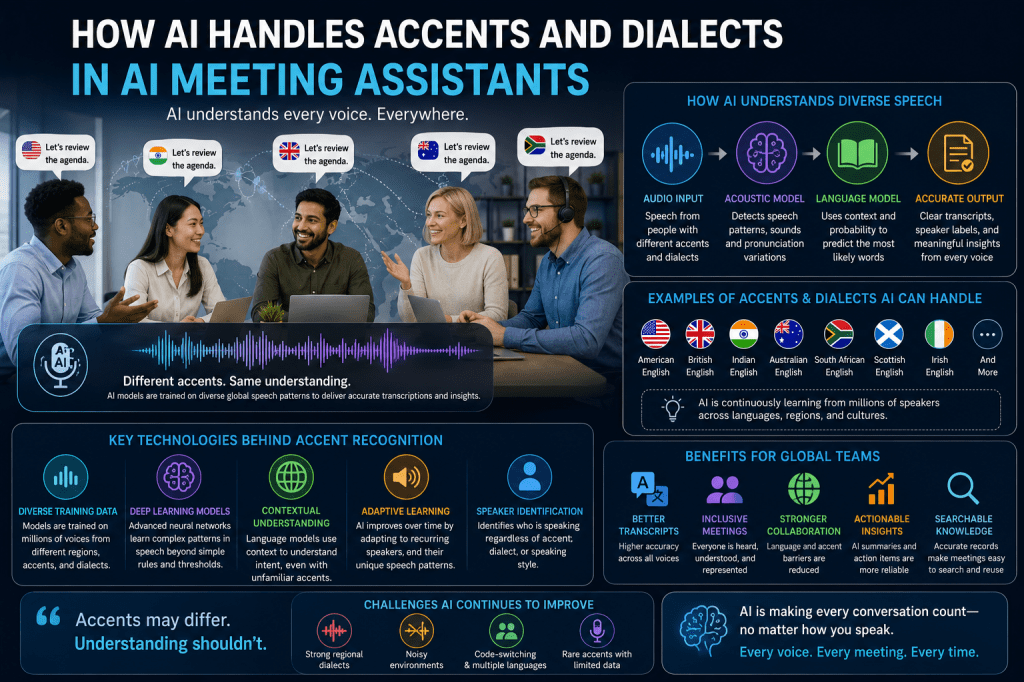
Modern workplaces are increasingly global. A single meeting may include participants from the United States, the United Kingdom, India, Australia, South Africa, Germany, Singapore, and many other regions. Even when everyone speaks the same language, accents, dialects, pronunciations, and speaking styles can vary significantly.
For AI meeting assistants, this creates a major challenge.
To generate accurate transcripts, summaries, action items, and meeting insights, the AI must correctly understand speech regardless of how words are pronounced. A system that performs well only with a single accent would be of limited value in today’s international business environment.
Fortunately, advances in machine learning, speech recognition, and large-scale language modeling have dramatically improved how AI meeting assistants handle accents and dialects.
This guide explains how AI systems recognize diverse speech patterns and why accent handling has become a critical capability for modern meeting intelligence platforms.
What Are Accents and Dialects?
Although often used interchangeably, accents and dialects are different concepts.
Accent
An accent refers to the way words are pronounced.
Examples include:
- American English
- British English
- Australian English
- Indian English
- Irish English
- South African English
The vocabulary remains largely the same, but pronunciation differs.
Dialect
A dialect includes differences in:
- Pronunciation
- Vocabulary
- Grammar
- Expressions
- Sentence structure
Examples include:
- Scottish English
- African American Vernacular English (AAVE)
- Regional British dialects
- Regional Spanish dialects
AI meeting assistants must handle both pronunciation differences and language variations.
Why Accents Matter in AI Meeting Assistants
Speech recognition systems depend on accurately converting spoken language into text.
Accents can affect:
Transcription Accuracy
Pronunciation differences may cause words to be misinterpreted.
Speaker Identification
Voice patterns vary across regions.
Meeting Summaries
Incorrect transcripts lead to inaccurate summaries.
Action Item Extraction
Misheard instructions can affect task tracking.
Searchability
Poor transcripts make meeting records harder to search.
For organizations with international teams, accent handling is essential.
Early Speech Recognition Systems Struggled
Traditional speech recognition systems relied on:
- Fixed pronunciation dictionaries
- Limited training datasets
- Rule-based language models
These systems often performed well for a small group of speakers but struggled with:
- Regional accents
- Non-native speakers
- Diverse pronunciation patterns
As a result, transcription accuracy varied significantly depending on the speaker.
The Shift to Machine Learning
Modern AI meeting assistants use machine learning rather than rigid rules.
Instead of memorizing pronunciations, systems learn patterns from enormous datasets.
Training data often includes:
- Millions of speakers
- Hundreds of accents
- Multiple languages
- Diverse speaking styles
- Various recording environments
This allows AI models to generalize across different speech patterns.
How AI Learns Accents
Speech recognition models are trained using supervised learning.
The training process typically includes:
Audio Samples
Recordings from speakers with different accents.
Human Transcripts
Accurate text versions of spoken content.
Pattern Recognition
The model learns relationships between audio patterns and words.
Over time, the system becomes capable of recognizing many ways a word can be pronounced.
For example, the word “schedule” may be pronounced differently in American and British English.
Modern AI systems learn both pronunciations.
Acoustic Models
One of the most important components in speech recognition is the acoustic model.
The acoustic model analyzes:
- Sound frequencies
- Speech patterns
- Pronunciation characteristics
- Voice features
Its job is to determine:
“What sounds am I hearing?”
Modern acoustic models are trained on highly diverse datasets, allowing them to recognize speech from a wide range of accents.
Language Models
Speech recognition is not based solely on sound.
AI also considers context.
This is where language models help.
Language models answer questions such as:
- Which words are likely to appear together?
- What phrase makes sense in context?
- What is the speaker probably saying?
For example:
A speaker says:
“We need to finalize the budget.”
Even if pronunciation is unclear, the language model may infer the correct phrase based on context.
This significantly improves recognition accuracy.
Deep Learning and Accent Recognition
Modern meeting assistants rely heavily on deep learning.
Common architectures include:
Convolutional Neural Networks (CNNs)
Analyze audio patterns and frequency structures.
Recurrent Neural Networks (RNNs)
Process speech sequences over time.
Transformer Models
Capture long-range relationships within speech.
End-to-End Speech Models
Convert speech directly into text using deep neural networks.
These systems are much better at handling accent variation than earlier technologies.
Large Language Models and Accent Understanding
Large Language Models (LLMs) have further improved transcription quality.
Although LLMs do not directly process raw audio in many systems, they help:
- Correct transcription errors
- Interpret context
- Improve punctuation
- Resolve ambiguous phrases
- Enhance summaries
This reduces the impact of accent-related recognition mistakes.
Accent Adaptation
Some advanced AI systems can adapt to speakers over time.
The process typically involves:
Initial Recognition
The system analyzes a speaker’s voice.
Pattern Learning
The AI identifies recurring pronunciation habits.
Improved Accuracy
Recognition improves as more speech samples become available.
This is particularly useful for frequent meeting participants.
Dialect Recognition Challenges
Dialects introduce additional complexity.
The same concept may be expressed differently depending on region.
Examples include:
Vocabulary Differences
- Elevator vs Lift
- Truck vs Lorry
- Apartment vs Flat
Phrase Differences
- Schedule a meeting
- Set up a meeting
- Arrange a meeting
Modern AI systems must recognize that these phrases often represent the same intent.
Multilingual Meetings
Global organizations often conduct meetings involving multiple languages.
Challenges include:
- Language switching
- Code-switching
- Mixed-language conversations
- Regional pronunciation influences
Advanced AI meeting assistants increasingly support:
Automatic Language Detection
Recognizing the language being spoken.
Multilingual Transcription
Generating transcripts in multiple languages.
Real-Time Translation
Translating conversations as they occur.
These capabilities help bridge communication gaps across international teams.
Speaker Identification and Accents
Accents also affect speaker identification systems.
Speaker recognition models analyze:
- Voice characteristics
- Pitch
- Timbre
- Speech rhythm
- Pronunciation patterns
Modern systems are designed to identify speakers regardless of accent.
This improves:
- Speaker attribution
- Meeting analytics
- Participation tracking
- Action item assignment
Challenges That Still Remain
Despite major progress, some challenges persist.
Rare Accents
Limited training data can affect performance.
Strong Regional Dialects
Pronunciation differences may be substantial.
Noisy Environments
Background noise complicates recognition.
Mixed Languages
Language switching remains difficult.
Industry Terminology
Specialized vocabulary may not appear frequently in training datasets.
AI providers continuously refine models to address these issues.
How AI Meeting Assistants Improve Accuracy
Most modern meeting assistants combine several technologies:
Noise Cancellation
Improves audio quality.
Voice Activity Detection
Identifies speech segments.
Speech Recognition
Converts speech to text.
Accent-Aware Acoustic Models
Handle pronunciation variation.
Language Models
Provide contextual understanding.
Large Language Models
Improve transcript quality and summaries.
Together, these systems deliver far better performance than earlier speech technologies.
Benefits for Organizations
Accurate accent and dialect recognition provides several advantages.
Better Transcripts
More accurate meeting records.
Improved Accessibility
Reliable captions for global teams.
Stronger Collaboration
Reduced communication barriers.
Better AI Insights
More accurate summaries and action items.
Enhanced Knowledge Management
Meeting records become more searchable and useful.
Future of Accent Handling in AI
Several innovations are expected to improve speech recognition further.
Personalized Speech Models
Systems adapt to individual speakers.
Larger Global Datasets
More diverse training data.
Better Dialect Understanding
Improved recognition of regional language variations.
Context-Aware AI
Greater understanding of meeting content and industry terminology.
Real-Time Multilingual Meetings
Seamless translation and transcription across languages.
These developments will make AI meeting assistants increasingly effective in international business environments.
Conclusion
Handling accents and dialects is one of the most important challenges in speech recognition. Modern AI meeting assistants address this challenge using machine learning, deep learning, acoustic modeling, language models, and large language models trained on vast collections of diverse speech data.
As global collaboration continues to grow, accurate accent and dialect recognition will become even more critical. By understanding speech from people with different backgrounds, regions, and languages, AI meeting assistants can provide more accurate transcripts, better meeting summaries, stronger collaboration, and more reliable meeting intelligence for organizations around the world.