Introduction
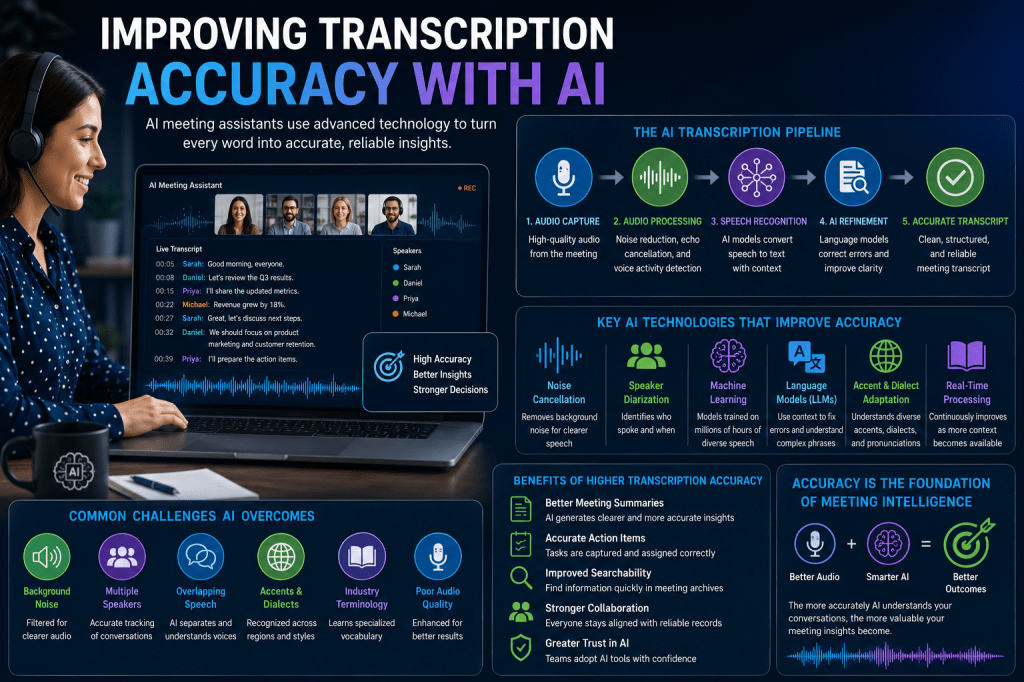
Transcription is one of the most valuable features offered by modern AI meeting assistants. By converting spoken conversations into searchable text, these tools help organizations capture knowledge, generate meeting summaries, track action items, and improve collaboration.
However, the usefulness of a transcript depends on one critical factor:
Accuracy.
Even small transcription errors can change the meaning of a discussion, create confusion, misassign tasks, or reduce trust in AI-generated insights. As organizations increasingly rely on AI meeting assistants to document conversations, improving transcription accuracy has become a major focus for software providers.
Fortunately, advances in artificial intelligence, machine learning, speech recognition, and large language models have dramatically improved transcription quality in recent years.
This guide explores how AI meeting assistants improve transcription accuracy and the technologies that make it possible.
Why Transcription Accuracy Matters
Meeting transcripts serve as the foundation for many AI-powered features.
Accurate transcripts support:
- Meeting summaries
- Action item extraction
- Speaker attribution
- Meeting analytics
- Knowledge management
- Compliance documentation
- Searchable meeting archives
When transcripts contain errors, every downstream AI feature becomes less reliable.
The relationship is straightforward:
Better Audio → Better Transcription → Better AI Insights
What Is Transcription Accuracy?
Transcription accuracy measures how closely a generated transcript matches the actual spoken conversation.
A common industry metric is:
Word Error Rate (WER)
WER evaluates:
- Insertions (extra words)
- Deletions (missing words)
- Substitutions (incorrect words)
Lower WER indicates higher accuracy.
For example:
Actual speech:
“Let’s schedule the client review for next Tuesday.”
Transcript:
“Let’s schedule the client interview for next Tuesday.”
Only one word is incorrect, but the meaning changes significantly.
Reducing these errors is the primary goal of modern AI transcription systems.
Challenges That Affect Accuracy
Meeting environments are often complex.
Several factors can reduce transcription quality.
Background Noise
Examples include:
- Keyboard typing
- Office conversations
- Traffic
- Air conditioning
- Construction sounds
Multiple Speakers
Meetings frequently involve speaker transitions and interruptions.
Overlapping Conversations
Participants may speak simultaneously.
Accents and Dialects
Global teams introduce pronunciation variation.
Poor Microphones
Low-quality audio capture reduces recognition performance.
Industry Terminology
Specialized vocabulary can be difficult for general-purpose models.
AI meeting assistants use multiple technologies to address these challenges.
Speech Recognition: The Foundation
Improving transcription begins with Automatic Speech Recognition (ASR).
ASR converts spoken language into text.
Modern speech recognition systems rely on:
- Deep learning
- Neural networks
- Massive speech datasets
- Language modeling
Unlike older rule-based systems, AI-powered ASR learns patterns from millions of speech examples.
This dramatically improves recognition accuracy.
Voice Activity Detection (VAD)
Before transcription begins, AI systems must determine whether speech is actually present.
Voice Activity Detection identifies:
- Human speech
- Silence
- Background noise
Benefits include:
- Reduced false transcriptions
- Improved processing efficiency
- Better speech segmentation
VAD ensures the system focuses on meaningful speech rather than environmental sounds.
Noise Cancellation Technology
One of the most effective ways to improve transcription accuracy is to improve audio quality.
AI-powered noise cancellation removes:
- Keyboard clicks
- Office chatter
- Traffic sounds
- Fan noise
- HVAC systems
Cleaner audio allows speech recognition systems to focus on voices rather than distractions.
This often results in significant transcription improvements.
Audio Enhancement Systems
Modern meeting assistants go beyond simple noise reduction.
Audio enhancement technologies may include:
Speech Enhancement
Improves vocal clarity.
Echo Cancellation
Removes audio reflections.
Gain Control
Balances speaker volume levels.
Speech Reconstruction
Uses AI to restore degraded audio signals.
The result is a stronger signal for transcription engines.
Speaker Diarization
One of the biggest challenges in meeting transcription is tracking multiple speakers.
Speaker diarization answers:
“Who spoke when?”
The system:
- Detects speaker changes
- Separates conversation segments
- Labels participants
- Maintains speaker context
Accurate speaker tracking improves transcript readability and downstream analysis.
Multi-Speaker Detection
Modern AI meeting assistants often include advanced multi-speaker detection systems.
These technologies:
- Identify multiple voices
- Separate overlapping conversations
- Track participation throughout meetings
This reduces confusion and improves transcription quality in group discussions.
Machine Learning and Transcription
Machine learning has transformed speech recognition.
Models are trained using:
- Millions of hours of speech
- Diverse accents
- Multiple languages
- Different recording environments
This allows systems to learn:
- Pronunciation patterns
- Speaking styles
- Acoustic variations
- Conversational behavior
The more diverse the training data, the better the transcription performance.
Deep Learning Models
Most modern transcription engines rely on deep learning.
Common architectures include:
Convolutional Neural Networks (CNNs)
Analyze audio patterns.
Recurrent Neural Networks (RNNs)
Process speech sequences.
Transformer Models
Capture long-range relationships within conversations.
End-to-End Speech Models
Convert audio directly into text.
These approaches have significantly reduced transcription error rates.
How Large Language Models Improve Accuracy
Large Language Models (LLMs) have introduced a new layer of intelligence.
After speech recognition generates text, LLMs can:
Correct Contextual Errors
Interpret intended meaning.
Improve Grammar
Fix punctuation and formatting.
Resolve Ambiguous Words
Use surrounding context.
Understand Business Conversations
Recognize workplace terminology and intent.
For example:
If a transcript contains:
“Let’s update the sails pipeline.”
An LLM may recognize that:
“sales pipeline”
is the more likely phrase.
This contextual understanding improves final transcript quality.
Handling Accents and Dialects
Global teams introduce a wide range of speech patterns.
Modern AI systems improve accent handling through:
- Diverse training datasets
- Adaptive speech models
- Context-aware language models
- Continuous learning systems
These technologies help reduce errors caused by pronunciation differences.
Industry-Specific Vocabulary
Many meetings contain specialized terminology.
Examples include:
Healthcare
- Patient records
- Diagnostic imaging
- Clinical trials
Finance
- EBITDA
- Cash flow
- Portfolio allocation
Technology
- Kubernetes
- LangGraph
- API integrations
Advanced AI systems increasingly learn domain-specific language to improve recognition accuracy.
Real-Time Transcription Improvements
Many meeting assistants now provide live transcription.
Real-time systems continuously improve accuracy through:
Incremental Processing
Predictions improve as more speech becomes available.
Context Accumulation
Additional conversation context reduces errors.
Speaker Tracking
Maintains continuity across discussions.
Dynamic Language Modeling
Adjusts predictions based on meeting topics.
These improvements help create more accurate live captions and transcripts.
Human-in-the-Loop Approaches
Some organizations use human review to improve critical transcripts.
Benefits include:
- Error correction
- Specialized terminology validation
- Compliance verification
Although AI handles most transcription tasks automatically, human oversight can improve accuracy in high-stakes environments.
Best Practices for Better Transcripts
Organizations can improve results by following several best practices.
Use Quality Microphones
Better audio capture improves recognition.
Reduce Background Noise
Quieter environments produce cleaner transcripts.
Encourage Clear Speech
Participants should avoid speaking too quickly.
Limit Overlapping Conversations
Sequential speaking improves accuracy.
Use Modern Meeting Platforms
Integrated audio processing enhances transcription quality.
Review Important Transcripts
Verify critical information when necessary.
These practices complement AI technologies and further improve outcomes.
Benefits of High Transcription Accuracy
Organizations gain several advantages.
Better Meeting Summaries
AI generates more reliable insights.
More Accurate Action Items
Tasks are assigned correctly.
Improved Searchability
Knowledge becomes easier to find.
Better Analytics
Participation tracking becomes more reliable.
Stronger Knowledge Management
Organizations retain valuable institutional knowledge.
Greater User Trust
Teams are more likely to adopt AI tools when transcripts are accurate.
Future of AI Transcription
Several innovations are expected to further improve transcription accuracy.
Personalized Voice Models
Systems learn individual speakers.
Better Speaker Separation
Improved handling of overlapping conversations.
Context-Aware AI
Deeper understanding of meeting topics.
Real-Time Multilingual Transcription
Support for global teams.
Generative Audio Models
AI reconstruction of difficult-to-hear speech.
These advances will continue narrowing the gap between machine transcription and human-level accuracy.
Conclusion
Improving transcription accuracy is one of the most important goals of modern AI meeting assistants. Through speech recognition, machine learning, noise cancellation, speaker diarization, audio enhancement, and large language models, today’s systems can generate highly accurate meeting records even in complex environments.
As AI technologies continue to evolve, transcription accuracy will improve further, enabling better meeting summaries, stronger collaboration, more reliable knowledge management, and smarter workplace communication. For organizations adopting AI meeting assistants, transcription accuracy remains the foundation upon which all other meeting intelligence capabilities are built.