AI meeting assistants have dramatically improved the way organizations capture, document, and analyze conversations. Modern platforms can automatically transcribe meetings, identify speakers, generate summaries, extract action items, and create searchable meeting records within minutes.
Despite these impressive capabilities, AI transcription is not perfect. Even the most advanced speech recognition systems face technical, linguistic, and environmental challenges that can impact transcription accuracy and meeting intelligence.
Understanding the limitations of AI transcription helps organizations set realistic expectations and implement best practices that maximize the value of AI meeting assistants.
How AI Meeting Transcription Works
Before exploring the challenges, it is useful to understand the transcription process.
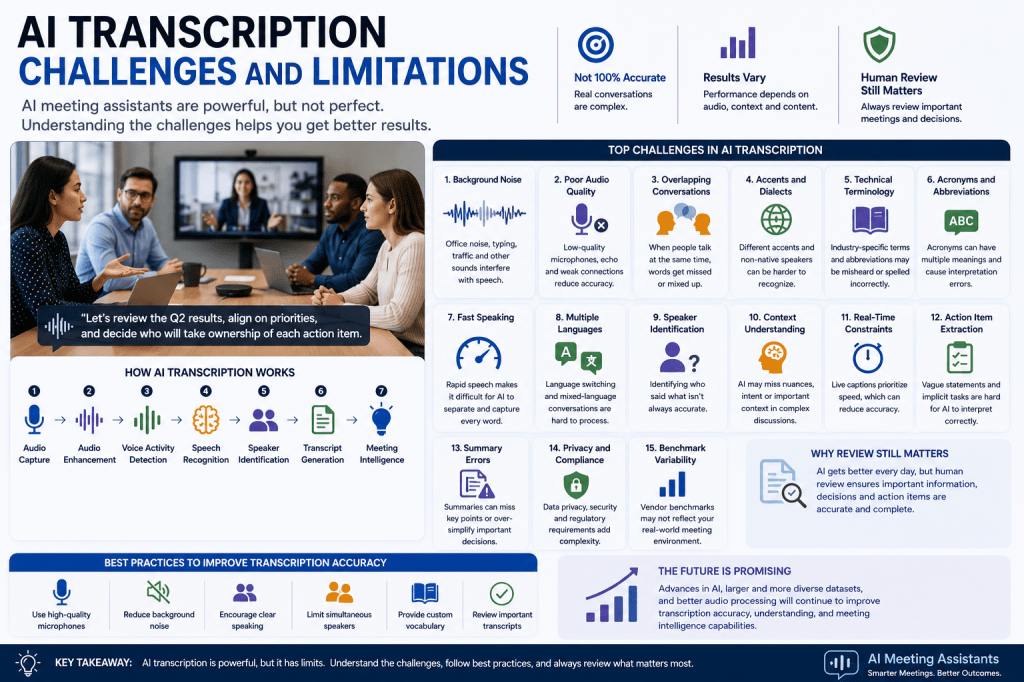
Most AI meeting assistants follow a workflow that includes:
- Audio capture
- Audio enhancement
- Voice activity detection
- Speech recognition
- Speaker identification
- Language processing
- Transcript generation
- Meeting intelligence analysis
Errors can occur at any stage of this pipeline, and those errors may affect downstream features such as summaries and action item extraction.
Challenge 1: Background Noise
One of the biggest obstacles to transcription accuracy is background noise.
Examples include:
- Office conversations
- Keyboard typing
- HVAC systems
- Traffic sounds
- Construction noise
- Café environments
- Household distractions
Although modern AI meeting assistants use advanced noise cancellation technologies, excessive background noise can still interfere with speech recognition models.
When speech becomes difficult to distinguish from surrounding sounds, transcription accuracy often declines.
Challenge 2: Poor Audio Quality
Audio quality remains one of the strongest predictors of transcription performance.
Common issues include:
- Low-quality microphones
- Weak internet connections
- Audio compression artifacts
- Distorted recordings
- Echo and reverberation
- Inconsistent speaker volume
Even highly advanced AI models struggle when the source audio is poor.
The principle remains simple:
Better audio produces better transcripts.
Challenge 3: Overlapping Conversations
Human conversations rarely occur in a perfectly organized sequence.
Meeting participants frequently:
- Interrupt one another
- Speak simultaneously
- Finish each other’s sentences
- Engage in side conversations
Overlapping speech remains one of the most difficult problems in speech recognition.
Even modern speaker diarization systems may struggle to determine:
- Who is speaking
- When speaker transitions occur
- Which words belong to which speaker
This can lead to attribution errors and incomplete transcripts.
Challenge 4: Accents and Dialects
Global organizations often involve participants with diverse speech patterns.
Examples include:
- Regional accents
- Non-native speakers
- Local dialects
- Unique pronunciation styles
Although AI models have improved significantly in accent recognition, performance can still vary depending on:
- Training data diversity
- Accent prevalence
- Language complexity
Some accents remain underrepresented in training datasets, leading to higher transcription error rates.
Challenge 5: Technical Terminology
Many meetings involve specialized vocabulary.
Examples include:
Healthcare
- Drug names
- Medical procedures
- Clinical terminology
Engineering
- Technical acronyms
- Product names
- Software frameworks
Legal
- Regulatory terminology
- Contract language
- Legal references
Finance
- Investment products
- Accounting terminology
- Compliance language
When AI models encounter unfamiliar words, they may substitute similar-sounding terms that completely change the meaning of a conversation.
Challenge 6: Acronyms and Abbreviations
Business meetings frequently contain acronyms.
Examples include:
- KPI
- OKR
- CRM
- API
- SLA
- ROI
The same acronym can have different meanings across industries.
Without sufficient context, AI systems may:
- Misinterpret acronyms
- Spell them incorrectly
- Expand them inaccurately
This challenge becomes more noticeable in highly specialized environments.
Challenge 7: Fast Speaking Rates
Some speakers naturally communicate very quickly.
Rapid speech creates several difficulties:
- Reduced word separation
- Less distinct pronunciation
- Increased overlap between sounds
- More frequent recognition errors
Fast-paced discussions often generate higher Word Error Rates than slower conversations.
Challenge 8: Multiple Languages
Many modern workplaces operate internationally.
Meetings may include:
- Multiple languages
- Language switching
- Mixed-language discussions
- Code-switching within sentences
Although multilingual AI systems have improved considerably, language transitions remain challenging.
The AI must first identify the language before applying the appropriate speech recognition model.
Frequent switching can introduce transcription errors.
Challenge 9: Speaker Identification Errors
Most AI meeting assistants attempt to identify individual speakers.
This process, known as speaker diarization, remains imperfect.
Common issues include:
- Incorrect speaker labels
- Missed speaker transitions
- Merged speakers
- Fragmented speaker identities
These errors can affect:
- Meeting summaries
- Accountability tracking
- Action item assignment
- Search functionality
Speaker identification is often one of the most difficult components of meeting intelligence systems.
Challenge 10: Context Understanding
Speech recognition systems primarily focus on converting audio into text.
Understanding the meaning behind conversations is a separate challenge.
Consider the sentence:
“Let’s move forward with the launch.”
Without context, AI may not know:
- Which product is being discussed
- Which team is responsible
- What timeline applies
Large language models improve contextual understanding, but ambiguity remains a significant challenge.
Challenge 11: Real-Time Transcription Constraints
Live captions require immediate processing.
To achieve near-instant results, AI systems must make decisions quickly.
This creates tradeoffs between:
- Speed
- Accuracy
- Context analysis
Real-time captions are often slightly less accurate than finalized post-meeting transcripts because there is less opportunity for correction and refinement.
Challenge 12: Action Item Extraction Limitations
Many AI meeting assistants automatically generate action items.
However, human conversations often contain vague commitments such as:
- “I’ll look into that.”
- “We should revisit this later.”
- “Someone needs to handle this.”
Determining:
- Who owns the task
- What exactly must be done
- When it is due
requires contextual reasoning that AI may not always perform perfectly.
Challenge 13: Summary Generation Errors
Modern AI meeting assistants frequently generate meeting summaries.
Although summaries save time, they introduce additional risks.
Potential issues include:
- Missing important details
- Overemphasizing minor topics
- Misinterpreting decisions
- Omitting action items
- Generating inaccurate conclusions
Since summaries are built on transcripts, transcription errors can propagate into the final output.
Challenge 14: Privacy and Compliance Concerns
Not all transcription challenges are technical.
Organizations must also address:
- Data privacy
- Regulatory compliance
- Data retention policies
- Security controls
- Sensitive information handling
Industries such as healthcare, finance, and legal services often require additional safeguards when using AI meeting assistants.
Challenge 15: Benchmark Variability
Transcription accuracy claims often depend on testing conditions.
Vendor benchmarks may not reflect:
- Your meeting environment
- Your participants
- Your terminology
- Your audio quality
Performance can vary significantly across organizations.
This is why pilot testing remains essential before large-scale deployment.
Best Practices for Improving AI Transcription Accuracy
Organizations can significantly improve results by following several best practices.
Use High-Quality Microphones
Better audio capture leads to better transcription.
Reduce Background Noise
Quiet environments improve speech recognition performance.
Encourage Clear Speaking
Clear pronunciation benefits both human listeners and AI systems.
Limit Simultaneous Speakers
Reducing overlap improves speaker attribution and transcript quality.
Provide Custom Vocabulary
Some platforms allow organizations to add:
- Product names
- Customer names
- Industry terminology
Review Critical Transcripts
Important meetings should still receive human review when accuracy is essential.
The Future of AI Transcription
Despite current limitations, transcription technology continues to improve rapidly.
Future AI meeting assistants are expected to deliver:
- Better speaker separation
- Lower Word Error Rates
- Improved accent recognition
- Stronger multilingual support
- Enhanced context understanding
- More accurate summaries
- Real-time meeting intelligence
Large language models, multimodal AI, and improved audio processing technologies are helping close many of today’s performance gaps.
Conclusion
AI transcription has become one of the most valuable capabilities within modern AI meeting assistants, but it still faces significant challenges. Background noise, poor audio quality, overlapping speech, accents, technical terminology, multilingual conversations, speaker identification, and contextual understanding all influence transcription performance. While today’s systems are remarkably capable, organizations should recognize that AI-generated transcripts, summaries, and action items are not infallible. By understanding these limitations and following best practices, teams can maximize transcription accuracy and unlock greater value from AI-powered meeting intelligence.