
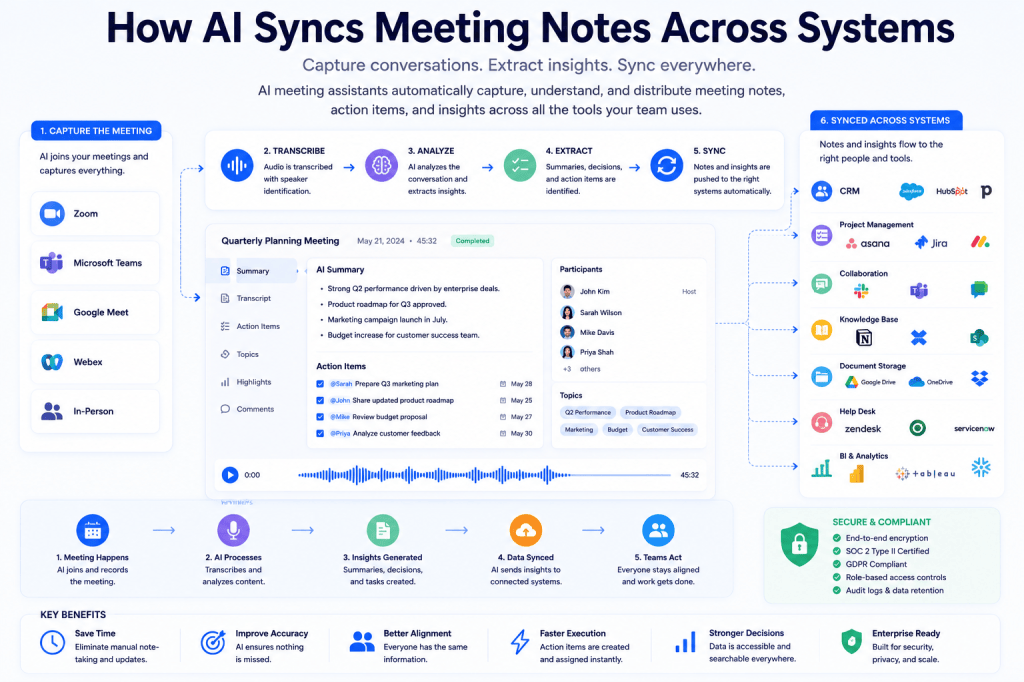
One of the most valuable features of modern AI meeting assistants is their ability to automatically generate meeting summaries. Instead of manually reviewing lengthy transcripts or listening to recordings, teams can receive concise overviews of key discussions, decisions, action items, and outcomes within minutes of a meeting ending.
While AI-generated summaries may appear simple on the surface, they are powered by a sophisticated combination of speech recognition, natural language processing, machine learning, and large language models. These technologies work together to transform hours of conversation into structured, actionable insights.
Understanding how AI generates meeting summaries helps organizations better evaluate AI meeting assistants and maximize the value of their meeting intelligence platforms.
What Is an AI Meeting Summary?
An AI meeting summary is a condensed version of a meeting that highlights the most important information discussed during a conversation.
Depending on the platform, summaries may include:
- Key discussion points
- Major decisions
- Action items
- Follow-up tasks
- Project updates
- Questions raised
- Risks and concerns
- Participant contributions
The goal is to help participants quickly understand what happened without reviewing the entire meeting transcript.
Why Meeting Summaries Matter
Modern organizations spend countless hours in meetings every week.
Without summaries, teams often face challenges such as:
- Information overload
- Missed action items
- Forgotten decisions
- Poor follow-up
- Limited visibility for absent participants
AI-generated summaries solve these problems by making meeting information easier to consume and act upon.
Benefits include:
- Improved productivity
- Better collaboration
- Faster decision-making
- Enhanced accountability
- Stronger knowledge management
Step 1: Audio Capture
The summary generation process begins with audio capture.
AI meeting assistants record conversations from:
- Video conferences
- Phone calls
- In-person meetings
- Hybrid meetings
The system collects raw audio data that serves as the foundation for all subsequent processing.
Audio quality plays a critical role in determining the accuracy of summaries.
Poor audio often leads to transcription errors that affect downstream analysis.
Step 2: Audio Enhancement
Before speech recognition begins, most AI meeting assistants improve audio quality.
Common enhancement techniques include:
Noise Cancellation
Removes background sounds such as:
- Keyboard typing
- Traffic noise
- Office chatter
Echo Reduction
Eliminates reverberation and feedback.
Voice Isolation
Separates human speech from environmental sounds.
Volume Normalization
Balances speaker volume levels.
These improvements help create cleaner audio for transcription.
Step 3: Speech Recognition (ASR)
Once the audio has been enhanced, the system converts speech into text using Automatic Speech Recognition (ASR).
ASR models analyze:
- Speech patterns
- Pronunciation
- Language structures
- Acoustic signals
The result is a complete transcript of the meeting.
For example:
Spoken conversation:
“Let’s move the product launch to October and schedule a customer webinar.”
Transcription output:
“Let’s move the product launch to October and schedule a customer webinar.”
This transcript becomes the primary input for summary generation.
Step 4: Speaker Identification
Most meetings involve multiple participants.
AI meeting assistants use speaker diarization technology to determine:
- Who is speaking
- When speakers change
- Which comments belong to which participant
A transcript may become:
Sarah: Let’s move the product launch to October.
Michael: I’ll update the project timeline.
Emily: I’ll coordinate the webinar planning.
Speaker identification helps AI understand responsibilities and commitments during discussions.
Step 5: Natural Language Processing (NLP)
After transcription is complete, Natural Language Processing analyzes the conversation.
NLP systems examine:
- Sentence structure
- Keywords
- Topics
- Relationships between statements
- Intent and meaning
The AI begins identifying information that is likely to be important.
Examples include:
- Decisions
- Tasks
- Deadlines
- Questions
- Concerns
- Recommendations
This stage transforms raw text into structured information.
Step 6: Topic Detection
Meetings often cover multiple subjects.
AI systems automatically group related discussions into topics.
For example:
Product Launch
- Launch timing
- Marketing strategy
- Customer communications
Budget Planning
- Spending approvals
- Forecast updates
- Resource allocation
Hiring Plans
- Open positions
- Recruiting timelines
- Candidate evaluations
Topic detection helps summaries remain organized and easy to understand.
Step 7: Identifying Key Discussion Points
Not every sentence deserves inclusion in a summary.
AI systems must determine which information is most important.
Large language models evaluate:
- Frequency of discussion
- Participant emphasis
- Relevance to objectives
- Relationship to decisions
- Business impact
The AI prioritizes meaningful content while filtering routine conversation.
For example:
This statement may be excluded:
“Can everyone see my screen?”
This statement is likely included:
“The team approved the October launch date.”
Step 8: Decision Detection
One of the most valuable meeting intelligence capabilities is decision tracking.
AI systems identify phrases such as:
- “We agreed to…”
- “The team approved…”
- “Let’s proceed with…”
- “We’ve decided to…”
The summary may generate:
Decision:
The product launch has been moved to October.
Capturing decisions helps create organizational accountability.
Step 9: Action Item Extraction
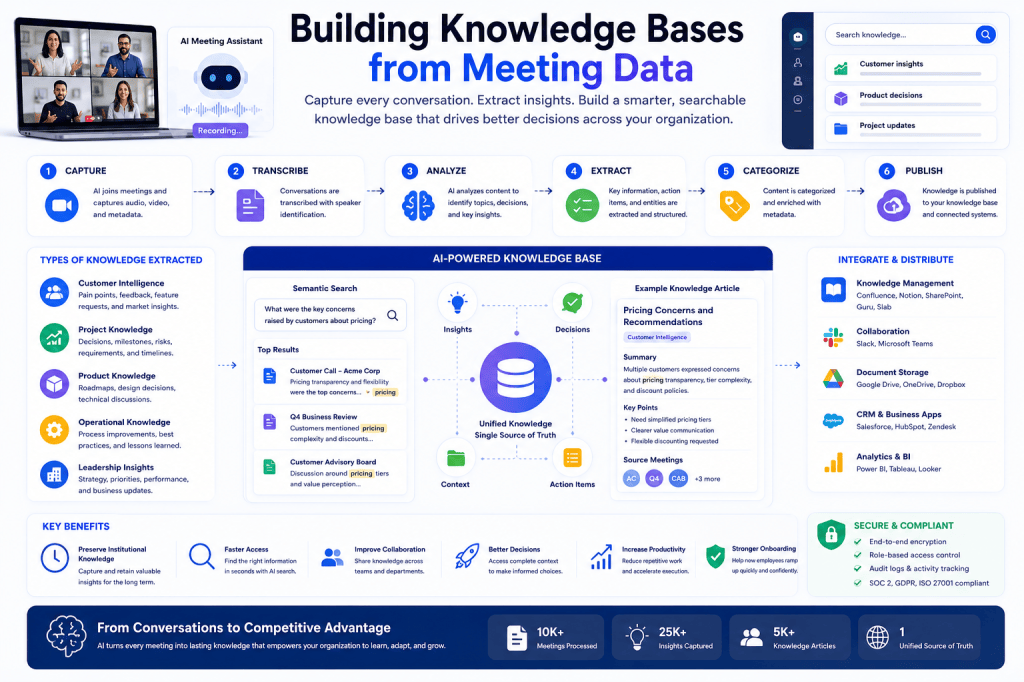
Modern AI meeting assistants automatically detect tasks and responsibilities.
Examples:
Conversation:
“Michael will update the roadmap by Friday.”
Summary output:
Action Item:
Michael to update the roadmap by Friday.
The AI identifies:
- Task owner
- Required action
- Due date (if mentioned)
Action item extraction is often one of the most valuable outputs of meeting summaries.
Step 10: Large Language Model Summarization
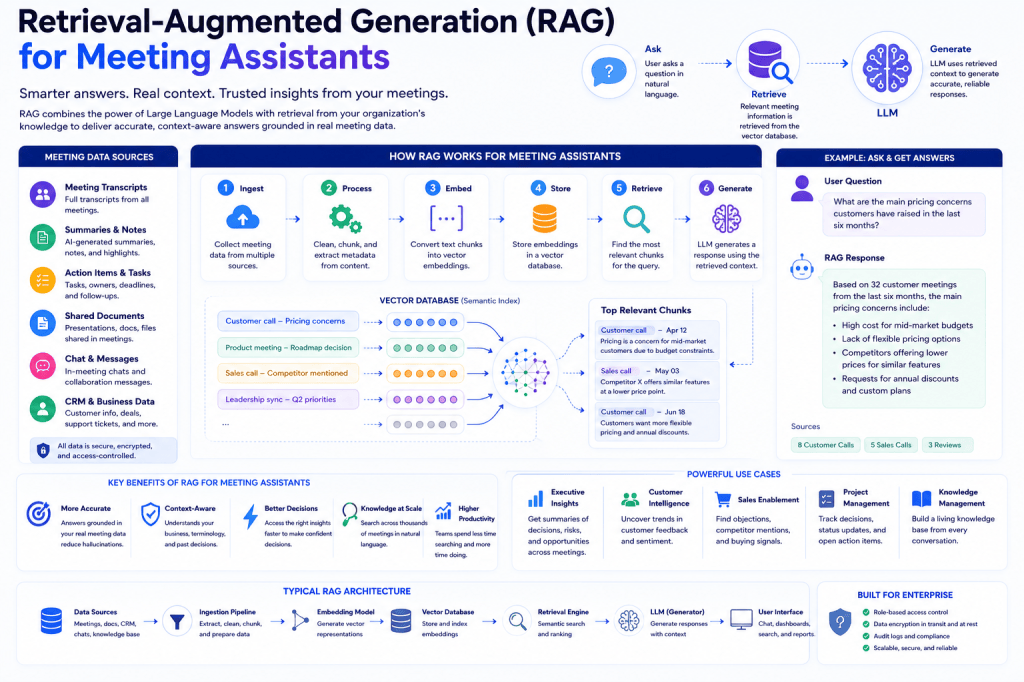
After identifying important information, large language models generate a concise summary.
LLMs analyze:
- Context
- Topics
- Decisions
- Action items
- Participant contributions
The model creates human-readable summaries that may include:
Executive Summary
A high-level overview.
Key Takeaways
Important discussion points.
Decisions Made
Documented outcomes.
Action Items
Assigned responsibilities.
Risks and Issues
Potential concerns raised during the meeting.
This step transforms structured data into a coherent narrative.
Step 11: Formatting and Presentation
The final summary is organized into a user-friendly format.
Common sections include:
Meeting Overview
Purpose and context.
Topics Discussed
Major conversation themes.
Decisions
Approved actions and outcomes.
Action Items
Tasks and owners.
Follow-Up Requirements
Next steps and future meetings.
Well-structured summaries improve readability and adoption.
Extractive vs Abstractive Summarization
AI meeting assistants typically use one of two summarization approaches.
Extractive Summarization
The AI selects important sentences directly from the transcript.
Advantages:
- High factual accuracy
- Less interpretation
Disadvantages:
- Can feel repetitive
- Less concise
Abstractive Summarization
The AI rewrites information into new sentences.
Advantages:
- More readable
- More concise
- More human-like
Disadvantages:
- Greater risk of inaccuracies
Most modern AI meeting assistants use a combination of both techniques.
Challenges in AI Meeting Summaries
Although summary generation has improved dramatically, challenges remain.
Transcription Errors
Incorrect transcripts can create inaccurate summaries.
Ambiguous Discussions
Not all decisions are stated clearly.
Context Limitations
AI may miss organizational nuances.
Overlapping Speech
Multiple speakers talking simultaneously can complicate analysis.
Industry-Specific Terminology
Specialized vocabulary may be misunderstood.
These challenges continue to drive research and innovation.
The Future of AI Meeting Summaries
Future AI meeting assistants are expected to generate increasingly sophisticated summaries.
Emerging capabilities include:
- Real-time summaries during meetings
- Personalized summaries for different roles
- Multilingual summaries
- Decision tracking across multiple meetings
- Long-term organizational memory
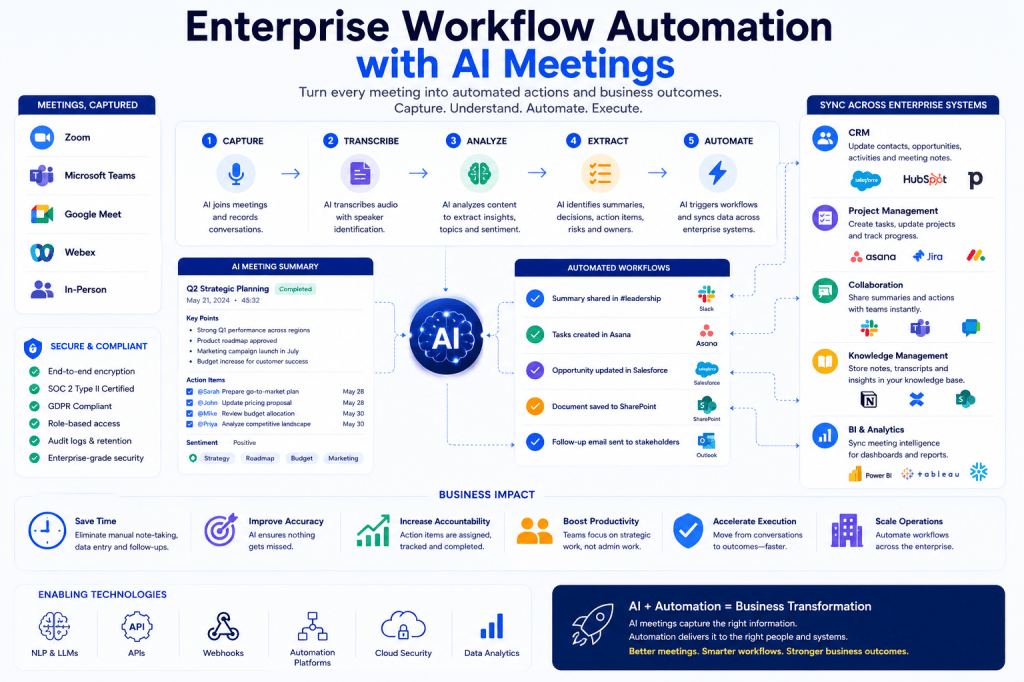
- Automated workflow integration
- Predictive recommendations
Meeting summaries will evolve from simple documentation tools into intelligent business assistants.
Conclusion
AI meeting summaries are generated through a complex pipeline involving audio capture, speech recognition, speaker identification, natural language processing, topic detection, decision tracking, action item extraction, and large language model summarization. These technologies allow AI meeting assistants to transform lengthy conversations into concise, actionable insights that improve productivity, collaboration, and knowledge management. As artificial intelligence continues to advance, meeting summaries will become more accurate, personalized, and deeply integrated into organizational workflows, making them one of the most valuable capabilities of modern meeting intelligence platforms.

 Meeting Notes AI