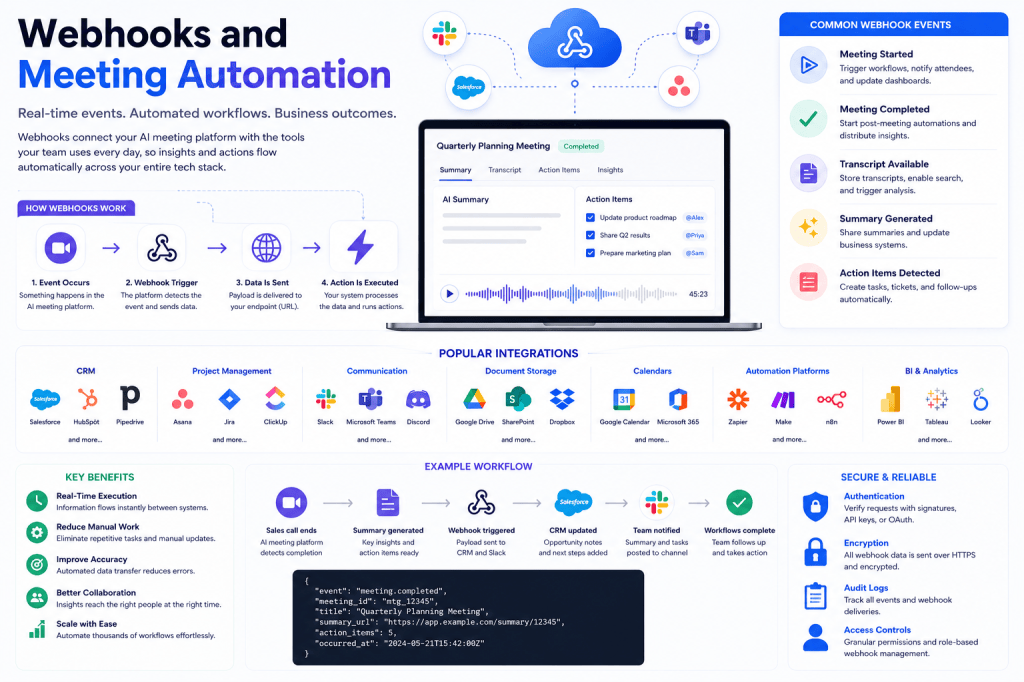
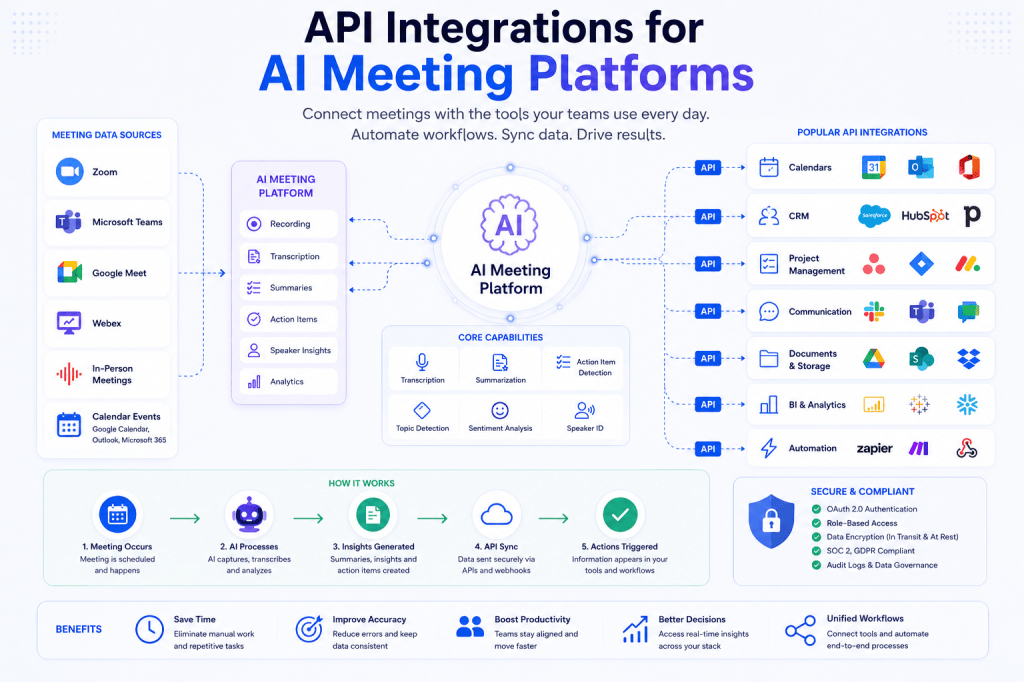
One of the most valuable capabilities of modern AI meeting assistants is their ability to automatically generate meeting summaries. These summaries help teams quickly understand key discussions, decisions, action items, and outcomes without reviewing lengthy transcripts.
Behind every AI-generated summary lies a summarization technique that determines how information is selected and presented. The two primary approaches used in artificial intelligence are extractive summarization and abstractive summarization.
Understanding the differences between these methods helps organizations evaluate AI meeting assistants more effectively and understand how meeting summaries are generated.
What Is AI Summarization?
AI summarization is the process of automatically condensing large amounts of information into shorter, easier-to-read content while preserving the most important meaning.
In AI meeting assistants, summarization transforms:
- Meeting transcripts
- Recorded conversations
- Team discussions
- Project updates
into concise summaries that save time and improve productivity.
Most modern meeting assistants rely on either extractive summarization, abstractive summarization, or a hybrid combination of both.
Why Summarization Matters in Meetings
Organizations generate enormous volumes of conversational data every day.
Without summarization, teams often struggle with:
- Reviewing long transcripts
- Remembering decisions
- Tracking action items
- Sharing meeting outcomes
- Preserving organizational knowledge
AI-generated summaries help solve these challenges by presenting only the most relevant information.
What Is Extractive Summarization?
Extractive summarization creates summaries by selecting and combining important sentences directly from the original transcript.
The AI does not create new sentences.
Instead, it identifies existing statements that appear most relevant and includes them in the summary.
Example
Original conversation:
Sarah: The product launch will move to October due to testing delays.
Michael: The engineering team needs two additional weeks.
Emily: Marketing materials will be updated before launch.
Extractive summary:
The product launch will move to October due to testing delays.
The engineering team needs two additional weeks.
Marketing materials will be updated before launch.
The selected sentences come directly from the original transcript without modification.
How Extractive Summarization Works
Extractive systems analyze transcripts using techniques such as:
Keyword Analysis
Frequently discussed topics receive higher importance scores.
Sentence Ranking
The AI scores sentences based on relevance and significance.
Topic Detection
Sentences associated with major discussion themes are prioritized.
Statistical Methods
Algorithms identify information that appears most representative of the conversation.
More advanced systems may also use machine learning models to improve sentence selection.
Advantages of Extractive Summarization
High Accuracy
Because the AI uses original sentences, there is less risk of introducing incorrect information.
Easier Verification
Users can easily compare extracted sentences against the transcript.
Lower Hallucination Risk
The AI does not invent new content.
Regulatory Benefits
Industries requiring precise documentation often prefer extractive approaches because they preserve original wording.
Limitations of Extractive Summarization
Less Readable
Selected sentences may feel disconnected or repetitive.
Limited Conciseness
Important ideas may require multiple sentences to explain.
Poor Flow
Extracted content may not read like a naturally written summary.
Redundant Information
Different sentences may repeat similar concepts.
These limitations can make summaries longer than necessary.
What Is Abstractive Summarization?
Abstractive summarization generates entirely new sentences that describe the meaning of a conversation.
Instead of copying existing text, the AI interprets the discussion and rewrites it in a concise format.
This approach resembles how humans summarize meetings.
Example
Original conversation:
Sarah: The product launch will move to October due to testing delays.
Michael: The engineering team needs two additional weeks.
Emily: Marketing materials will be updated before launch.
Abstractive summary:
The team agreed to postpone the product launch until October to allow additional testing and marketing preparation.
The summary conveys the same meaning without directly copying the original statements.
How Abstractive Summarization Works
Modern abstractive summarization relies heavily on:
Natural Language Processing (NLP)
Understanding sentence meaning and relationships.
Large Language Models (LLMs)
Generating coherent human-like summaries.
Context Analysis
Understanding the overall discussion rather than isolated sentences.
Semantic Understanding
Identifying the meaning behind conversations.
The AI effectively rewrites the meeting in a shorter and more understandable format.
Advantages of Abstractive Summarization
More Human-Like
Summaries often read as though written by a person.
Greater Conciseness
Complex discussions can be condensed significantly.
Better Organization
Related information can be combined into cohesive narratives.
Improved Readability
Summaries are easier for busy professionals to consume quickly.
These benefits make abstractive summarization highly attractive for workplace productivity.
Limitations of Abstractive Summarization
Hallucination Risk
The AI may generate information not explicitly stated during the meeting.
Interpretation Errors
Important nuances may be misunderstood.
Missing Context
Some details may be omitted unintentionally.
Verification Challenges
Generated summaries can be harder to trace back to specific transcript sections.
These risks require careful quality control, particularly for critical meetings.
Extractive vs Abstractive Summarization: Side-by-Side Comparison
| Feature | Extractive Summarization | Abstractive Summarization |
|---|---|---|
| Uses Original Sentences | Yes | No |
| Creates New Text | No | Yes |
| Readability | Moderate | High |
| Conciseness | Moderate | High |
| Hallucination Risk | Very Low | Higher |
| Human-Like Writing | Limited | Excellent |
| Regulatory Compliance | Strong | Moderate |
| Context Understanding | Limited | Advanced |
| Meeting Intelligence | Basic | Advanced |
Both approaches offer unique advantages depending on organizational needs.
Which Method Do AI Meeting Assistants Use?
Early meeting transcription platforms primarily relied on extractive summarization.
Modern AI meeting assistants increasingly use abstractive summarization powered by large language models.
Examples of summary sections generated through abstractive techniques include:
Executive Summaries
High-level meeting overviews.
Key Takeaways
Most important discussion points.
Decisions Made
Documented outcomes and agreements.
Action Items
Assigned tasks and responsibilities.
Risks and Concerns
Potential issues identified during discussions.
These outputs often require contextual understanding that extractive methods alone cannot provide.
Hybrid Summarization: The Best of Both Worlds
Many leading AI meeting assistants now use hybrid approaches.
A typical workflow might include:
- Generate a transcript.
- Identify important transcript segments.
- Extract key information.
- Use large language models to rewrite the content.
- Generate concise summaries.
- Link summaries back to transcript evidence.
This approach combines:
- The accuracy of extractive methods
- The readability of abstractive methods
Hybrid summarization is becoming the industry standard for meeting intelligence platforms.
Why Large Language Models Changed Summarization
The emergence of large language models dramatically improved abstractive summarization.
LLMs can:
- Understand context
- Recognize relationships
- Detect decisions
- Identify action items
- Generate coherent narratives
As a result, modern AI meeting assistants produce summaries that are significantly more useful than earlier generations of transcription software.
The Future of AI Meeting Summaries
Future summarization systems are expected to become even more sophisticated.
Emerging capabilities include:
Personalized Summaries
Different summaries for executives, project managers, and contributors.
Real-Time Summaries
Live updates during meetings.
Cross-Meeting Intelligence
Connecting insights across multiple meetings.
Predictive Recommendations
Suggesting next steps automatically.
Multilingual Summaries
Generating summaries in multiple languages simultaneously.
These developments will further enhance workplace productivity and collaboration.
Conclusion
Extractive and abstractive summarization represent two fundamental approaches used by AI meeting assistants to transform conversations into actionable insights. Extractive summarization focuses on selecting important sentences directly from transcripts, offering strong accuracy and traceability. Abstractive summarization uses artificial intelligence and large language models to rewrite information into concise, human-like summaries that are easier to consume. While each approach has advantages and limitations, modern AI meeting assistants increasingly rely on hybrid methods that combine the strengths of both. As meeting intelligence technology continues to evolve, summarization will become more accurate, contextual, personalized, and valuable for organizations worldwide.