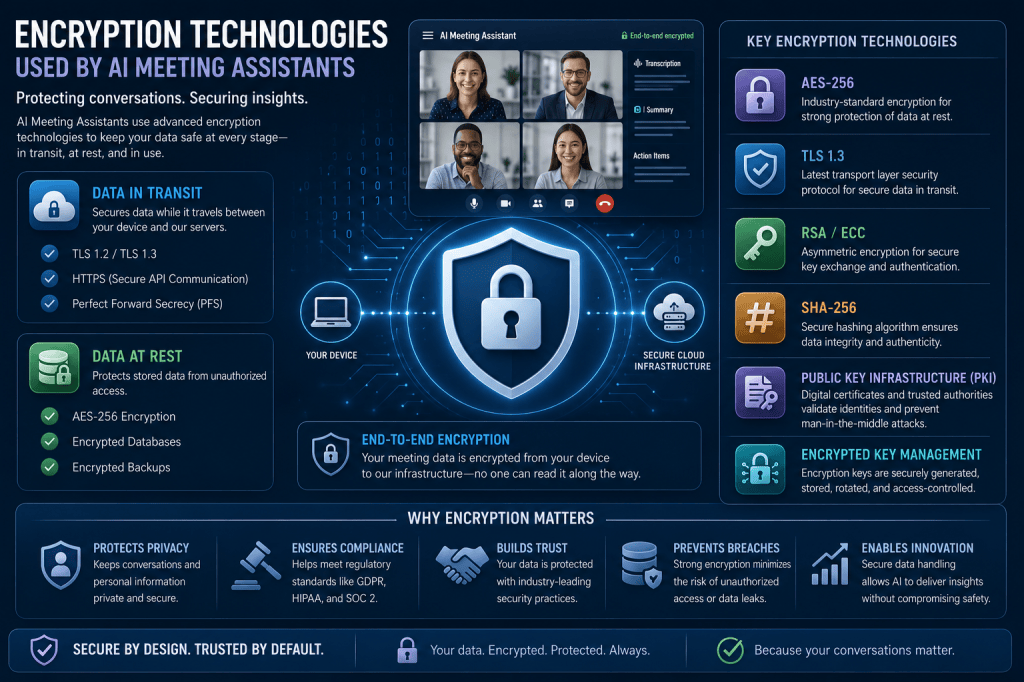
As AI Meeting Assistants become a standard part of modern workplaces, organizations are increasingly relying on them to record conversations, generate transcripts, create summaries, extract action items, and provide meeting intelligence. While these capabilities improve productivity, they also raise an important question: how is all of this sensitive meeting data protected?
Encryption is one of the most important security technologies used by AI Meeting Assistants. It helps ensure that recordings, transcripts, summaries, and analytics remain protected from unauthorized access throughout their lifecycle.
In this article, we’ll explore the encryption technologies commonly used by AI Meeting Assistants and why they are critical for protecting business conversations.
Why Encryption Matters
Meetings often contain highly sensitive information, including:
- Financial forecasts
- Customer information
- Product roadmaps
- Strategic discussions
- Employee reviews
- Legal matters
- Intellectual property
Without encryption, this information could potentially be exposed during transmission, storage, or processing.
Encryption converts readable information into encoded data that can only be accessed by authorized parties possessing the correct cryptographic keys.
For AI Meeting Assistants, encryption serves as a foundational layer of security.
The Three Stages of Meeting Data Protection
Meeting data typically exists in three states:
- Data in Transit
- Data at Rest
- Data in Processing
Each stage requires different protection mechanisms.
Data in Transit
This refers to information moving between:
- User devices
- Meeting platforms
- AI processing services
- Cloud storage systems
Examples include:
- Audio streams
- Video streams
- Transcript uploads
- API communications
Data at Rest
This refers to stored information such as:
- Meeting recordings
- Audio files
- Video files
- Transcripts
- Summaries
- Analytics data
Data in Processing
This refers to information actively being analyzed by:
- Speech recognition systems
- Natural language processing engines
- Large language models
- Analytics systems
Modern AI Meeting Assistants implement encryption strategies for each stage.
TLS Encryption (Transport Layer Security)
The most common encryption technology used for protecting data in transit is TLS.
TLS secures communication between systems and prevents attackers from:
- Intercepting data
- Reading transmitted information
- Modifying content during transfer
- Impersonating trusted systems
When users access an AI Meeting Assistant through a web browser, TLS is responsible for securing the connection.
Common uses include:
- User logins
- File uploads
- Transcript retrieval
- Dashboard access
- API communications
Most modern platforms use TLS 1.2 or TLS 1.3.
TLS 1.3 offers:
- Faster connection establishment
- Improved security
- Stronger cryptographic algorithms
- Reduced vulnerability to attacks
Today, TLS serves as the standard encryption protocol for internet communications.
AES-256 Encryption
For stored data, AES-256 is one of the most widely used encryption standards.
AES stands for Advanced Encryption Standard.
The “256” refers to the size of the encryption key.
AES-256 is used to protect:
- Audio recordings
- Video recordings
- Meeting transcripts
- AI-generated summaries
- User account data
- Analytics databases
AES-256 is trusted by:
- Governments
- Financial institutions
- Healthcare organizations
- Cloud providers
Because of its strength and efficiency, AES-256 has become the industry standard for data-at-rest encryption.
End-to-End Encryption (E2EE)
Some meeting platforms offer End-to-End Encryption.
With E2EE:
- Data is encrypted on the sender’s device.
- Data remains encrypted while traveling across networks.
- Data is decrypted only on authorized recipient devices.
Even service providers cannot view the content.
Benefits include:
- Maximum privacy
- Reduced insider risk
- Strong protection against interception
However, implementing E2EE within AI Meeting Assistants can be challenging.
AI systems often need access to content in order to:
- Generate transcripts
- Create summaries
- Extract action items
Because of this requirement, many AI Meeting Assistants use strong transport and storage encryption rather than full end-to-end encryption.
Public Key Infrastructure (PKI)
TLS relies heavily on Public Key Infrastructure.
PKI uses two keys:
Public Key
Used to encrypt data.
Private Key
Used to decrypt data.
PKI helps verify:
- Server identity
- Service authenticity
- Secure communication channels
Without PKI, users would have no reliable way to verify they are connecting to legitimate services.
PKI forms the backbone of secure internet communication.
Encryption Key Management
Encryption is only as strong as the protection of its keys.
Modern AI Meeting Assistants use dedicated key management systems.
Common solutions include:
- AWS Key Management Service (KMS)
- Azure Key Vault
- Google Cloud Key Management
- Hardware Security Modules (HSMs)
These systems provide:
- Key rotation
- Access controls
- Audit logging
- Secure storage
Strong key management significantly reduces security risks.
Envelope Encryption
Many cloud platforms use envelope encryption.
This approach uses two layers of encryption:
Data Encryption Key (DEK)
Encrypts the actual meeting data.
Key Encryption Key (KEK)
Encrypts the DEK itself.
Benefits include:
- Improved scalability
- Better performance
- Simplified key rotation
- Enhanced security
Envelope encryption is commonly used by major cloud providers.
Database Encryption
Meeting intelligence platforms often store data in databases.
Database encryption protects:
- User accounts
- Meeting metadata
- Action items
- Analytics records
- Search indexes
Techniques include:
Transparent Data Encryption (TDE)
Encrypts database files automatically.
Column-Level Encryption
Encrypts specific sensitive fields.
Field-Level Encryption
Protects highly confidential data elements.
Database encryption adds another layer of defense against unauthorized access.
Object Storage Encryption
Meeting recordings are frequently stored in cloud object storage systems.
Examples include:
- Amazon S3
- Azure Blob Storage
- Google Cloud Storage
Object storage encryption protects:
- Audio recordings
- Video files
- Attachments
- Exported reports
Most cloud providers support:
- Server-side encryption
- Customer-managed encryption keys
- Automatic encryption policies
Confidential Computing
A newer technology gaining attention is confidential computing.
Traditional encryption protects data:
- In transit
- At rest
Confidential computing protects data while it is being processed.
This is accomplished through:
- Trusted Execution Environments (TEEs)
- Secure enclaves
- Hardware-based isolation
Benefits include:
- Reduced insider risk
- Protection during AI processing
- Stronger privacy guarantees
Confidential computing may play a major role in the future of AI-powered meeting intelligence.
Homomorphic Encryption
Homomorphic encryption allows computations to be performed on encrypted data without decrypting it first.
Potential applications include:
- Privacy-preserving analytics
- Secure AI processing
- Confidential data analysis
Although computationally expensive today, homomorphic encryption represents an exciting future direction for AI security.
Tokenization and Data Masking
Many AI Meeting Assistants combine encryption with additional privacy controls.
Tokenization
Sensitive values are replaced with non-sensitive tokens.
Example:
Customer Account Number: 123456789Becomes:Customer Account Number: TOKEN-XYZ
Data Masking
Sensitive information is partially hidden.
Example:
Credit Card: **** **** **** 1234
These techniques reduce exposure of sensitive information even when data is accessed by authorized systems.
Encryption and Compliance
Strong encryption helps organizations comply with regulations such as:
GDPR
Protects personal information within the European Union.
HIPAA
Protects healthcare-related information.
SOC 2
Evaluates organizational security controls.
ISO 27001
Defines information security management best practices.
Encryption is often a key requirement within these frameworks.
Future Encryption Trends
Several emerging technologies are shaping the future of meeting security:
Post-Quantum Cryptography
Designed to resist attacks from future quantum computers.
Confidential AI
Combines encryption and AI processing in protected environments.
Customer-Controlled Keys
Allows organizations to manage their own encryption keys.
Zero Trust Architectures
Applies continuous verification to all users and devices.
As AI Meeting Assistants become more deeply integrated into business workflows, encryption technologies will continue evolving to address new threats and privacy requirements.
Conclusion
Encryption is one of the most important security foundations of modern AI Meeting Assistants. Technologies such as TLS, AES-256, PKI, envelope encryption, database encryption, object storage encryption, and emerging approaches like confidential computing work together to protect meeting data throughout its lifecycle.
Organizations evaluating AI Meeting Assistants should understand not only the productivity benefits these platforms offer but also the encryption technologies used to secure recordings, transcripts, summaries, and meeting intelligence data.
The future of AI-powered collaboration depends not only on intelligent insights but also on maintaining trust, privacy, and security through strong encryption practices.

 Meeting Notes AI