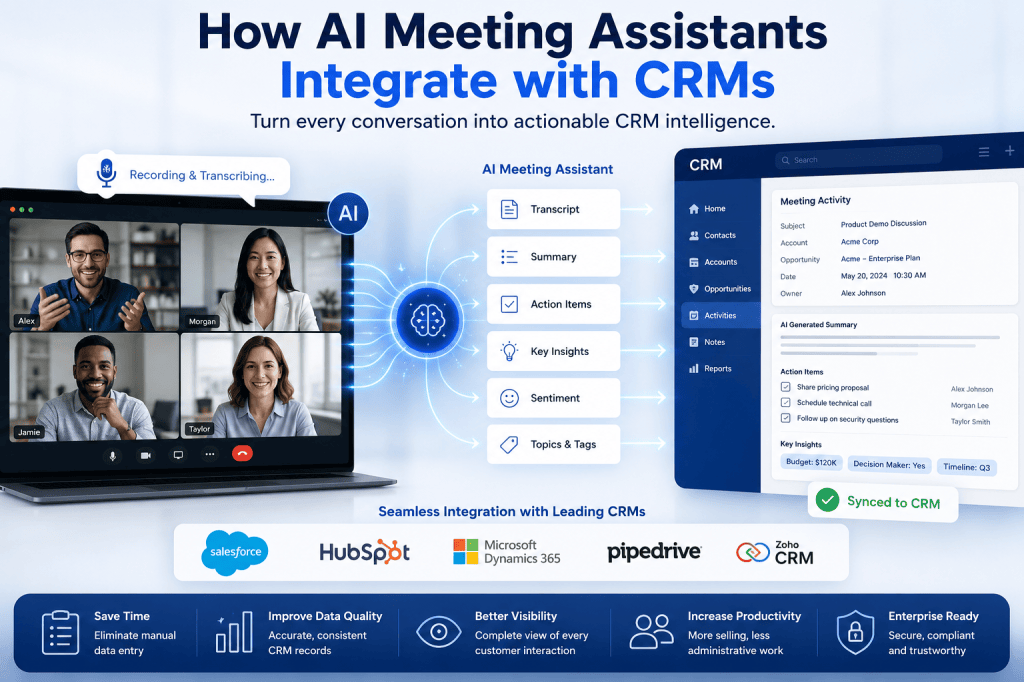
In today’s sales-driven and customer-centric business environment, conversations generate some of the most valuable data an organization possesses. Every customer call, discovery meeting, demo, onboarding session, and account review contains insights that can influence revenue, customer satisfaction, and business growth. Yet much of this information is often lost, poorly documented, or manually entered into Customer Relationship Management (CRM) systems.
AI meeting assistants are changing that reality.
By automatically capturing conversations, generating transcripts, extracting insights, and synchronizing information with CRM platforms, AI meeting assistants help organizations transform meetings into actionable business intelligence. The integration between AI meeting assistants and CRMs is becoming a critical component of modern sales, customer success, and operational workflows.
What Are AI Meeting Assistants?
AI meeting assistants are software tools that join virtual meetings, record conversations, transcribe discussions, generate summaries, identify action items, and extract key insights using artificial intelligence.
These platforms can:
- Record meetings automatically
- Generate real-time or post-meeting transcripts
- Create concise summaries
- Identify tasks and follow-ups
- Analyze customer sentiment
- Detect buying signals
- Track commitments and next steps
- Surface trends across conversations
Instead of relying on manual note-taking, teams gain a searchable and structured record of every customer interaction.
Why CRM Integration Matters
A CRM serves as the central repository for customer information, opportunities, account history, and sales activities. However, CRM adoption often suffers because data entry is time-consuming and frequently viewed as administrative work.
Sales representatives may spend hours updating records after meetings, while customer success teams struggle to document conversations accurately.
AI meeting assistants solve this challenge by automatically transferring relevant information from meetings into CRM systems.
The result is:
- More accurate customer records
- Reduced administrative workload
- Better forecasting
- Improved customer visibility
- Stronger team collaboration
- Higher CRM adoption rates
Instead of asking employees to update systems manually, information flows automatically from conversations into structured CRM records.
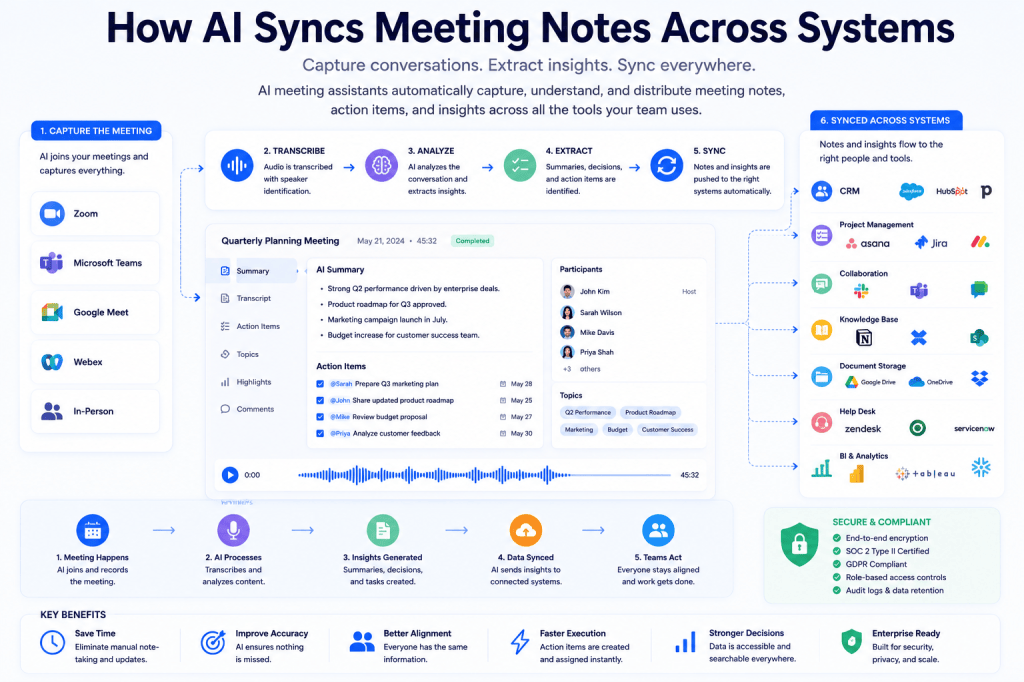
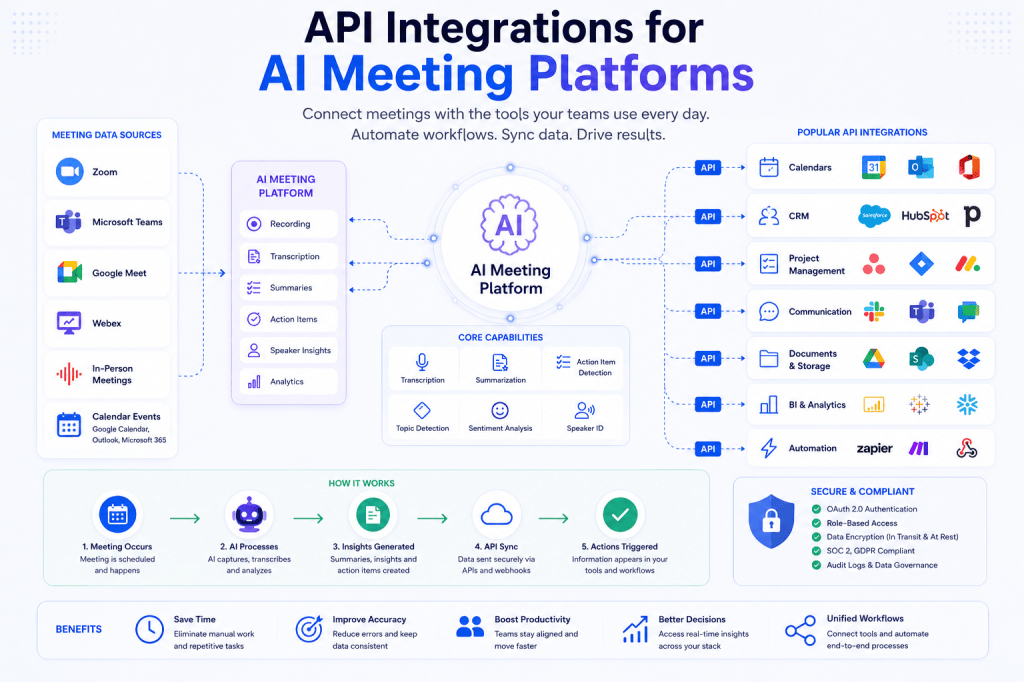
How the Integration Works
1. Meeting Capture
The process begins when an AI meeting assistant joins a meeting conducted through platforms such as Zoom, Microsoft Teams, or Google Meet.
The assistant captures:
- Audio
- Video (if enabled)
- Speaker identification
- Meeting metadata
- Chat messages
Every conversation becomes a structured source of information.
2. AI-Powered Transcription
The meeting assistant converts spoken dialogue into text using advanced speech recognition technology.
Modern systems can:
- Distinguish multiple speakers
- Recognize industry terminology
- Support multiple languages
- Timestamp conversations
- Create searchable transcripts
This transcript becomes the foundation for further analysis.
3. Insight Extraction
Natural Language Processing (NLP) models analyze the conversation to identify important business information.
Examples include:
- Customer pain points
- Product requirements
- Budget discussions
- Competitive mentions
- Decision-maker involvement
- Objections raised
- Renewal risks
- Upsell opportunities
The AI transforms unstructured conversation into structured business insights.
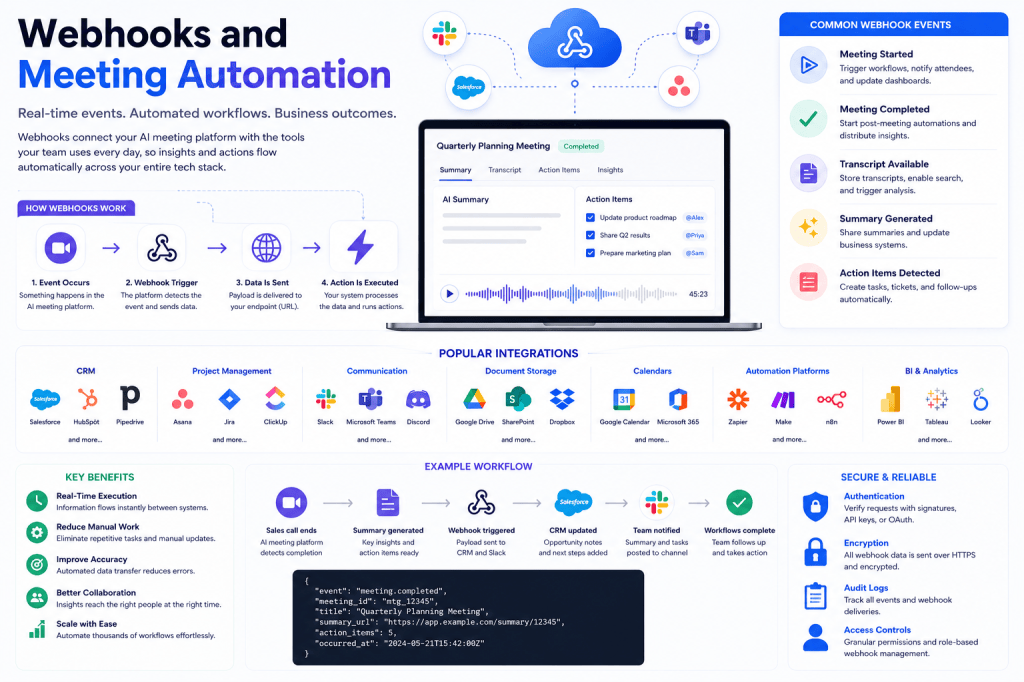
4. Automatic CRM Updates
Once insights are identified, the AI assistant maps relevant information to CRM fields.
Examples include:
- Creating meeting notes
- Updating contact records
- Logging activities
- Creating follow-up tasks
- Updating opportunity stages
- Adding customer feedback
- Recording next steps
Information is automatically synchronized with platforms such as Salesforce, HubSpot, Microsoft Dynamics 365, and other CRM solutions.
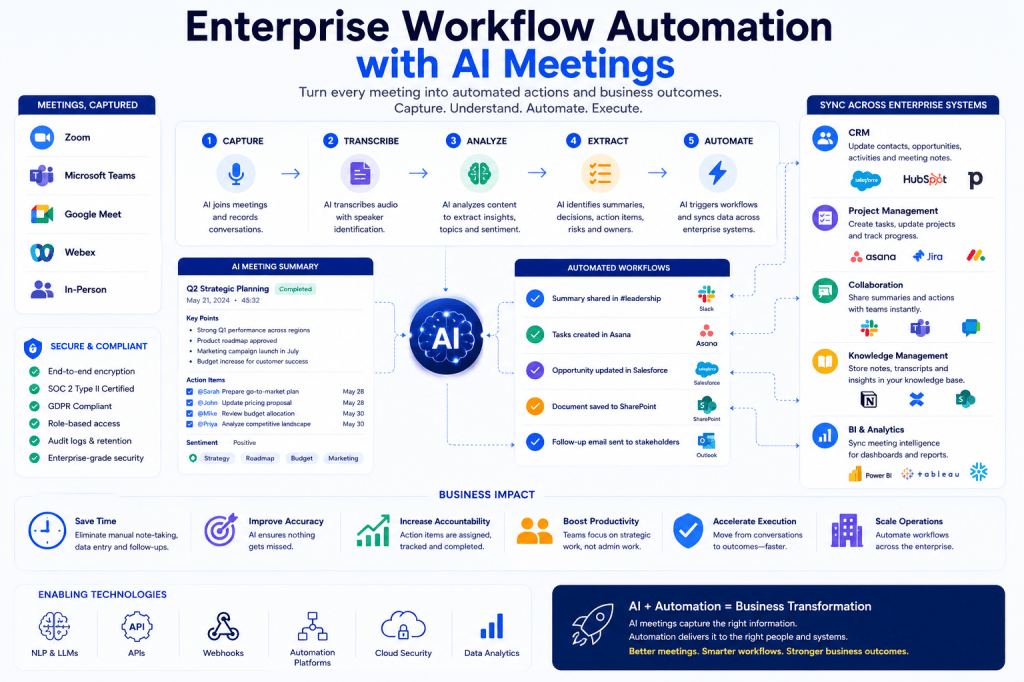
5. Workflow Automation
Many integrations trigger additional workflows based on meeting outcomes.
For example:
- Creating tasks for account managers
- Sending follow-up emails
- Scheduling next meetings
- Alerting managers about deal risks
- Updating forecasting dashboards
The CRM becomes an active system rather than a passive database.
Key Benefits for Sales Teams
Reduced Administrative Work
Research consistently shows that sales professionals spend significant time on non-selling activities.
AI meeting assistants automate:
- Note-taking
- CRM updates
- Meeting summaries
- Follow-up documentation
This allows representatives to focus more on customer engagement and revenue generation.
Improved Data Quality
Manual CRM updates often contain:
- Missing information
- Inconsistent notes
- Delayed entries
- Human errors
Automated integrations ensure customer interactions are recorded accurately and consistently.
Better Pipeline Visibility
Sales leaders gain access to richer data because conversations are documented automatically.
Managers can review:
- Customer concerns
- Deal progress
- Competitive threats
- Stakeholder engagement
This improves forecasting accuracy and sales coaching effectiveness.
Faster Follow-Ups
AI-generated summaries and action items can be instantly pushed into CRM workflows.
This ensures:
- Faster customer responses
- Better accountability
- Improved meeting outcomes
Benefits for Customer Success Teams
Customer success teams rely heavily on relationship intelligence.
CRM-integrated AI meeting assistants help by:
- Tracking customer objectives
- Monitoring satisfaction signals
- Identifying churn risks
- Recording implementation requirements
- Capturing feature requests
Instead of relying on memory or scattered notes, teams have a complete history of customer interactions.
Benefits for Marketing Teams
Meeting intelligence can provide valuable customer insights beyond sales.
Marketing teams can analyze conversations to discover:
- Frequently asked questions
- Product misconceptions
- Emerging market trends
- Customer pain points
- Competitor mentions
These insights can improve:
- Content strategy
- Campaign messaging
- Product positioning
- Demand generation efforts
Common CRM Platforms Supported
Many AI meeting assistants integrate directly with leading CRM systems, including:
- Salesforce
- HubSpot
- Microsoft Dynamics 365
- Zoho CRM
- Pipedrive
- Freshsales
Integrations typically occur through native connectors, APIs, workflow automation platforms, or middleware solutions.
Security and Compliance Considerations
Because meetings often contain sensitive customer information, organizations must evaluate security and compliance requirements carefully.
Important considerations include:
- Data encryption
- Access controls
- User permissions
- Audit logging
- Data retention policies
- GDPR compliance
- CCPA compliance
- SOC 2 certification
Organizations should ensure that AI meeting assistant vendors align with their regulatory and security obligations before deployment.
The Future of CRM and Meeting Intelligence
The next generation of AI meeting assistants will move beyond simple transcription and note-taking.
Future capabilities are expected to include:
- Predictive deal scoring
- Real-time sales coaching
- Automated opportunity updates
- Revenue risk detection
- Customer health forecasting
- Cross-meeting intelligence analysis
- Autonomous workflow execution
As AI models become more sophisticated, CRMs will increasingly function as dynamic intelligence platforms powered by insights gathered directly from customer conversations.
Conclusion
AI meeting assistants are transforming how organizations capture, manage, and utilize customer interactions. By integrating directly with CRM systems, they eliminate manual data entry, improve data accuracy, accelerate workflows, and provide deeper visibility into customer relationships.
For sales, customer success, and revenue teams, the combination of AI-powered meeting intelligence and CRM automation creates a more complete view of the customer journey. As businesses continue to embrace AI-driven workflows, the integration between meeting assistants and CRM platforms will become a foundational capability for modern customer engagement and revenue operations.

 Meeting Notes AI